



Quick answer: Ultahost is a competent budget host whose pricing page is built around a countdown. The headline $3.44 is a two-year rate; pay month to month and the same plan is $4.39. The discount badges say 40%, but measured against Ultahost’s own monthly rate, the real gap runs from 15.8% to 21.6% depending on plan. Shared Business is the plan to avoid: it is the worst value per gigabyte and per visitor in the range, and a VPS with root access costs half as much. Figures captured from ultahost.com on 5 October 2026 in USD.
Disclosure: Stack99 earns a commission if you buy through links on this page. It costs you nothing extra and never changes our assessment.

What you are actually looking at when the page loads
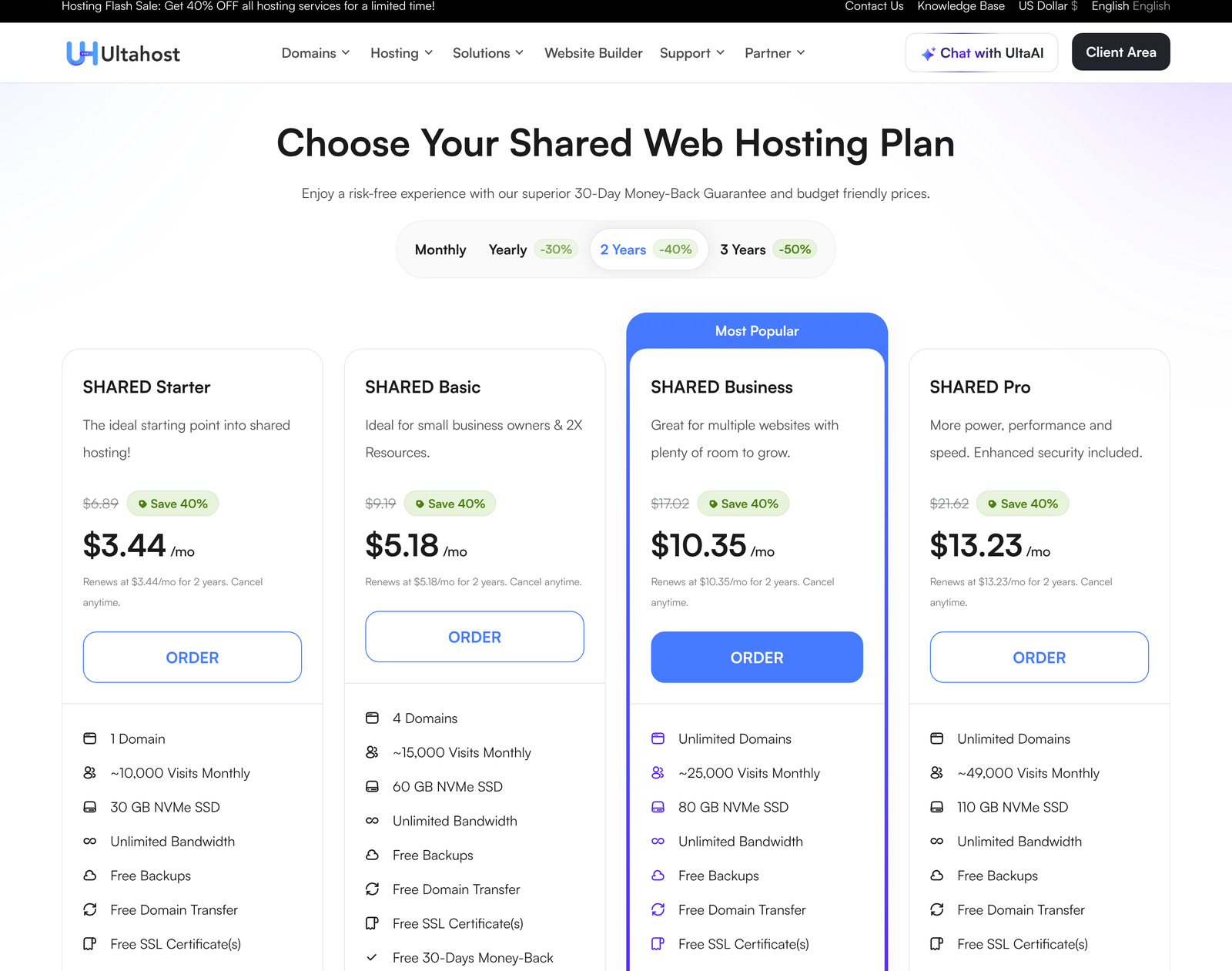
Three things are running on the Ultahost shared hosting page before you have read a single plan name. A black bar across the top announces a flash sale at 40% off. A countdown timer sits over the plan cards. A notification slides up telling you that 27 people in the United States chose UltaHost today.
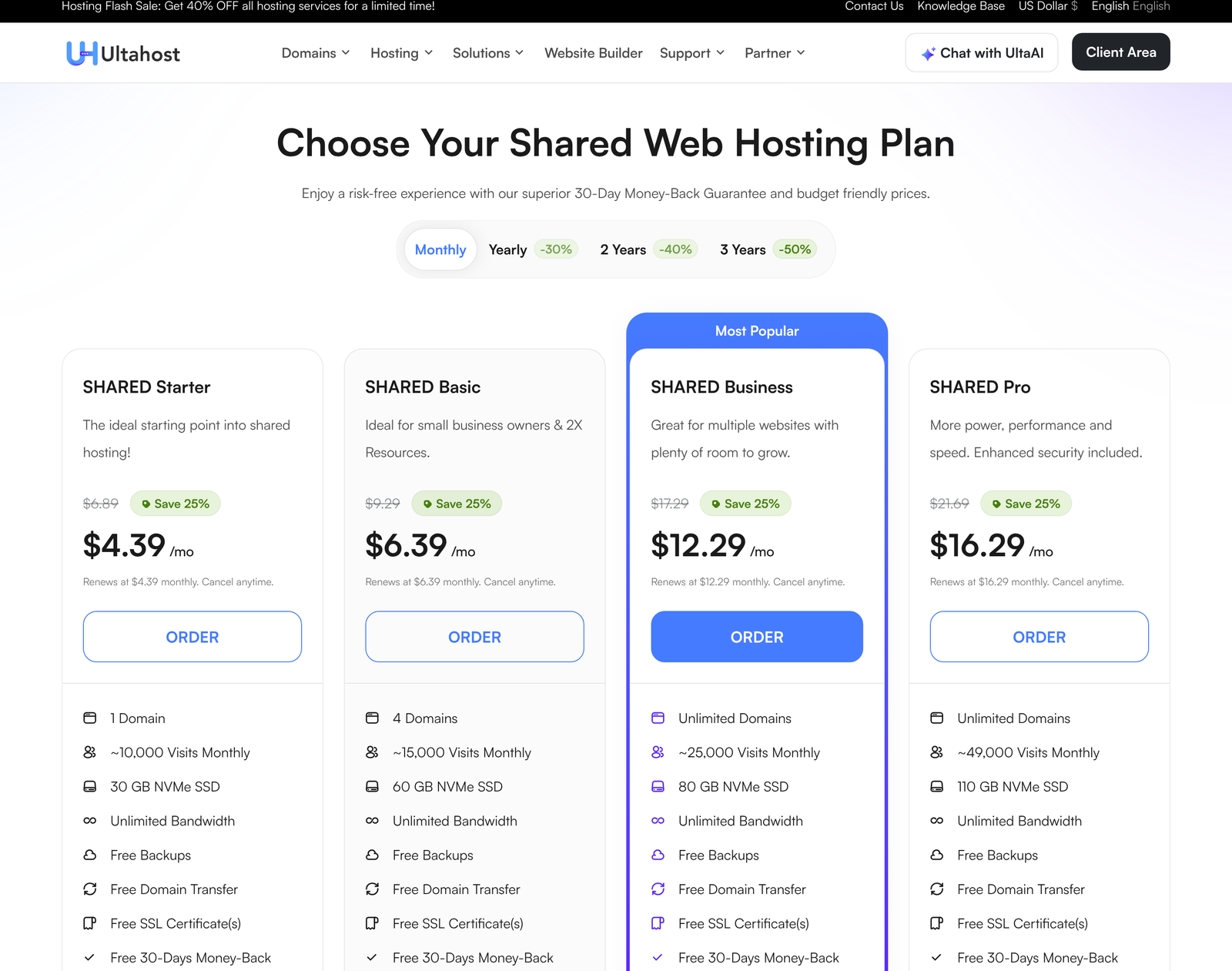
None of that is unusual for budget hosting. It matters here because the term selector underneath has already been moved for you. Four options sit in that control: Monthly, Yearly at -30%, 2 Years at -40%, and 3 Years at -50%. The page opens on 2 Years.
So the first number you see is a 24-month commitment rate. The card is honest about it if you read the grey line under the price, which says “Renews at $3.44/mo for 2 years. Cancel anytime.” Most buyers do not read that line.
The two price lists, side by side
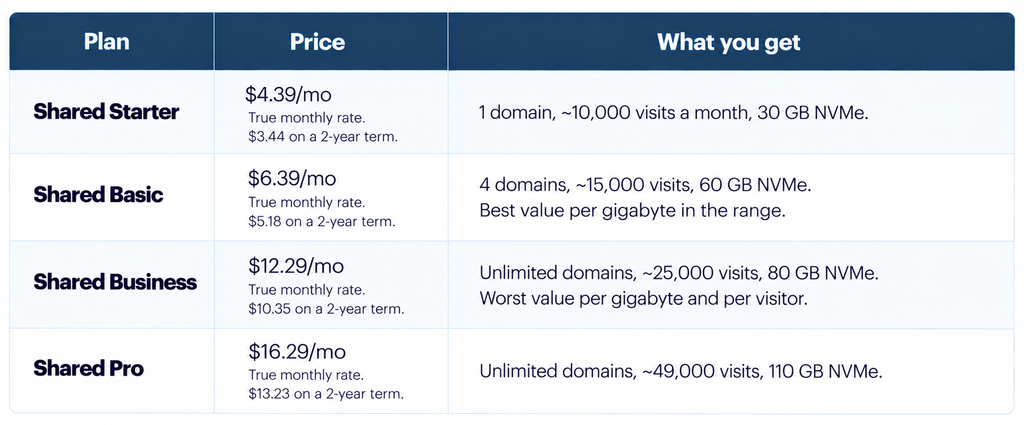
Our table leads with the monthly rate, because that is what you pay if you do not commit. The two-year figure follows in the notes.
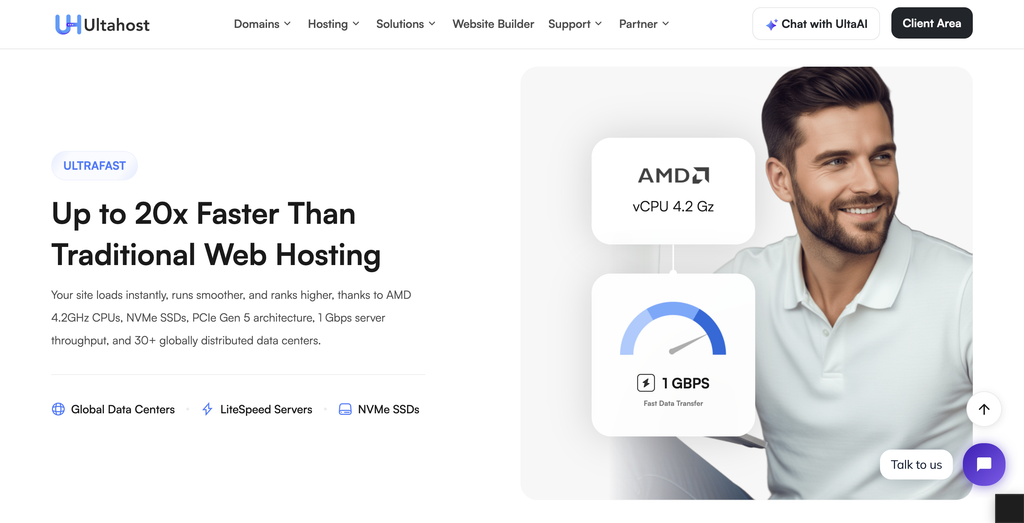
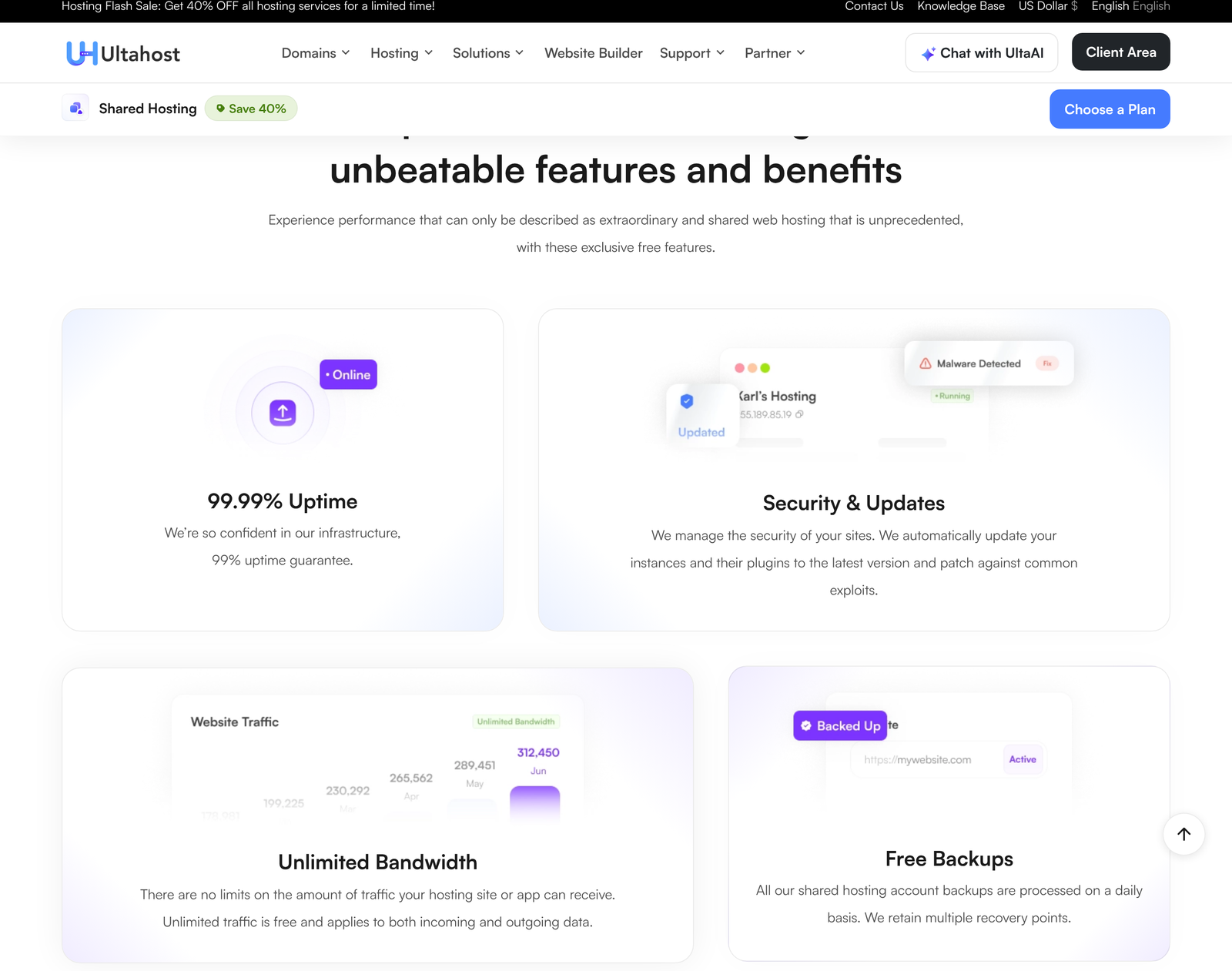
Every shared plan carries unlimited bandwidth, free backups, free domain transfer, free SSL certificates, and a 30-day money-back guarantee. The hero section claims 99.99% uptime, free DDoS protection, and 24/7 support.
Doing the arithmetic, the badges skip
Each card on the two-year view wears a “Save 40%” badge. Each card on the monthly view wears “Save 25%”. Both percentages are measured against Ultahost’s own undiscounted figure, the struck-through number beside the badge. Neither tells you what moving from monthly billing to a two-year commitment is worth.
Here is that comparison, which the page never shows you in one place.
- Starter. $4.39 monthly against $3.44 on two years. You give up $0.95 a month, a 21.6% reduction.
- Basic. $6.39 against $5.18. A $1.21 gap, or 18.9%.
- Business. $12.29 against $10.35. A $1.94 gap, or 15.8%.
- Pro. $16.29 against $13.23. A $3.06 gap, or 18.8%.
Nowhere near 40%. The real range is 15.8% to 21.6%, and the plan with the biggest sticker discount delivers the smallest actual saving. Starter buyers gain most from committing; Business buyers gain least.
Put that in cash over the full term. Twenty-four months of Starter at $3.44 comes to $82.56. Twenty-four months at $4.39 comes to $105.36. You are locking in two years of hosting to keep $22.80. That is a reasonable trade if the site is going to exist in two years and a poor one if you are testing an idea.
A small inconsistency in the undiscounted prices
Switching between the two views and the struck-through “original” price moves slightly. Basic shows $9.19 on the two-year view and $9.29 on the monthly view. Business shows $17.02 against $17.29. Pro shows $21.62 against $21.69. Starter is the only plan where both views agree, at $6.89.
The gaps are pennies, and nothing is being hidden. What it suggests is that the two views are generated from separate base figures rather than from one list price with a percentage applied. For a buyer, that is a reason to treat the struck-through number as decoration and compare the two live prices instead.
Where the shared range breaks down
Price per plan tells you little on its own. Price per unit of what you are buying tells you a great deal. Two measures matter for shared hosting: storage and traffic headroom.
Cost per gigabyte of NVMe, at two-year rates
- Basic: $5.18 for 60 GB = $0.086 per GB
- Starter: $3.44 for 30 GB = $0.115 per GB
- Pro: $13.23 for 110 GB = $0.120 per GB
- Business: $10.35 for 80 GB = $0.129 per GB
Cost per thousand monthly visits, at two-year rates
- Pro: $13.23 for ~49,000 = $0.270 per thousand
- Starter: $3.44 for ~10,000 = $0.344
- Basic: $5.18 for ~15,000 = $0.345
- Business: $10.35 for ~25,000 = $0.414 per thousand
Business finishes last on both measures. It is the plan carrying the “Most Popular” ribbon.
That ribbon is doing a job. Business is the first plan with unlimited domains, which is a real jump from Basic’s four, and unlimited domains is what a freelancer or small agency thinks they need. Genuinely hosting more than four sites justifies the jump. Hosting two and buying Business because it was highlighted means you paid $1.94 a month over Basic for 20 GB plus 10,000 visits you may never use.
The VPS range undercuts the shared range
This is the finding most likely to save you money, and it requires leaving the shared hosting page.
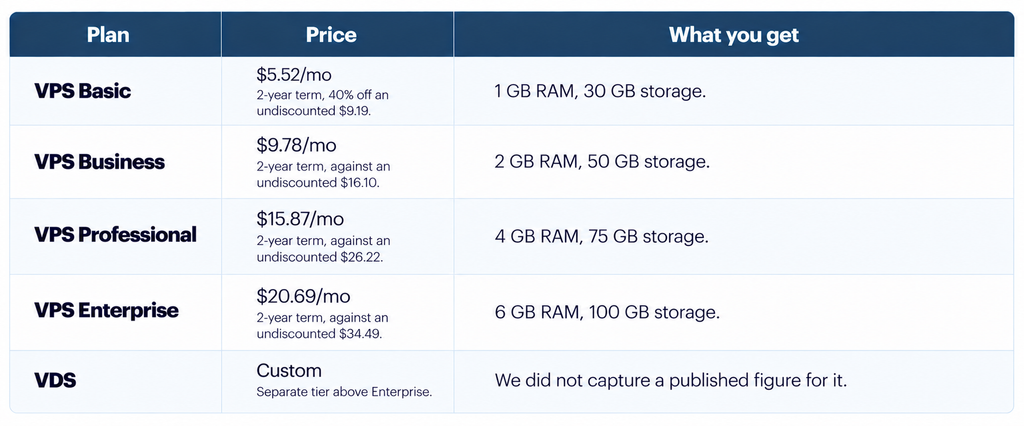
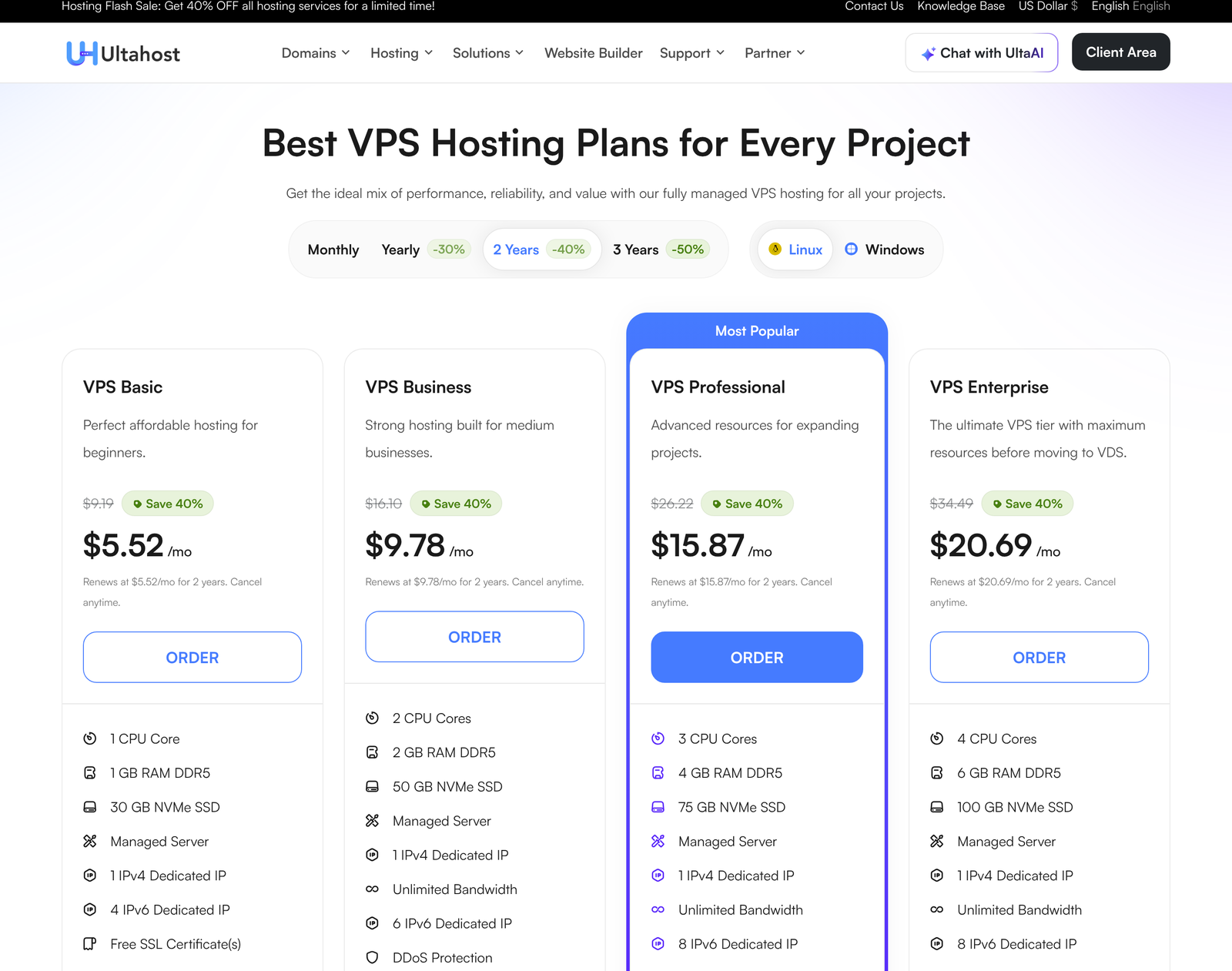
Compare VPS Basic at $5.52 with Shared Business at $10.35. Root access, a dedicated slice of RAM, and no neighbours on your filesystem cost $4.83 a month less than the mid shared tier. VPS Business at $9.78 still comes in under Shared Business while giving you 2 GB of RAM.
The catch is competence. Shared hosting hands you a control panel and absorbs the system administration. A VPS hands you a machine. If nobody on your side can patch a kernel or read a log, the $4.83 you saved evaporates the first time the server stops responding at 2 am. Ultahost markets these as managed VPS, which softens the problem without removing it.
What is included and what gets upsold
Budget hosts differ less on headline price than on what sits behind a second checkout. On this range, four items that competitors routinely charge for are listed on every shared card.
SSL certificates come free on all four plans. That stopped being a differentiator once Let’s Encrypt made domain-validated certificates free to issue and automated renewal through the ACME protocol, but plenty of hosts still bill for installing one. Ultahost does not, which saves you an argument more than it saves you money.

Backups are included rather than sold as an add-on. The cards say “Free Backups” without stating retention or frequency, so treat that as a feature rather than a guarantee and ask what the schedule actually is. Domain transfer is free, which matters if you are leaving another host and want to move the registration at the same time as the files.
Bandwidth is advertised as unlimited across all four plans, while visits are capped at roughly 10,000, 15,000, 25,000 and 49,000 a month. Those two statements coexist because the visit figure is the real constraint and bandwidth is not. A host that caps visitors and not transfer is telling you the limit is CPU and database load, not the pipe. Read the visit number as the plan’s actual ceiling.
Storage is NVMe across the whole range
All four shared plans specify NVMe SSD rather than SATA SSD or spinning disk. At this price point, NVMe is not universal, and it is the specification most likely to show up as a difference you can feel on a database-driven site.
The reason is latency rather than raw throughput. A WordPress page load on a busy shared server spends much of its time waiting on many small reads: option rows, post meta, transients, plugin files. NVMe drives connect over PCIe and handle deep queues of small random operations far better than a SATA device can. On a site serving 25,000 visits a month, you are unlikely to saturate either, so the benefit shows up at the tail, on the slowest requests rather than the median one.

Treat it as a floor you should expect rather than a reason to choose. Any host still selling SATA shared hosting in 2026 at these prices is the one to question.
Who this suits, and who should look elsewhere
Ultahost fits a particular buyer well. You have one site or a handful, traffic in the low tens of thousands a month, no compliance requirement that dictates where data sits, and a willingness to commit to a term in exchange for a lower rate. For a brochure site, a small store, or a personal project that needs to stay up, the shared range is fine, and the price is competitive.
Three situations argue against it. Traffic that spikes unpredictably runs into the visit ceiling rather than a bandwidth bill, and shared hosting handles spikes badly by design. A requirement to pin data to a specific jurisdiction needs a conversation about datacentre location before you buy, not after. Anyone who needs an uptime commitment with a contractual remedy attached should be reading a service level agreement rather than a hero banner.
Month-to-month buyers deserve a separate note. The pricing structure here is built to reward commitment, and the monthly rates are 15.8% to 21.6% higher as a result. Paying monthly is the right call when you are unsure, and the 30-day money-back window gives you a cheap way to test the service before locking in 24 months at the lower rate.
What we could not verify
A review that only reports what the vendor publishes is a brochure. Here is what we tried to check and could not.
- The 4.9 rating. Ultahost’s page displays “4.9 out of 5 based on 2500+ UltaHost Reviews” attributed to HostAdvice. We attempted to read that rating at the source, and hostadvice.com refused our request. The figure is reproduced here only as a claim UltaHost makes about itself, not as something we confirmed.
- The 99.99% uptime guarantee. No independent monitoring data for these servers is available to us. Treat the figure as a marketing commitment until you have read the service level terms and found out what the remedy actually is.
- Yearly and three-year pricing. The term control offers -30% and -50% options we did not capture. If you are weighing a one-year commitment, read those cards yourself rather than interpolating from our two.
- Renewal pricing beyond the stated term. The footnote says “Renews at $3.44/mo for 2 years”, which covers the second term. The card says nothing about what happens at the end of that second term.
Also, every figure in this review was read during an advertised flash sale with a live countdown. We have no way to tell whether that sale ever ends, and perpetual countdowns are common in this market. Assume the prices above are promotional and re-check them on the day you buy.
The verdict
Ultahost does the job at the price. NVMe storage across the whole shared range is better than several competitors at this level still offer, free SSL and backups are included rather than upsold, and a 30-day money-back window gives you a real exit. The product is not the problem.

The presentation is where you need to keep your guard up. A preselected two-year term, a discount badge measured against a number nobody pays, a countdown timer, and a “Most Popular” ribbon on the worst-value plan in the range all push in the same direction. Read the grey footnote, click Monthly once, then decide.
Choose Starter if: you are hosting one site with modest traffic and want the cheapest credible entry. $4.39 monthly, $3.44 if you commit.
Choose Basic if: you want the best storage value in the shared range. Four domains, 60 GB, $0.086 per gigabyte. This is the plan we would pick from the shared four.
Skip Business unless: you actually need more than four domains. On every value measure it trails the plan below it and the plan above it.
Choose Pro if: traffic is your constraint rather than storage. At $0.270 per thousand visits, it is the most efficient plan in the shared range.
Choose a VPS if: someone on your side is comfortable on a command line. The entry VPS costs less than Shared Business while giving you a machine rather than a slice of one.
For the full plan-by-plan breakdown, see our Ultahost pricing guide. If you are still shortlisting, Ultahost alternatives covers the nearest competitors, and the integrations guide covers what connects to what. Control panel questions are handled in Plesk vs. cPanel.
FAQ
Is $3.44 a month the real price?
It is real if you commit to 24 months and pay for that term. Month-to-month, the same Starter plan is $4.39. The difference over two years is $22.80.
Does the price go up at renewal?
The two-year card states it renews at the same rate for another two years. Beyond that the page says nothing, and introductory-then-higher renewal pricing is standard across budget hosting, so get the long-term rate in writing before you commit.
Which shared plan is the best value?
Basic, on storage. At $0.086 per gigabyte, it beats Starter at $0.115, Pro at $0.120, and Business at $0.129. On traffic, Pro wins at $0.270 per thousand visits.
Why avoid the Most Popular plan?
It finishes last in the range on cost per gigabyte and last on cost per visitor. The one genuine advantage over Basic is unlimited domains instead of four. Buy it for that reason or not at all.
Can I get a refund?
The plan cards list a 30-day money-back guarantee and the hero section repeats it. We have not tested the claim, and refund terms on long commitments usually carry conditions, so read them before paying for 24 months.
Is a VPS worth it over shared hosting here?
On price, clearly. VPS Basic at $5.52 undercuts Shared Business at $10.35. On effort, only if you or a colleague can administer a server. Managed VPS reduces that burden without eliminating it.
Sources
- Ultahost shared hosting plans, read 5 October 2026 in USD, both the Monthly and 2 Years term views.
- Ultahost VPS hosting plans, read 5 October 2026 on the default two-year term.
- Ultahost knowledge base.
Attempted and refused: hostadvice.com returned an error to our declared crawler, so the 4.9 rating Ultahost displays could not be checked at source.