



Quick answer: Bókun is a booking and channel management system for tour and activity operators, owned by Tripadvisor since 2018 and built so that Viator distribution costs you nothing in Bókun fees. Plans are a subscription plus a percentage of applicable bookings: $49 a month plus 1.5% on Start, $149 plus 1.25% on Plus, $499 plus 1% on Premium. Which plan is cheapest depends entirely on booking volume, and the crossover points are $40,000 and $140,000 a month in applicable revenue. If most of your sales come through Viator or walk-ups, the percentage barely touches you, and the free tier may be enough.
Disclosure: Stack99 earns a commission if you buy through links on this page. It costs you nothing extra and never changes our assessment.
What Bókun is, and who owns it
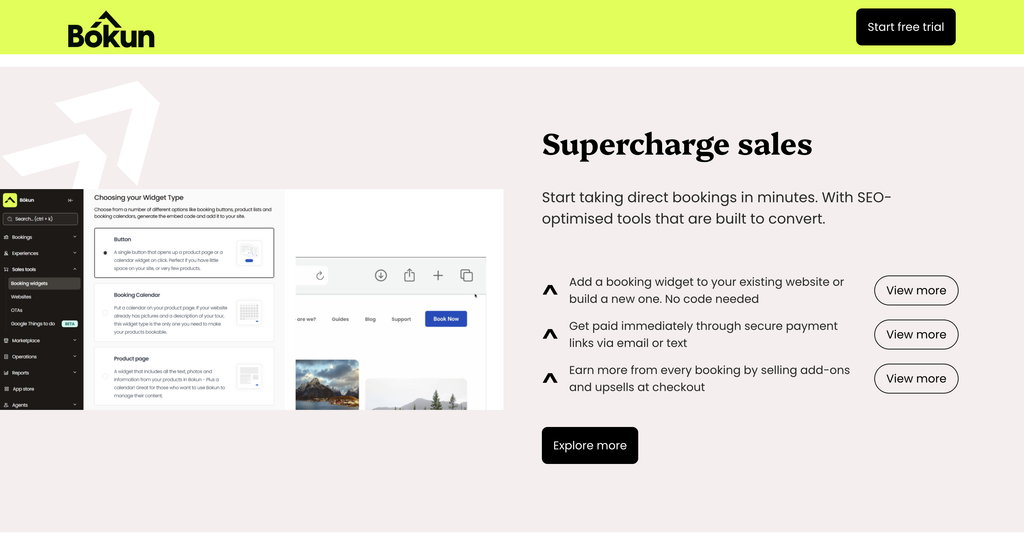
Bókun sells reservation software to the people who run tours, activities, and attractions. It offers availability management, a booking widget for your own site, a website builder, point of sale, gift cards, payment links, and a marketplace that connects you to resellers. Standard territory for the category.
The ownership is what makes it unusual. Bókun was founded in Iceland in 2012 and acquired by Tripadvisor in 2018. Viator, the large tours and activities marketplace, is also a Tripadvisor company. The company says it operates independently with its own leadership team under general manager Jennie Peacock-Putt, and states on its about page that it never shares operator data with Tripadvisor or anyone else.
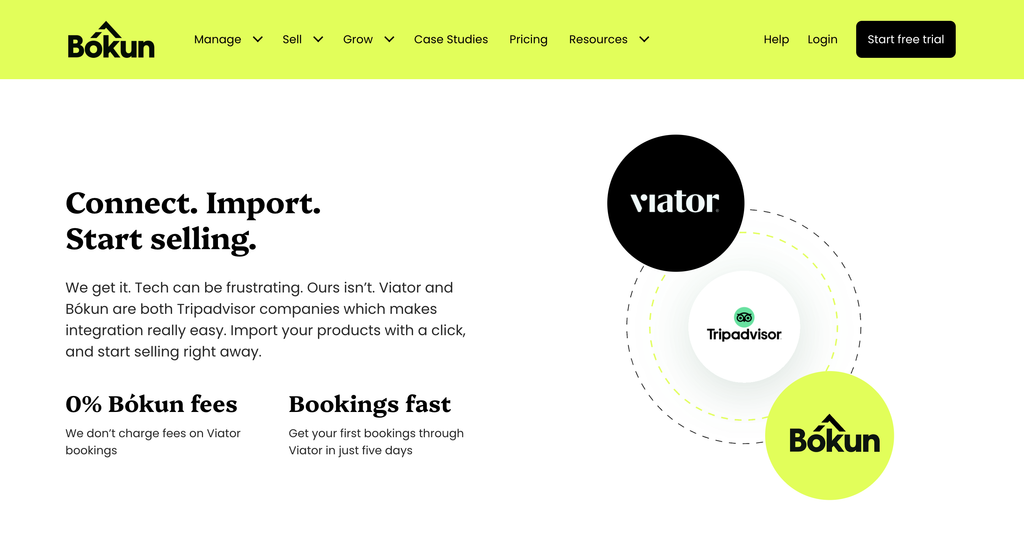
Keep that corporate structure in mind while reading the pricing, because it explains the single most attractive line in the whole product: Bókun charges no booking fee on Viator reservations. One Tripadvisor company is not going to tax bookings flowing through another.
How the pricing actually works
Most software in this category charges either a flat subscription or a commission. This product charges both, and reading only one half of that will mislead you badly.
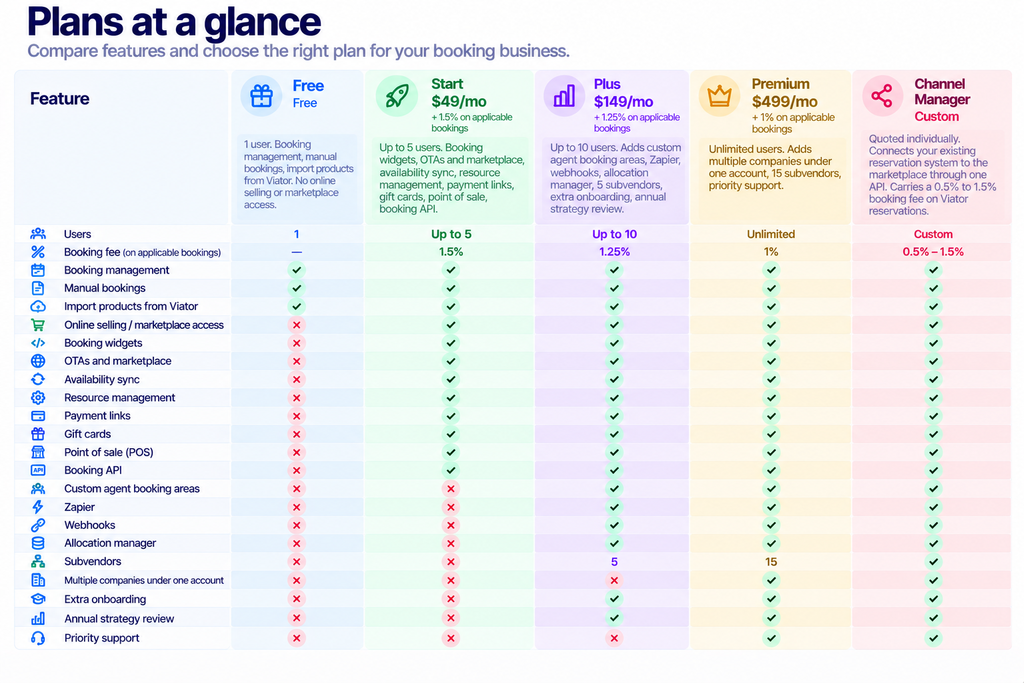
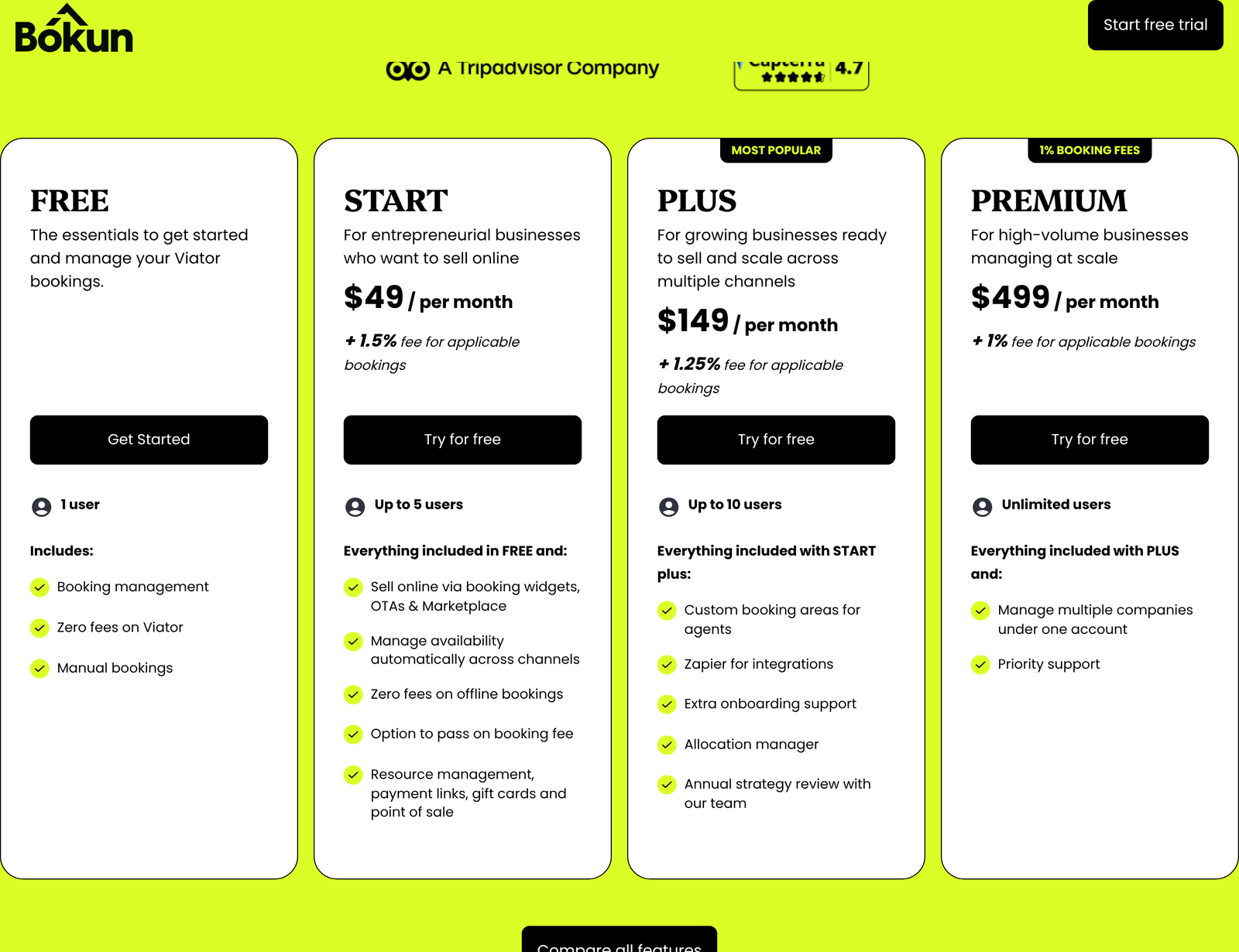
The word doing the heavy lifting is applicable. The vendor charges nothing on bookings through Viator and nothing on offline bookings. So the percentage applies to your own website, the marketplace resellers, and the other OTAs you connect. For many operators that is a minority of total revenue, which changes the sums entirely.
Where each plan stops being cheapest
Two subscriptions with different percentages always cross at a calculable point. Set the Start and Plus formulas equal and solve: $49 plus 1.5% of revenue equals $149 plus 1.25% of revenue when the quarter-point difference covers the $100 gap. That happens at $40,000 a month in applicable bookings.
Run the same calculation for Plus against Premium. The $350 subscription gap divided by the 0.25 percentage point difference gives $140,000 a month.
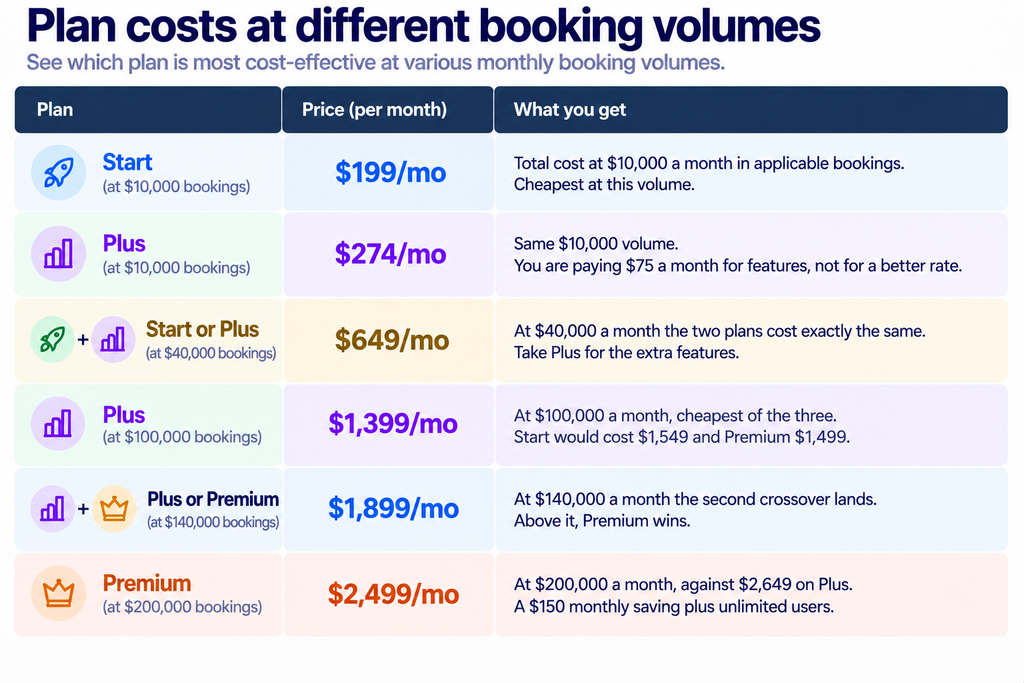
Read that table once, and the plan question answers itself. Below $40,000 a month in applicable bookings, Start is cheapest, and any upgrade is a decision about features. Between $40,000 and $140,000, Plus. Above $140,000, Premium.
One trap sits inside those numbers. Applicable bookings are not total revenue. An operator turning over $120,000 a month with 70% of it coming through Viator has only $36,000 in applicable bookings, which puts them below the first crossover. Measure the right number before choosing.
A contradiction worth asking about
The free plan is described as the essentials to manage your Viator bookings, and its feature list includes a bullet reading “Zero fees on Viator”.
Scroll down the same page to the detailed comparison table, and the row labelled “0% booking fees on Viator bookings” carries a red cross in the Free column, with green ticks on Start, Plus, and Premium.
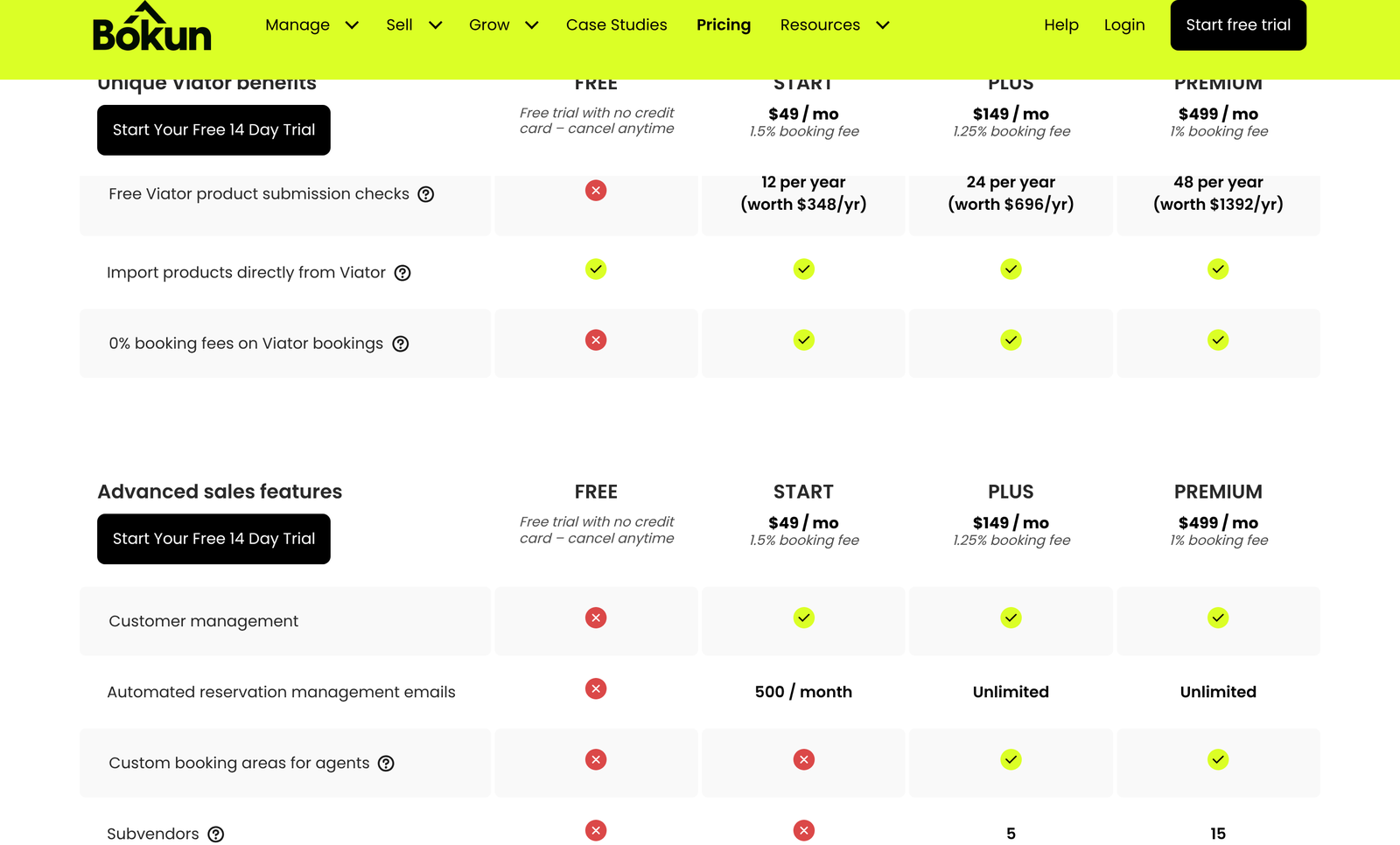
Those two statements cannot both be right. We captured them in a single page load on 27 October 2026, so this is not a caching artefact. It may be a stale row in the table, or the plan card may be the optimistic one. We are not going to guess.
If the free tier is your plan, ask Bókun directly and get the answer in writing. On any paid tier the point is moot, since all three carry the tick.
The Viator perks, priced
Beyond the fee waiver, paid plans include a quota of free Viator product submission checks. Start gets 12 a year, Plus 24, Premium 48.
Helpfully, the same cells price them for you: $348, $696 and $1,392 of annual value respectively. Divide any of those by the quota and you get $29 per check, consistently across all three tiers, which is a rare piece of transparent unit pricing.
Whether that value is real depends on how often you submit new products to Viator. Run a stable catalogue of six tours and you will not use twelve checks a year. A company launching seasonal products monthly will exhaust Start’s allowance by midsummer.
Importing products directly from Viator is the one Viator feature available on every tier, free included. For an operator already selling on Viator, that import is the fastest route to a populated system, and Bókun claims first bookings through Viator within five days of connecting.
What the free tier is really for
Free plans in this category are usually crippled trials. Bókun’s is something odder and, for the right operator, genuinely useful.
What you get is one user, booking management, manual booking entry, and the ability to import your products directly from Viator. What you do not get is any way to sell online: no booking widget for your website, no marketplace, no OTA connections, no availability sync across channels, no live chat support.
Go through that list again and the intended user becomes obvious. Somebody already selling through Viator, taking the rest of their bookings by phone or at the kiosk, who wants one calendar instead of a notebook. Bókun gives that person a reservation system at no cost, and in return gains an operator already inside a Tripadvisor product.
The upgrade trigger is the moment you want your own website to take bookings. Everything about selling online begins on Start, so the free plan has a hard edge rather than a gentle slope. Treat $49 a month plus 1.5% as the real entry price of the product, and the free tier as a way to get your catalogue in order first.
One practical note for anyone planning that path. Since the free plan carries no live chat, your first contact with support will come during the trial or after you start paying. Use the 14-day trial on a paid tier to test the widget and the channel sync while a support route is open to you.
Distribution, which is the actual product
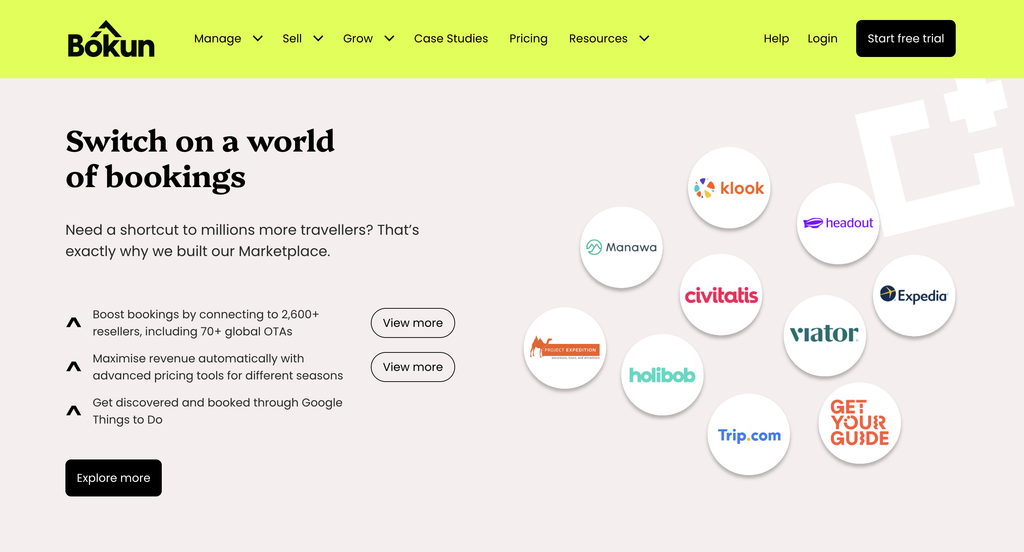
Bókun’s marketplace claims more than 2,600 resellers, among them 70 or more global OTAs. The pitch is that one connection replaces negotiating and maintaining relationships with each channel separately, with availability syncing across all of them so you stop double-booking.
Marketplace access begins on Start. The free plan gets booking management and manual entry, which makes it an operations tool rather than a sales channel. Google Things to Do listing is included too, which matters more than it sounds for operators whose customers search rather than browse OTAs.
Reseller relationships go deeper on the upper plans. Custom booking areas for agents, where you choose which experiences an agent can sell and set their commission in advance, arrive on Plus. So does the allocation manager, for holding seat inventory back for particular channels. Subvendors, which let a multi-branch operation run sub-accounts under one login, are capped at 5 on Plus and 15 on Premium.
Integrations, and the webhook wall
Three rows in the comparison table cover technical integration, and the gating is not what you would expect.
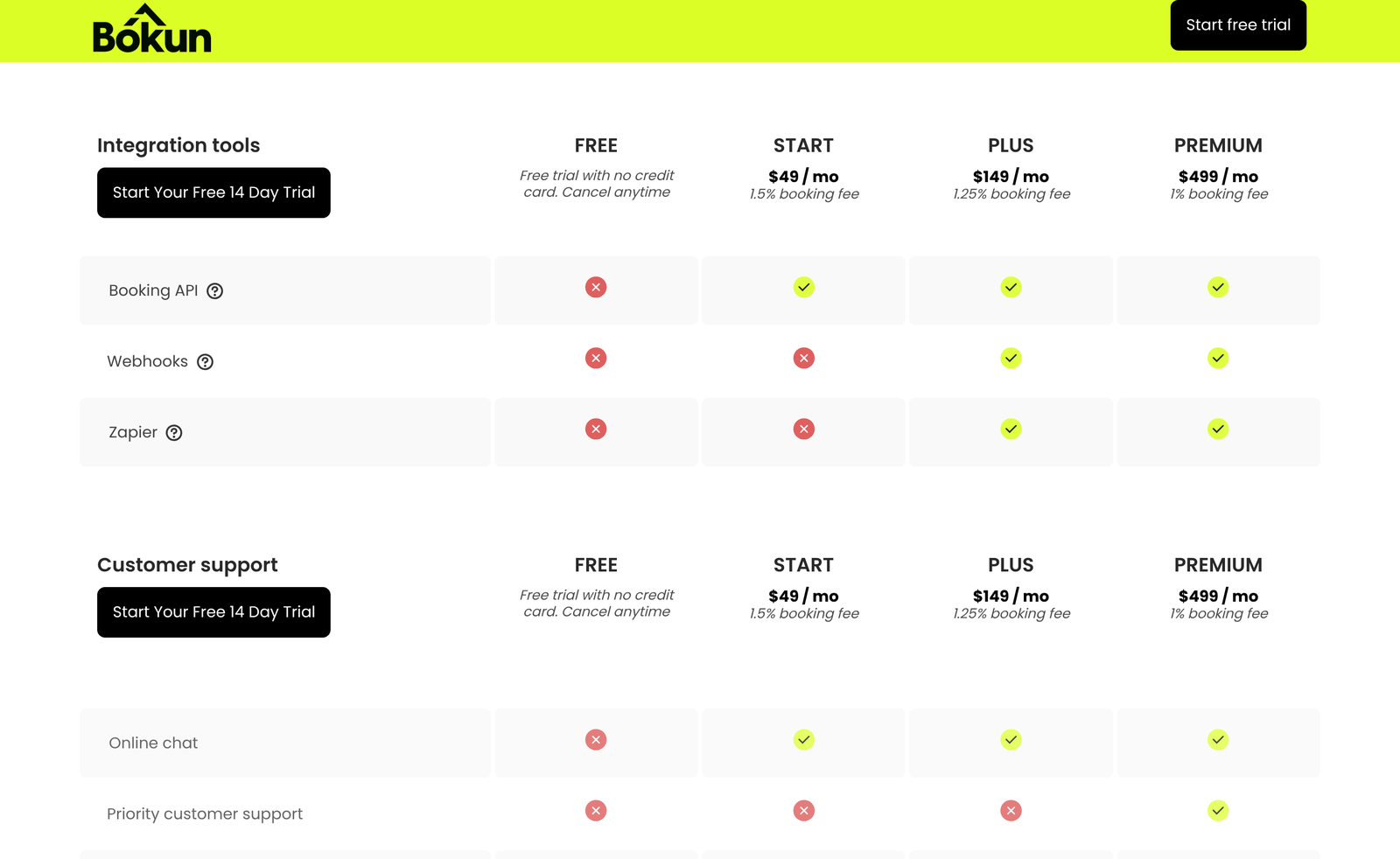
The booking API is available from Start upwards, which is unusually generous for a $49 plan. Webhooks and Zapier both sit on Plus and Premium only.
That split has a practical consequence. On Start you can read and write bookings programmatically, but nothing notifies you when a booking arrives, so any integration you build has to poll the API on a schedule. Add webhooks and the same integration becomes event-driven and near-instant. For an operator wiring Bókun into accounting or a messaging tool, that difference is the whole reason to pay $100 more a month.
Automated reservation emails follow a similar pattern: 500 a month on Start, unlimited on Plus and Premium. At an average of two emails per booking, 500 covers around 250 bookings a month. Busy operators will hit that ceiling in a good July.
Our guide to the Bókun app store and APIs goes through the connection catalogue in more detail.
An exception called Channel Manager
Operators who already run a reservation system they like can skip the booking software and buy only distribution. The Channel Manager plugs your existing system into the marketplace through a single API, and bookings flow back into whatever you already use.
Pricing is quoted individually, with no public figure. More importantly, the page carries a line that contradicts the headline promise everywhere else on the site: Channel Manager plans include a 0.5% to 1.5% Bókun booking fee on Viator reservations.
Worth reading twice if you came here for the zero-fee Viator pitch. Buy the full Bókun system and Viator bookings cost you nothing in Bókun fees. Buy only the Channel Manager, and they cost up to 1.5%. Push $50,000 a month through Viator and you would pay up to $750 monthly for the privilege of keeping your own reservation software.
Charging for distribution alone is a defensible commercial choice. It is also exactly the kind of exception that gets discovered after signing rather than before.
Support, and what the tiers really buy
Online chat starts on the Start plan, so the free tier has no live support channel at all. Extra go-live support and an annual account review both begin on Plus. Priority support is Premium only.
Strip the percentages away, and the $100 gap between Start and Plus buys agent booking areas, the allocation manager, webhooks, Zapier, unlimited reservation emails, five subvendors, twelve extra Viator checks worth $348 a year, and a human who reviews your account annually. That is a dense $1,200 of annual spend if you use even half of it.
The $350 gap from Plus to Premium is thinner on features: unlimited users rather than ten, fifteen subvendors rather than five, multiple companies under one account, priority support, and double the Viator checks. Unless you are multi-entity or genuinely above the $140,000 crossover, Plus is the better buy.
What we could not verify
Honesty about the gaps matters more in a review than another paragraph of features.
The pricing page displays a Capterra badge showing 4.7. We could not confirm that figure at source, because Capterra refuses our declared crawler. Treat the badge as a vendor-displayed claim rather than an independently checked rating.
The customer quotes on the homepage are attributed to named people at named businesses, including operators in Iceland, Venice and the wider attractions sector. One claims four times the bookings in the first month. These are vendor-supplied testimonials with no published methodology, so read them as marketing rather than evidence.
The 2,600 reseller and 70 OTA figures come from Bókun and are not independently auditable. Nor is the claim of first Viator bookings within five days. None of these is implausible for a Tripadvisor-owned distribution network, but none is confirmed either.
Who should buy it
Choose it if: a meaningful share of your bookings already comes through Viator. The fee waiver is worth real money and no competitor can match it, because no competitor is owned by Viator’s parent.
Choose it if: you sell through several OTAs and spend time reconciling availability by hand. One connection replacing six is the clearest value in the product.
Skip it if: nearly all your revenue comes through your own website at high volume. You will pay 1 to 1.5% on your best channel for a distribution network you are not using. Flat-fee reservation software will cost less.
Skip it if: you want to keep your current reservation system and assumed the Viator fee waiver came with it. Going the Channel Manager route carries a Viator fee of up to 1.5%.
Any paid plan lets you pass the booking fee to guests, which some operators will use, and others will consider bad practice in a price-sensitive market. Worth modelling both ways before committing.

Frequently asked questions
Does Bókun really charge nothing on Viator bookings?
On the Start, Plus and Premium plans, yes, and the comparison table confirms it. The Free plan carries a contradiction between its card and the table, so check that one directly. Channel Manager plans are explicitly excluded and carry a 0.5% to 1.5% Viator fee.
Which plan is cheapest for my business?
Calculate your monthly applicable bookings, meaning everything except Viator and offline sales. Below $40,000, choose Start; between $40,000 and $140,000, choose Plus; above $140,000, choose Premium.
Is there a free trial?
Yes, 14 days with no credit card required, and Bókun says you can upgrade, downgrade or cancel at any time with no long-term lock-in.
How many users does each plan allow?
One on Free, up to five on Start, up to ten on Plus, unlimited on Premium.
Can I get webhooks on the cheapest paid plan?
No. Start includes the booking API but not webhooks or Zapier, both of which begin on Plus. Integrations built on Start have to poll the API instead of receiving events.
Does Tripadvisor see my data?
Bókun’s about page states that it never shares your data with Tripadvisor or anyone else, while describing itself as part of the Tripadvisor family with independent leadership. Take it as the vendor’s own statement; your data processing agreement is the document that binds them.
The verdict
Bókun is a competent booking system with one structural advantage nobody else can copy. If Viator is a serious channel for you, the fee waiver plus the one-click product import plus a 2,600-reseller marketplace is a strong package at $49 a month.
The percentage is the thing to watch. It is modest on paper and compounds quietly on your own website traffic, which is usually the channel you worked hardest to build. Operators whose direct sales dominate should price a flat-fee competitor before signing.
Two items need a direct answer from the vendor before you commit: whether the Free plan really waives Viator fees, and what a Channel Manager quote looks like given its separate Viator charge. Neither is a reason to walk away. Both are reasons to ask.
For the fee mechanics in isolation, see our breakdown of what sits behind the $49.
Start a free Bókun trial, or read the vendor’s pricing page and company background first.