


Disclosure: Stack99 earns a commission if you buy through links on this page. It costs you nothing extra and never changes our assessment.
Almost every CRM you can name sells you a ladder. Three or four tiers, each one withholding a feature you will eventually want, and a sales call waiting at the top. Keap has thrown that model out. Its pricing page carries a single headline figure and a blunt line above it: “Say goodbye to feature-based plans.”
That simplicity is real, and it is also incomplete. The platform price is one of four separate things that decide what you pay. This page records every figure the pricing page showed on 3 November 2026, the arithmetic behind the seat charge, and the two costs the page mentions without pricing.
One plan, eight feature groups, no tiers
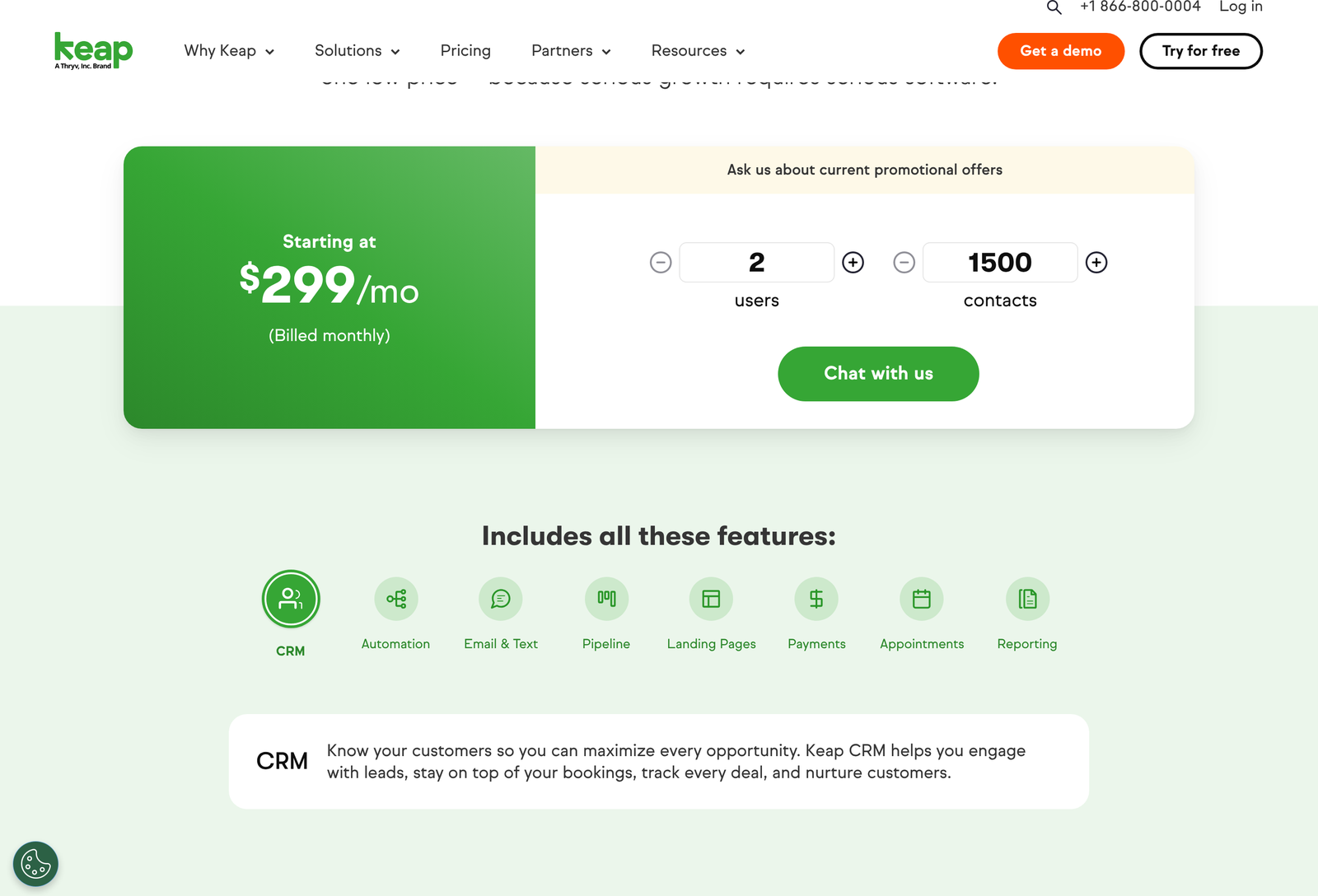
Keap lists eight capability groups and gives all of them to every customer: CRM, Automation, Email & Text, Pipeline, Landing Pages, Payments, Appointments and Reporting. There is no Starter edition missing automation. There is no Pro edition that unlocks reporting.
Compare that with how the rest of the category behaves. GetResponse charges by list size across three self-serve tiers, and its cheapest plan caps you at a single automation workflow. Campaign Monitor runs four tiers plus an enterprise quote. Keap’s answer to all of that is a flat refusal to segment, which removes a whole class of upgrade decisions from your first year.
The trade is obvious once you see the number. A platform that will not sell you less also will not sell you cheap. $299 a month is the floor, and small operations that would have taken a $30 plan elsewhere have nowhere to land.
What $299 covers before you change anything
The configurator loads pre-filled. Two counters sit beside the price: users set to 2, contacts set to 1,500. Every published comparison of Keap that quotes “from $299” is quoting that exact configuration, whether or not it says so.
Read the label under the price carefully. It says “(Billed monthly)”. Most vendors in this bracket put an annual toggle beside the headline and default it to the discounted view, which is why the figure you first see on a pricing page is so often the yearly rate divided by twelve. Keap does not do this. No annual toggle appears, no yearly equivalent, no “save 20%” badge. The $299 is a genuine month-to-month rate, and it is the only billing basis the page offers.
One line sits above the counters: “Ask us about current promotional offers.” Treat that as a signal rather than a detail. A vendor inviting you to ask about discounts by phone is a vendor whose list price is negotiable, and the published $299 is the number before any conversation happens.
The seat charge is $39, and you have to derive it
Keap never states a per-seat price. The counter simply recalculates, so the only way to learn the rate is to move it and watch.
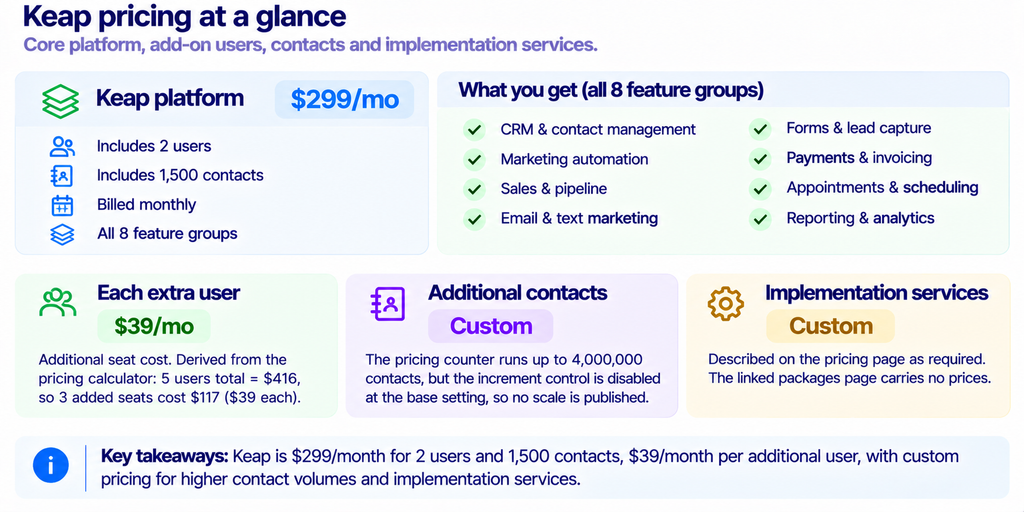
We set the user field to 5 and held contacts at 1,500. The headline changed from $299 to $416. Subtract, and three additional seats cost $117. Divide, and each one is $39 a month.
Run that forward and the shape of the bill becomes clear quickly. A five-person team pays $416 a month, or $4,992 a year. Ten users, if the rate holds linearly, would be $299 plus eight seats at $39, which is $611 a month. We verified the 2-to-5 step directly and did not test beyond it, so treat anything above five seats as an estimate until you see it in a quote.
Worth sitting with: $39 per seat is not a small number for a CRM in 2026. It is roughly what a mid-tier seat costs at vendors who also sell you a cheaper entry plan. Keap’s flat-feature promise is paid for at the margin, by the second, third, and fourth person you add.
Contacts move the bill, and the page will not show you how
The second counter is marked “contacts” and starts at 1,500. Reading the markup behind it tells you more than the page does: the field carries a minimum of 1,500 and a maximum of 4,000,000, and it is set to read-only.
We tried to step it. The increment button beside the contacts field renders disabled at the default configuration, with an accessible label that reads “Increment contacts button disabled”. So the control exists, the range is enormous, and the page declines to price any point on it.
We are not going to invent a curve for you. What can be said with confidence is narrow and still useful. A contact ceiling of four million means Keap intends this product to carry databases far larger than the 1,500 in the default view, and the price at those volumes is set in a conversation rather than on a page. If your list is already past a few thousand records, the $299 headline tells you almost nothing about your bill.
Text marketing is a second subscription
“Email & Text” appears in the included feature list, which reads as though messaging comes with the platform. A footnote further down the page corrects that impression, and the correction is where real money sits.
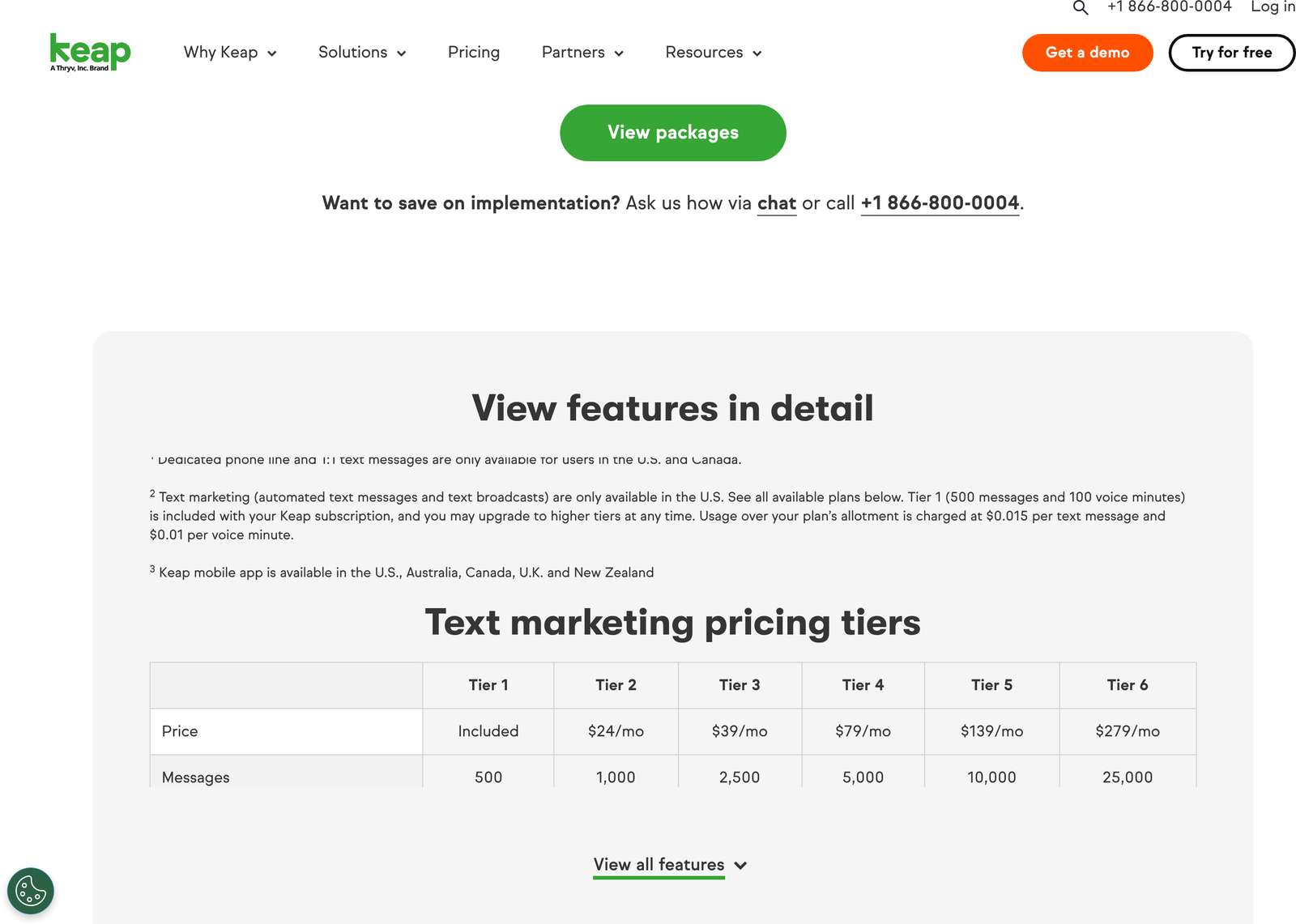
Tier 1 is included with every subscription and gives you 500 messages and 100 voice minutes a month, plus a toll-free number. Everything above that is a separate monthly charge on a six-step ladder.
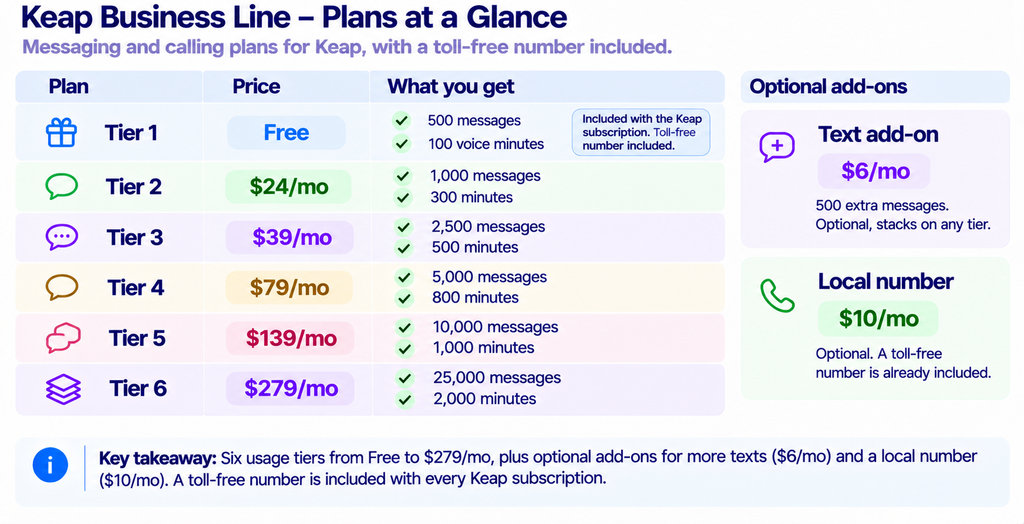
Notice how the per-message rate falls as you climb. Tier 2 buys 500 extra messages for $24, which is 4.8 cents each. Tier 6 buys 24,500 extra messages for $279, which is 1.1 cents each. A business sending heavily is rewarded, and a business sending 1,200 messages a month is paying the worst rate on the ladder.
An arithmetic trap sits at the bottom of that ladder. The $6 add-on also buys 500 messages, which is 1.2 cents each, and that is cheaper per message than Tier 2, Tier 3, Tier 4, and Tier 5. If your overflow is modest, stacking the add-on beats climbing a tier by a wide margin. Check that against your own send volume before a sales call talks you upward.
What happens when you go over
Usage past your allotment is charged at $0.015 per text message and $0.01 per voice minute. Those are the only two usage rates Keap publishes, and they apply to every tier.
Put numbers to it. Suppose you sit on Tier 1 and send 2,000 messages in a month. The first 500 are covered. The remaining 1,500 cost $22.50. That is just under the $24 that Tier 2 would have cost, and Tier 2 only covers 1,000 messages anyway, so overage would still apply. A month like that is a signal to move to Tier 3 at $39, which covers all 2,000 with room left.

Voice minutes rarely bite as hard. At a penny a minute, running 500 minutes past a Tier 1 allowance costs $5. The messages are what move your invoice.
Implementation is required, and nobody will tell you the price
Below the configurator sits a heading that deserves more attention than its placement suggests: “Required implementation services help you achieve faster results.” The copy under it describes strategy consulting, data import, migration, and done-for-you services, then offers a “View packages” button.
We followed that button. The implementation services page describes a quick-start process and a full year of strategy support, carries a customer quote sourced from G2, and sets out an implementation timeline. It publishes no prices at all. Not a range, not a starting figure, nothing.
Back on the pricing page, one line makes the position plainer than any of the marketing copy: “Want to save on implementation? Ask us how via chat or call +1 866-800-0004.” A discount is being dangled on a cost that has never been named.
Budget for this as an unknown and insist on the number in writing before you sign. A mandatory onboarding fee is common in this part of the market, and it is frequently a four-figure sum. We cannot tell you what Keap charges, because Keap does not say.

Three footnotes that narrow the product by geography
The footnotes under the feature table carry restrictions that never appear in the headline copy, and each one removes a capability depending on where you are.
- A dedicated phone line and one-to-one text messages are available only to users in the United States and Canada.
- Text marketing, meaning automated messages and broadcasts, is available only in the United States. Everything in the tier table above is therefore a US-only purchase.
- The Keap mobile app is available in the United States, Australia, Canada, the United Kingdom and New Zealand.
Read those together and a pattern emerges. A business outside the United States pays the same $299 floor and the same $39 a seat while being unable to buy the text tiers at all. If messaging was the reason Keap appealed to you, your location may settle the decision before price does.
Three worked totals
Every figure below comes from the published rates, with implementation excluded because it has no published price. Add it yourself once you have a quote.
- Two people, light messaging. Platform $299, Tier 1 included. $299 a month, $3,588 a year.
- Five people, 2,500 messages a month. Platform $299 plus three seats at $39 is $416, plus Tier 3 at $39. Call it $455 a month, or $5,460 a year.
- Ten people, 10,000 messages a month. Platform $299 plus eight seats at $39 is $611, plus Tier 5 at $139. Call it $750 a month, or $9,000 a year, with the seat rate above five users unverified.
The middle case is the one most small teams will recognise, and $5,460 a year is the honest entry cost for a five-person operation that uses what it bought. Compare that against a stack assembled from cheaper parts: SocialBee for scheduling plus a separate email tool plus a separate CRM will usually land lower, at the cost of running three bills and three integrations.

One detail in the logo
The wordmark in the site header reads “keap” with a line under it: “A Thryv, Inc. Brand”. The footer navigation carries a “Thryv acquisition” link, and support resources point at Thryv Academy rather than a Keap-branded equivalent.
None of that changes a price today. It does explain why the pricing model looks the way it does, since flat all-in packaging with mandatory services and a phone number instead of a checkout is a pattern you see across businesses selling to small operators through a sales team rather than a signup form.
What we could not verify
- Contact-based pricing. The counter is read-only at the base setting, and its increment control renders disabled, so no price above 1,500 contacts could be read from the page.
- Seat pricing above five users. The $39 rate is derived from a single measured step, from 2 users to 5. Whether it stays linear at 10 or 25 seats is unknown.
- Implementation cost. No figure is published on either the pricing page or the implementation services page.
- Annual billing. Nothing on the pricing page offers an annual option. Whether one exists through sales is not stated.
- Promotional pricing. The page invites you to ask about current offers without describing any.
FAQ
Does Keap have a cheaper plan than $299?
Not a published one. The pricing page shows a single platform price with $299 as the floor at two users and 1,500 contacts. A free trial is offered through the “Try for free” button, and the page separately invites you to ask about promotional offers.
Is there an annual discount?
None is published. The price carries the label “(Billed monthly)” and the page has no annual toggle, which is unusual enough to be worth asking about directly if you intend to commit for a year.
How much is an extra user?
$39 a month, derived rather than stated. Setting the counter to five users returns $416 against a two-user base of $299, so three seats add $117.
Can I use Keap text marketing outside the United States?
No. Footnote 2 on the pricing page restricts automated text messages and text broadcasts to the United States. Dedicated phone lines and one-to-one texts extend to Canada as well.
What happens if I send more texts than my tier covers?
You are charged $0.015 per message and $0.01 per voice minute over the allotment. For small overflows, the $6 add-on, which buys 500 messages, is cheaper per message than moving up a tier.
Are implementation services genuinely mandatory?
The pricing page heading calls them required. No price is published for them on either that page or the implementation services page it links to, so get the figure in writing before signing.
Sources
- Keap pricing page, read 3 November 2026: keap.com/pricing
- Keap implementation services page, read 3 November 2026: keap.com/resources/implementation-services
- CTIA messaging principles and best practices, for the industry rules that govern the toll-free and local numbers Keap resells: ctia.org
- US Federal Trade Commission, CAN-SPAM Act compliance guide, for the consent and unsubscribe obligations that apply to the email side of the platform: ftc.gov
Prices were read from the vendor’s own page on 3 November 2026 and will drift. Check the current Keap pricing page before you budget.