


Quick answer: Gushwork publishes one number, $900 a month, billed monthly with cancellation any time. No tier ladder exists above or below it. That figure is a floor rather than a price: the vendor says the final number depends on how many pages you want published, how fast you want to grow, and how much paid support you add, and it is settled on a call. Budget roughly $2,700 to $3,600 before the first qualified leads arrive, because Gushwork’s own answer puts them around month three to four.
Disclosure: Stack99 earns a commission if you buy through links on this page. It costs you nothing extra and never changes our assessment.
One price, and what it actually is
Pricing pages in this category usually show three columns and a toggle. Gushwork shows a single card.
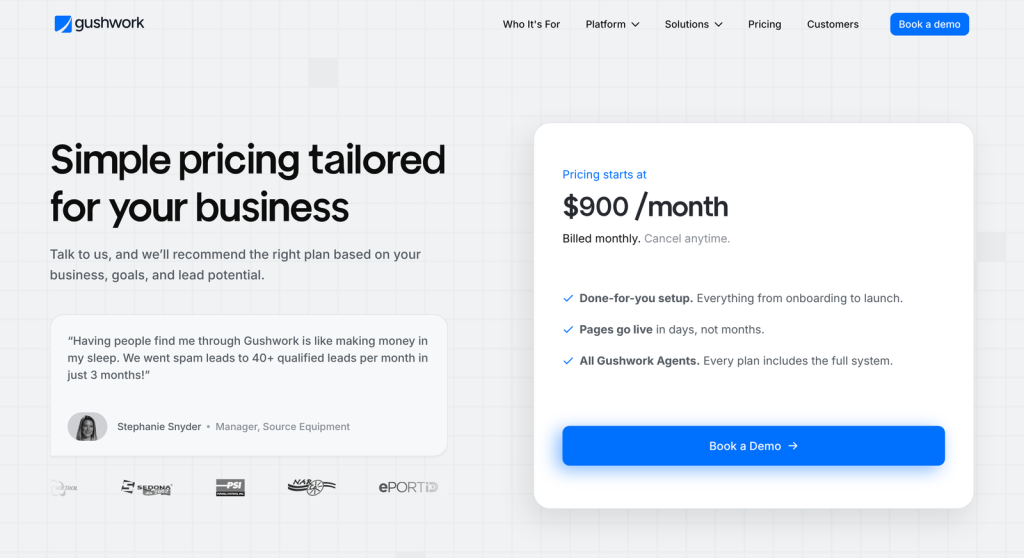
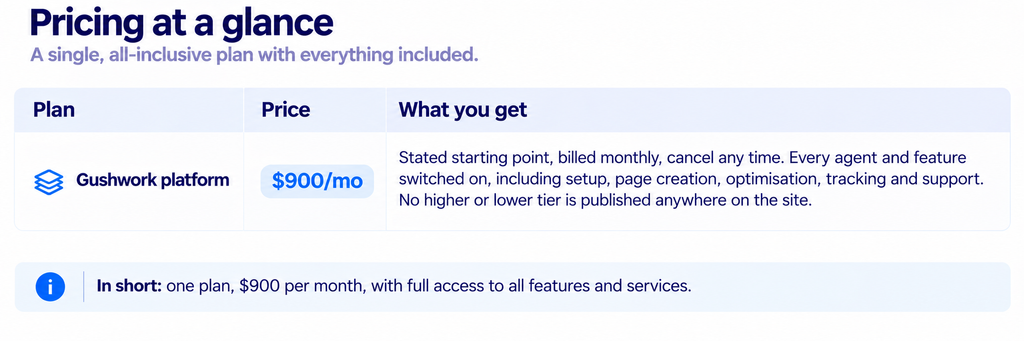
Read the three words above the figure before the figure itself. “Pricing starts at” makes $900 a floor, and the FAQ confirms it in plain terms: $900 is the starting point. Beneath the number sits the billing basis, which is monthly with cancellation any time, so there is no annual commitment to discount and no prepayment trap to walk into.
That combination is unusual and mostly in your favour. Most vendors selling a done-for-you service at this price point want twelve months up front. Monthly billing shifts the risk back toward Gushwork, which matters a great deal once you look at how long the vendor says results take.
What the $900 switches on
Nothing is held back for a higher tier, which is the direct consequence of there being no higher tier. Every agent and feature is switched on at the starting price, according to the FAQ.
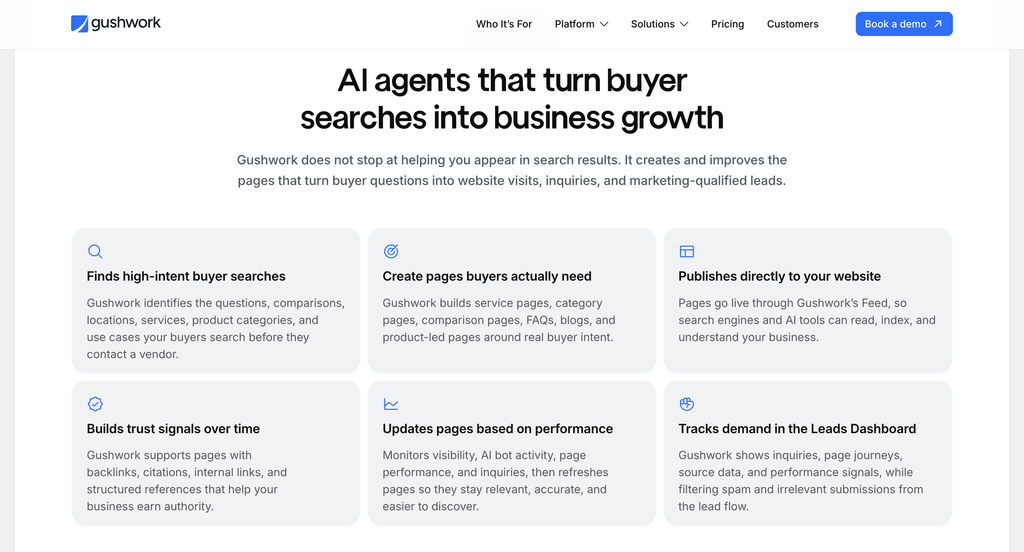
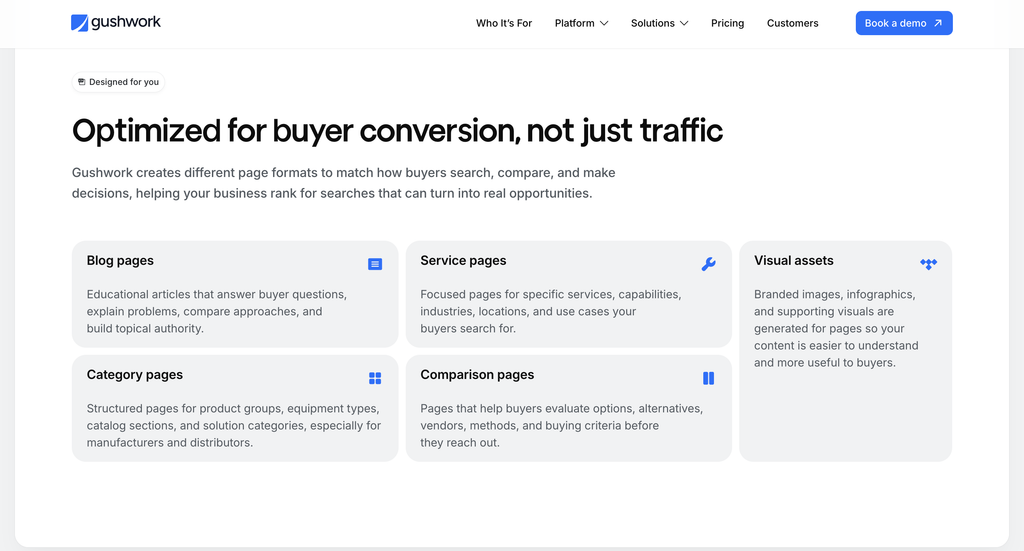
Six things are named. AI Feed carries the only output commitment anywhere on the page, at 100 or more high-quality pages published in six months. Spam protection filters junk before it reaches your team. Buyer journey tracking shows what each lead read before they got in touch. High-quality backlinks are described as authority signals. Custom analytics views and a lead dashboard round it out, with the dashboard holding every inquiry with its status and journey.
Setup is included rather than charged separately. Gushwork calls it done-for-you and covers everything from onboarding to launch, with a stated time to live of under 30 days and a few minutes a week from you after that. An agency charging a separate onboarding fee is the normal pattern here, so folding it in is worth real money in month one.
One structural point deserves attention. You cannot buy agents individually. The FAQ states the platform is not sold agent by agent and that Gushwork decides which agents run at each stage based on what your business needs. Anyone hoping to buy only the page creation engine and keep their own analytics will be disappointed.
The three levers that move your number
Gushwork names them explicitly, which is more than most quote-based vendors do. Your final price depends on how many pages you want published, how fast you want to grow, and how much paid support you add. The exact figure gets confirmed on the call.
Each lever behaves differently, and you should go into the call knowing which one you are pulling. Page volume is the one tied to the published commitment, so ask what page count $900 corresponds to and what the next band costs. Growth speed is really a schedule question, which means you are paying to compress the same work into fewer months rather than buying more of it. Paid support is the third item, and that phrase points at advertising spend sitting alongside the subscription, since Gushwork sells a Paid Boost solution for generating leads from paid campaigns.
Get the third one itemised. A quote that blends a software subscription with media spend is impossible to evaluate later, because you cannot tell which half produced the leads.
The arithmetic at the floor price
Take the published numbers at face value and the maths is short.
Six months at $900 comes to $5,400. Against the commitment of 100 or more pages in that window, you are paying $54 a page at exactly 100 pages. Land 150 and the figure drops to $36. Twelve months runs to $10,800.
Compare that per-page number against what you actually pay for content today. A commissioned article from a competent freelance writer in a technical B2B niche frequently costs more than $54, and this price includes publishing, internal linking, tracking, and the surrounding platform. Judged purely as a content cost per page, the floor price is defensible.
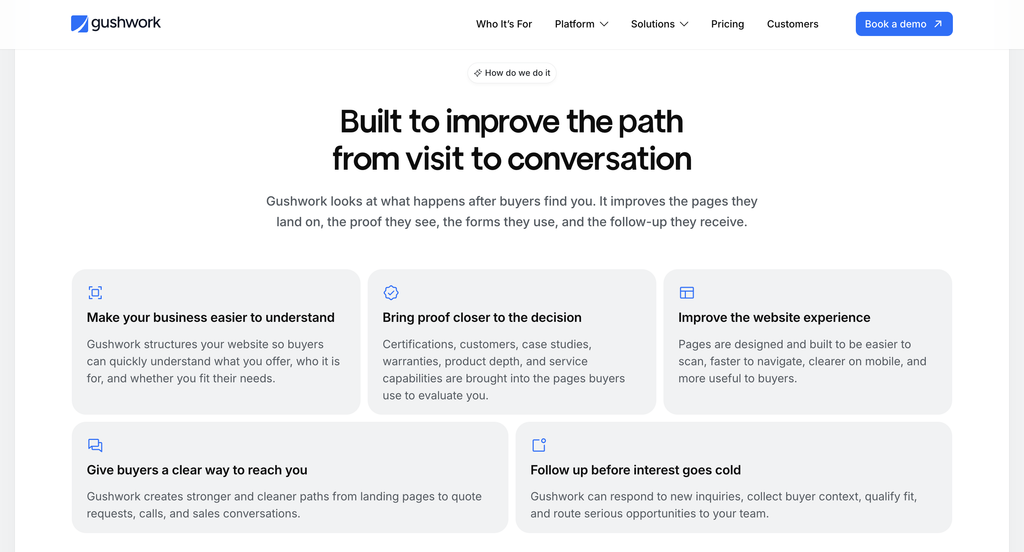
Judged as a lead cost, it looks different, and that is the comparison that will decide whether you renew. Gushwork’s own timeline says qualified leads start around month three to four. Spend to that point is $2,700 after three months and $3,600 after four, with nothing attributable yet. Suppose you then average ten qualified leads a month for the remaining eight months of year one. Eighty leads against $10,800 of spend works out at $135 a lead. That ten-a-month figure is ours as an illustration, not a Gushwork projection, and you should rerun the sum with whatever number the vendor is willing to put in writing for your market.
Monthly billing is what makes the waiting period survivable. Your worst case is capped at however many months you choose to run before deciding, which is a materially better position than the annual contract this kind of service usually carries.
The disqualifier Gushwork publishes about itself
Buried in the signup flow is the most useful sentence on the whole site, and it is a reason not to buy.
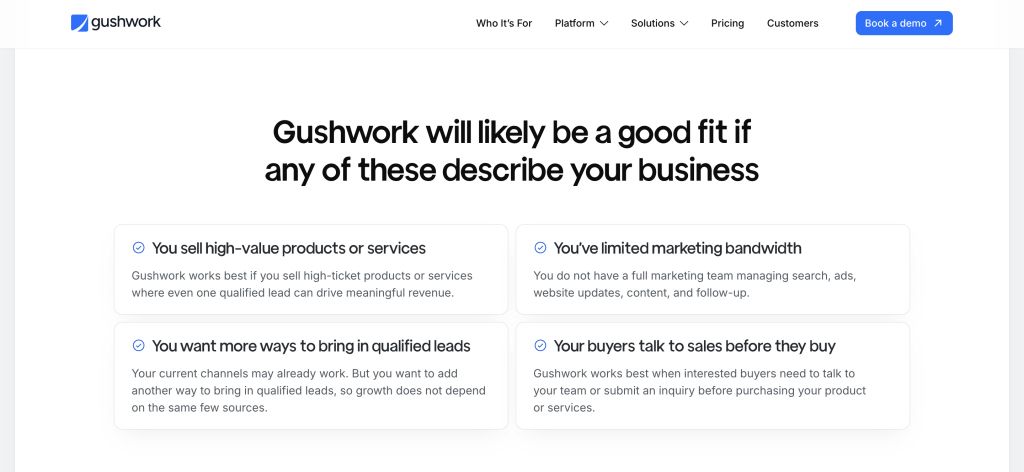
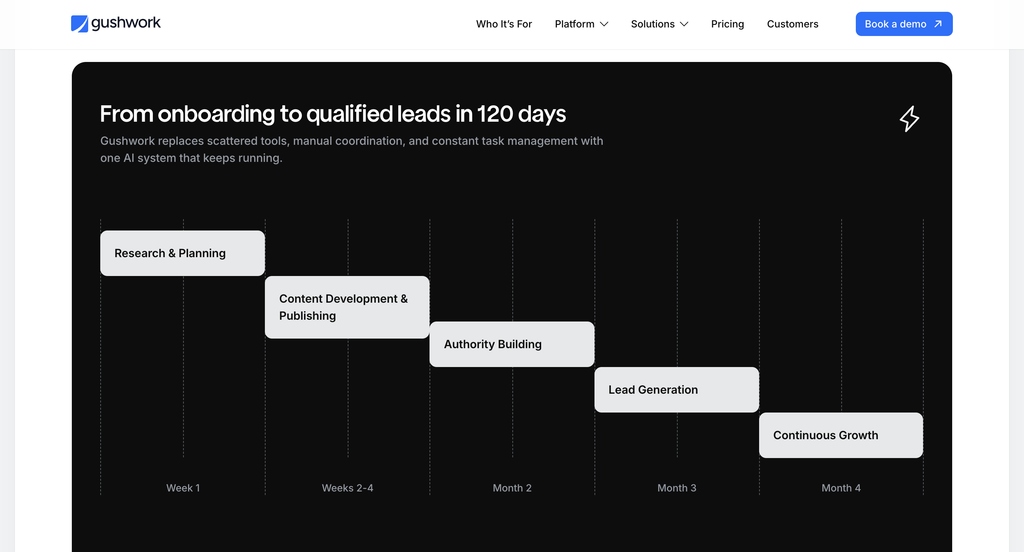
The platform is described as working best for sales-led B2B businesses, meaning the ones that get quote requests, consultation calls, or service inquiries. Then comes the exclusion: if customers can purchase or sign up directly on your site without speaking to anyone first, Gushwork says its platform will not add value for you right now. Self-serve businesses are offered a waiting list instead of a quote.
Vendors rarely turn away revenue in writing. Take it seriously as a qualification rather than as modesty, and notice what it implies about the product: the whole system is tuned to produce a human conversation, which is why the lead dashboard tracks inquiry status and buyer journey rather than conversions or revenue.
Ecommerce operators and self-serve SaaS companies can stop reading here. Everyone selling through quotes, consultations or scoped services is in the target market.
What Google says about the thing you are buying
Gushwork positions itself around visibility in AI search, with an AI Feed described as your website’s protocol for the AI era. Before paying $900 a month for that, read what Google publishes about how its own AI features pick content.
Google’s documentation on AI features states plainly that there are no additional requirements to appear in AI Overviews or AI Mode, and that existing SEO best practices remain relevant for those experiences. No separate feed, schema or protocol is required by Google to be eligible.
Hold both of those facts at once rather than picking the convenient one. Google saying there is no special entry requirement does not make a content programme worthless, because publishing 100 well-researched pages that answer real buyer questions is the work that earns visibility under either framing. What it does mean is that nobody can sell you privileged access to AI answers, so evaluate Gushwork as a content and lead operation rather than as a key to a locked door. Ask what proportion of their reported wins came from AI surfaces specifically against ordinary organic search.
Our write-up of Rank Prompt pricing covers a tool aimed at the measurement side of the same question, which is a cheaper first step if you want to know how you currently appear before paying anyone to change it.
The results on the page, and how to read them
Three customer outcomes appear beside the price. Midwest Power Products is credited with 3 leads in the first 10 days, Source Equipment with more than 40 leads a month, and Fraxtional with over $500,000 in contracts at a stated 30 times return on investment.
Gushwork attaches its own asterisk, and it is a fair one: these are individual customer outcomes, and results vary with your market, your competition and the search demand that exists for what you sell. That last variable is the one buyers underweight. A plumbing supplier in a metro area has search demand to capture. A company selling something nobody searches for cannot have pages rank for searches that do not happen, however well written those pages are.
Notice also the tension between the first testimonial and the FAQ. Three leads in ten days sits oddly beside an answer that declines to promise leads in week one and puts first results at month three to four. Both can be true, since one is an outlier and the other a typical case, but the FAQ is the number to budget against.
What is not published
Several things a buyer needs are absent, and we could not verify any of them from the site.
No page count is attached to the $900 figure, so the per-page arithmetic above rests on the six-month commitment rather than on a monthly quota. No upper price is shown, meaning you have no idea whether the next step is $1,200 or $5,000. Cancellation is described as available any time with no notice period stated. Nothing explains what happens to the pages if you leave, which matters because they sit on your domain and were produced by somebody else. And the phrase “paid support” is never defined, despite being one of the three named price levers.
Put all five on the call agenda. The answers are the actual price.
Who you would actually be contracting with
Two legal entities appear in the site footer, and a buyer signing a monthly agreement should know both.
Regents Inc is listed at 16192 Coastal Highway, Lewes, Delaware. Delfin Technologies India Pvt Ltd is listed in Indiranagar, Bengaluru. A US holding entity paired with an Indian delivery operation is a common and perfectly workable structure for a service sold at this price, and it goes some way to explaining how done-for-you page production lands at $900 a month rather than at agency rates.
It does raise two practical questions for a regulated or technical buyer. Ask which entity appears on your contract and invoice, and ask where your data and draft content are processed. Gushwork states that a human reviews work before it goes live for technical or regulated niches, so establish who that reviewer is and what qualifies them in your field.
The site also claims more than 500 businesses worldwide as customers. No breakdown by size, industry, or region accompanies it, so treat it as scale signalling rather than evidence about your own market.
Four things to get in writing
Because the number is set in conversation, the contract is where the price becomes real. Four items are worth insisting on.
A monthly page count tied to your agreed fee, since the only published volume commitment runs over six months and says nothing about pace. A definition of a qualified lead, because the whole proposition is measured in them and the lead dashboard filters spam on criteria you have not seen. Ownership and portability of the pages, covering what happens to content on your domain when you stop paying. And the split between subscription and any paid media, itemised separately so you can judge each one on its own after six months.
Where this leaves you
Gushwork prices like an agency and packages like software. At $900 a month billed monthly with everything switched on, the entry cost sits below what a mid-tier content agency charges and well below a full-time hire, and the absence of an annual lock is a genuine advantage rather than a marketing line.
The honest risk is time rather than money. Four months at the floor price is $3,600 spent before the vendor’s own timeline says you should expect qualified leads, and that is the decision you are really making. Companies with the patience and the search demand to support it have a reasonable bet here. Companies that need pipeline this quarter should spend the money somewhere with a shorter feedback loop.
If you want to see who is already finding you before you pay anyone to increase it, Leadfeeder pricing covers the visitor identification side at a fraction of the cost.
Frequently asked questions
How much does Gushwork cost?
Pricing starts at $900 a month, billed monthly, with cancellation available any time. That is the only figure published. Your final number is set on a call and depends on page volume, the speed you want and any paid support added.
Are there cheaper plans?
None is published. The pricing page shows a single card and the FAQ describes $900 as the starting point, so there is no entry tier below it.
Is there an annual discount?
No annual option is shown at all. The card states billed monthly and cancel any time, with no toggle and no prepayment offer on the page.
How long before it produces leads?
Gushwork says most businesses it has worked with see their first qualified leads around month three to four, and explicitly declines to promise leads in week one. Going live takes under 30 days by the same FAQ.
Can I buy just one agent?
No. The FAQ states Gushwork is not sold agent by agent and that the right agents are activated by the vendor according to what your business needs at each stage.
Who is it not for?
Self-serve businesses, by Gushwork’s own account. If customers can buy or sign up on your site without talking to someone first, the vendor says its platform will not add value right now and offers a waiting list instead.
How many pages do I get for $900?
No monthly page count is published. The only volume commitment on the site is 100 or more pages in six months under the AI Feed feature, which works out at $54 a page across $5,400 of spend if exactly 100 are delivered.
Sources
- Gushwork pricing page, for the $900 starting price, the monthly billing basis, the included feature list, the full FAQ and the customer outcome disclaimer, read 15 October 2026.
- Gushwork platform pages, for the AI Feed, Brand Memory, Page Creation Engine, Leads Dashboard and Paid Boost descriptions, and for the sales-led B2B qualification in the signup flow.
- Google Search Central, AI features and your website, for the statement that no additional requirements exist to appear in AI Overviews or AI Mode and that SEO best practices still apply.