


Quick answer: Rippling sells around forty named modules across four suites: HR, Payroll, IT, and Finance. You do not buy the suites. You buy the modules you want, and they all read from one employee record, which is the part competitors struggle to copy. Rippling publishes one price, a floor of $8 per employee per month plus a monthly base fee, and quotes everything above that. Nothing on the site tells you what an individual module costs.
Disclosure: Stack99 earns a commission if you buy through links on this page. It costs you nothing extra and never changes our assessment.
Everything hangs off one employee record
Most platforms that call themselves all-in-one got there by acquisition. Rippling makes the opposite claim on its own HR page: that rival suites are “acquired systems” whose modules are disconnected, and that it builds every product on a single source of truth instead. Treat the marketing framing with the usual scepticism, but the architecture claim is testable, and it shows up in how the modules behave.
A worked example. Someone changes department. In a stitched-together stack, that change gets typed into the HRIS, then syncs overnight to the payroll system, then maybe reaches the identity provider, and someone opens a ticket when the app permissions do not follow. Rippling treats the department field as one value that policies read directly. Rippling’s IT page describes the result as updates in the HR system instantly triggering device and app provisioning for onboarding, offboarding, and role changes.
That design decision is why the module list below is worth reading closely. Each module is a thin product sitting on a shared data layer. Buying three of them gets you more than three separate tools would.
What Rippling will tell you about price
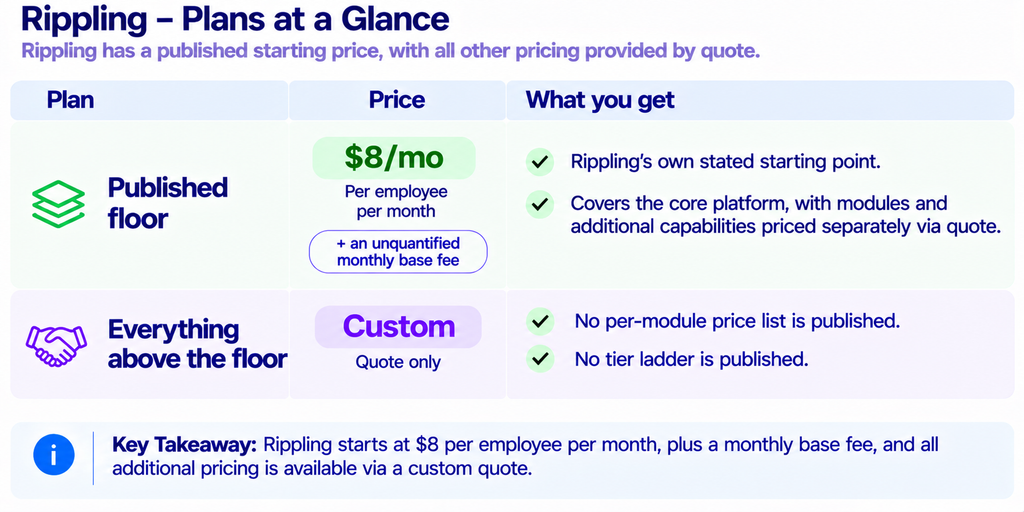
Very little, and the company is upfront about that. The pricing page is a quote request form rather than a price list. The one number Rippling commits to appears in its own FAQ: “Rippling plans start at $8 per employee per month, with a monthly base fee. Your total cost depends on the products and services you choose.”
Read that carefully. The $8 is a floor, not a rate card, and the monthly base fee is unquantified. A company taking HRIS alone and a company taking HRIS plus payroll plus device management plus corporate cards are both quoted off the same opaque process. Our Rippling review covers what that means when you try to budget.
Because pricing is modular, the module inventory doubles as your cost lever. Knowing which of the forty products you actually need is the only way to go into a quote conversation with a position.
The HCM suite, four columns deep
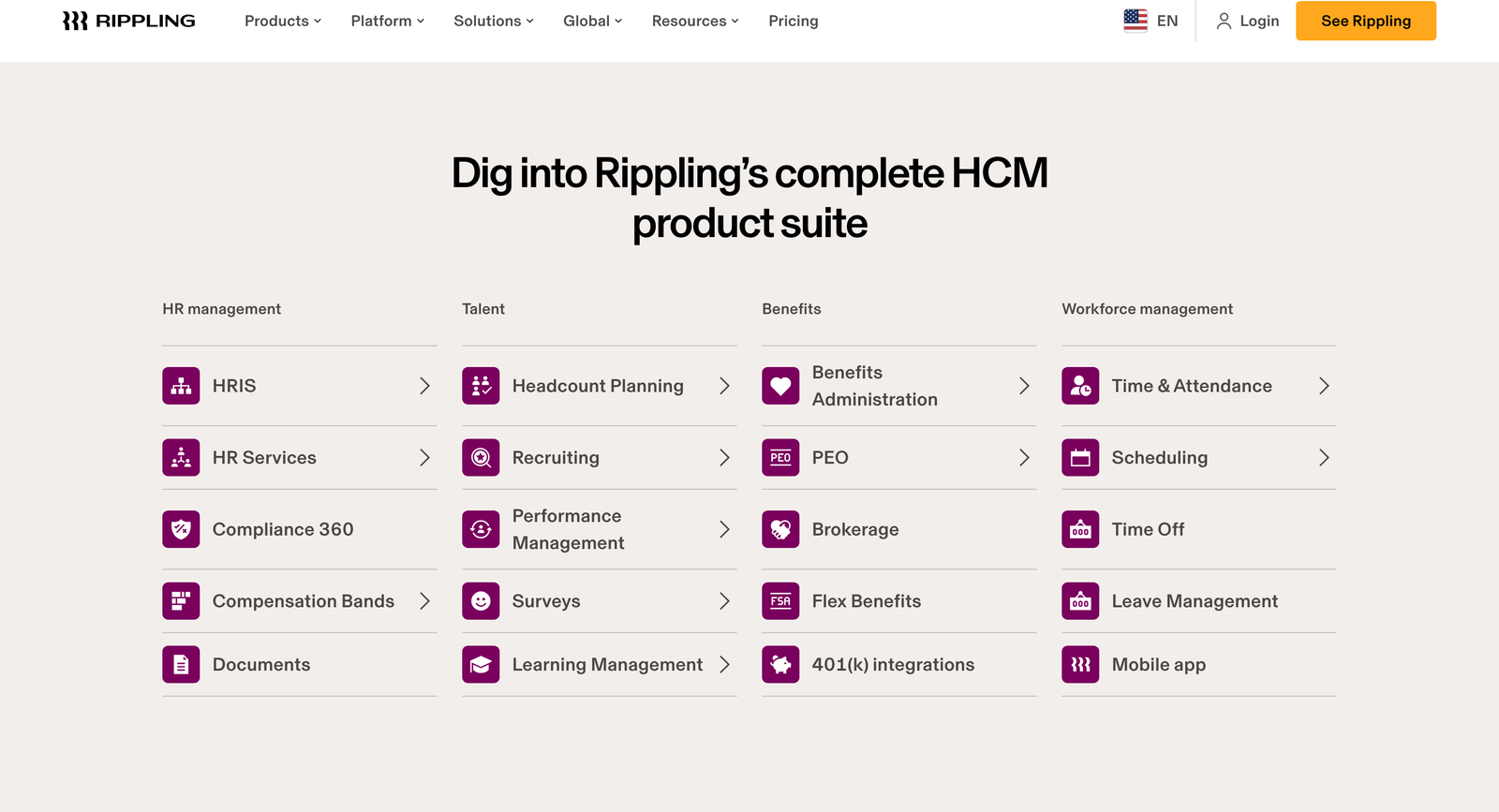
Rippling splits HCM into HR management, Talent, Benefits, and Workforce management. Nineteen named products sit under those four headings.
HR management
HRIS is the spine: the employee record every other module reads. HR Services is Rippling’s people-advice layer rather than software. Compliance 360 is the interesting one, because Rippling claims coverage across all 50 US states and 180+ countries, flagging risks and recommending fixes as labour law, training requirements, and termination rules change. Compensation Bands handles pay ranges. Document stores offer letters, W-4s, and the rest with audit trails attached.
Talent
Five products: Headcount Planning, Recruiting, Performance Management, Surveys, and Learning Management. This is the column most likely to lose a bake-off against a specialist. A dedicated applicant tracking system will usually out-feature Rippling Recruiting. What Rippling offers instead is that a hire approved in Headcount Planning becomes a requisition, then an employee record, then a provisioned laptop, without anyone re-keying a name.
Benefits
Benefits Administration, PEO, Brokerage, Flex Benefits and 401(k) integrations. Note that PEO appears here and again under payroll. A PEO arrangement changes your employer-of-record relationship, so it is a commercial decision rather than a feature toggle. Rippling also advertises AI that approves dependents, updates coverage, and routes evidence-of-insurability requests in bulk.
Workforce management
Time & Attendance, Scheduling, Time Off, Leave Management and a mobile app. Shift-based businesses live in this column. Rippling lists clock-in, schedule viewing, shift swapping, and time-off requests as mobile capabilities, which matters when most of your workforce never opens a laptop.
Payroll, and the four ways to employ someone
Rippling lists Payroll, Global Payroll, EOR, and PEO as separate products, which is correct, because they are four legally distinct arrangements rather than four feature levels.
Domestic payroll calculates federal, state, and local taxes and files them automatically. Two details are easy to miss. Rippling says you can run payroll as often as you need at no extra charge, which is unusual; many providers bill per pay run. And the platform compares the current run against previous ones so you can catch a discrepancy in gross pay, taxes or deductions before approval rather than after.
Global Payroll covers your own entities abroad. EOR covers countries where you have none. Accounting syncs go to Xero, QuickBooks, and NetSuite.
The IT suite is the real differentiator
Plenty of vendors sell HR software. Far fewer sell HR software that also manages laptops. Rippling groups five IT products under one tab bar.
- Identity and Access Management. Single sign-on plus automatic access changes when a role changes or someone leaves. Rippling cites a G2 ranking of #1 for SSO and a 4.8 G2 rating.
- Device Management. Setup, configuration, and software installation across macOS, Windows, iOS, and iPadOS. Note the omission: Android and Linux are not in that list.
- Inventory Management. Procurement, shipping, retrieval, and buyback, worldwide. This is the module that quietly justifies itself when someone leaves, and nobody knows where the MacBook went.
- Helpdesk. Ticket resolution, with Rippling claiming automatic resolution of some requests at the moment they are raised.
- Automated Compliance. SOC 2 evidence collection in the background, with one-click remediation.
Sitting across those five is Rippling AI Governance, which tracks AI tool usage, enforces spend controls, and manages agent identity against the same employee data. That is a newer category, and you should ask for a demo rather than trust a bullet point.
Rippling publishes customer figures for this suite: an average of $200,000 a year saved on tool and service consolidation, attributed to a Maui Oil case study, and an 80% reduction in IT tickets attributed to a Decimal case study. Productiv is quoted at a 30% drop in monthly helpdesk tickets and five times faster onboarding. These are vendor-selected references. Useful as a ceiling, not as a forecast.
Finance: six products and a banking footnote
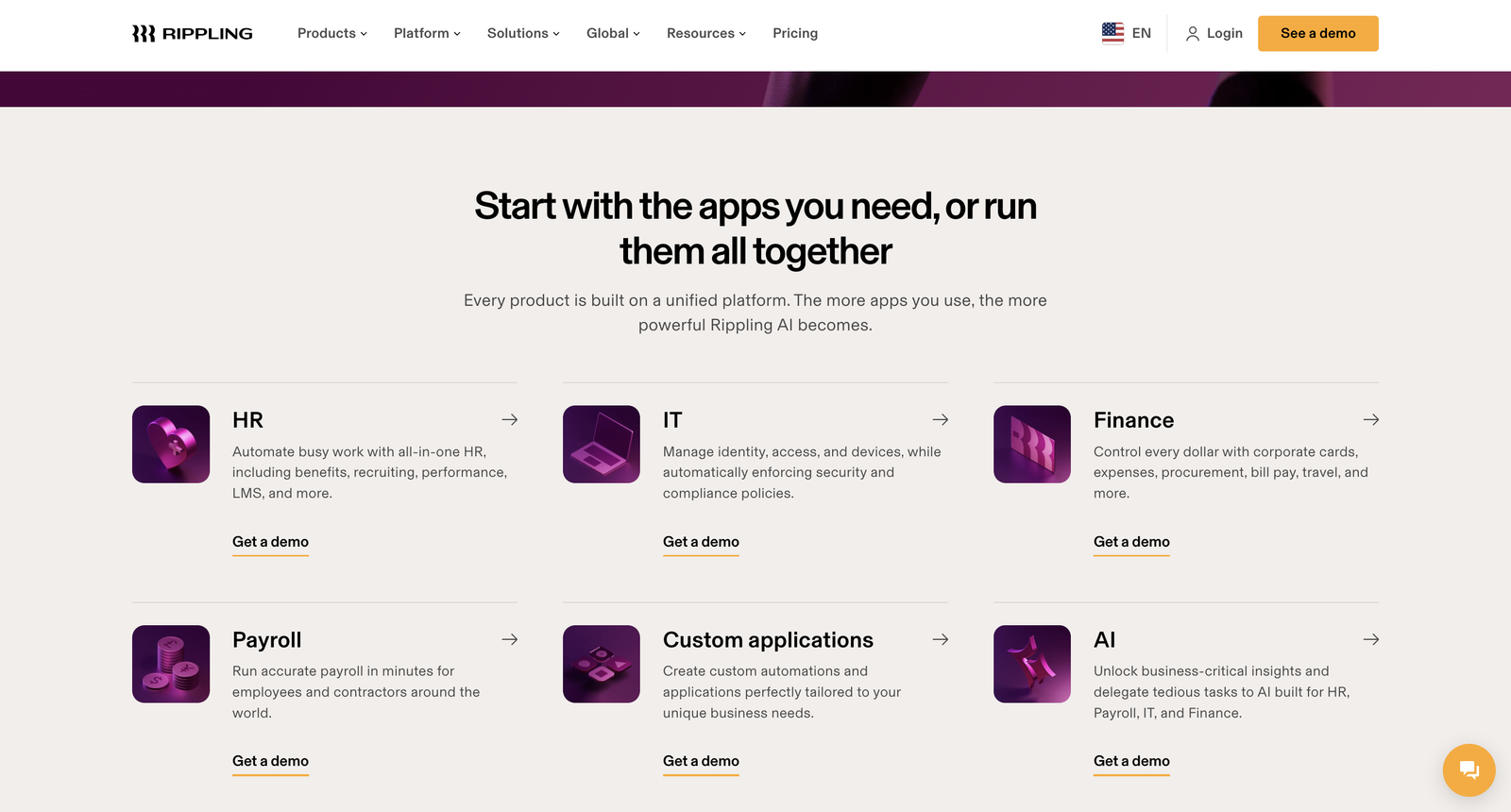
Corporate Cards, Bill Pay, Expense Management, Banking, Travel and Procurement. The pitch is that spend policies can key off employee data you already maintain, so an approval chain follows role, department, and location without being rebuilt by hand.
Concrete capabilities Rippling documents: card controls based on employee record, vendor and transaction amount; automatic SMS and email receipt requests when a card is used; bill payment by ACH, cheque or wire; international bill payments in the vendor’s local currency; and a vendor portal where suppliers update their own details and submit invoices.
Now the part most reviews skip. Read Rippling’s own small print and the finance suite is partly a regulated financial product. The Rippling Corporate Card is issued by Fifth Third Bank, N.A., Member FDIC, or by Celtic Bank, subject to approval, under a Visa licence. Rippling Payments, Inc. holds NMLS No. 1931820. Rippling Travel LLC carries California seller-of-travel registration CST#2156725-50 and Florida registration ST44398. If your finance team has an opinion about who holds the banking relationship, that opinion belongs in the evaluation.
The platform layer you cannot buy separately
Four capabilities appear on every product page, which is a reasonable signal that Rippling considers them the actual product.
- Permissions. Governs what each person can see, do, and access, derived from the employee record.
- Policies. Custom rules that enforce how your business works.
- Automations. Custom triggers and actions across modules.
- Analytics. A report builder running on unified data.
Beyond those four, Rippling’s platform section lists App Studio for building internal apps, Data Cloud, Sites, Automation Studio, and an integrations directory. The integration count Rippling repeats across every product page is 650+. For how those connections behave once you depend on them, see our breakdown of Rippling integrations.
The AI layer is sold as part of every suite
Rippling does not sell an AI module. It threads AI claims through each suite instead, which makes them harder to evaluate and harder to price. Collecting them in one place helps.
On the HR side, the pitch is bulk administrative work: approving dependents, updating coverage, routing evidence-of-insurability requests, standardising job titles across a messy org chart, and flagging attrition risk by team and manager. On payroll, it is adding one-off bonuses, comparing payroll costs across entities, and answering employee questions about why a payslip changed. On the IT side, it surfaces shadow IT and unused spend. Finance gets AI reporting and workflow automation from intake through to payment.
Two of these deserve a harder look during a demo. “Spot attrition risks by team and manager” is a prediction, and predictions about people carry real consequences when a manager acts on one. Ask what signals feed it and whether the output is advisory. Separately, AI Governance promises to manage agent identity, meaning non-human accounts get treated like employees for access purposes. That is a sensible idea and a young one. Ask how an agent is offboarded.
None of this changes the module inventory. It does change what you should test before signing, because an AI claim attached to a module you are already buying is not free; it is bundled into a quote you cannot itemise.

Where the module list is thinner than it looks
Forty products sounds overwhelming. Several of them are narrow.
Surveys, Brokerage and Sites are features in most competing products rather than standalone modules. Counting them separately inflates the headline. Device Management covers Apple and Microsoft but not Android or Linux, which rules it out for some engineering teams. Talent will lose to a specialist on depth. And the whole value argument collapses if you only buy one module, because a single source of truth with one consumer is just a database.
There is a second, quieter risk in the architecture itself. A shared employee record means a bad value propagates everywhere at once. Get a department wrong, and you have mis-provisioned access, mis-routed an approval chain and possibly mis-filed a tax jurisdiction, all from one typo. Vendors rarely advertise this side of a single source of truth. Ask during implementation how corrections are audited and how far a rollback reaches.
Consolidation cuts the other way too. Four suites on one contract means one renewal conversation with very little leverage, because unpicking payroll, devices, and corporate cards simultaneously is not a credible threat. Companies that buy the full stack should expect that dynamic at year three.
Rippling also cites 30,000+ customers and a 4.9 rating from Software Advice. Both are company-reported figures on a marketing page. The named customer outcomes carry the same caveat: Clay is quoted automating 80% of onboarding tasks while growing five times in eighteen months, and Aptera is quoted saving $225,000 a year across compliance, benefits administration and payroll. Those are real companies and selected results.
Which modules earn their place
Choose HRIS plus Payroll if you want the baseline and nothing else. You will get a competent system and almost none of the leverage.
Choose HRIS plus the IT suite if onboarding is your pain. Provisioning a laptop, an SSO account, and a payroll record from one action is where the architecture pays. Productiv’s quoted numbers all come from that combination.
Choose HRIS plus Global Payroll or EOR if you hire across borders. Compliance 360’s 180+ country claim only matters if you operate in more than one.
Choose the Finance suite last. Corporate cards and bill pay are the most replaceable part of the stack and the part with the most mature competition. Andros is quoted cutting month-end close from ten business days to three, which is a strong number, though it reflects a full consolidation rather than adding one module. Our guide to who Rippling fits goes further on company size and spread.

You can request a quote from Rippling once you know which modules you are asking about. Going in without that list is how you end up comparing two quotes that describe different products.
FAQ
How many modules does Rippling sell?
Counting the named products on Rippling’s own HR, IT, Finance and Payroll pages gives roughly forty, spread across nineteen HCM products, four payroll arrangements, five IT products plus AI Governance, six finance products and the platform capabilities. No official total is published.
Can I buy a single Rippling module?
Rippling describes its structure as modular and says you only pay for what your business needs. The published floor of $8 per employee per month plus a base fee applies regardless, so a single small module still carries the base fee.
Does Rippling manage Android or Linux devices?
Rippling’s device management page lists macOS, Windows, iOS, and iPadOS. Android and Linux do not appear in that list. Confirm with Rippling before assuming coverage for a mixed fleet.
Is Rippling’s PEO the same as its payroll product?
No. PEO is listed separately under both Benefits and Payroll because it changes the employment relationship rather than adding software features. Treat it as a commercial decision requiring legal review.
How many integrations does Rippling have?
Rippling states 650+ integrations, a figure repeated on its HR, IT, Finance, and Payroll pages.
Does Rippling charge per payroll run?
Rippling states that you can process payroll as often as you need at no extra charge. Confirm this in writing for your quote, since the base fee structure is not published.
Who issues the Rippling corporate card?
Fifth Third Bank, N.A., Member FDIC, or Celtic Bank, subject to approval, under a Visa licence. Rippling Payments, Inc. holds NMLS No. 1931820. These disclosures appear in the footer of Rippling’s finance page.
What is the platform layer and does it cost extra?
Permissions, Policies, Automations, and Analytics appear on every product page as shared capabilities rather than separate purchases. Rippling does not list them with individual prices, so treat them as included and confirm during the quote.
Sources
- Rippling pricing page and FAQ, read 21 November 2026, for the $8 per employee per month floor and base fee.
- Rippling HCM product suite, for the nineteen HCM modules and the 50-state, 180+ country compliance claim.
- Rippling IT, for the five IT modules, supported device platforms and the cited case study figures.
- Rippling Finance, for the six spend products and the card issuer, NMLS and seller-of-travel disclosures.
- Rippling Payroll, for pay run frequency, accounting integrations and the four employment arrangements.
Module names, claims and the published price floor were read from Rippling’s own pages on 21 November 2026. Rippling does not publish per-module prices, so no figure beyond the stated floor appears above.