



Quick answer: Nouswise is a research agent that answers from a library you curate and cites what it used. Its feature list splits at two places rather than one. The first split sits between Essential at $19.99 and Pro at $49.99, where MCP Tools, Web Search and Workspace switch on, and your file ceiling jumps from 300 MB to 2 GB. The second sits between Pro and Enterprise, where Connectors, Custom Data Sources, Access Management, Knowledge Gap Analysis and Enterprise Data Security all appear at once. Everything an organisation would need to deploy this across a team is on the far side of that second wall, and Enterprise carries no published price.
Disclosure: Stack99 earns a commission if you buy through links on this page. It costs you nothing extra and never changes our assessment.
Four things it claims to do
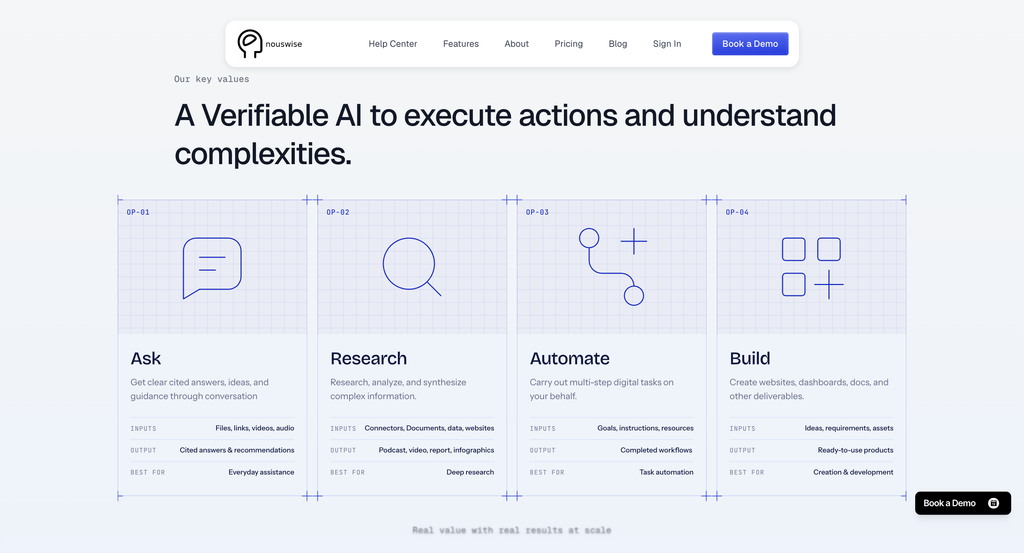
Nouswise describes itself as an autonomous thinking partner delivering source-traceable answers. Underneath that phrasing, its homepage organises the product into four numbered operations, each with stated inputs, outputs and a target use. Reading them as a set tells you more than any feature list does.
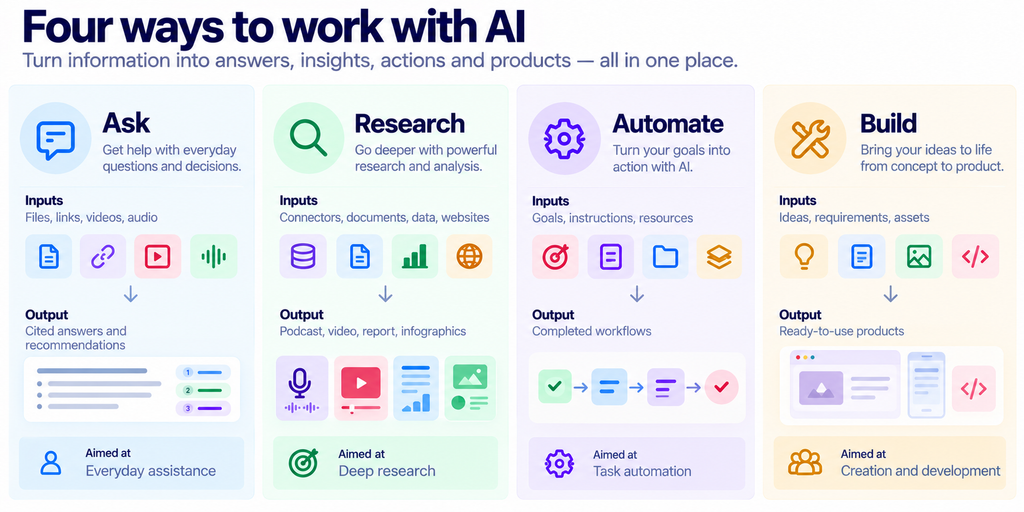
Note what the Research row lists as inputs. Connectors come first, ahead of documents and websites. Hold that thought, because connectors turn out to be an Enterprise-only line item, which means the operation the product is named around is only partly available on the plans you can actually buy with a card.
The capabilities, as the features page names them
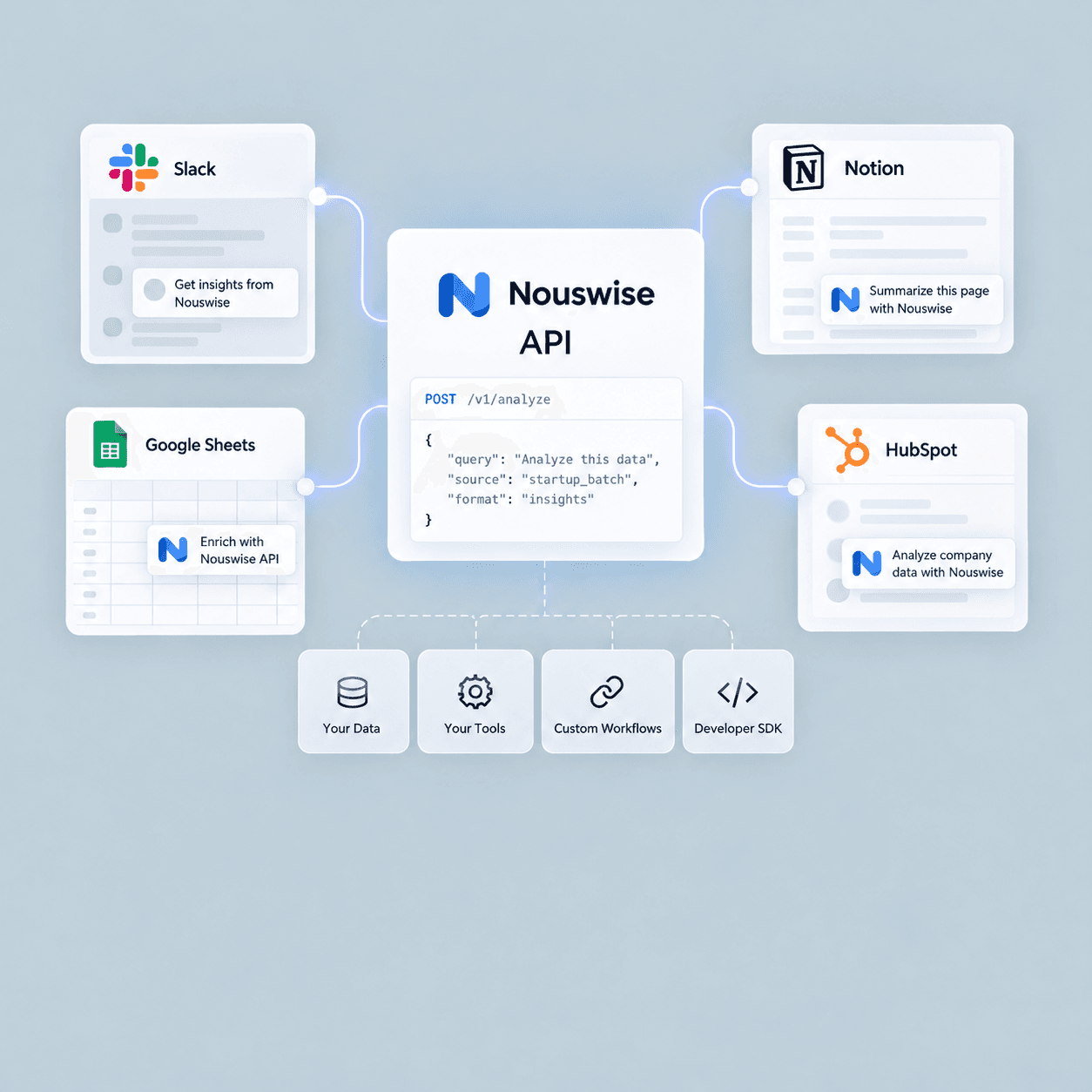
Five capabilities get a description rather than a label.
Data and Document Search indexes and queries your files so answers come from your own curated library.
Model Context Protocol is how Nouswise plugs into external systems, and the vendor is explicit about why: standardising the connection reduces custom integration work and speeds up deployment.
Agentic search is described as coordinating several expert agents that cross-check sources, fill gaps, and resolve conflicts between them, which is a more specific claim than most vendors make about their retrieval.
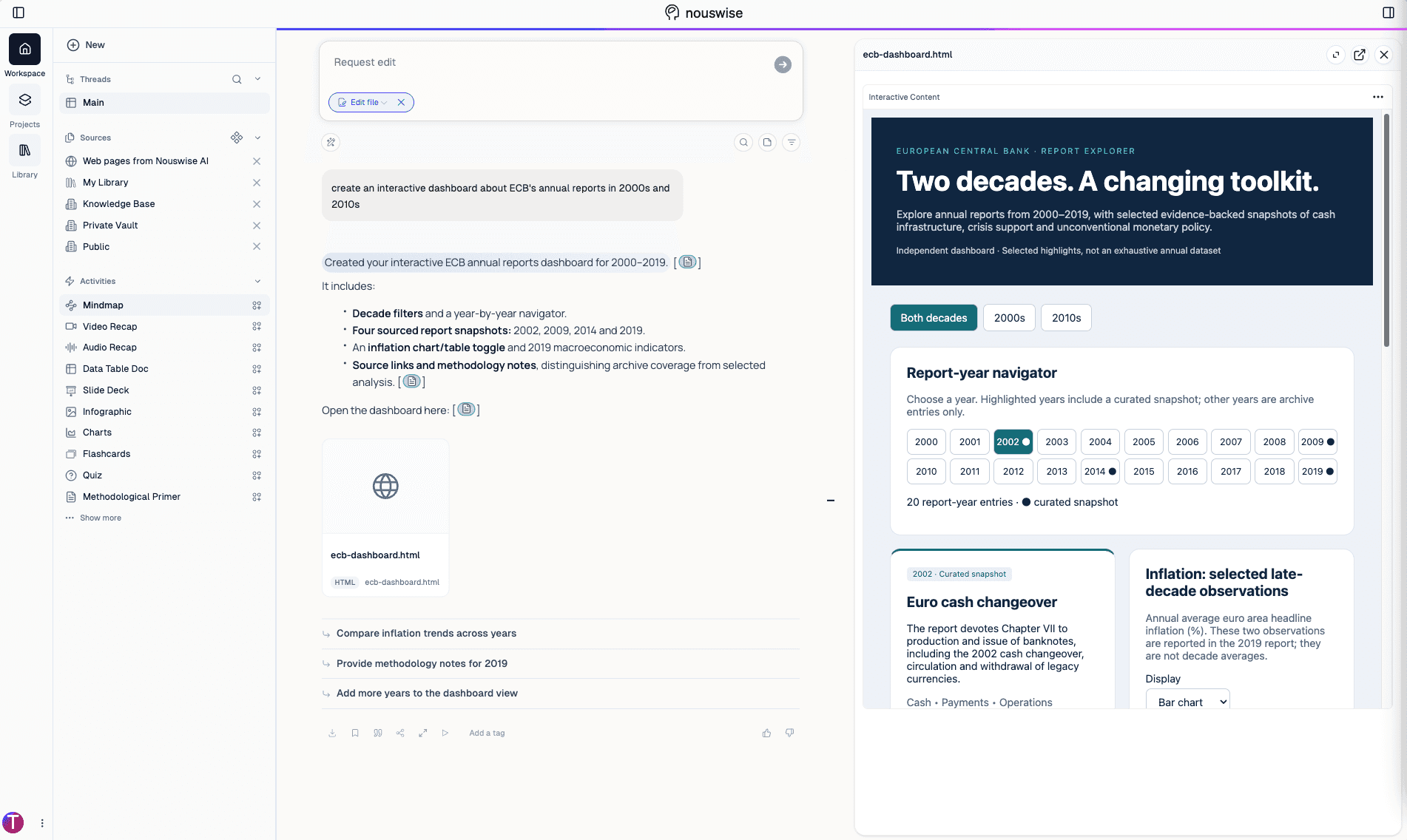
Visual Recap generates a short video of two AI voices talking through the main insights from content you select. The Nouswise API exposes search, reasoning, and summarisation to your own tools.
MCP deserves a sentence of context because it is doing real work in that list. It is an open protocol, published with a dated specification, that standardises how applications share context with language models and expose tools to them. The June 2025 revision defines three roles: hosts, which are the LLM applications initiating connections; clients, which are connectors inside the host; and servers, which are the services exposing capabilities. Messages travel as JSON-RPC 2.0. A vendor supporting MCP is committing to an interface anybody can read, which is a meaningfully different proposition from a proprietary connector catalogue you have to take on faith.
Two further items sit lower on the page: a Direct Feedback Loop aimed at organisations that publish information and want to see where their audience’s knowledge gaps are, and a Unified Intelligence Platform framing for pulling several data sources into one place.
A caveat about that page
Being straight about what we found. The features page carries three statistics counters, labelled VERIFIABLE, DOCUMENTS and LANGUAGE, and all three render as zero: “0.00 %”, “0 +” and “0 +”. They are animated counters that never receive their values.
Further down, the same page contains blocks of unmistakable template filler left over from a recruiting product. Among the benefits listed for a research agent are “Easily collaborate with teams to find & hire the right candidate”, “Access up-to-the-minute data on hiring trends, candidate progress” and “Integrate with your existing HR and recruiting platforms with ease”.
None of that says anything about whether the software works. It does say the marketing site has not been finished, and it means you should treat the lower half of the features page as unreliable and rely on the pricing comparison table instead. That table is specific, internally consistent, and the basis for everything below.
Where the feature line actually falls
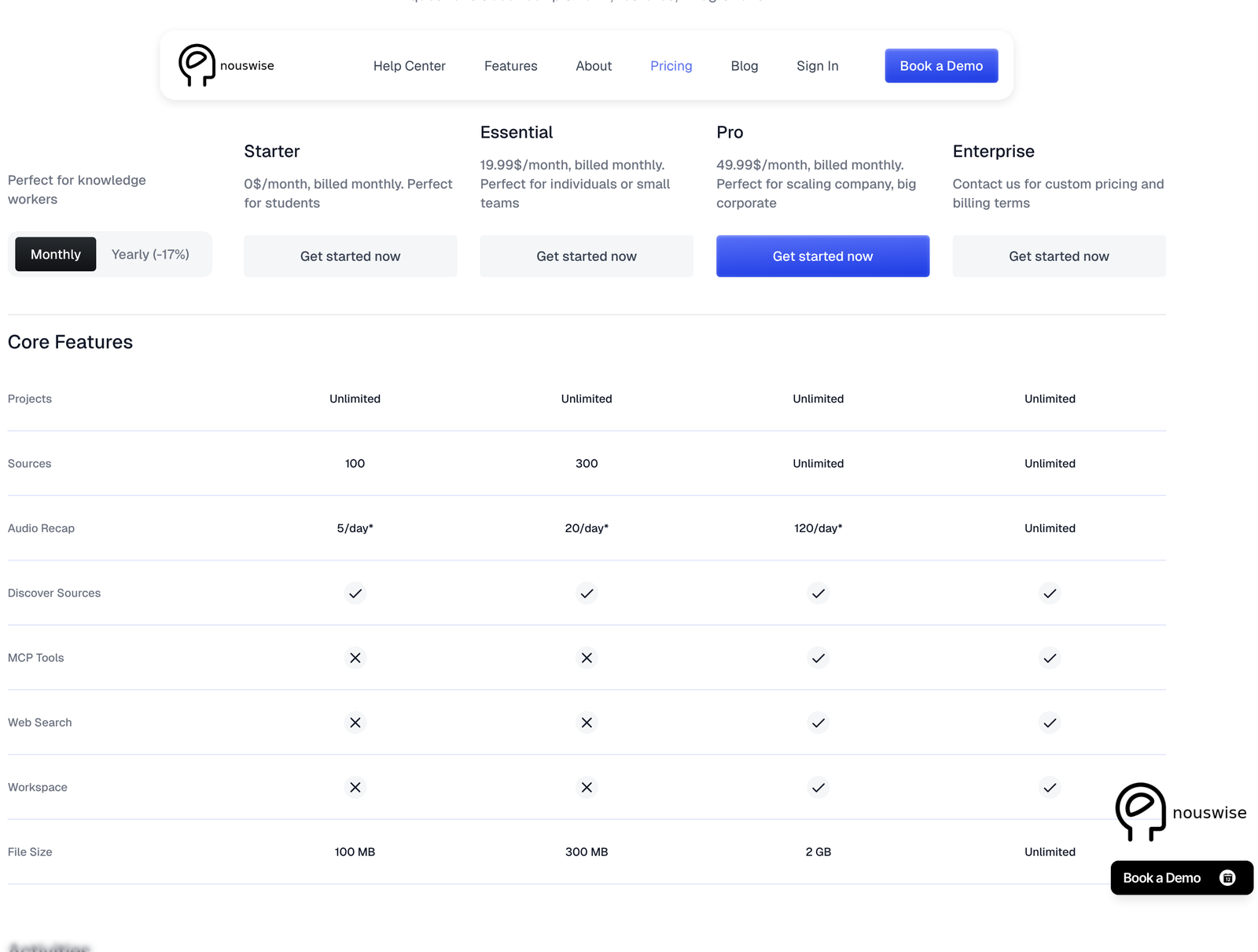
Here are the published rates, as of 19 October 2026, with the Monthly option selected.
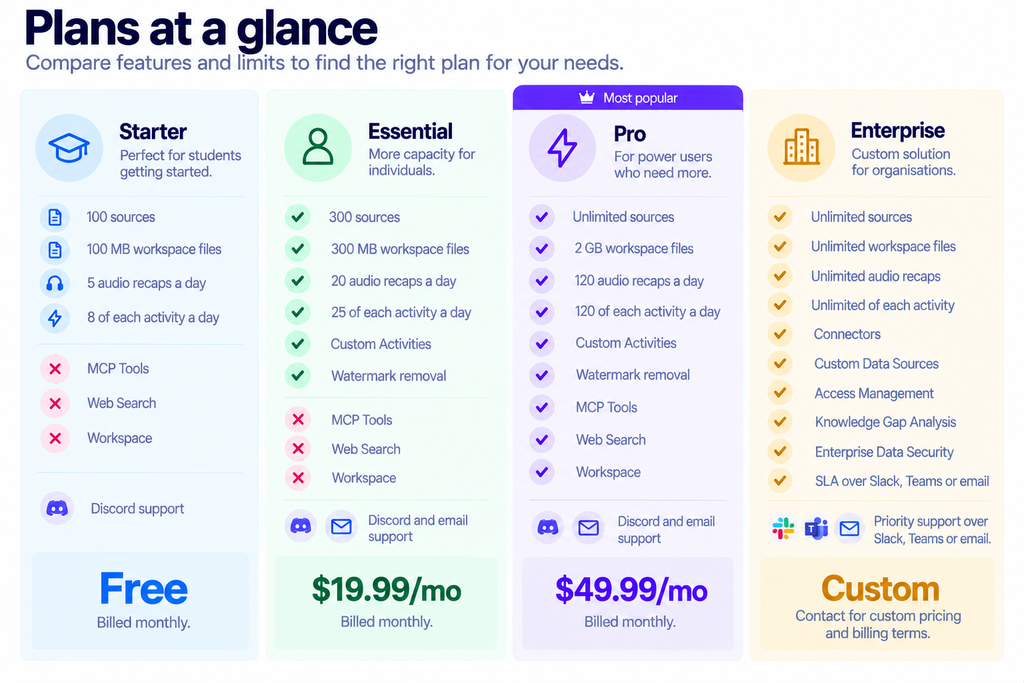
Projects are unlimited on every plan, including the free one, which is unusual. The metering happens elsewhere.
Sources run 100, then 300, then unlimited from Pro upward. Workspace file size runs 100 MB, 300 MB, 2 GB, then unlimited. Audio Recap runs 5, 20, and 120 a day before going unlimited. Discover Sources is the one core row ticked on all four plans.
Then three rows behave identically to each other and differently from everything else. Three capabilities, MCP Tools, Web Search, and Workspace, are each crossed out on Starter and on Essential, and ticked on Pro and Enterprise. That is the shape of the first real decision. Paying $19.99 buys you volume. Paying $49.99 buys you reach, because those three rows are what lets the agent look beyond the files you have uploaded by hand.
Essential is therefore a bigger version of the free plan rather than a different product. Anyone whose reason for paying is connecting Nouswise to live information is choosing between free and Pro, with the middle tier serving people who have a lot of documents and no need to go outside them.

The arithmetic of the two paid tiers
Running the numbers makes the shape of the ladder clearer than the ticks do.
Essential costs $240 a year at the published monthly rate. Pro costs $600. The step between them is $360 a year, or $30 a month, and the step buys three gated rows plus four raised ceilings.
Measured on daily activity volume alone, Essential works out at roughly 80 cents per daily activity slot per month, taking 25 as the figure, while Pro works out at about 42 cents at 120. Pro is therefore close to twice as efficient per unit of output, which is the opposite of how tier ladders usually behave. Most vendors charge a premium for the upper tier and deliver diminishing value per unit. Nouswise prices its middle tier poorly against its top self-serve one.

Storage tells the same story. Essential gives 300 MB for $19.99 and Pro gives 2 GB for $49.99, so the file ceiling grows by a factor of roughly seven for two and a half times the money. Source limits go from 300 to unlimited for the same step.
Put those together and Essential looks like a plan aimed at a buyer who will not spend $50, rather than a plan built around a distinct set of needs. Anyone weighing the two should price the gap at $30 a month and ask whether web access, MCP and a seven-fold storage increase are worth that. For most working researchers, the answer is straightforwardly yes, which leaves Essential serving people on a fixed budget and people whose corpus genuinely fits in 300 MB.
The activities, and a word doing a lot of work
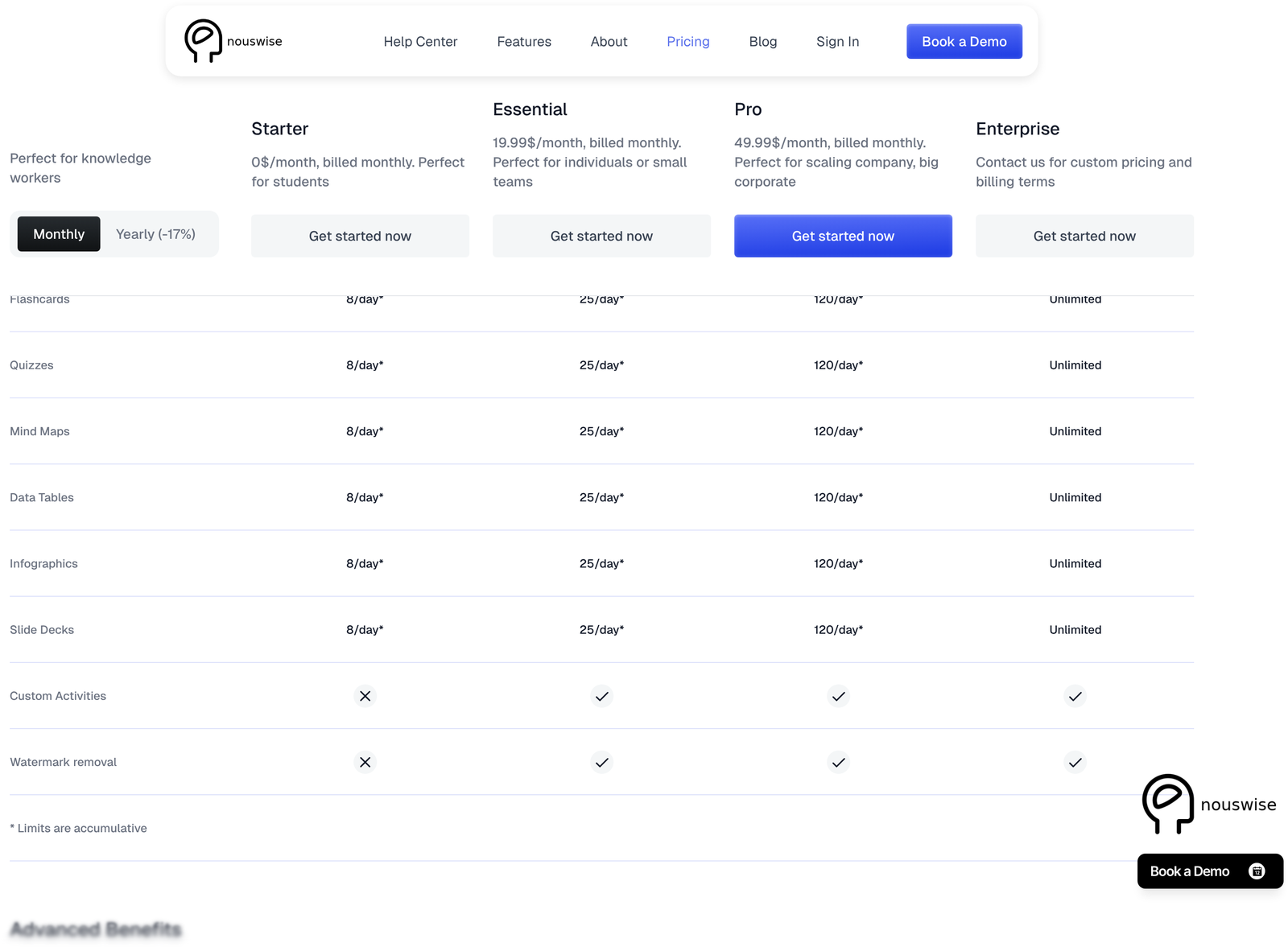
Activities are the output formats. Having pulled an answer together, Nouswise can render it as a report, a set of flashcards, a quiz, a mind map, a data table, an infographic or a slide deck, and Deep Research sits in the same group. Flashcards and quizzes alongside slide decks tells you the product is chasing education and corporate knowledge work at the same time.
Every activity carries the same allowance: 8 a day on Starter, 25 on Essential, 120 on Pro, unlimited on Enterprise. Custom Activities, meaning formats you define yourself, are crossed out on Starter and ticked on the three paid plans, as is watermark removal. Free output therefore carries a watermark, which matters if you intended to put a generated infographic in front of a client.
Now the asterisk. A footnote under the table reads “Limits are accumulative”. That wording is ambiguous in a way the rest of the table is not. It could mean unused daily allowance rolls forward, which would be generous. It could mean the per-activity limits draw on one shared daily pool, so 25 a day on Essential is 25 across all eight activity types rather than 25 of each. The difference is eightfold. Nouswise defines the term nowhere on the page or in the FAQ, and we are not going to guess at it. Ask before you buy, particularly on Essential where the ceiling is low enough to hit.
The Enterprise wall
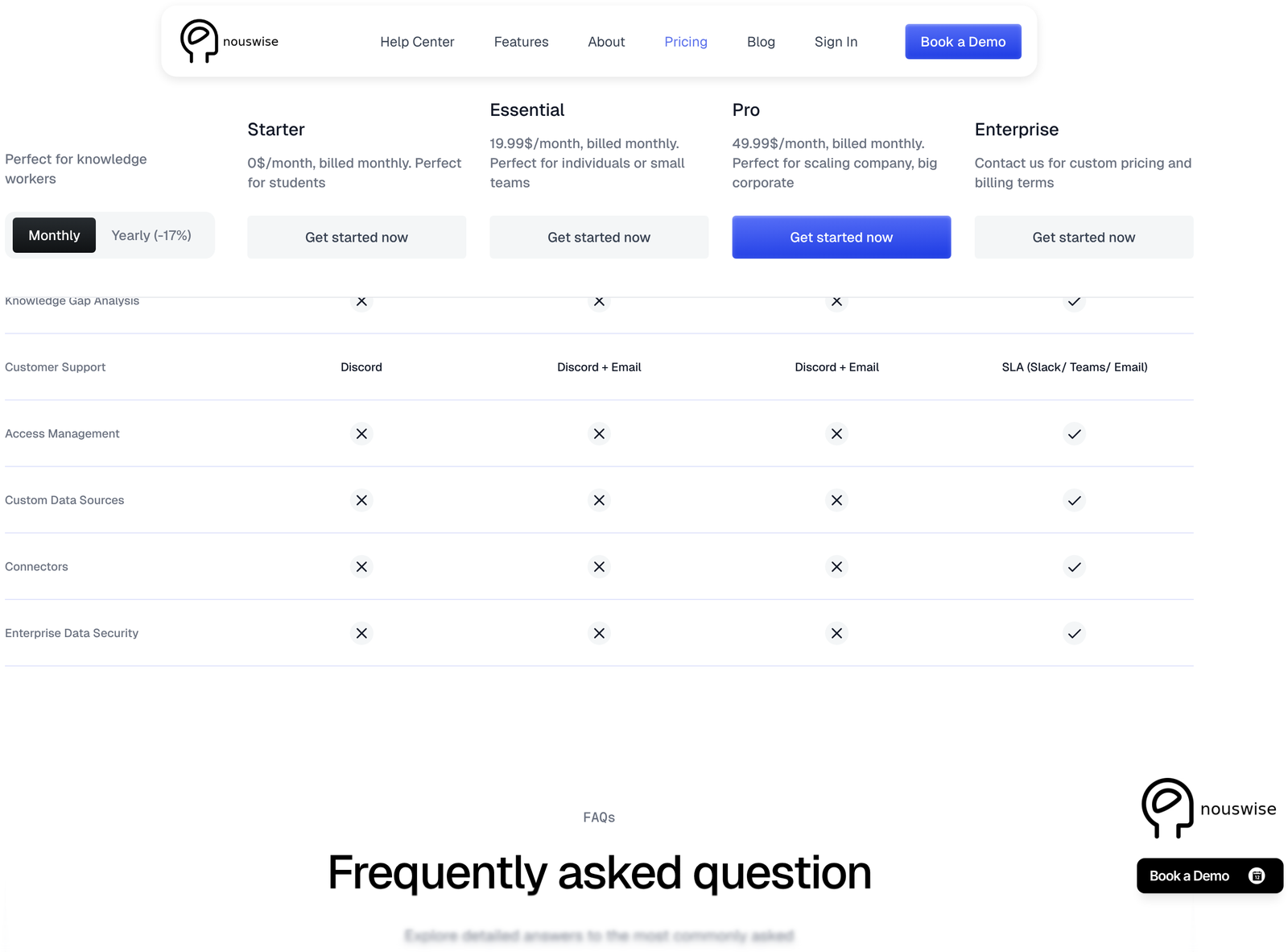
Under Advanced Benefits, the pattern changes completely. Knowledge Gap Analysis, Access Management, Custom Data Sources, Connectors and Enterprise Data Security are each crossed out on Starter, Essential and Pro, and ticked only on Enterprise.
Run through what that excludes from a $49.99 Pro seat. No connectors, so no automated pull from the systems where your organisation’s documents actually live. No custom data sources. No access management, which means no way to control who in a team can see what. Those three absences together put Pro firmly in individual-user territory regardless of the “scaling company, big corporate” label on its card.
Support follows the same contour. Starter gets Discord. Essential and Pro get Discord plus email, so paying an extra $30 a month buys no support improvement. Enterprise gets an SLA over Slack, Teams or email, and it is the only plan with any committed response time at all.
Knowledge Gap Analysis being Enterprise-only is the quietly interesting one, since the features page builds a whole section around understanding your audience and surfacing what they do not know. That capability is the pitch to publishers and institutions, and it is not purchasable at any published price.
The yearly toggle does nothing
Pricing pages usually hide a trap in their billing toggle, where the figures on arrival turn out to be prepaid annual rates. Nouswise has the opposite problem.
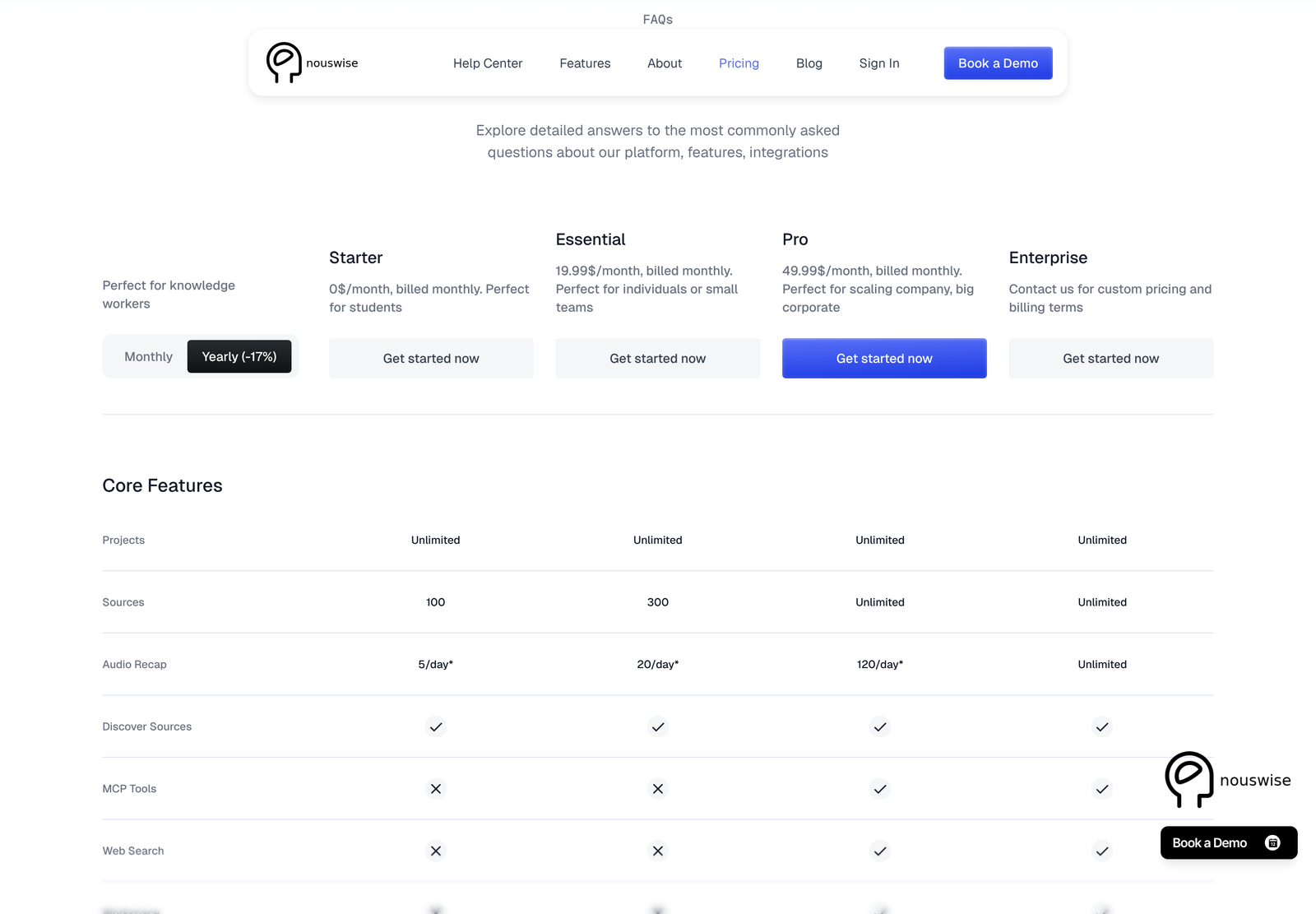
The page offers a Monthly and Yearly control, with the Yearly half advertising minus 17 percent. Monthly is preselected on arrival, so the figures you land on are genuine recurring monthly rates. Good so far.
Clicking Yearly moves the selection, and nothing else changes. Starter still reads “0$/month, billed monthly”. Essential still reads “19.99$/month, billed monthly”. Pro still reads “49.99$/month, billed monthly”. We captured both states and compared them directly. The discount is advertised and never shown.
Seventeen percent off $19.99 would be $16.59 a month, and off $49.99 it would be $41.49, for annual totals near $199 and $498. We are not publishing those as Nouswise prices, because Nouswise does not publish them. Treat the annual discount as something to confirm at checkout.

One more offer appears above the plans, worded as “first 30 days enterprise plan are free trial if you book now”. Given that Enterprise is the only tier carrying connectors and access management, thirty days on it is the sensible way to evaluate those features. No terms accompany the offer.
Security and where your data sits
The FAQ is more forthcoming here than the feature table. Data is encrypted in transit and at rest by default, on cloud infrastructure hosted in servers located within Europe and the United States. For customers with strict jurisdictional or compliance requirements, Nouswise offers dedicated data centres in a region you choose, or a fully on-premises installation it manages for you.
European hosting as a standard option, rather than as an enterprise upgrade, is a genuine differentiator against American-hosted rivals, and an on-premises route is rare for a product that also sells a $19.99 consumer-looking tier. Both belong in the Enterprise conversation.
What the FAQ does not mention is any named attestation. No SOC 2, no ISO 27001, no CSA listing appears anywhere we looked. The row labelled Enterprise Data Security is a tick in a table, not a report you can request by name. Ask what stands behind it.
On positioning, Nouswise states its mission as grounding every response in an institution’s own vetted data, and distinguishes itself from consumer search engines by saying it surfaces what is proven rather than what is popular. That is a claim about design intent, and the citation behaviour described under the Ask operation is the part a buyer can actually test during a trial.
What we could not verify
- Any annual price. The toggle changes no figure, so no annual rate is published.
- Any Enterprise figure, seat minimum or contract term.
- What “Limits are accumulative” means.
- The Workflow customization and Custom Dashboard and Analytics rows. Those two sit in the Advanced Benefits block, and we could not map their values to columns reliably enough to report them, so we have left them out rather than guess.
- Which MCP servers or connectors are supported. None is named publicly.
- Whether the Nouswise API is available on the self-serve plans. It appears on the features page and nowhere in the comparison table.
- Any security certification. None is claimed.
Which plan fits which person
Choose Starter if you want to test the citation behaviour and the output formats on documents you upload yourself. Unlimited projects and 100 sources go a long way for that, and the only real sting is the watermark.

Choose Essential if you have a large document corpus, no need for live web or MCP access, and you want the watermark gone. Students and solo researchers working from a fixed reading list are the obvious fit.
Choose Pro if the agent needs to reach outside your uploads. Having MCP Tools, Web Search and Workspace arrive together is the entire argument for the tier, and 2 GB of files plus unlimited sources comes along with it.
Go to Enterprise, or go elsewhere, if more than one person needs access. Access management, connectors and custom data sources are all on that side of the wall, and a team cannot sensibly share a Pro seat without them. Use the thirty-day Enterprise trial rather than buying Pro and discovering the gap.
FAQ
How much does Nouswise cost?
Starter is free, Essential is $19.99 a month, and Pro is $49.99 a month, all billed monthly. Enterprise is quote-only. Read on 19 October 2026.
Is there an annual discount?
A Yearly control advertises minus 17 percent, but selecting it leaves every figure and every “billed monthly” label unchanged. No annual rate is published, so confirm it at checkout.
What is the difference between Essential and Pro?
Pro adds MCP Tools, Web Search and Workspace, lifts sources from 300 to unlimited, raises the file ceiling from 300 MB to 2 GB, and raises daily activity limits from 25 to 120. Support is identical on both.
Does Nouswise support MCP?
Yes, and it names Model Context Protocol on its features page as the reason it avoids custom integrations. MCP Tools appear as a gated row available on Pro and Enterprise only. No specific MCP servers are named.
Can Nouswise run on our own servers?
The FAQ says yes, as a fully on-premises installation Nouswise manages, aimed at organisations handling highly confidential data. Dedicated regional data centres are offered as a middle option.
What output formats can it produce?
Reports, flashcards, quizzes, mind maps, data tables, infographics and slide decks, plus Deep Research and audio recaps. Custom Activities are available on the paid plans.
Is Nouswise SOC 2 certified?
No certification is claimed anywhere publicly. The comparison table has a row called Enterprise Data Security, and the FAQ describes encryption and hosting regions, but no named attestation appears. Ask directly if your review requires one.
Sources
- Nouswise pricing, read on 19 October 2026, in both billing states, for the four plans, the Core Features, Activities and Advanced Benefits rows, the accumulative-limits footnote and the 30-day Enterprise offer.
- The Nouswise features page, read on 19 October 2026, for Data and Document Search, Model Context Protocol, agentic search, Visual Recap, the API and the Direct Feedback Loop, and for the zeroed counters and template filler described above.
- Nouswise’s homepage, read on 19 October 2026, for the four operations with their inputs, outputs and intended uses.
- The Model Context Protocol specification, revision 2025-06-18, the protocol’s own authoritative text, for the host, client and server roles and the JSON-RPC 2.0 message format.
Prices were read from the Nouswise pricing page on 19 October 2026 and are quoted in US dollars. Vendors change them without notice, so check before you budget.