


Quick answer: Aircall lists Essentials at $30 and Professional at $50 per licence per month, but those are the annual-billing rates. Pay month-to-month, and the same seats cost $40 and $70. Both plans also carry a three-licence minimum, so the cheapest real Aircall bill is $120 a month on monthly billing or $90 a month prepaid for a year. Enterprise is quote-only and starts at 25 users. Add-ons such as Analytics+ and AI Assist Pro are charged per seat on top.
Disclosure: Stack99 earns a commission if you buy through links on this page. It costs you nothing extra and never changes our assessment.
The first number you see is the annual rate
Open the Aircall pricing page, and Essentials reads $30, Professional reads $50. Neither figure is a monthly price. Above the cards sit two controls, “Pay annually” and “Pay monthly”, and the annual one is already active when the page finishes rendering. We captured both states on 22 November 2026.
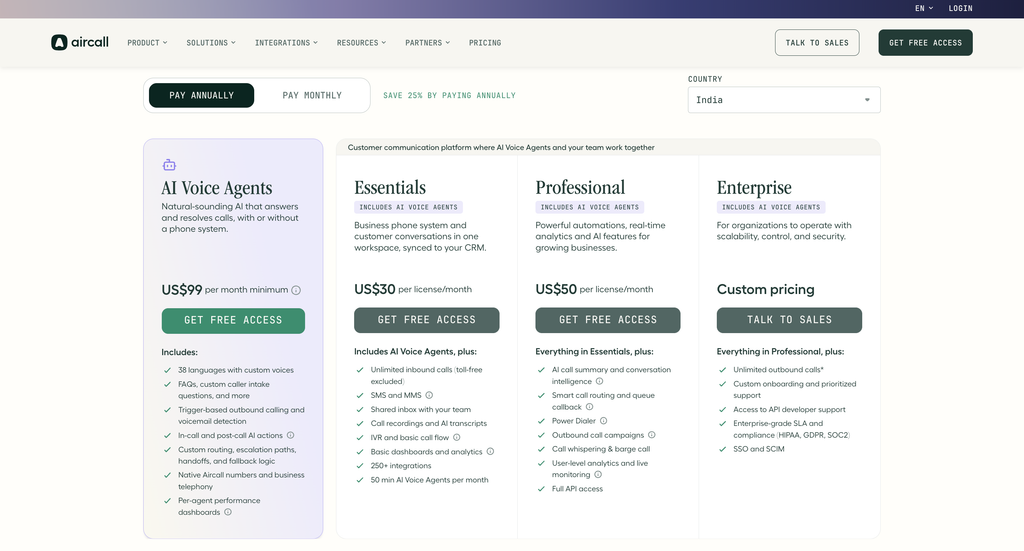
Click “Pay monthly” and every figure on the page moves. Essentials becomes $40. Professional becomes $70. The AI Voice Agents line climbs from a $99 monthly minimum to $120.
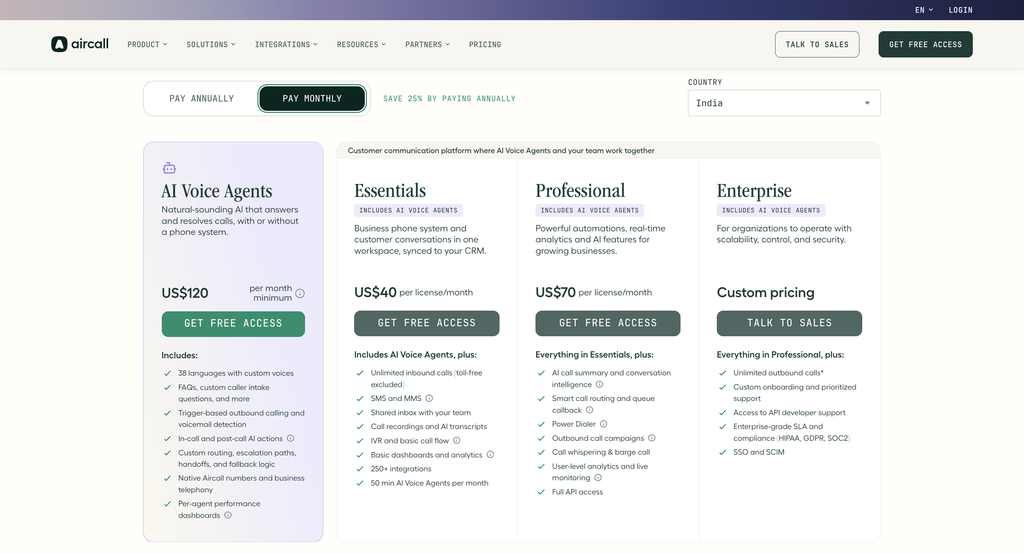
Nothing here is concealed. The label under each price does say “per licence/month”, and a banner does advertise the annual saving. A buyer comparing four vendors in a browser tab each will still carry away $30 as the Aircall number, then meet $40 at checkout.
Every published Aircall price, both ways
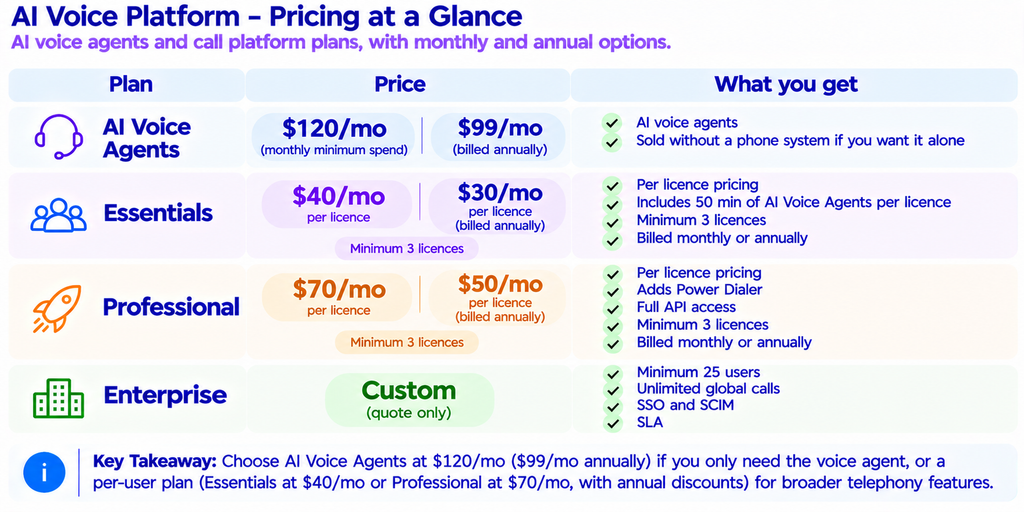
Aircall also charges $6 a month for each phone number beyond the one included with a plan. That applies to all three published tiers.
The “save 25%” badge is exact on one plan and wrong on two
Aircall puts a single claim above the cards: save 25% by paying annually. Run it against the two states we captured and it holds for Essentials alone.
Essentials moves from $40 to $30, which is a saving of exactly 25%. Professional moves from $70 to $50, and $20 off $70 is 28.6%. AI Voice Agents moves from a $120 minimum to $99, which is 17.5%. Two of the three plans do not save 25%, and one of them saves considerably less.
Professional buyers come out ahead of the badge. Anyone budgeting around the AI Voice Agents minimum should know the discount there is roughly two-thirds of what the banner implies. Over a year on a single AI Voice Agents commitment, the gap between the advertised 25% and the actual 17.5% is about $108.
Three licences is the floor, so $30 is never the bill
The detailed comparison table carries a row most people scroll past: minimum number of users. Essentials and Professional both require three. Enterprise requires 25.
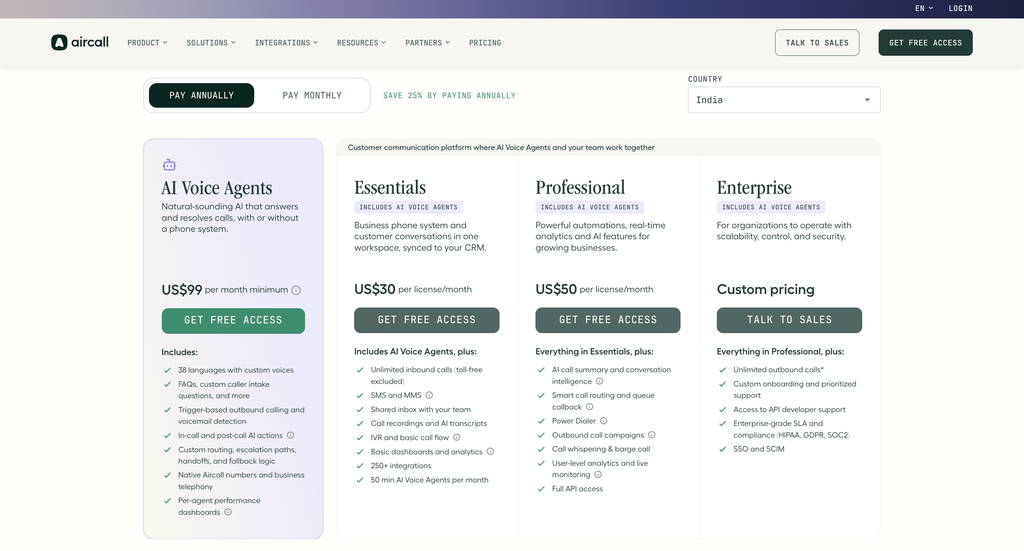
Stack the two qualifications, and the headline figure needs three conditions before it applies. You pay annually. You buy at least three licences. You take Essentials rather than Professional.
A solo consultant cannot buy one seat at $30. The smallest possible commitment is three Essentials licences at $90 a month prepaid, which is $1,080 for the year. Choose monthly billing instead, and three licences cost $120 a month, or $1,440 across twelve payments. That $360 difference is the real decision in front of a small team, not the $10 printed on the card.
Teams of two pay for three. A two-person support desk on annual Essentials spends $1,080 a year for seats it does not fully use, which works out at $45 per working person per month rather than $30.
Add-ons are priced per seat, and one costs more than a seat
Below the plan cards, Aircall lists six paid extras. These are not bundled into any tier.
- AI Assist Pro, $49 per seat a month, for real-time coaching during live calls
- Aircall for Salesforce Voice, $30 per seat a month
- Analytics+, $15 per seat a month, for custom dashboards and unlimited history
- WhatsApp in Aircall, $10 per seat a month
- AI Messaging Agents, $0.15 to $0.35 per conversation
- Number Reputation Dashboard, $0.03 per reputation check
Look at the first line again. AI Assist Pro costs $49 a seat. An annual Essentials licence costs $30 a seat. The coaching add-on is 63% more expensive than the plan it attaches to, and more than an Essentials seat bought monthly at $40.
Analytics+ deserves a second look for a different reason. The comparison table marks the Analytics+ add-on as available on Enterprise only, while advanced analytics itself arrives on Professional. Teams on Essentials get six months of basic analytics and no route to the add-on.

AI Voice Agents is a product, not a tier
The leftmost card on the pricing page confuses people, and the layout is partly to blame. AI Voice Agents sits beside Essentials and Professional as though it were the cheapest rung on the same ladder. It is a separate purchase with its own pricing model.
Aircall prices it as a monthly minimum rather than per licence: $120 a month on monthly billing, $99 prepaid annually. The card states it can run “with or without a phone system”, so a company that already has telephony elsewhere can buy the agent layer alone. What the published page does not say is what happens above the minimum, which strongly implies usage-based billing beyond it. We could not verify the overage rate, so treat $99 as a floor and ask for the per-minute schedule.
Every paid plan also includes some agent capability. Essentials bundles 50 minutes of AI Voice Agents a month. Fifty minutes is a demo allowance rather than a deployment, roughly two or three real support calls a day for a week before it runs out. Teams planning to lean on voice agents should price the standalone product and not assume the bundled minutes will stretch.
Worth separating from the agents: AI call summary and conversation intelligence are a Professional feature, and AI transcripts of recordings appear as far down as Essentials. Three different AI capabilities sit at three different price points, which is easy to conflate when the word “AI” appears on every card.
When annual billing stops being the obvious answer
Prepaying looks free. Saving $360 a year on three Essentials seats is real money for a small team, and on twenty Professional seats the annual commitment saves $4,800 against monthly billing. Two situations change the arithmetic.
Seasonal headcount is the first. A support desk that runs eight agents through the winter and three through the summer is buying twelve months of eight seats to get the annual rate, which costs $4,800 on Professional. Running monthly at $70 for eight seats across five busy months and three seats for the remaining seven comes to $2,800 plus $1,470, or $4,270. Monthly billing wins by $530 despite the worse headline rate.
Uncertainty about the vendor is the second. Phone systems touch number porting, CRM sync, and agent habits, and a team that has never run Aircall is making a twelve-month bet on all three. The 25% premium on Essentials buys the option to leave after thirty days. For three seats, that option costs $30 a month, which is cheap insurance against a migration you regret.
Growing teams face a smaller version of the same question. Adding a seat mid-term on an annual plan is usually prorated to the renewal date rather than billed as a fresh year, but the mechanics vary by contract. Confirm it before you sign rather than after.
The limit that catches growing support desks
One row in the detailed table does more damage than its position suggests. Essentials caps you at three teams. Professional and Enterprise are unlimited.
A team in Aircall is the unit that routing, ring groups and distribution rules hang off. Three is enough for Sales, Support and Billing. Add a fourth function, split support into tier one and tier two, or open a second region, and you have hit the ceiling. The upgrade from Essentials to Professional is $20 a seat annually, so a ten-person desk pays $2,400 more a year to create a fourth routing group.
Analytics retention has a similar shape. Essentials holds analytics data for up to six months with basic reporting only. Professional keeps the same six-month window but unlocks advanced analytics, and Enterprise moves to unlimited history through Analytics+. Any company with a compliance requirement to review call data beyond six months is on Enterprise whether its headcount justifies it or not.
Both limits share one trait. Neither is about call volume or minutes, which is what buyers usually model. They are structural caps, and a team can run into them at any size.
Four realistic bills
Published rates only become useful once you put a team behind them. Each line below uses the annual rate, since that is the cheaper option and the one Aircall shows first.
Three-person startup on Essentials. $90 a month, $1,080 a year. One number included. Add a second number and it becomes $96 a month.
Eight-person sales team on Professional. $400 a month, $4,800 a year. Power Dialer and outbound campaigns are included at this tier, which is the usual reason sales teams skip Essentials.
The same eight people with WhatsApp. Add $10 a seat and the monthly figure moves from $400 to $480. Across a year that single add-on costs $960, which is nearly as much as the three-person startup pays for everything.
Twenty agents on Professional with AI Assist Pro. Seats cost $1,000 a month. The add-on costs another $980. Total $1,980 a month, $23,760 a year, with the coaching tool accounting for 49% of it.
That last line is the pattern to watch. Once per-seat add-ons stack, they stop being extras and start being half the invoice.
What the licence fee does not include
Unlimited calling on Essentials and Professional covers the United States and Canada, with an asterisk on the page. International outbound is not included on either plan: both cards direct you to contact Aircall for rates and bundles. Unlimited global calls appear on Enterprise, which is the tier with no published price and a 25-user floor.
Business text messaging works the same way. SMS and MMS are listed as plan features, yet the detailed table notes that rates for the United States, Canada, the United Kingdom, Australia, France and Germany require a conversation with sales. A team whose volume is mostly texting cannot size its bill from the pricing page at all.
Call recording access also differs by tier. Essentials keeps recordings for up to a year by request, with six months reachable in the dashboard. Retention on Professional and Enterprise is listed as unlimited, on the same by-request basis.
Where the tiers actually divide
Price aside, the split between Essentials and Professional is cleaner than most vendor ladders. Essentials gives you a working phone system: shared inbox, recordings and AI transcripts, IVR, basic call flow, 250 or more integrations, and 50 minutes of AI Voice Agents a month.
Professional adds the things an outbound team cannot operate without. Power Dialer, outbound campaigns, smart routing, queue callback, call whispering and barge, live monitoring, and full API access all begin here. Developers should note that last one: the Aircall API reference documents a public REST API, but the pricing table gates full access behind Professional.
Enterprise is about governance rather than telephony. SSO and SCIM, HIPAA and SOC 2 commitments, custom onboarding, and an SLA are what the quote buys. Companies below 25 seats cannot reach it regardless of budget.
How to check your own number before you sign
Three steps take about five minutes and remove most of the risk here.
- Click “Pay monthly” before you write any figure down, then decide which commitment you actually want.
- Multiply by three, or by your real headcount if it is higher. The licence minimum applies regardless of how many people will log in.
- Ask for international and SMS rates in writing if either matters to you, because neither is published.
Aircall’s help centre keeps a billing and subscription section covering payments, invoices and taxes, which is the right place to confirm how a mid-term seat change is prorated before you commit to twelve months.
What we could not verify
Several numbers a buyer would want are simply absent from public pages, so they are absent here too. Enterprise pricing is quote-only. International call rates and SMS rates are quote-only in every market the page names. The price of exceeding the 50 included AI Voice Agent minutes on Essentials is not published.
Prices on the page are shown for the United States and there is a country selector that changes them. Everything above reflects the United States view captured on 22 November 2026. Check your own country before budgeting.
Verdict
Aircall’s list price is honest once you read the controls above it, and the feature split between $30 and $50 is defensible. Small teams should budget $90 a month minimum and treat $30 as a per-seat unit rather than a bill. Sales teams will almost always need Professional, where the annual discount is quietly better than advertised. The genuine risk is add-on creep: at $49 a seat, AI Assist Pro can cost more than the telephony it sits on, and nothing on the pricing page nudges you to notice.
For a fuller picture of what the platform does once it is running, see our Aircall features breakdown and the Aircall advanced guide. New buyers may prefer the beginner’s guide first, and the case study shows the tool in a live deployment. Ready to price it yourself? Check current Aircall pricing.
Frequently asked questions
How much does Aircall cost per month?
Essentials is $40 per licence per month, and Professional is $70 per licence per month on monthly billing. Prepay a year, and those drop to $30 and $50. Both plans require a minimum of three licences, so the smallest monthly bill is $120 or $90, respectively.
Is the $30 price on the Aircall site monthly or annual?
Annual. The pricing page loads with “Pay annually” already selected, so $30 is what you pay per licence per month when you commit to a year. The monthly rate for the same Essentials licence is $40.
Can I buy a single Aircall licence?
No. Essentials and Professional both carry a three-licence minimum, and Enterprise requires 25 users. A sole trader would pay for three seats.
Does Aircall really save 25% on annual billing?
Only on Essentials, where $40 falls to $30. Professional saves 28.6% because $70 falls to $50, and the AI Voice Agents minimum saves 17.5% going from $120 to $99.
Are international calls included?
Not on Essentials or Professional. Unlimited calling on those plans covers the United States and Canada, and both cards tell you to contact Aircall for international rates. Unlimited global calling is an Enterprise feature.
What do Aircall add-ons cost?
AI Assist Pro is $49 per seat per month, Aircall for Salesforce Voice is $30, Analytics+ is $15, and WhatsApp in Aircall is $10. AI Messaging Agents are billed at $0.15 to $0.35 per conversation, and reputation checks at $0.03 each.
How many phone numbers come with a plan?
One local or toll-free number on every published tier. Extra numbers cost $6 a month each.
How many teams can I create on Essentials?
Three. Professional and Enterprise list unlimited teams. A support desk that needs a fourth routing group has to upgrade, which costs $20 more per seat per month on annual billing.
Is AI Voice Agents included in my plan?
Partly. Essentials bundles 50 minutes a month. Buying the capability properly means the standalone product, which carries a $120 monthly minimum or $99 prepaid annually and can run without an Aircall phone system.
Sources
- Aircall pricing, plan cards and detailed comparison, United States view, both billing states captured 22 November 2026
- Aircall API references, public REST API documentation
- Aircall Help Center, billing and subscription