


Quick answer: Mentionlytics bills by keyword rules, monthly mention volume, and refresh speed. Paid monthly, the ladder runs $39 Core, $199 Essential, $349 Advanced, $599 Pro, $849 Business, and from $1,299 Enterprise. Commit to a year and the same tiers cost $29, $149, $259, $449, $639, and from $969 a month. The pricing page arrives with the annual toggle already selected, so the first number you see is not the monthly rate. Two things catch buyers out: Core is sold only alongside an AI Visibility plan, and the cheapest tier with continuous updating is Advanced, not Essential.
Disclosure: Stack99 earns a commission if you buy through links on this page. It costs you nothing extra and never changes our assessment.
The page lies to you by default, politely
Load mentionlytics.com/pricing and a switch sits above the plan cards reading “Billed Yearly”, with a small badge promising you save three months. That switch is already flipped to yearly when the page renders. Every figure underneath it is a per-month equivalent of an annual contract, and each card says so in grey type beneath the price: “Billed yearly”.
Essential reads $149 on arrival. Pay month to month, and it is $199. The gap is fifty dollars every month, which is the whole reason the toggle exists.
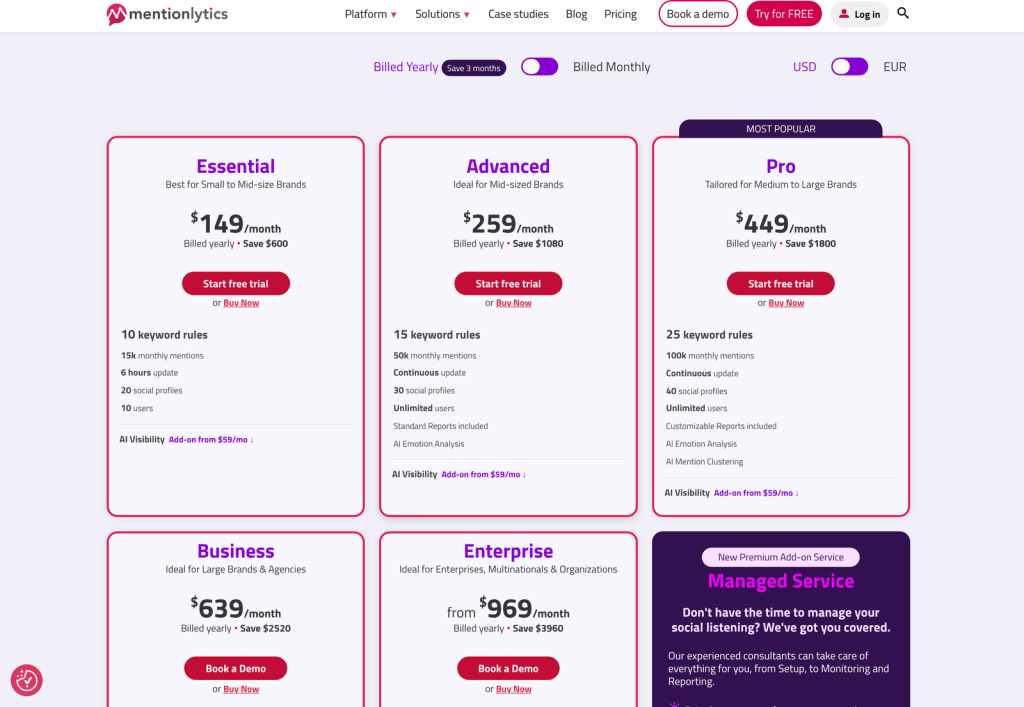
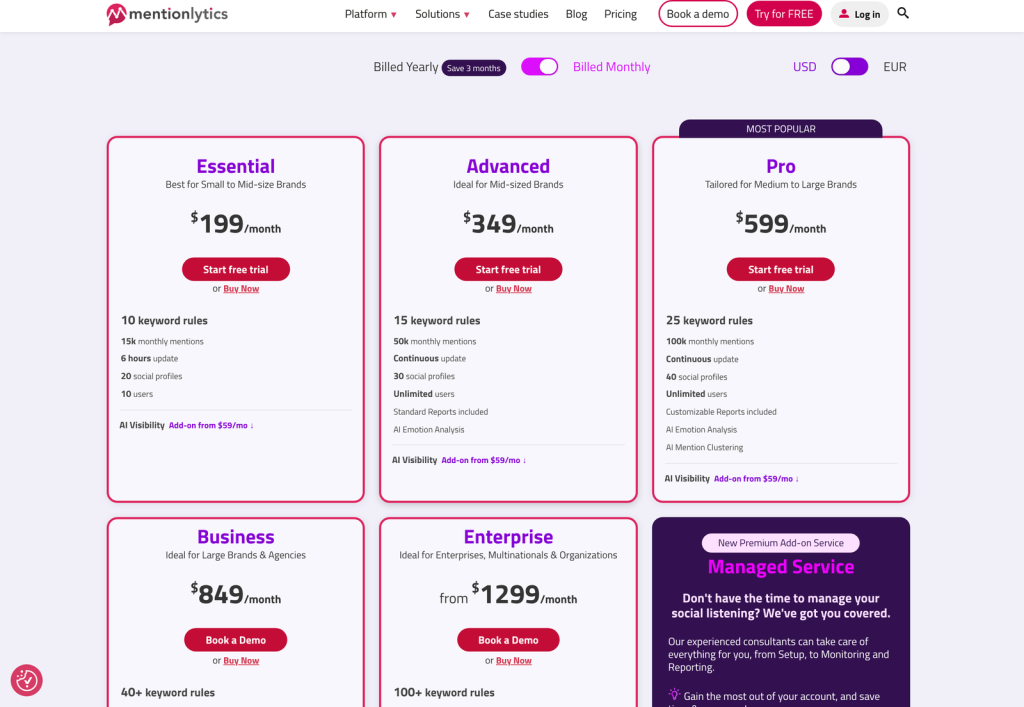
We clicked the switch and captured the other state. The cards redraw to $199, $349 and $599, and the small “Save $600” style lines vanish, because there is nothing left to save.
There is a second control to the right of the billing switch offering USD or EUR. Everything below is captured in USD. A currency selector moves the figures, so if you are reading euro prices your ladder will not match this one.
The full ladder, monthly first
Prices below are the month-to-month rates, because that is what you pay if you do not sign for a year. The annual equivalent follows in the notes.
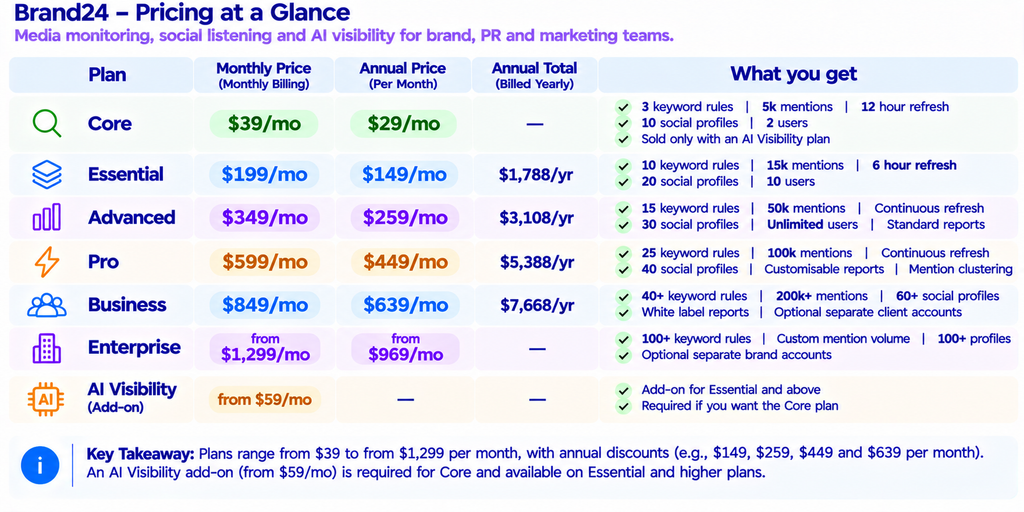
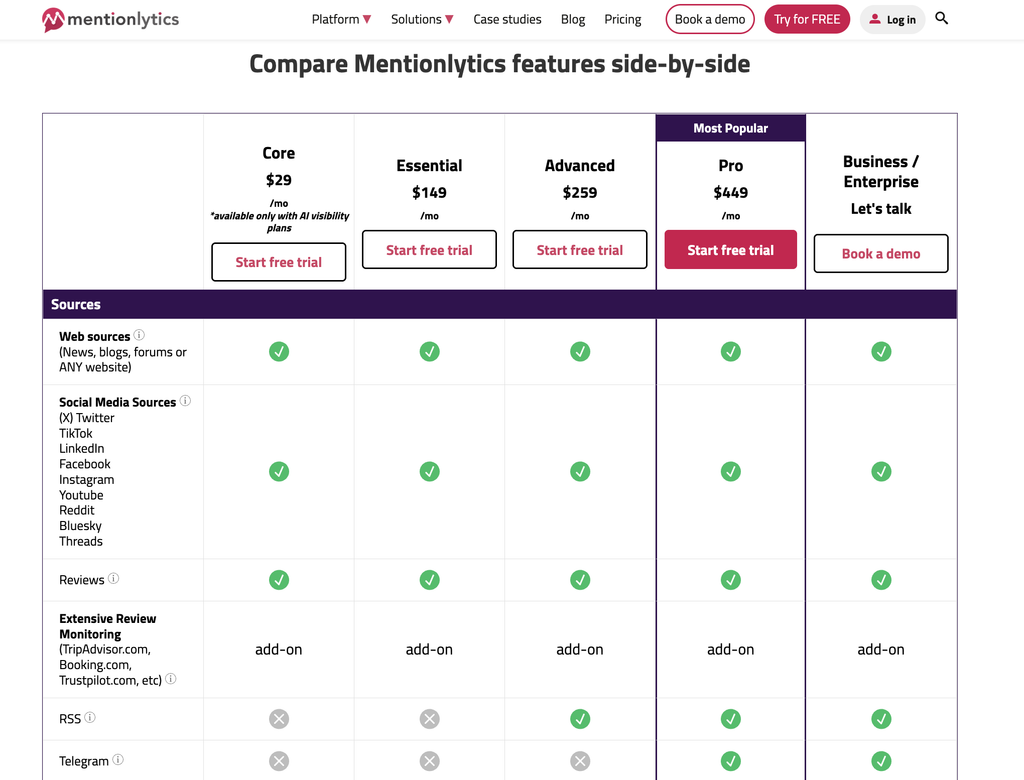
Business and Enterprise carry “Book a Demo” buttons on their cards, and the feature comparison table lower down collapses both into a single “Let’s talk” column. The card prices are still printed, so these are published rates rather than pure quote-only tiers.
Checking the “save three months” claim
Badges like this usually overstate. This one does not.
Take Essential. Twelve months at the annual rate costs 12 x $149, or $1,788. Nine months at the monthly rate costs 9 x $199, or $1,791. The difference across a full year is three dollars, so “save three months” describes the deal accurately rather than approximately.
Each annual card also prints an explicit saving, and those reconcile exactly. Essential shows “Save $600”, and 12 x ($199 minus $149) is $600. Advanced shows $1,080 against a $90 monthly gap. Pro shows $1,800 against $150. Business shows $2,520 against $210. Enterprise shows $3,960 against $330. Five tiers, five clean matches, which is rarer than it should be.
Core breaks the pattern. Its card reads “Save $29”, yet the gap between $39 and $29 is ten dollars a month, which would be $120 over a year. We cannot reconcile that badge with its own arithmetic, so treat the Core saving figure as unreliable and the two rates as the reliable part.
Core is not the entry tier it looks like
At $39 a month, Core reads like the obvious starting point for a small brand. It is not available on its own.
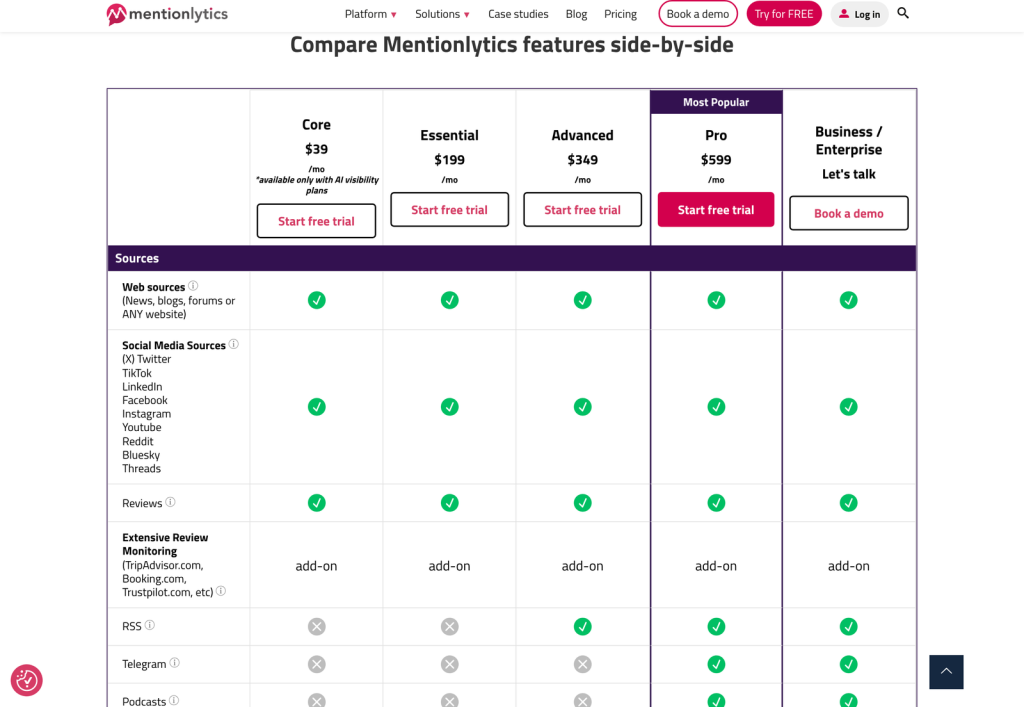
In the feature comparison table, the Core column carries a footnote in italics directly under the price: available only with AI visibility plans. Core also does not appear as a card in the main plan grid on a desktop viewport. You find it in the comparison table and nowhere else. Since the AI Visibility add-on starts at $59 a month, the realistic floor for a Core subscription is $39 plus $59, which is $98 a month, and that is more than half of Essential while giving you three keyword rules instead of ten.
What you are actually renting
Three dials set the price, and they are not equally important.
Keyword rules are the searches you run. One brand name, one misspelling, one competitor, and one campaign hashtag already uses four of your ten on Essential. Agencies burn through rules faster than volume.
Monthly mentions are the results those rules collect. Essential allows 15,000. Advanced jumps to 50,000, Pro to 100,000.
Refresh interval is how often the system goes looking. Core checks every twelve hours. Essential halves that to six. Advanced and everything above it update continuously. If your reason for buying a listening tool is catching a problem before it spreads, a six-hour window is the difference between a reply and an apology, and continuous monitoring starts at $349 monthly or $259 annually.
Cost per thousand mentions, which is the number that matters
Dividing price by volume exposes something odd about the ladder. At annual rates:
- Core: $29 for 5,000 mentions, so $5.80 per thousand
- Essential: $149 for 15,000, so $9.93 per thousand
- Advanced: $259 for 50,000, so $5.18 per thousand
- Pro: $449 for 100,000, so $4.49 per thousand
- Business: $639 for 200,000, so $3.20 per thousand
Essential is the worst value per mention on the entire ladder. It costs nearly twice per thousand what the tier above it costs, and almost double Core. The curve is supposed to slope downward as you buy more, and here it spikes in the middle.
Read that as a signal about who Essential is for. You are not paying for volume at that rung; you are paying for the ten keyword rules and the twenty social profiles. A business tracking one brand across many channels gets its money’s worth. A business tracking one brand in one noisy category does not, and should look at whether Advanced at $110 more a month solves the problem properly.
The upgrade arithmetic supports that. Moving from Essential to Advanced costs an extra $110 a month on annual billing and buys 35,000 additional mentions, five more keyword rules, ten more social profiles, continuous refresh, and unlimited users. Those extra mentions alone work out at $3.14 per thousand, which is cheaper than any tier’s headline rate.
The seat cliff nobody mentions
Essential includes ten users. Advanced includes unlimited users. There is no middle option and no published per-seat add-on.
A marketing team of nine fits Essential comfortably at $149 a month on annual billing. Hire two more people, and you are out of seats. The only route forward is Advanced at $259, so those two logins cost $110 a month between them, or $1,320 a year. That is $660 per seat annually for people who may only ever read a dashboard.
The compensation is real, since you also get continuous refresh and 35,000 extra mentions. Knowing the cliff exists before you plan headcount is still better than discovering it in month seven.
Which sources your money unlocks
The comparison table gates data sources by tier, and the gating is not where you would guess.
Web sources, meaning news, blogs, forums, and any website, are included on every plan, including Core. So are the social platforms: X, TikTok, LinkedIn, Facebook, Instagram, YouTube, Reddit, Bluesky and Threads. Basic review coverage is also universal.
Then the gates start. RSS appears on Advanced and above, so Core and Essential subscribers cannot pull a feed. Telegram and podcasts appear only on Pro and above. If podcast mentions matter to your category, your entry price is $599 a month or $449 annually, and no amount of mention volume at a lower tier will substitute.
Extensive Review Monitoring, which is the one covering TripAdvisor, Booking.com and Trustpilot, is marked “add-on” in every single column. Enterprise does not include it. A hotel group cannot buy its way to review coverage by climbing tiers, which matters because hospitality is one of the industries Mentionlytics markets to directly.
Why listening tools price this way at all
Metering mentions looks arbitrary until you look at what the vendor pays upstream.
X documents its v2 API as pay-per-usage. Its usage and billing page describes a credit model where you buy credits in advance, and they are deducted as you call the API, with different endpoints costing different amounts and billing tracked per app. Pay-as-you-go plans are capped at three million post reads a month before you need an enterprise agreement. One detail is particularly relevant to refresh intervals: X deduplicates daily, so retrieving the same post twice in one day counts once, but retrieving it again tomorrow costs again.
Continuous monitoring therefore costs a vendor more than a twelve-hour sweep, not because each call is dearer, but because a tool watching all day crosses more daily boundaries and touches more unique posts. The refresh interval on your plan card is a direct pass-through of someone else’s metered bill.
Meta applies a different shape of constraint. Its Graph API rate limiting documentation splits requests into platform rate limits and business use case rate limits, and states that once a limit is reached, further calls simply fail with an error code until enough time passes for the count to drop. That is a hard ceiling rather than a meter, which is why social profile counts appear as a separate dial from mention volume on the pricing page.
Add-ons, and what sits outside the ladder
AI Visibility is the prominent one, advertised from $59 a month on Essential, Advanced, Pro, Business and Enterprise cards alike. It tracks how a brand appears inside large language model answers, covering sentiment, share of voice, and the citations behind those answers. The word “from” is doing work in that price, and the page does not publish an upper bound.
Managed Service is the other. Mentionlytics will run setup, monitoring, and reporting with its own consultants, and the page states this can be added to Pro and higher plans only. No price is published. Anyone below Pro cannot buy it regardless of budget.
Picking a tier without overbuying
Work from your constraints rather than your budget.
Choose Essential if you have fewer than ten people, under 15,000 mentions a month, and a six hour refresh is acceptable. That last condition rules out crisis work and most consumer brands with an active complaints channel.
Choose Advanced if any of three things is true: you need continuous updating, you have more than ten users, or you want RSS. At $259 a month on annual billing it is also the point where cost per mention starts behaving sensibly.
Choose Pro if you need Telegram, podcasts or mention clustering, or if your reporting has to be customisable rather than standard.
Choose Business if you are an agency. White label reports and optionally separate client accounts are the two features that make reselling possible, and neither appears below that tier.
Worth comparing against a direct rival before you commit. Our Brand24 pricing breakdown covers a tool aimed at much the same buyer, and the Brand24 review goes through how its own mention quotas behave in daily use.
What we could not verify
Honesty about gaps is more useful than a tidy article.
The pricing page claims an exceptional 4.9 out of 5 star rating on G2 and displays a row of G2 badges. G2 refused our request, so that figure is vendor-reported and we have not confirmed it independently. The badges visible on the page are labelled Spring 2025, which is not the same thing as a current score.
No annual total is published for Enterprise, since its monthly figure is prefixed “from”. The $11,628 a year implied by $969 across twelve months is our arithmetic on a floor price, not a quoted contract value. Business and Enterprise mention allowances are written as “200k+” and “Custom”, so the per thousand figures for those tiers are ceilings on cost rather than precise rates. The Core saving badge, as covered above, does not reconcile. We also found no public page defining exactly what counts as one mention, which is the single most useful definition a buyer could have.
All prices here were captured on 26 November 2026 in USD, in both toggle states, from the vendor’s own pricing page. Check the page before you buy, because the one thing every pricing article has in common is an expiry date.
Frequently asked questions
Does Mentionlytics have a free plan?
No free tier appears on the pricing page. Every plan card offers “Start free trial” instead, and Business and Enterprise offer a demo booking alongside it. The trial length is not stated on the pricing page.
What is the cheapest Mentionlytics plan you can actually buy?
Essential at $199 a month, or $149 a month on an annual commitment. Core is cheaper on paper at $39, but the comparison table states it is available only with AI visibility plans, and that add-on starts at $59 a month.
How much does annual billing save?
Close to a quarter. The published savings are $600 on Essential, $1,080 on Advanced, $1,800 on Pro, $2,520 on Business, and $3,960 on Enterprise, each equal to twelve times the monthly gap. Twelve months on annual billing costs roughly what nine months of month-to-month billing costs.
Which plan gives real-time monitoring?
Advanced and above. Core refreshes every twelve hours and Essential every six. Advanced, Pro, Business and Enterprise all list continuous updating.
Can I monitor TripAdvisor and Trustpilot reviews?
Only by buying an add-on. Extensive Review Monitoring is marked as an add-on in every plan column, Enterprise included. Basic review monitoring is included everywhere, but the named review sites sit outside the tier ladder.
Is there a per-user charge?
None is published. Seats come bundled: two on Core, ten on Essential, and unlimited from Advanced upward. Growing past ten users means moving to Advanced rather than buying extra logins.
Ready to look at it yourself? Start a Mentionlytics trial and check the toggle before you check the price.