



Apollo lists four plans on one page, and the page does not open on the price most people expect. The annual toggle is preselected. Switch it and every paid number moves.
Disclosure: Stack99 earns a commission if you buy through links on this page. It costs you nothing extra and never changes our assessment.
The two prices Apollo shows you
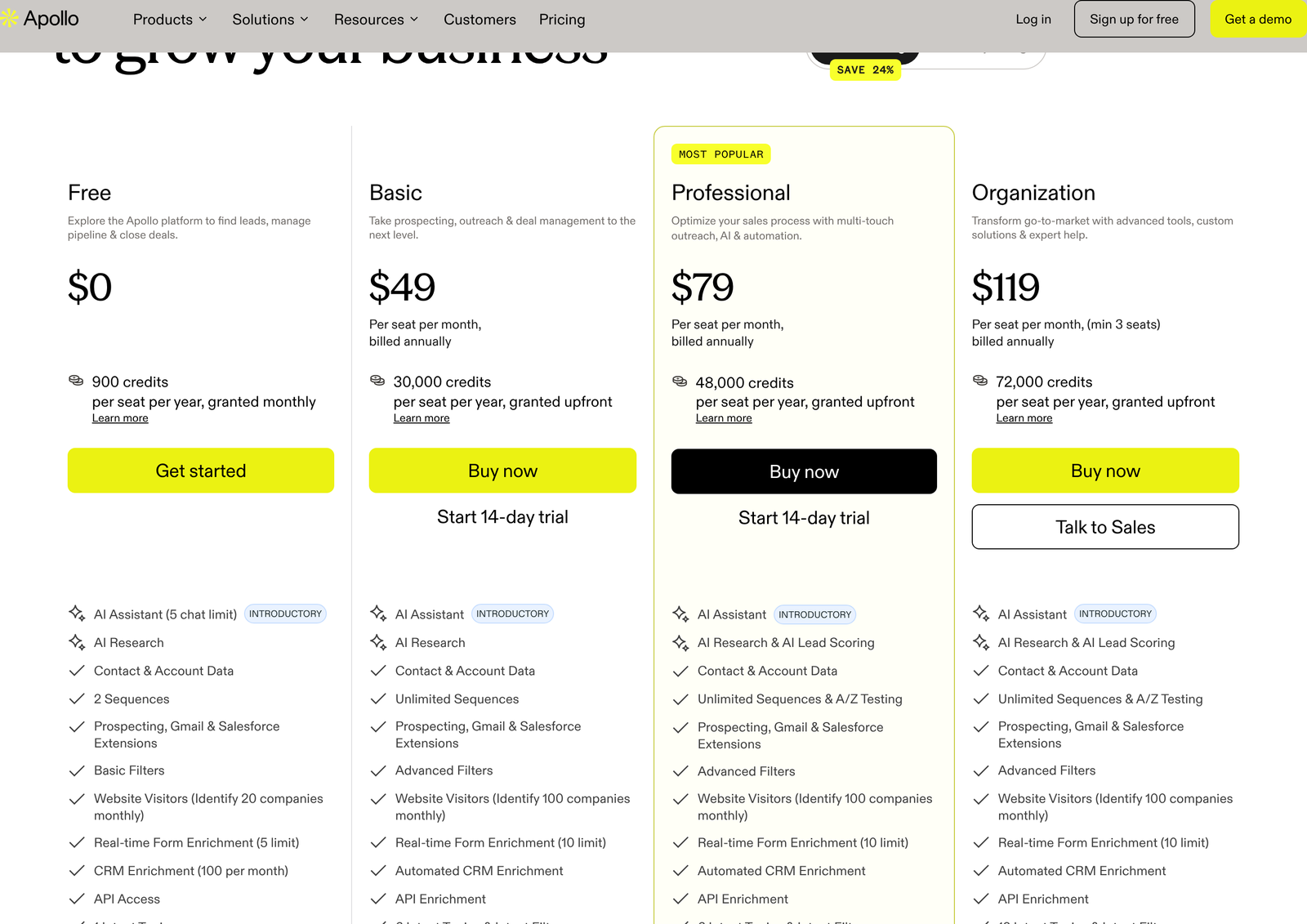
Load apollo.io/pricing and a yellow badge reading SAVE 24% sits next to the billing switch. The switch is already set to annual. Four cards follow: Free at $0, Basic at $49, Professional at $79, and Organization at $119, each one carrying the line “Per seat per month, billed annually” in small type under the figure.
Click Monthly billing and the four cards redraw. Free stays at $0. Basic becomes $65. Professional becomes $99. Organization becomes $149 and picks up a second line of small type that reads “Annual Only”, which is worth pausing over and which we come back to below.
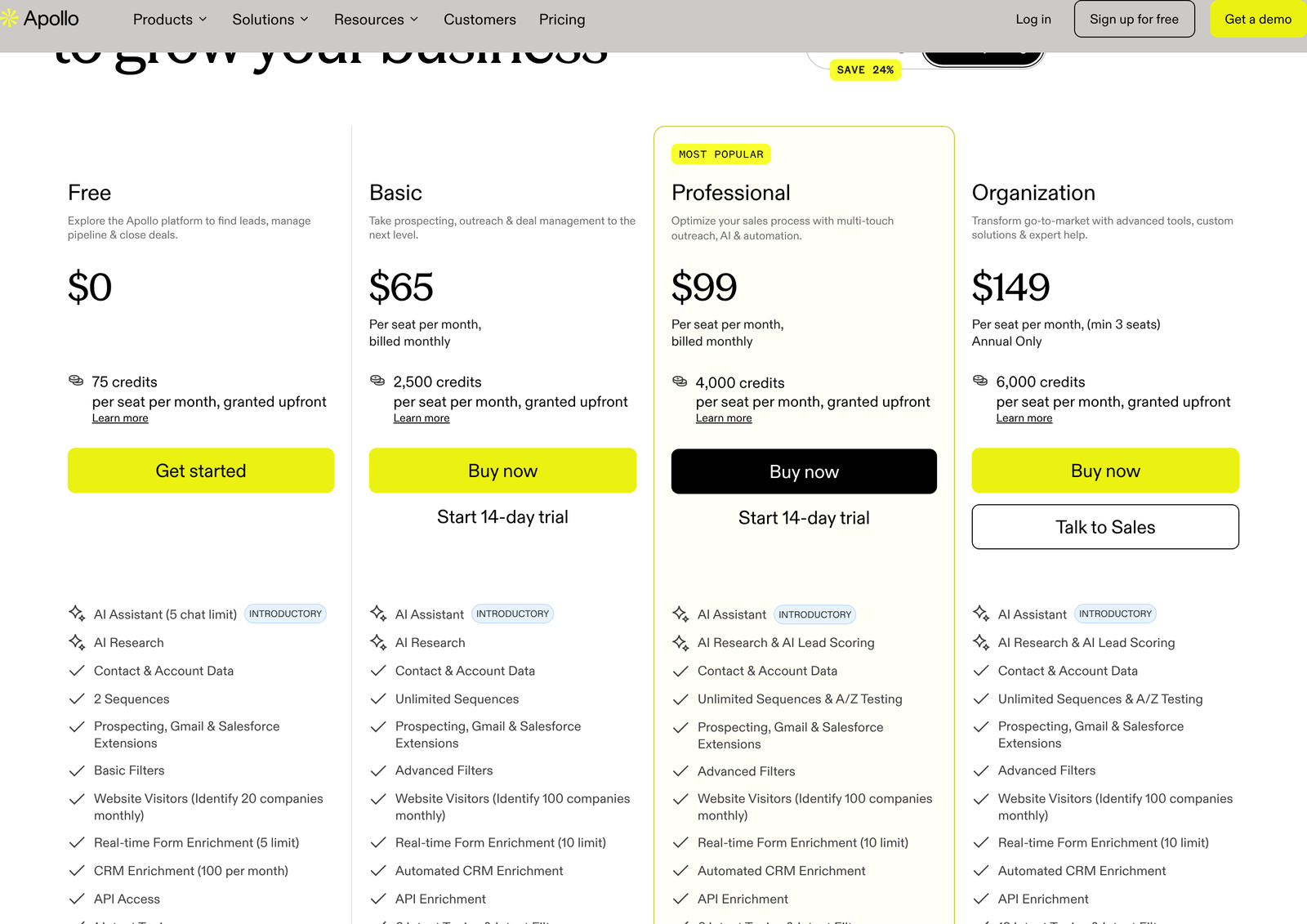
Neither screen is hiding anything. The small type is accurate on both. But a reader who skims the cards without noticing which way the switch is set walks away with a number that is 20 to 25 percent below what a month-to-month subscription actually costs, and that gap compounds across a team.
Apollo pricing per seat: monthly vs annual
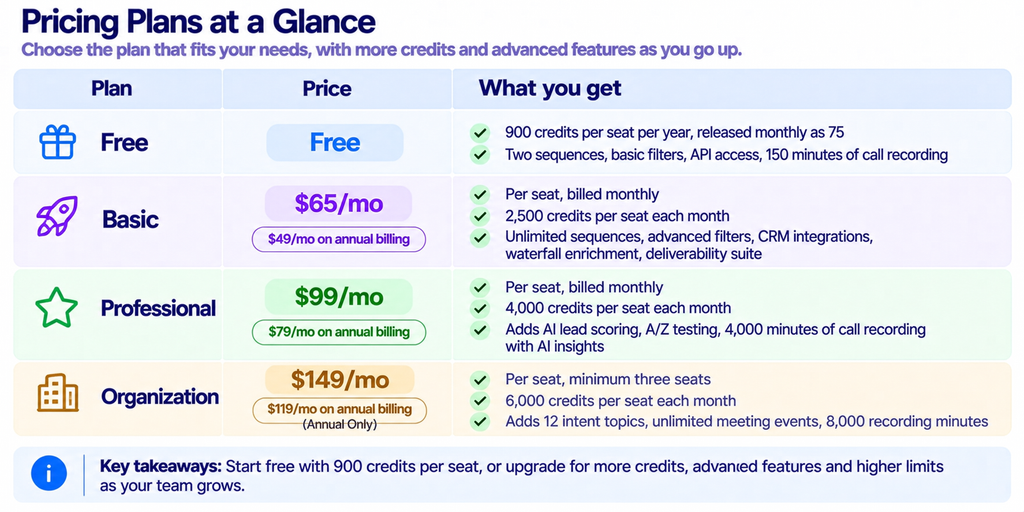
Prices exclude applicable taxes. Apollo also labels the current rates introductory and notes that features and pricing may change, so treat any figure here as a snapshot taken on 23 November 2026 rather than a contract.
What the annual commitment is actually worth
Run the subtraction per tier, and the SAVE 24% badge turns out to describe one plan rather than all of them.
- Basic: $65 falls to $49, a saving of $16 per seat per month, or 24.6 percent.
- Professional: $99 falls to $79, worth $20 per seat per month, or 20.2 percent.
- Organization: $149 falls to $119, worth $30 per seat per month, or 20.1 percent.
The badge matches Basic almost exactly and overstates the other two by about four points. Annualised, one Basic seat costs $588 instead of $780, a $192 difference. One Professional seat costs $948 instead of $1,188, a difference of $240. One Organization seat costs $1,428 instead of $1,788, a difference of $360.
Five Professional seats on annual billing come to $4,740 for the year. The same five on monthly come to $5,940. You are deciding whether $1,200 is worth a twelve-month lock, and that is a cash flow question more than a software question.
Credits do not change with the toggle
Here is the part the two screens obscure. On annual billing, the cards quote credits per year: 30,000 for Basic, 48,000 for Professional, 72,000 for Organization, all granted upfront per seat. On monthly billing, the same cards quote 2,500, 4,000, and 6,000 per seat per month.
Divide, and the two sets are identical. 30,000 over twelve months is 2,500 a month. 48,000 is 4,000. 72,000 is 6,000. Switching to annual does not buy a single extra credit. It buys the same allocation at a lower price, with one difference in how you may spend it.
The difference is the expiry window
Apollo’s credits explainer states that credits expire at the end of each billing cycle and do not roll over into the following cycle or upon renewal. On an annual plan, every credit is unlocked at the start of the annual cycle. On a monthly plan, your 2,500 arrive at the start of the month and are gone at the end of it.
That changes how a lumpy workload behaves. A team that enriches a 20,000-row list in January and barely touches Apollo in February is fine on an annual Basic seat and badly served on a monthly one, where January’s ceiling is 2,500 and February’s unused 2,500 evaporates. Steady daily prospecting at a flat rate does not care either way.
What one credit buys
Apollo publishes two prices for data, and they are not close to each other.
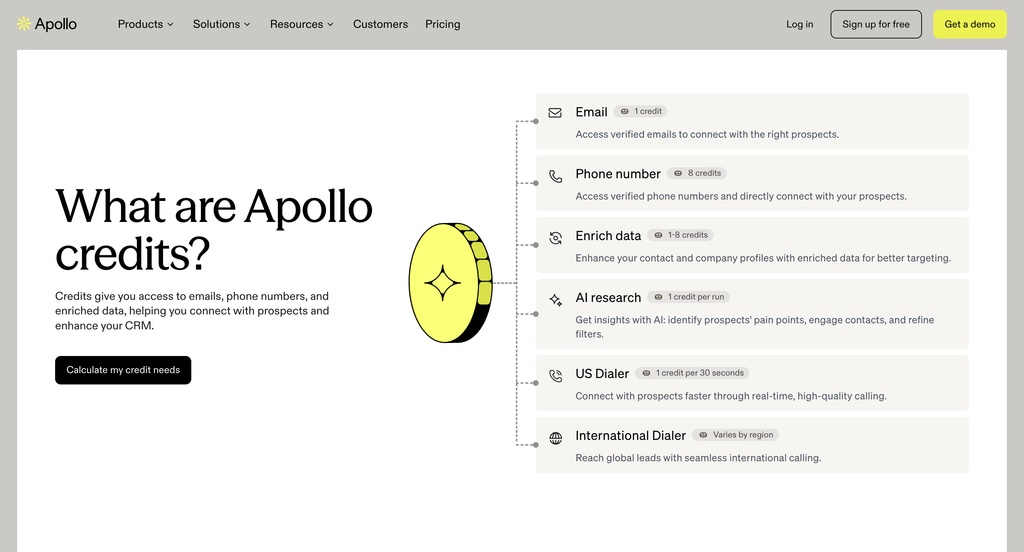
- An email address costs 1 credit. That covers a contact’s personal address, business address, or both, and Apollo says it never charges more than one credit per contact.
- A phone number costs 8 credits. Mobile, direct dial, and office extension all cost the same.
- You are only charged for email addresses Apollo can verify.
- Credits are sometimes consumed when exporting company data, and Apollo reserves the right to attach credit costs to future features.
Eight to one is a steep ratio, and it is the single biggest variable in what Apollo costs you. A Basic seat on annual billing holds 30,000 credits a year. Spend them entirely on emails, and you get 30,000 contacts. Spend them entirely on phone numbers, and you get 3,750. Most teams land somewhere in between, but a calling-led team burns a seat’s annual allocation roughly eight times faster than an email-led one.
Cost per credit is almost flat across the paid tiers
Divide annual seat cost by annual credits and the three paid plans converge.
- Basic: $588 for 30,000 credits, or 1.96 cents each. A verified email costs about 2 cents, a phone number about 15.7 cents.
- Professional: $948 for 48,000 credits, or 1.98 cents each. Phone number: about 15.8 cents.
- Organization: $1,428 for 72,000 credits, or 1.98 cents each. Phone number: about 15.9 cents.
Within two hundredths of a cent, you pay the same for data, whichever paid plan you sit on. Moving up a tier does not make records cheaper. It raises the volume ceiling and unlocks features. Anyone upgrading in the hope of a bulk discount on data is buying something else and calling it a discount.
Monthly billing lifts the same arithmetic to roughly 2.6 cents a credit on Basic and 2.5 cents on the other two, which is the annual discount showing up in a different unit.
The Organization tier and its minimum
Organization carries a three-seat minimum. At the annual rate, that is $357 a month, or $4,284 a year, before any add-on. The allocation at that size is 216,000 credits a year across the three seats.
Flip to monthly and the Organization card shows $149 with the words “Annual Only” directly beneath the seat minimum. Read plainly, Apollo is displaying a monthly equivalent rate for a plan it does not sell month to month. We could not confirm from the public page whether a true month-to-month Organization subscription exists, so treat $149 as a comparison figure rather than a purchasable rate, and ask sales before budgeting around it. Organization is also the only paid tier whose card offers Talk to Sales rather than a trial button.
Add-ons sit outside the seat price
Two add-ons are published with prices, and both are charged per team rather than per seat, which makes them cheap at scale and expensive for a pair of reps.
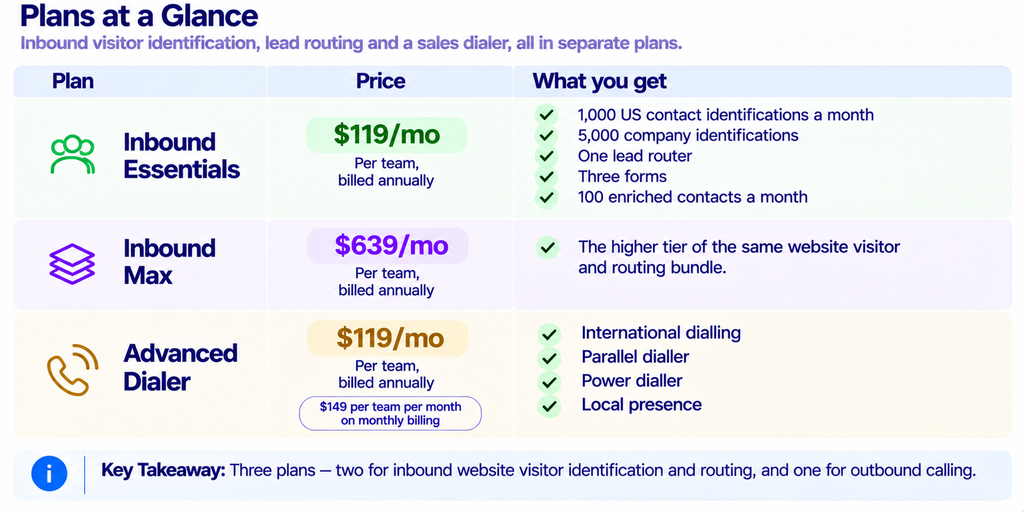
Apollo requires you to select a paid plan first and attach add-ons in the app afterwards, so none of this is available to a free account. A three-seat Organization team that wants the Advanced Dialer is looking at $4,284 plus $1,428, which is $5,712 a year. The dialler adds a third again to the bill.
Note also that the US dialler on Basic and Professional is marked “credits apply”. Calls draw on the same pool that funds your data lookups, so heavy calling competes directly with enrichment for the same budget.
What the free plan is good for
Free gives 900 credits per seat per year, released at 75 a month. Seventy-five credits buy 75 verified emails, or nine phone numbers, or a mix of the two. You also get two sequences, basic filters only, the Chrome and Gmail extensions, API access, 150 minutes of call recording, and website visitor identification capped at 20 companies a month. The AI assistant is limited to five chats.
A monthly allowance that small is enough to check whether Apollo’s data covers your market and nothing more. A single afternoon of serious prospecting exhausts it. Treat the free tier as an evaluation sandbox rather than a working plan, and use the 14-day trial on Basic or Professional when you want to test at realistic volume.
Picking a tier without guessing
Work backwards from credits rather than from the feature list, because credits are what run out.
Choose Basic if:
Your team prospects mostly by email, needs unlimited sequences and CRM sync, and can live inside 2,500 contacts per seat a month. Waterfall enrichment, the deliverability suite and automated workflows are already here, capped at five workflows. Lead scoring is limited to two scores, and there is no A/Z testing.
Choose Professional if:
You want AI lead scoring without a cap, A/Z testing on sequences, and call recording that comes with AI insights rather than raw minutes. The jump from 150 to 4,000 recording minutes is the largest single change between the two plans. Credits rise by 60 percent while price rises by 61 percent on annual, so the upgrade is close to credit-neutral, and you are paying for the features.
Choose Organization if:
You have at least three seats, you want 12 intent topics rather than six, and unlimited meeting events matter to how your reps book. Recording minutes double again to 8,000. The three-seat floor means this tier never costs less than $4,284 a year.
One more sizing rule. If your reps dial, multiply your expected monthly phone lookups by eight before comparing against the credit allowance. Two hundred phone numbers a month is 1,600 credits, which already consumes most of a Basic seat before a single email is enriched.
A worked example: four SDRs who dial
Abstract credit ceilings are hard to judge, so put numbers on a team. Four SDRs, each expected to add 400 new contacts a month and reach 150 of them by phone.
Per rep per month: 400 emails at one credit each is 400 credits. 150 phone numbers at eight credits each is 1,200 credits. Total: 1,600 credits per rep, 6,400 across the team.
Basic allows 2,500 per seat, so each rep has 900 credits of headroom and the plan holds. Seat cost on annual billing is 4 x $49, or $196 a month and $2,352 a year. Now raise the calling target to 250 numbers per rep. Phone spend climbs to 2,000 credits, total demand to 2,400, and the margin shrinks to 100 credits a rep before anyone runs a bulk enrichment. At 300 numbers, the team is over the Basic ceiling and either buys extra credits or moves to Professional at $79 a seat, which costs another $1,440 a year and lifts the allowance to 4,000.
Notice what drove the upgrade. Nobody needed A/Z testing or unlimited lead scoring. The dial target did it, because the eight-to-one ratio turns a modest calling quota into the largest line in the credit budget. Model your phone volume first, and the plan choice usually answers itself.
What Apollo does not publish
Several things a buyer would want are absent from the public page, and we are not going to guess at them.
- The price of extra credits bought mid-cycle. Apollo confirms you can add credits from the plan subscription page in the app, but the rate is not published.
- Whether a genuine month-to-month Organization plan can be bought at all, given the Annual Only label.
- Per-minute or per-number charges for the US dialer beyond the note that credits apply.
- Any volume discount at higher seat counts, which is the sort of thing the Talk to Sales button exists for.
Apollo does ship a credit calculator on the pricing page that takes your team size, usage, and goals and recommends a plan. Use it before you commit to a year, because the credit ceiling is the constraint that bites first.
Frequently asked questions
Does Apollo charge per seat or per company?
Per seat for the plans themselves, and per team for the Inbound and Advanced Dialer add-ons. A five-person team on Professional annual pays 5 x $79 a month. Adding the dialer adds a single $119, not five.
Do unused Apollo credits roll over?
No. Apollo states that credits expire at the end of each billing cycle and do not carry into the next one or survive a renewal. Annual plans release the full year’s credits at the start of the cycle, which gives you twelve months to use them rather than one.
How much does a phone number cost on Apollo?
Eight credits, whether it is a mobile, a direct line, or an extension. At Basic annual rates, that works out to roughly 15.7 cents per number. At Basic monthly rates, it is roughly 20.8 cents.
Is the free plan enough to evaluate Apollo?
It is enough to judge data coverage in your market and to see how the interface works. Seventy-five credits a month will not support a live campaign. For a realistic test, take the 14-day trial on Basic or Professional.
Why does the pricing page show different numbers each time I visit?
It does not change on its own. The page loads with annual billing preselected, and the toggle resets on a fresh visit. If a figure looks higher than you remember, check which side of the switch is active before assuming a price rise.
Can I buy Apollo for one seat?
Yes, on Free, Basic, and Professional. Organization carries a three-seat minimum.
The short version
Apollo’s annual discount is real and is worth between 20 and 25 percent depending on tier, with Basic getting the best of it. The thing to check before signing is not the seat price. It is whether 2,500, 4,000, or 6,000 credits a month survives contact with how your team actually prospects, because a dialling team spends eight credits where an emailing team spends one, and nothing you do not use carries forward.
You can start on Apollo’s free plan or take a 14 day trial here and run the credit calculator against your own numbers before committing to twelve months.
Related reading on Stack99: our Apollo.io review, a walkthrough of Apollo’s top features, and an advanced guide for teams already running sequences.
Sources
- Apollo pricing page, both billing states, checked 23 November 2026.
- What are Apollo Credits?, Apollo’s own credit cost and expiry documentation.