


Disclosure: Stack99 earns a commission if you buy through links on this page. It costs you nothing extra and never changes our assessment.
Deel’s integration story is told in three different places that never reference each other. There is a consumer-facing marketplace, a set of HRIS and identity sync capabilities, and a developer portal that most buyers never open. Each one answers a different question, and the marketplace alone will mislead you about what the platform can do.
Everything below was read off Deel’s own marketplace and its public developer documentation on 24 November 2026.
The marketplace: 200+ apps, 17 categories
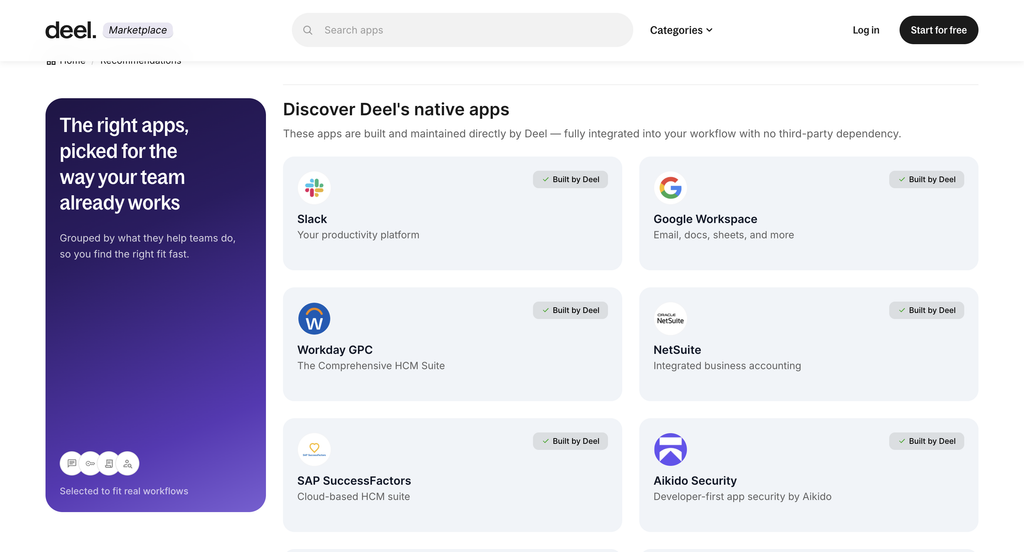
The header on Deel’s marketplace reads “Browse 200+ integrations and connect your favorite tools to Deel in minutes.” Seventeen categories are listed in the sidebar, split into a Top group and a Featured group.
- Top categories: Human Resources, Accounting, Recruiting and Applicant Tracking, App Provisioning and SSO, Automation and Productivity, Expense Management, Time and Attendance.
- Featured categories: Collaboration, Calendar, Equity, Learning Management, Performance Management, Endpoint Protection, SFTP, Discount.
- Two more sit outside both lists: Retirement and Software Resale.
SFTP as a marketplace category is unusual and tells you something about Deel’s customer base. Payroll data moving to a bank or a local provider still travels that way in plenty of countries, and a vendor that lists SFTP alongside Slack is being honest about what global payroll involves.
Who built the integration you are about to rely on
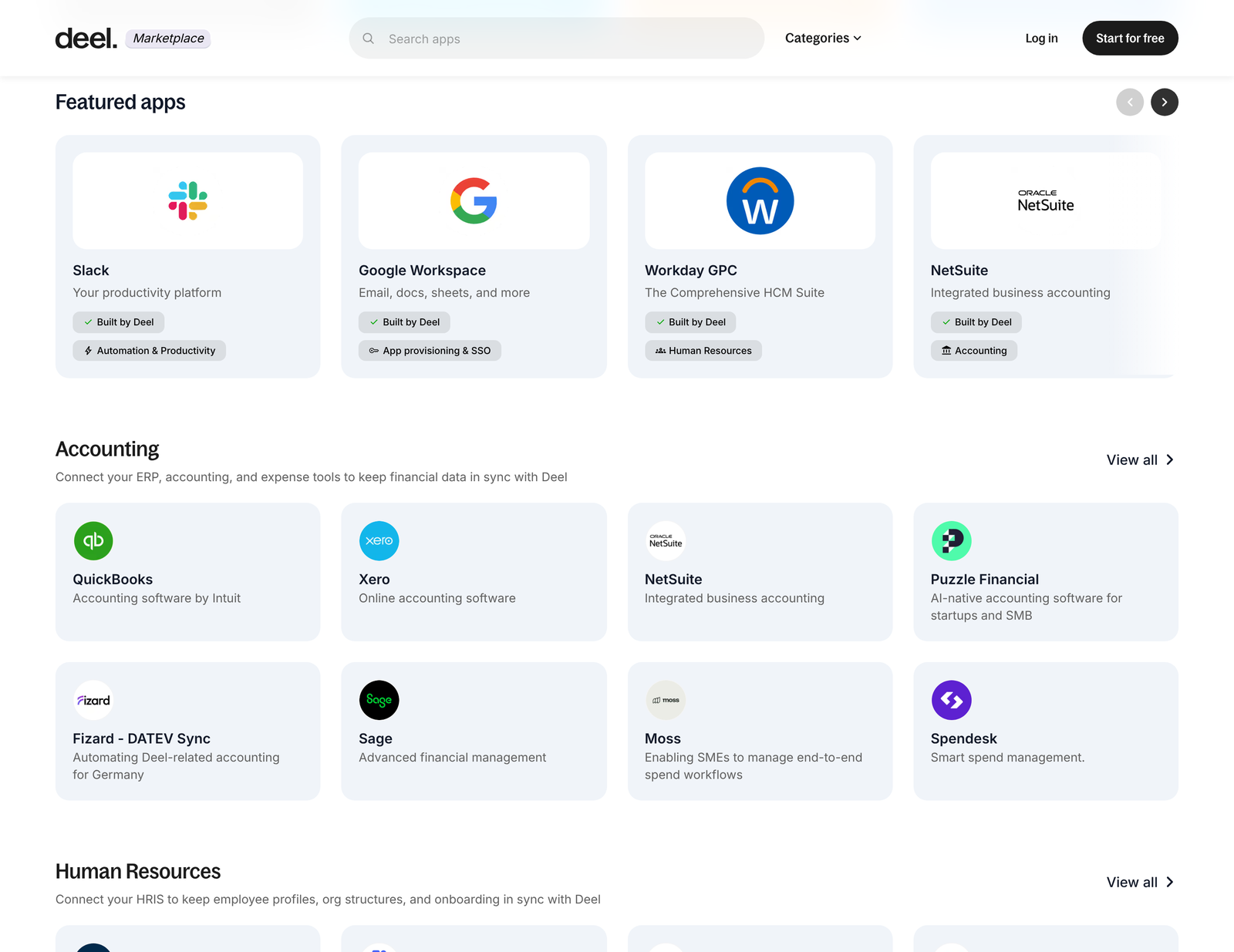
This distinction decides who fixes the integration when it breaks. A first-party connector is Deel’s problem. A partner-built one is the partner’s, and your support ticket travels further.
Counting the badge across both curated rows on the marketplace front page gives nine distinct apps.
- Slack, described as “your productivity platform”.
- Google Workspace, under App provisioning and SSO.
- Workday GPC, under Human Resources.
- SAP SuccessFactors, also Human Resources.
- NetSuite, QuickBooks, and Xero, all Accounting.
- Calendar, which syncs Deel events to your calendar tool.
- SAML 2.0 Connect, a generic SSO connector.
Read that list as a statement of priorities. Deel builds and maintains the plumbing to the systems that hold money and identity, which is to say accounting ledgers, HR systems of record, and single sign-on. Everything else is somebody else’s code.
The gap in the interface is the real finding. Browse into the Accounting category and the same NetSuite, QuickBooks and Xero cards appear without any badge at all. A buyer evaluating thirty apps has no way to filter by who maintains them, and no indication on an individual card. Nine out of 200-plus is a small first-party footprint, and the marketplace does not help you see it.
What sits in the categories that matter
Four categories carry most of the weight for a company evaluating Deel. Here is what the marketplace listed in each on the day of writing.
Accounting. QuickBooks, Xero, NetSuite, Puzzle Financial, Fizard for DATEV sync in Germany, Sage, Moss and Spendesk. The category blurb promises to “keep financial data in sync with Deel”, and the DATEV entry is a good sign for anyone operating a German entity, since DATEV compatibility is a hard requirement there rather than a nice extra.
Human Resources. Human Interest, Pave, BambooHR, Hofy, HiBob, Personio, Workday GPC and Employee Navigator. Personio and HiBob cover European mid-market HR well, and Human Interest handles US 401(k).
Recruiting and Applicant Tracking. Pro5, Webstarted, Hitch, JobzMall, FloCareer, Pangea, Greenhouse and Ashby. Greenhouse and Ashby are the recognisable names; the rest are staffing marketplaces rather than classic ATS products. Deel describes this category as triggering contracts and onboarding the moment a candidate is hired.
Automation and Productivity. Slack, JumpCloud, Google Workspace, Puzzle Financial, Hubstaff, CrowdStrike, Time Doctor and Microsoft. Hubstaff and Time Doctor appearing here rather than under Time and Attendance is a quirk of Deel’s own taxonomy, and a reminder to search rather than browse.
The joiner and leaver problem
Between the marketplace and the raw API sits the capability most buyers are actually shopping for, and Deel documents it as HRIS and identity sync rather than as an app.
Deel’s developer docs describe two-way sync with your identity provider or HRIS, phrased as making sure a new hire shows up everywhere they need to, and a leaver disappears just as cleanly. SCIM appears in the authentication documentation as one of the things an organisation token is meant for, which places provisioning on the server-to-server side rather than inside a marketplace connector.
Why this matters more than a Slack notification: offboarding is where cross-border employment goes wrong. Someone leaves an EOR arrangement in one country, their contract terminates in Deel, and their access to email, the VPN, and the code repository should end on the same day. Doing that by hand across six systems is how dormant accounts survive for months.
Three of the nine first-party integrations serve this directly. Google Workspace and SAML 2.0 Connect handle identity, while Workday GPC and SAP SuccessFactors keep the system of record aligned. JumpCloud appears in the catalogue as well, though without a badge.
What the public documentation does not settle is how much of this works without engineering. The phrase “two-way sync” covers everything from a configuration screen to a project. Ask for a demonstration against your own identity provider before you assume it is a setting.
Software Resale is a different kind of integration
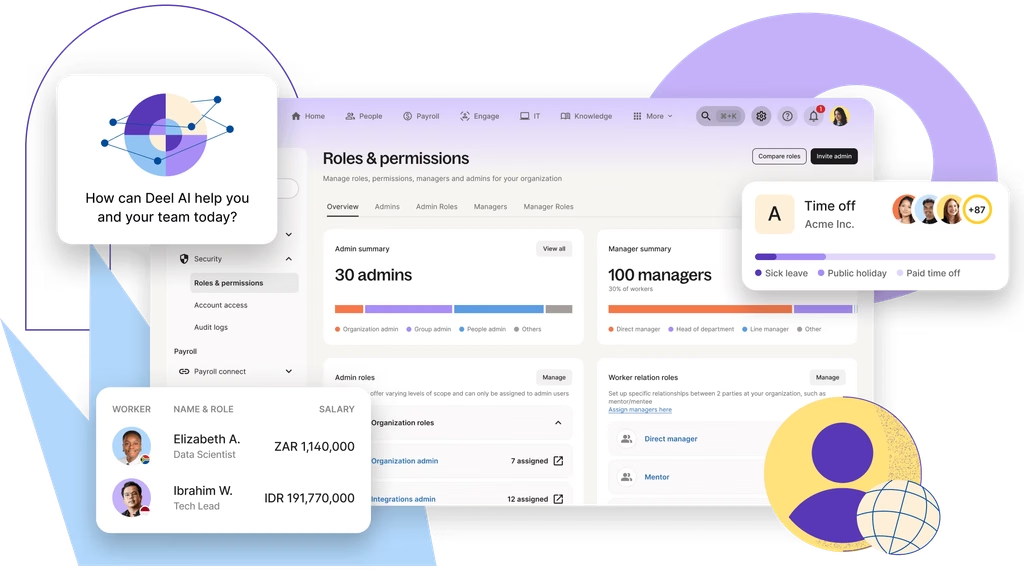
Most marketplace categories connect Deel to software you already pay for. Software Resale does the opposite: Deel sells you the licence. The page describes it as buying third-party software “bundled, billed, and managed in one place”.
Eight products were listed, with the sidebar indicating five more: Google Workspace, CrowdStrike, JumpCloud, Microsoft 365, Aikido Security, NordLayer, Proofpoint Essentials and Scrut Automation.
The logic is clear enough for a company hiring through an employer of record in six countries. You already have Deel issuing contracts and paying people; letting it also provision the laptop security and the VPN removes a procurement cycle. The trade is concentration. Payroll, contracts, device security, and identity all land on one vendor relationship, and unwinding that later is a bigger project than cancelling a subscription.
No prices are published for any resold product on the marketplace page, so budget for a conversation rather than a checkout.
One integration checked from the other side
Vendor marketplaces describe their own work generously. Xero runs an independent app store with its own reviews, which makes the Deel listing there a useful cross-check.
The Deel listing on the Xero App Store has been live since February 2021 and holds an aggregate 4.12 out of 5 from 8 reviews. The review count is small, so treat the score as weak evidence either way.
The mechanics described there are more useful than the rating. The integration creates a bill in Xero automatically when a Deel payment is processed, and you can map Deel payment methods to specific Xero payment accounts. Syncing starts from the date you connect, and historical invoices require a separate request rather than flowing in automatically.
That last detail is the kind of thing a marketplace card never mentions and a finance team discovers in week two. Connect the integration before your first payment run, not after.
One discrepancy surfaced in the cross-check. The Xero listing describes Deel as serving “more than 15,000 customers”, while Deel’s own developer documentation says 40,000+ companies. Marketplace copy ages, and this is a reminder that a partner listing is a snapshot of whenever it was last edited.
The developer surface is the real integration layer
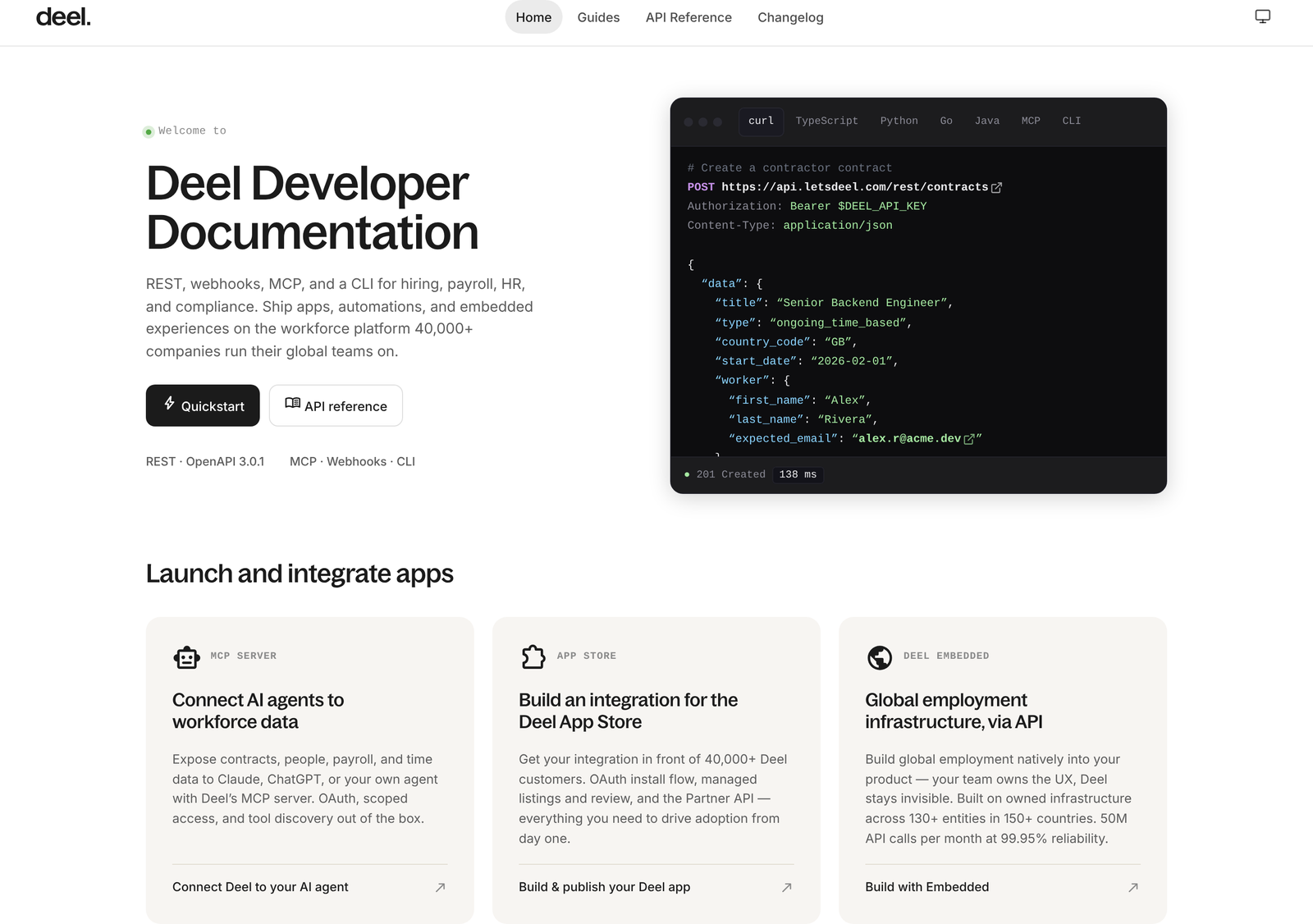
Anyone whose requirement is not on the marketplace should start here instead. The documentation covers a REST API published as OpenAPI 3.0.1, with the current stable version dated 2026-01-01 and separate beta and deprecated documentation sets. The base endpoint is api.letsdeel.com.
Authentication comes in four shapes, which matters more than it sounds when you are deciding what a script is allowed to touch.
- Organization tokens represent the whole organisation and suit server-to-server work across contracts, payroll, invoices and SCIM.
- Personal tokens represent one user, for contract creation and user-scoped actions.
- Worker API tokens represent a single employer-of-record worker, for embedded flows where the worker acts on their own data.
- OAuth 2.0 covers user-authorised app access, which is what a published integration uses.
Scopes are granular, with names like contracts: read, contracts: write, people: read, and timesheets: write. A sandbox exists as an isolated environment pre-populated with test workers and admins, where payments simulate rather than move money and invoice status flips to paid with no transfer. Sandbox keys are separate from production keys, and rate limits apply in both.
Webhooks and a command-line tool round it out. The CLI handles things like creating an invoice adjustment from a terminal against a demo environment.

131 MCP tools, and 30 of them are beta
Deel runs a Model Context Protocol server at api.letsdeel.com/mcp, which lets an AI assistant query and act on workforce data directly. Connecting it to a desktop AI client takes a few lines of configuration, and the documentation uses Claude as its worked example.
Counting the entries in the published tools reference gives 131 distinct tools, grouped into roughly twenty categories.
- Contracts and hiring: listOfContracts, createANewContract, amendContract, signContract, createContractForEOR and related endpoints.
- People and HRIS: getListOfPeople, getHrisProfilePerson, searchUserByEmail, getHrisOrganizationStructures.
- Applicant tracking: twelve tools prefixed ats_, covering jobs, candidates, applications, offers and interview feedback.
- Hiring intelligence: calculateEmploymentCost, calculateEorVersusEntityHiringCosts, calculateTakeHomePay and a salary histogram across multiple countries.
- Deel IT: assets, orders, hardware policies, seats, clearance requests, agreements, products and warehouses.
- Payroll, invoices, benefits, compliance, time off, immigration and organisation reference data.
Thirty of the 131 carry a _beta suffix, and almost all of those are in the Deel IT group. Anything touching assets, orders, seats or clearance requests through an agent is a newer surface than the contracts and people tools, which is a reasonable signal about where to be cautious.
The hiring-intelligence tools stand out. Being able to ask an assistant what an engineer costs in Portugal versus setting up an entity there, and get the answer from Deel’s own cost model, is a genuinely different capability from a Slack notification.
Building on Deel rather than into it
Two routes exist for companies that want to ship something themselves.
The first is the Deel App Store, with an OAuth install flow, managed listings and review, and a Partner API. Deel pitches it as distribution to its customer base.
The second is Deel Embedded, which puts global employment inside your own product while Deel stays invisible to your users. The documentation claims it runs on owned infrastructure across 130+ entities in 150+ countries, handling 50 million API calls a month at 99.95% reliability.
Those reliability and volume figures are vendor statements with no linked status report or methodology, so weigh them accordingly. Deel does publish a status page, which is the place to check uptime claims against something observable.
How to evaluate this for your own stack
- Find your accounting system first. QuickBooks, Xero and NetSuite are first-party, which puts them in a different support category from the rest.
- Check your HRIS next. Workday and SAP SuccessFactors are first-party; BambooHR, HiBob and Personio are present but not badged.
- Search rather than browse. Deel’s category assignments put time-tracking tools under Automation, so a category walk will miss things.
- Ask who maintains any integration you intend to depend on. The marketplace will not tell you once you leave the front page.
- Open the developer docs before concluding something is impossible. The API covers considerably more ground than the 200 listed apps.
What we could not check
- Per-category app counts. The marketplace renders entirely in the browser, and its category pages did not resolve to listable URLs for us, so the 200+ figure stands as a vendor claim we could not count independently.
- Whether apps outside the two curated rows are first-party. No badge is displayed in the category grids.
- Specific API rate limits. The documentation references a rate limits page but does not state figures on the pages we read.
- Partner API commercial terms, listing fees or revenue share.
- Whether any integration is gated behind a particular Deel product or plan. The marketplace does not say.
- The 40,000 company, 50 million call and 99.95% reliability claims, all of which are unsourced vendor statements.
FAQ
How many integrations does Deel have?
Deel advertises 200+ across 17 categories. We could not count them independently because the marketplace renders client-side, so that figure is the vendor’s.
Which integrations does Deel build and maintain itself?
Nine apps carry a Built by Deel badge on the marketplace front page: Slack, Google Workspace, Workday GPC, SAP SuccessFactors, NetSuite, QuickBooks, Xero, Calendar and SAML 2.0 Connect.
Does Deel have an API?
Yes. A REST API published as OpenAPI 3.0.1, currently at stable version 2026-01-01, with webhooks, OAuth 2.0, a sandbox environment, and a command-line tool alongside it.
Can I connect Deel to an AI assistant?
Yes. Deel runs an MCP server at api.letsdeel.com/mcp exposing 131 tools with OAuth and scoped access. Thirty of those tools are marked beta.
Does the Xero integration import my old invoices?
Not automatically. Syncing begins from the date you connect, and the Xero App Store listing says past invoices need a separate request.
What is Deel Software Resale?
A category where Deel sells third-party licences directly, including Google Workspace, Microsoft 365, CrowdStrike, JumpCloud and NordLayer, billed alongside your other Deel charges. No prices are published.
The verdict
Judged on the marketplace alone, Deel looks like every other HR platform with a few hundred logos and a connect button. Judged on the developer portal, it looks like infrastructure.
The nine first-party integrations cover exactly the systems where a sync failure costs real money, and that focus is the right one. What the marketplace gets wrong is transparency. Hiding the maintainer behind the front page means a buyer comparing twenty tools has no way to weigh the support risk, and that information already exists in Deel’s own data.
If your accounting and HR systems appear on the badged list, the integration story here is strong. If they do not, go straight to the API documentation and price the engineering, because the marketplace card will not tell you who answers the phone. Deel’s marketplace is here.
Related reading on Stack99: Deel Top Features 2026, Deel Review 2026, and Who Is Deel Best For?.