


Quick answer: Breezy HR lists 43 named integrations across eight categories, and its help centre documents more than the marketing page shows. The gating matters more than the count. Background checks, email, calendar and Slack unlock on Startup at $189 a month. Assessments and HRIS connections are held back to Business at $529 a month, a $340 monthly step. Reaching the API means a quote-only Custom Pro plan. Zapier and single sign-on appear on the integrations page but on no plan’s published feature list, so ask before you buy on either.
Disclosure: Stack99 earns a commission if you buy through links on this page. It costs you nothing extra and never changes our assessment.
What Breezy connects to
Breezy HR organises its integrations page into eight categories. Counting every partner named on that page gives 43, with a “View More” link under premium job boards that hides a longer list.
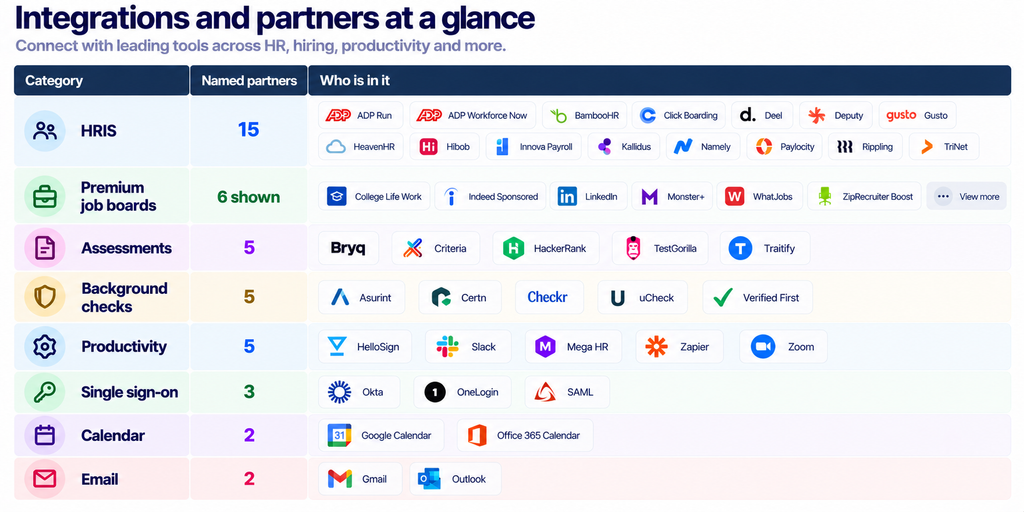
The shape of that table tells you what Breezy is for. Fifteen HRIS partners against two calendar options is a product built to hand finished hires to a payroll system. Everything upstream of the offer is thinner than everything downstream of it.
The marketing page undercounts
Breezy’s help centre carries an Integrations & Partners collection holding 52 articles, and several of them document partners the public page never mentions.
- GoodHire sits in the background check articles, making six screening partners rather than five.
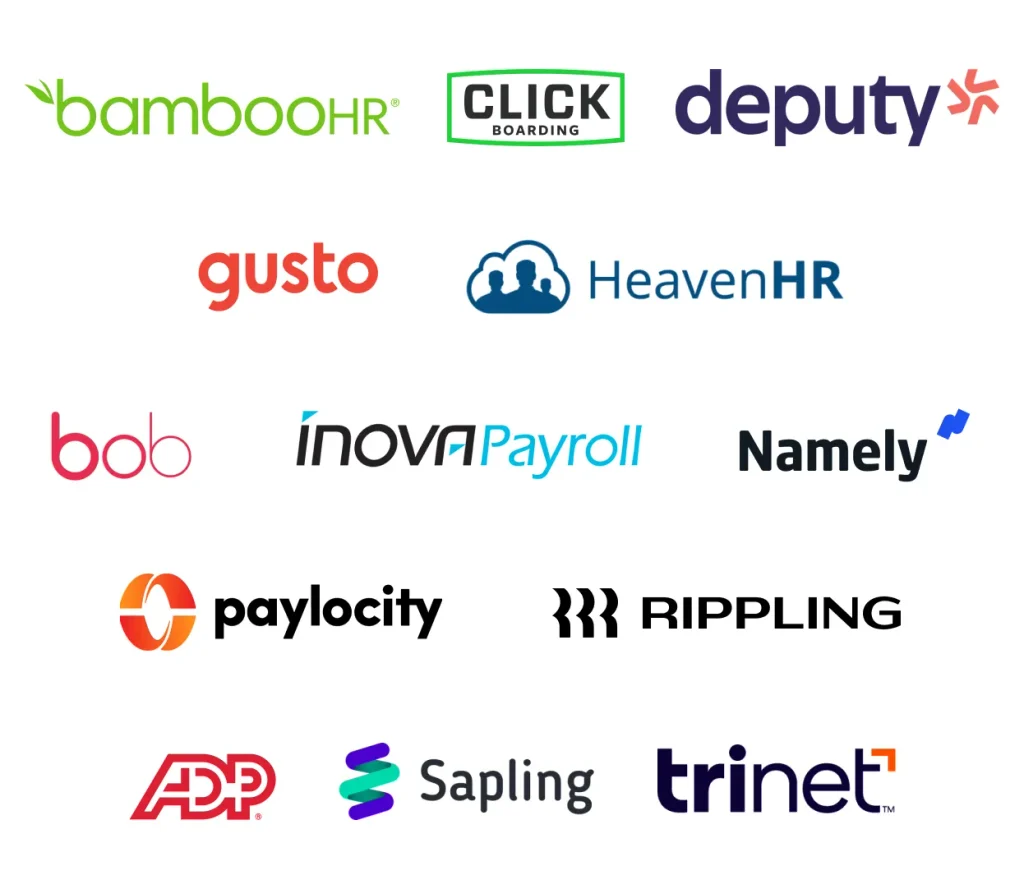
- PaySpace appears in the HRIS list, taking that category to 16.
- Indeed Assessments and Mega HR AI Interviewer are documented under assessments.
- hireEZ and LinkedIn Recruiter have their own sourcing section that the marketing page omits entirely.
- Microsoft Teams video interviews and an iCalendar feed are documented, though neither shows on the integrations page.
- Claira and a Breezy MCP server sit under a heading called AI Tools.
If a partner you need is missing from the integrations page, search the help centre before concluding it does not exist. Several of these are live and simply have not been added to marketing.
The gating, plan by plan
Breezy prices by plan, not by seat. Every tier carries unlimited users, so the figures below are the whole bill rather than a per-person rate. The pricing page opens on annual billing, where the monthly-equivalent rates read $157, $273 and $439. Switch the toggle to monthly, and they become $189, $329 and $529.
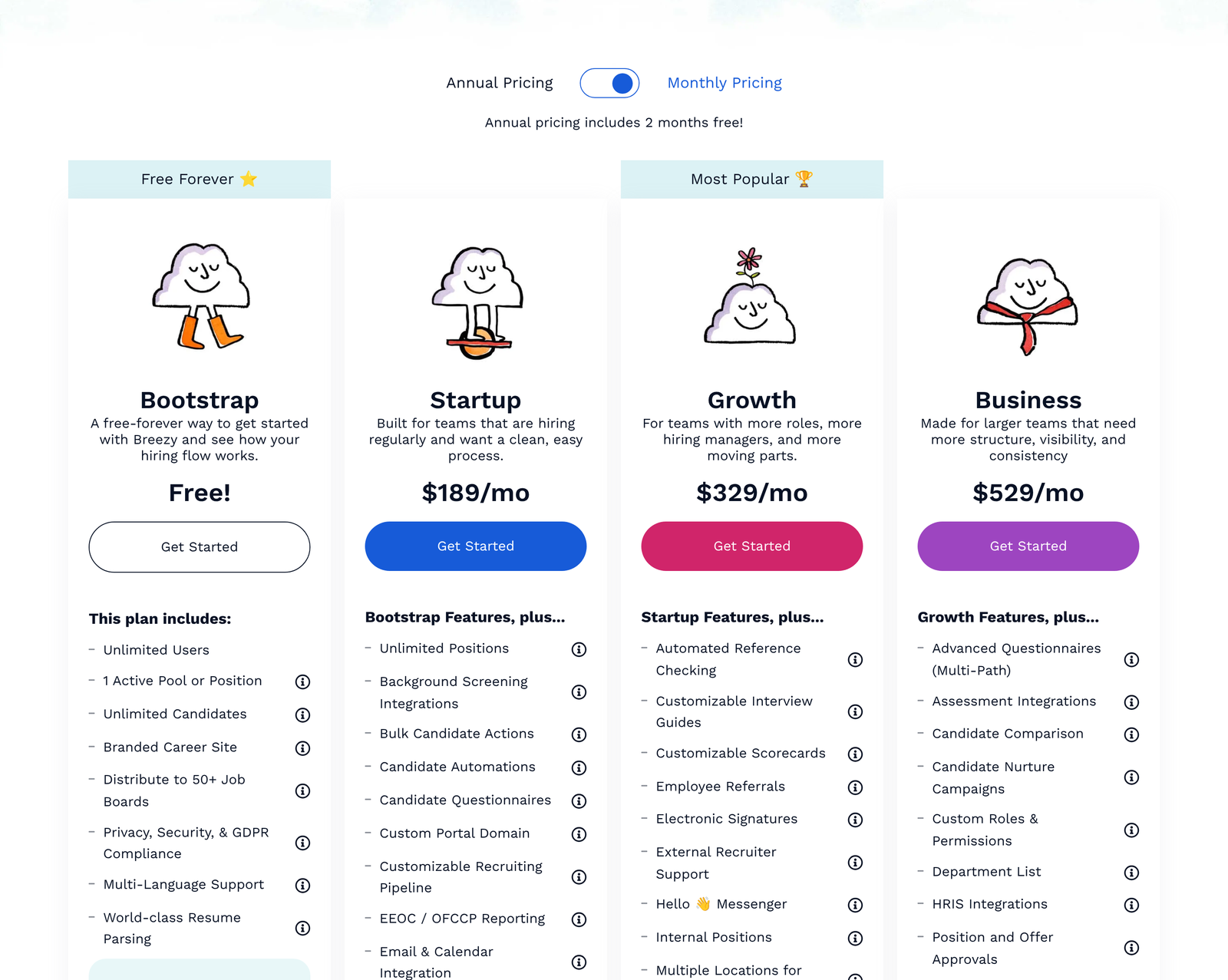
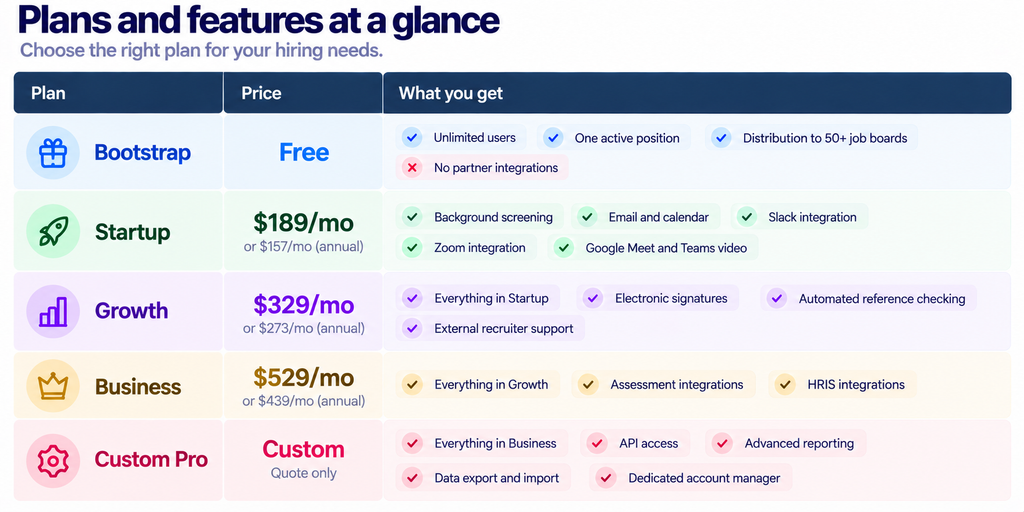
The annual discount is one of the few vendor claims that survives checking exactly. Breezy says annual billing includes two months free. Ten months of Startup at $189 spread over twelve is $157.50, and the page charges $157. Growth works out at $274.17 against a charged $273. Business lands at $440.83 against $439. The promise holds, and twice it rounds slightly in your favour.
The $529 line that decides your plan
Here is the single most expensive sentence on Breezy’s pricing page: HRIS Integrations appears in the Business column and nowhere below it.
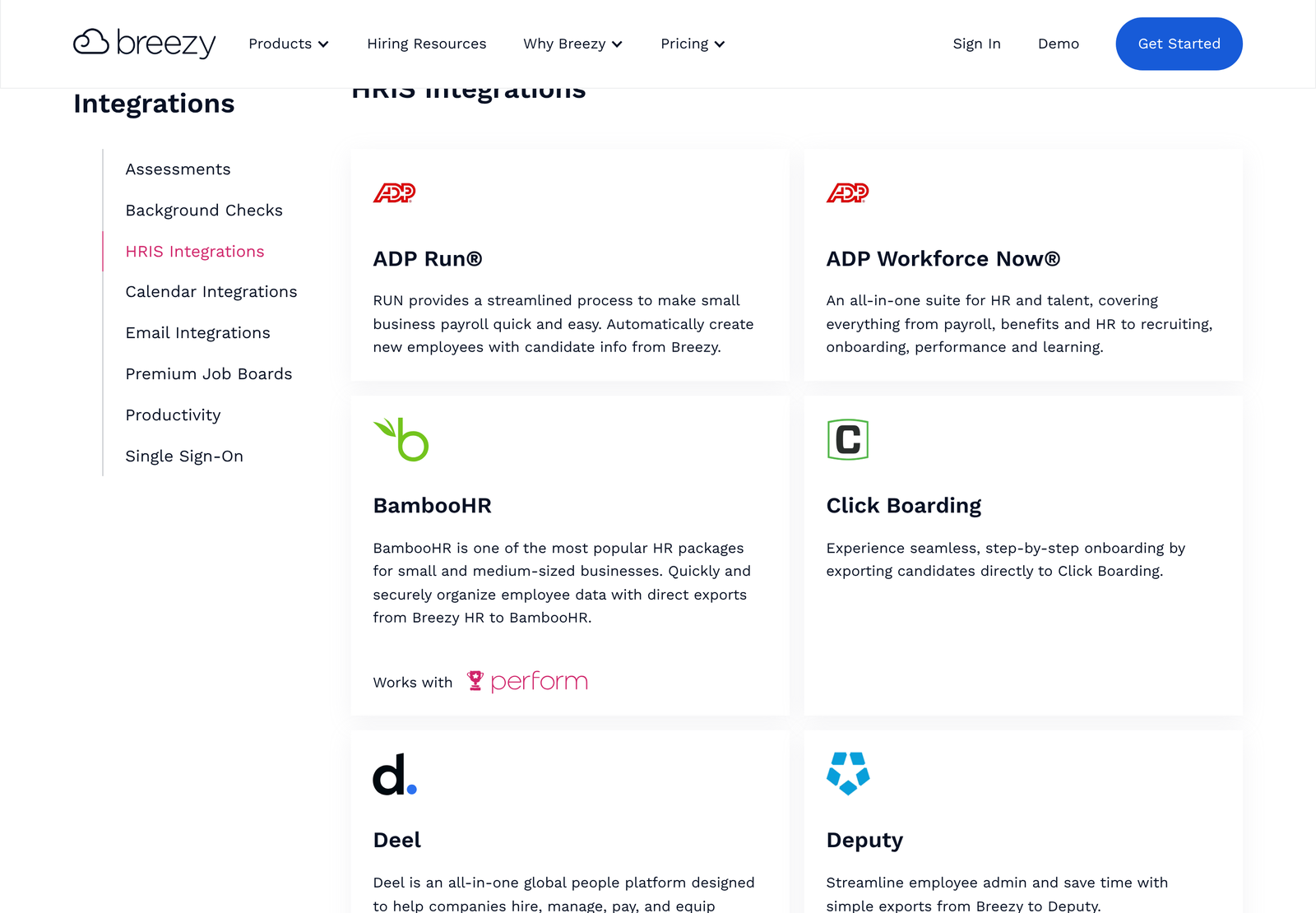
What those integrations do is narrow. Read the help centre description and the job is adding a new hire to your HR system: Breezy pushes candidate data across so payroll and onboarding start with the record already populated. Useful, and not complicated.
Now price it. A team on Startup pays $189 a month. Business costs $529, a difference of $340 every month, or $4,080 a year. On annual billing the gap narrows to $282 a month, $3,384 across the year. You are buying several Business features at once, but if the HRIS export is what pushed you, that is the number against which to judge it.
Work out what the manual version costs. Say you hire 40 people a year and retyping a new starter into BambooHR takes ten minutes. Call it 6.7 hours of admin annually. Paying $4,080 to remove 6.7 hours works out at roughly $609 an hour. Few recruiting coordinators cost that.
Hire 400 people a year and the arithmetic inverts completely: 67 hours saved, about $61 an hour, and the upgrade pays for itself several times over before you count error rates. Volume is what makes this line reasonable, and volume is the question to answer before upgrading.
The Zapier workaround, and its limits
Breezy lists Zapier under productivity, describing it as a way to connect with “more than 2,000 apps”. Zapier’s own site currently advertises 9,000 or more. The Breezy copy is several years stale, which matters less in itself than as a hint that the page has not been audited recently.
The more important detail is how little Breezy exposes through Zapier. Its app offers three triggers and one action, which is the whole surface area.
- Trigger: New Candidate, when someone is added to an active position
- Trigger: New Candidate in Stage, when a candidate enters a stage you choose
- Trigger: New Active Position, when a position goes live for the first time
- Action: Create Candidate
Those triggers poll rather than push. Zapier checks every 15 minutes on its free plan, so nothing here is instant.
Can that replace the $340 HRIS upgrade? Partly. Create a stage called Hired, fire the New Candidate in Stage trigger, and send the record to your HR system’s own Zapier app. BambooHR, Gusto, Rippling and Deel each publish a Zapier app with a create-employee action, so the path exists on paper.
Two caveats before you build it. The first is field mapping: Breezy’s trigger hands over candidate data, which is not the same shape as an employee record, so you will be writing transformations by hand and maintaining them. The second is that Zapier access is not named in any plan’s feature list on the pricing page, which brings us to the real gap.
Two integrations with no published plan
Compare the integrations page against the pricing page and two categories go missing.
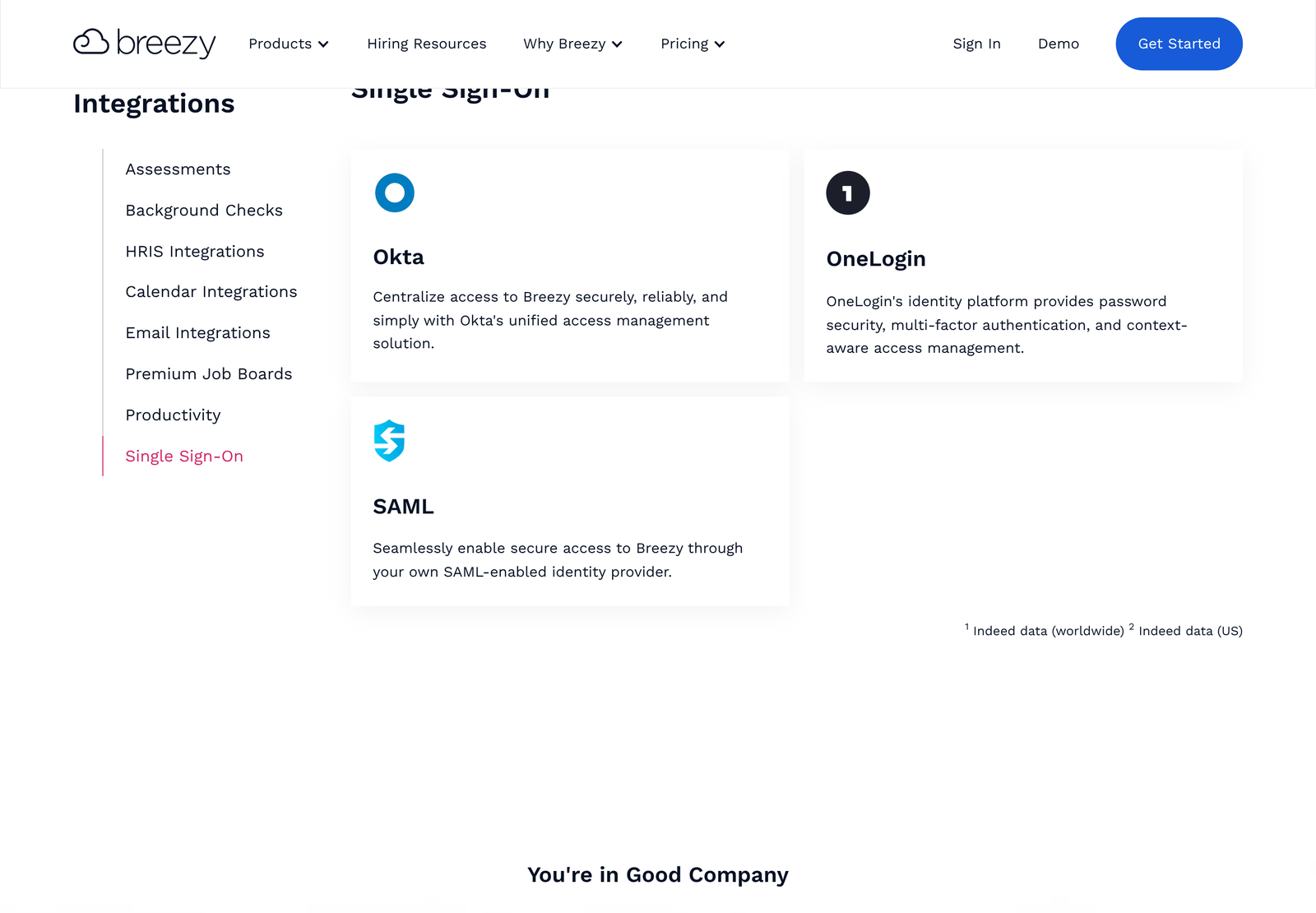
Single sign-on is the clearer case. Okta, OneLogin and SAML each get a card on the integrations page and a help centre article. Search the pricing page for any of those words, or for the phrase single sign-on, and nothing comes back. Multi-factor authentication is listed on Startup. SSO is listed nowhere.
Zapier has the same problem. It is advertised as an integration and absent from every plan column.
Neither absence proves the feature is restricted. It might ship on every paid tier, or it might be a Custom Pro item. The point is that you cannot tell from the published material, and SSO in particular is the kind of requirement that security review raises late and expensively. Get it in writing during the sales conversation, not after.
The MCP server, quietly in beta
The most interesting thing in Breezy’s integration catalogue is not on the integrations page at all. Under AI Tools in the help centre sits an article on connecting Breezy to an AI agent through the Model Context Protocol.
The server lives at mcp.breezy.hr/mcp and works with any MCP-capable client. Breezy names Claude, Cursor and ChatGPT, with a note that the ChatGPT route needs a Business subscription on that side. Breezy labels the server a beta still in development with limited support.
One design detail deserves credit. Breezy states that what an agent can do is bounded by your own Breezy permissions, so a connected assistant inherits your access rather than gaining its own. Breezy has that the right way round, and it is not universal among vendors shipping MCP endpoints.
Treat it as promising rather than production. Beta software with limited support should not sit on the critical path of a hiring process, and no plan requirement is published for it either.
What actually unlocks on Startup
Plenty, as it happens, and this is where most small teams should stop.
Background screening integrations arrive at $189 a month, which covers Asurint, Certn, Checkr, uCheck, Verified First and the help-centre-documented GoodHire. Those run from a candidate’s profile, so the screening order and its result live beside the application. Our Checkr review covers what the screening itself costs, since Breezy passes you through to the provider’s own pricing rather than bundling it.
Email and calendar also land on Startup. Gmail and Outlook connect to a user profile so candidate correspondence stays in Breezy. Google Calendar and Office 365 Calendar handle availability and interview scheduling, with Google Meet links generated automatically. Slack notifications come in at the same tier, and video interviews cover integrated video, Zoom, Google Meet and Microsoft Teams.
Growth adds electronic signatures at $329, which on the ground means HelloSign for offer letters. Whether that is worth $140 a month over Startup depends on how many offers you send and whether you already pay for a signing tool.
What each connection actually moves
A long partner list flatters every vendor. The useful question is what data crosses the boundary, and in which direction, because that is what determines whether an integration saves work or merely exists.
Breezy’s HRIS connections are one-way and one-event. The help centre describes them as a way to add new hires to your HR system, and the individual partner articles use the language of exporting a candidate. Nothing flows back. Your HRIS will not tell Breezy that the person started, changed role or left, so reporting on anything past the offer stays in the HR system.
Screening partners run the other way round and are genuinely two-way. You order the check from inside a candidate profile and the result returns to that profile. The screening fee belongs to the provider, so budget for two bills rather than one.
Email and calendar connect at the level of an individual user profile rather than the company. Each recruiter links their own mailbox. Plan for a small onboarding step per person rather than one admin switch, and remember that a departing recruiter takes their connection with them.
Job boards are distribution rather than integration in any technical sense. Breezy pushes the posting out and applications come back in. The free 50-plus board distribution behaves this way on every plan, premium boards included once you pay the board directly.
Gusto is the one listed partner that moves data in both directions, and the integrations page is explicit about it: new hires export from Breezy to Gusto, and employee information can be sent from Gusto into Perform, Breezy’s performance product. Worth noting if you are weighing the two Breezy products together rather than just the hiring half.
A note on the job board numbers
Breezy’s Indeed card claims an integration that increases likelihood of hire by 4.5 times and delivers up to 4 times the applicants. Both figures carry superscript markers, and the footnote at the bottom of the page reads: Indeed data worldwide, and Indeed data US.
Those are Indeed’s numbers about Indeed’s own sponsored products, not measurements of Breezy. The footnote is honest and easy to miss. No sample size, window or baseline is published for either.
Free distribution to 50 or more job boards is included from the Bootstrap tier up, and premium boards are a separate paid relationship with each board. Sponsored placement on Indeed, LinkedIn or ZipRecruiter costs whatever those platforms charge, on top of your Breezy subscription.
Choosing a plan by what you need to connect
- Nothing but job boards. Bootstrap, free, one active position at a time. Fine for a company hiring occasionally.
- Screening, calendar, email, Slack, and video. Startup at $189 monthly or $157 annually. This covers most teams under about 50 people.
- Offer letters signed in-product. Growth at $329 or $273. Skip it if you already own a signing tool.
- Automatic push into payroll or an HRIS, or pre-hire assessments. Business at $529 or $439. Justify it on hiring volume, not on convenience.
- Raw API access, bulk data export, and advanced reporting. Custom Pro, quote only. Ask about SSO and Zapier in the same conversation.
Breezy runs a 14-day trial with no card required and full features, which includes 100,000 Breezy Intelligence credits. Use it to test the one integration your decision hinges on. A trial that confirms the HRIS push works the way you expect is worth more than any comparison table.
Frequently asked questions
Which plan do I need for BambooHR or Gusto?
Business. HRIS Integrations appears in the Business column of Breezy’s pricing page and in no tier below it. Expect $529 a month billed monthly, or $439 on annual billing.
How many integrations does Breezy have?
Forty-three partners are named on the integrations page across eight categories, plus a longer premium job board list behind a “view more” link. The help centre documents at least eight more, so the real figure is above 50 before counting anything reachable through Zapier.
Does Breezy HR have an open API?
Only partly. Breezy lists API access as an optional advanced feature on the quote-only Custom Pro plan, and no self-serve tier includes it.
What can Breezy’s Zapier app actually do?
Three triggers and one action. The triggers cover a new candidate, a candidate entering a chosen stage, and a position going active. The single action creates a candidate. Triggers poll on a schedule rather than firing instantly.
Is single sign-on included on any plan?
Okta, OneLogin, and SAML are advertised as integrations and documented in the help centre, but no plan on the pricing page names single sign-on. Confirm availability and tier with Breezy in writing before you sign.
Are integrations priced per user?
No. Breezy charges a flat monthly rate per plan and includes unlimited users on every tier, including the free one. A 60-person company pays the same subscription as a 6-person one on the same plan.
The verdict
Breezy’s integration catalogue is broader than most applicant tracking systems at this price, and the flat per-plan billing with unlimited users is genuinely unusual. A growing recruiting team gets background checks, calendars, mailboxes, and video for $189 a month regardless of headcount.
The friction is concentrated in one jump. Assessment and HRIS connections sit two tiers up, and the step from $189 to $529 is large for a company hiring at modest volume. Build the Zapier path or accept some retyping until your hiring volume justifies the move.
Before deciding, read our Breezy HR pricing breakdown, check who the product suits, and compare against the field in our alternatives roundup. If an HRIS push is your deciding factor, our Rippling review covers one of the sixteen destinations.
Start a free Breezy HR trial, or check the vendor’s integrations page, pricing page, and help centre yourself.