



Quick answer: Rippling sells one system of record covering HR, IT, payroll, and spend, and it publishes no price for any of it. The pricing page is a quote form asking for your headcount band. What the company does publish, generously, is its security posture: SOC 1 Type II, SOC 2 Type II, SOC 3, CSA STAR Level 2, and ISO 27001, 27018, and 42001 certifications, all named on one page. So the buying decision splits in two. The compliance evidence is unusually easy to check before you talk to anyone. The commercial terms are impossible to check at all until you hand over your details.
Disclosure: Stack99 earns a commission if you buy through links on this page. It costs you nothing extra and never changes our assessment.
What you are actually buying
Most vendors in this space sell a product. Rippling sells a spine. The pitch is that employee data lives in one place and every downstream system reads from it, so hiring someone sets up their payroll, their laptop, their benefits and their app accounts from a single record rather than from five disconnected ones.
The navigation on rippling.com breaks the catalogue into five families. As of 19 October 2026, they look like this.
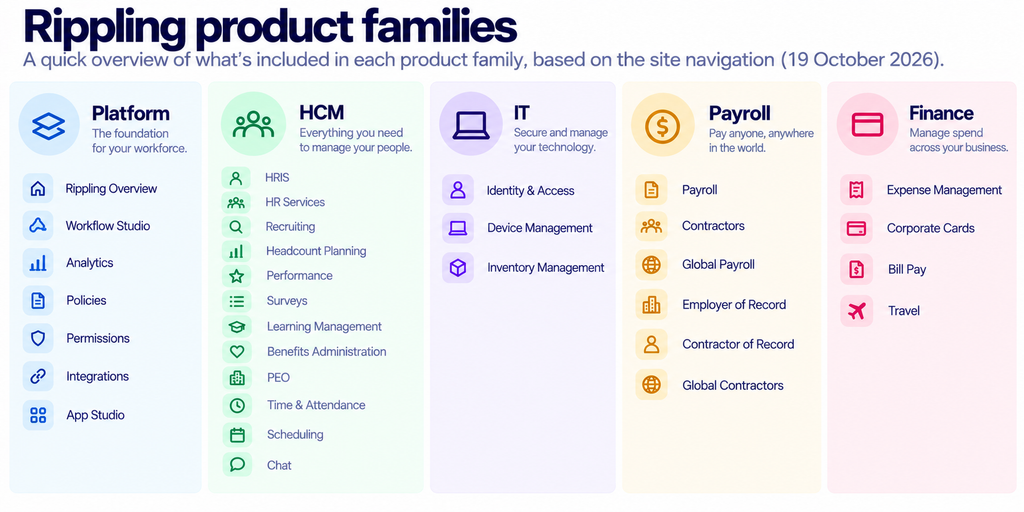
Thirty two named modules. Nobody buys all of them. The practical question becomes which subset you need, and that question is also the one that sets your price, which brings us to the part of this review that will frustrate you.
There is no price to report
We checked rippling.com/pricing on 19 October 2026 and read the full rendered page. It contains no figure for any plan, any module or any seat. What it contains is a form.
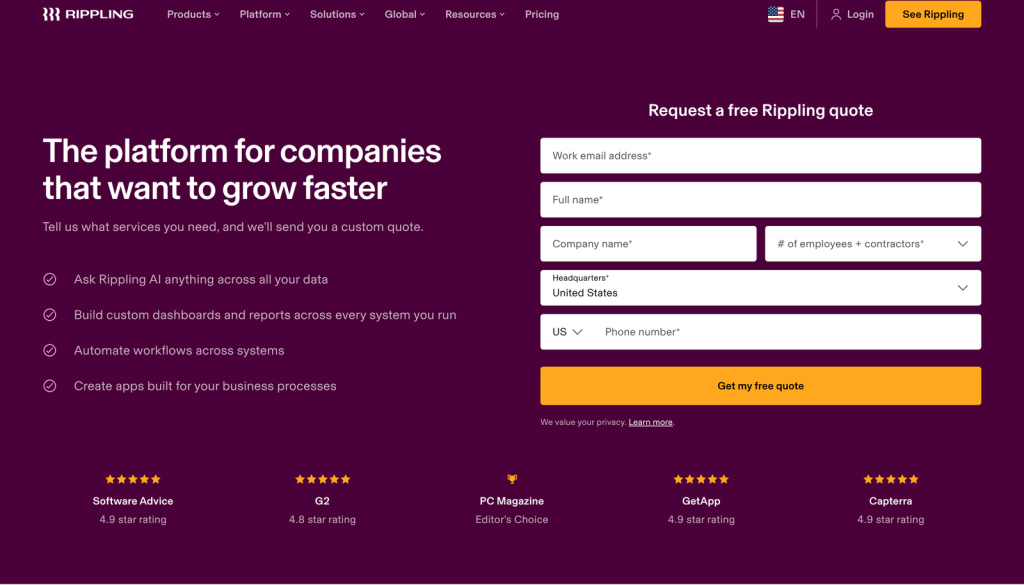
The headcount field offers five bands: 1 to 10, 11 to 50, 51 to 250, 251 to 1000, and 1001 plus. Those bands tell you something even though the prices do not. A vendor that segments a quote form at eleven people is willing to sell to very small teams. A vendor that puts a band above a thousand is chasing enterprise too. Rippling wants both ends.
This is our fourth look at the page across October, and the answer has not moved. Nothing is published, so nothing can be compared. If a competitor review quotes you a Rippling per-employee rate, ask where the number came from, because it did not come from Rippling.
One published commercial term does exist, and it sits on the homepage rather than the pricing page: qualified venture-backed companies are offered six free months of Rippling Payroll, HR, IT and Finance. No eligibility criteria accompany the offer on that page.
What to ask on the quote call
- Which modules are in the quoted figure and which are priced separately. With thirty-two modules on the menu, a quote without a line-item breakdown is unreadable.
- Whether the rate is per employee, per seat, or per module, and what happens when headcount crosses into the next band.
- The contract term, the notice period, and whether mid-term downgrades are allowed.
- Implementation cost. No implementation fee appears anywhere publicly, which does not mean there is none.
- Whether data connectors and AI plugins carry their own charge. Clicking a connector triggers account-manager outreach rather than a self-serve install, which usually signals a commercial gate.
The security page is the strongest part of the site
Plenty of vendors write “enterprise-grade security” and stop. Rippling names seven specific attestations and describes the scope of each one, which is a materially different thing and much easier to take into a procurement review.
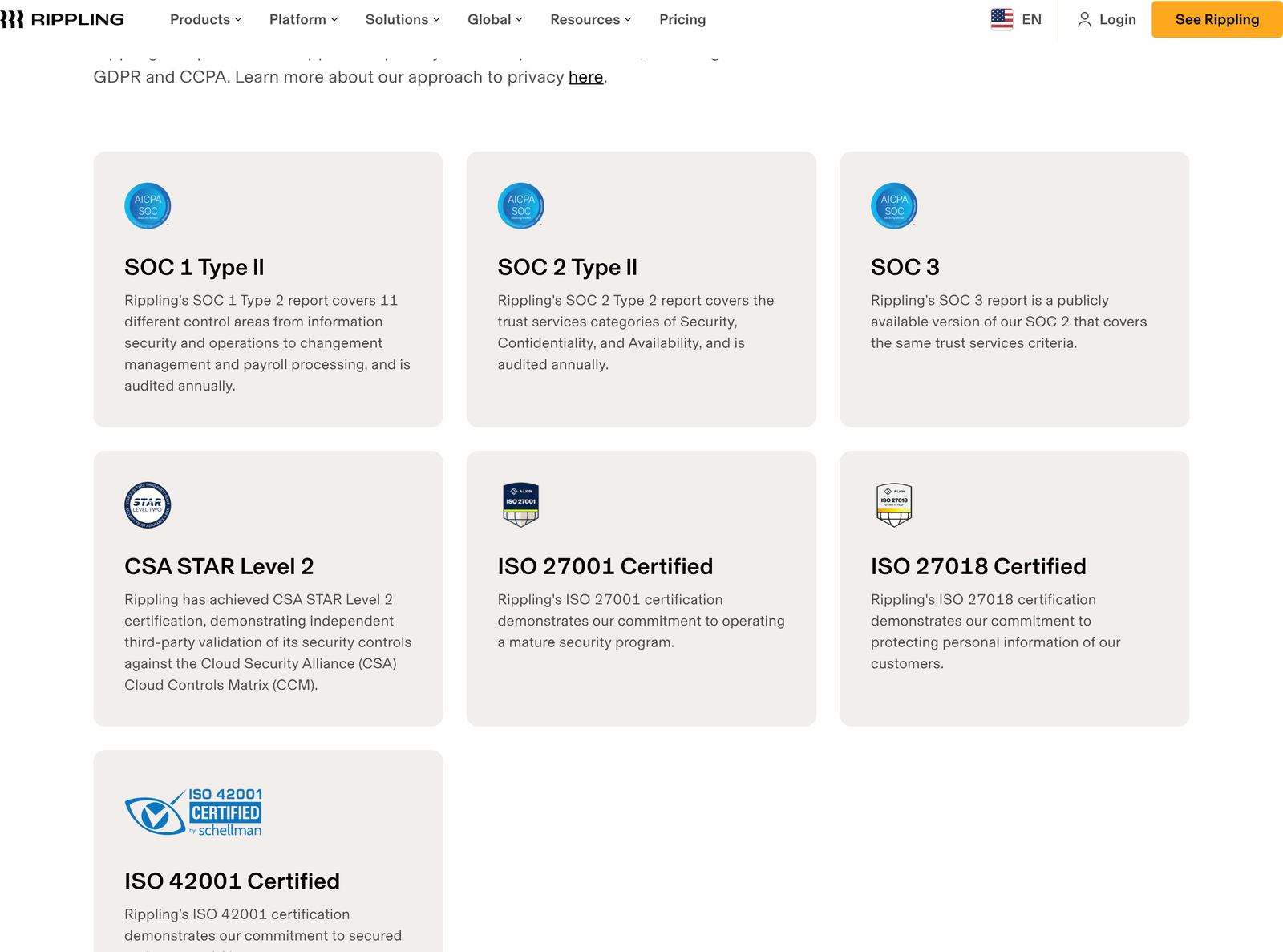
Taking them in turn, because the labels are not interchangeable. The SOC 1 Type 2 report is described as covering eleven control areas spanning information security, operations, change management and payroll processing, audited annually. SOC 1 concerns controls relevant to financial reporting, so for a payroll provider that report is the one your auditor is likeliest to request.
Rippling’s SOC 2 Type 2 report covers the trust services categories of Security, Confidentiality and Availability, also audited annually. Note which two categories are absent: Processing Integrity and Privacy. If either matters to your review, ask whether they are in scope for the next audit period rather than assuming a SOC 2 covers everything. The SOC 3 is the public summary of the same work, so it is the one you can read without an NDA.
The AICPA, which writes the professional standards these reports are issued under, maintains a public explainer of the SOC suite, and reading it before a vendor call is twenty minutes well spent. The AICPA has also been publishing warnings through 2026 about “fast and easy” SOC compliance offerings and about auditors who are not enrolled in peer review, which is a useful reminder that a badge is a claim about an auditor’s opinion rather than a guarantee.

Turning to the certifications, CSA STAR Level 2 means an independent third party validated Rippling’s controls against the Cloud Security Alliance Cloud Controls Matrix. ISO 27001 covers the security management system, ISO 27018 covers handling of personal information in the cloud, and ISO 42001 covers AI management. That last one is the interesting entry. Rippling ships an AI layer that queries connected third-party systems, and holding a certification aimed specifically at governed AI is still uncommon among payroll vendors. The badge shown on the page names Schellman as the certifying body.
GDPR and CCPA compliance are both claimed on the same page, with a link through to a separate privacy explanation.
Infrastructure and people
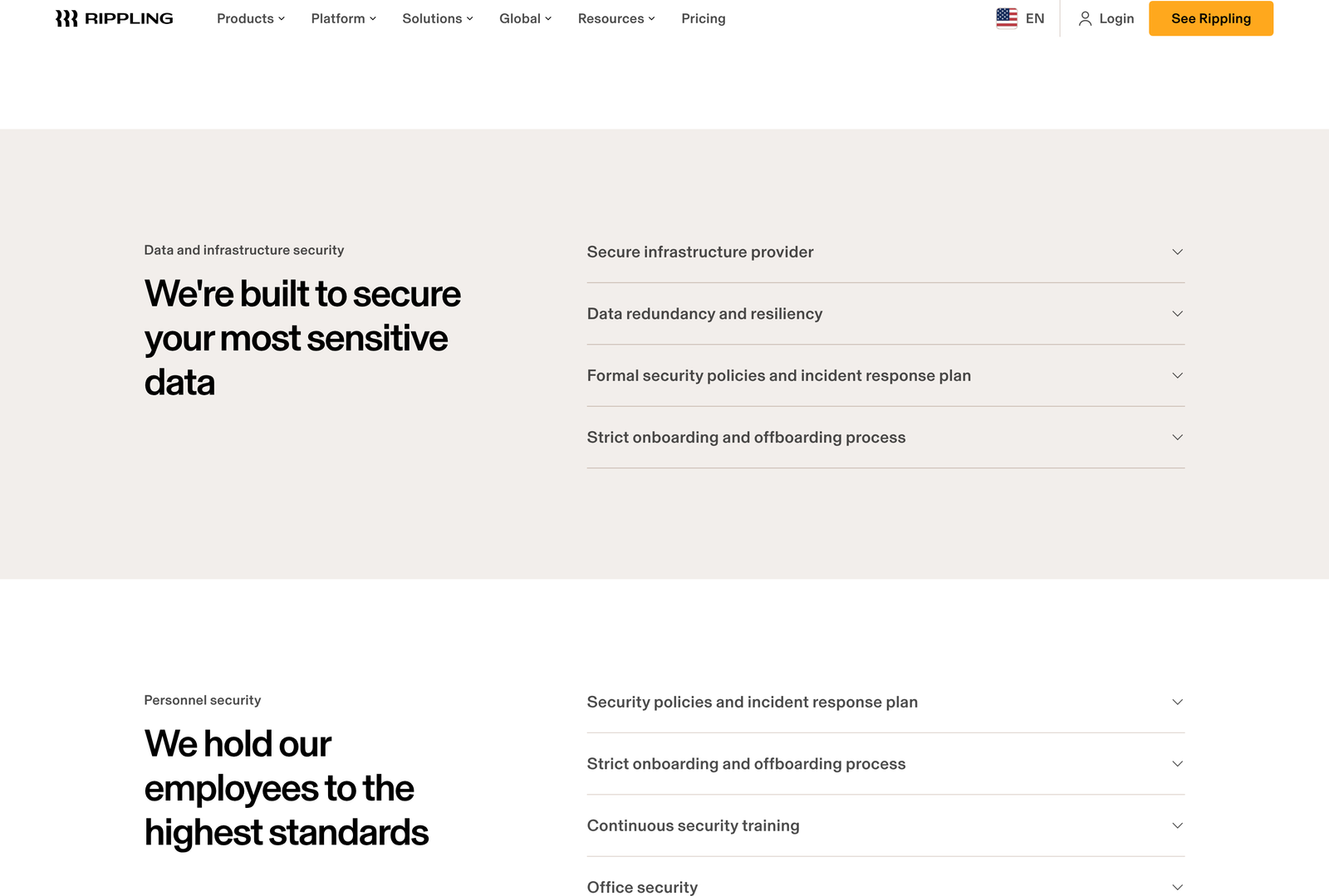
All data is described as housed in physically secure, US-based AWS data centres across multiple availability zones. Read that sentence twice if you are in the EU. There is no mention of European data residency anywhere on the security page, and for a system that holds payroll records for your entire workforce, residency is often the first question a European privacy review asks.
Beyond the hosting, the page commits to background checks for every new joiner, a legal and security training course at onboarding plus annual InfoSec training, and instant revocation of devices, apps and access at offboarding through Rippling’s own identity and device products. Using your own product to offboard your own staff is a reasonable signal.
For the software itself: regular internal and external penetration tests through outside firms, an open bug bounty, logged and audited app access, a web application firewall, a runtime application self-protection agent, and change management through GitHub with mandatory peer review and automated tests before production. Third-party vendors are reviewed against the same data protection standards.
Regulated entities, named in the footer
Something easy to miss, and genuinely useful. Rippling’s site footer names four regulated subsidiaries with their licence numbers: Rippling Insurance Services, Inc. under NPN 18578689, Rippling PEO 1, Inc. under Florida licence GL250, Rippling Payments, Inc. under NMLS 1931820, and Rippling Lending, Inc. under NMLS 2430865.

Those identifiers let a finance team confirm which legal entity is actually holding or moving money before signing. We attempted to pull the corresponding records from the NMLS Consumer Access register, and the site refused our declared crawler with a 403, so treat the numbers as published by Rippling rather than as independently confirmed here. Looking them up by hand in a browser takes a minute.
Integrations, briefly
Rippling uses one word for three different mechanisms, which trips up a lot of buyers. App integrations push identity outward for provisioning and single sign-on. Data connectors pull third-party records inward so they can be joined to workforce data. Plugins let the AI layer query an external system live at question time, bounded by the asking user’s own permissions. We pulled that apart in detail in our piece on Rippling integrations, connectors and plugins.
Two cautions carry over into this review. The App Shop still renders no catalogue to an ordinary request, so the widely repeated “600+ integrations” figure remains a vendor claim nobody outside the company can count. And developer.rippling.com is login-gated, meaning the API and SCIM documentation cannot be read before you are a customer. For a buyer whose main worry is whether a specific internal tool will connect, that is a real obstacle at evaluation time.
What an outside source says
Independent corroboration is thin, and we would rather say so than pad this section. G2, Capterra and Trustpilot all refuse our declared crawler, so any rating badge Rippling displays from those platforms goes unverified here.
One marketplace does serve a full listing. On the Xero App Store, Rippling has been listed since February 2019, seven years, carrying a 4.0 out of 5 rating from exactly one review. One review is not a sample, and we are reporting the listing rather than the score. The useful material is the technical description: the integration syncs Rippling payroll data to the Xero general ledger, including accounts and tracking categories, and setup runs through the Payroll app’s Accounting tab, authorising Xero and then mapping payroll items to Xero accounts.

Direction matters there. Data moves from Rippling into Xero. If you expected your accounting system to push anything back, the listing does not describe that. The listing also names twelve countries where the app is available, including Australia, Canada, Ireland, New Zealand, Singapore, South Africa, the United Kingdom and the United States.
The global side, and a claim to pin down
A separate Global menu runs alongside the five families, repeating several payroll and benefits lines for companies hiring across borders: Global Employer of Record, Global Payroll, Global Contractors, Contractor of Record, Global HRIS, Global HR Advisor, Global Benefits and Global Finance. Rippling also publishes hiring guides for eleven countries, from Canada and the UK through to Brazil, Poland and Switzerland, plus an employee cost calculator and a worker misclassification quiz.
Employer of Record is where Rippling makes its sharpest speed claim. Its own material puts the lead time from signing a new international hire to their first payday at five days in popular markets and twelve in less common ones, measured against three weeks or more for what it describes only as other EOR solutions. Those competitors go unnamed, no methodology accompanies the figures, and the comparison is the vendor’s own. Take it as positioning rather than as a benchmark. If speed to first payroll run is what you are buying, get the committed lead time for your specific countries written into the contract, because a number in a marketing page binds nobody.

Eleven industry pages sit alongside the country guides, covering construction, restaurants, healthcare, manufacturing, retail, technology, automotive, financial services, professional services, non-profits and marketing agencies. These are worth skimming before a demo, because they describe concrete behaviour rather than slogans. The restaurants page, for instance, covers automated overtime and tip-to-minimum calculations, wage garnishments, shift swaps within set parameters, and alerts for potential scheduling violations. Whether those behaviours are included in your quote or sit inside a module you have not been quoted for is exactly the kind of thing to establish early.
What we could not verify
- Any price, for any module, at any headcount.
- The integration count. Rippling’s App Shop does not render a catalogue to us.
- SCIM, SAML or OAuth support. Those strings appear nowhere on the public marketing pages and the developer documentation requires a login.
- Implementation timelines. Rippling’s own material repeats a 90-second onboarding figure, which describes provisioning one new hire in an already-configured account rather than standing the platform up. No figure for the latter is published.
- The licence records behind the four NMLS and state identifiers, for the 403 reason described above.
Who this suits
Choose it if you are consolidating. The argument for Rippling gets stronger the more separate systems you are currently paying for and reconciling by hand. A company running one HRIS, one payroll provider, a device management tool, a corporate card programme and a spreadsheet mapping all four has a real problem that this product is designed around.
Choose it if your security review is the bottleneck. Seven named attestations with written scopes, including an AI governance certification, will clear a procurement checklist faster than almost anything else in this category.
Look elsewhere if you need to budget before you can get approval to talk to a salesperson. That sequence is common in small companies, and it does not work here.

Look elsewhere, or at least ask hard questions first, if EU data residency is a requirement. US-based AWS is what the security page commits to, and nothing on it offers a European option.
Be cautious if your evaluation depends on confirming a specific integration or API capability in advance. The catalogue will not load, and the docs are gated, so you will be relying on a salesperson’s answer rather than on documentation you can read yourself.
FAQ
How much does Rippling cost?
Rippling publishes no prices. The pricing page is a quote request form asking for your work email, name, company, headcount band, country, and phone number. Checked again on 19 October 2026.
Is Rippling SOC 2 certified?
Rippling states it holds a SOC 2 Type 2 report covering Security, Confidentiality, and Availability, audited annually, plus SOC 1 Type 2 and a public SOC 3. Processing Integrity and Privacy are not listed among the covered categories.
Where does Rippling store data?
The security page says physically secure, US-based AWS data centres across multiple availability zones. No European or other regional residency option is mentioned.
Does Rippling really have 600 integrations?
That figure comes from Rippling. The App Shop page returns no catalogue to an ordinary request, so the count cannot be checked from outside. Nine integration partners are visible by name in the marketing carousel, among them HubSpot, Asana, Jira, Slack, Google, Datadog, Checkr and Carta.
Can I read the API documentation before buying?
No. developer.rippling.com requires a sign-in, and the base API, SCIM, and app management pages all render only a sign-in prompt.
Does Rippling connect to Xero?
Yes. The Xero App Store lists a Rippling app, built by Rippling, available since February 2019. It syncs payroll data from Rippling to the Xero general ledger, including accounts and tracking categories.
Is there a free trial?
No public trial is advertised. The homepage does offer qualified venture-backed companies six free months of Payroll, HR, IT and Finance, with no eligibility criteria published alongside it.
Sources
- Rippling security and data protection, read on 19 October 2026, for all seven attestations and their stated scopes, the AWS hosting description, and the personnel, application and vendor-review commitments.
- The Rippling pricing page, read on 19 October 2026, confirming a quote form with five headcount bands and no published figures.
- AICPA and CIMA on the SOC suite of services, the body that promulgates the professional standards for SOC engagements, used for what the report types mean and for its 2026 notices on SOC quality.
- Rippling on the Xero App Store, read on 19 October 2026, for the listing date, the rating and review count, the twelve available countries and the payroll-to-general-ledger sync description.
All vendor claims above were read from Rippling’s own pages on 19 October 2026. Compliance scopes and hosting arrangements change, so confirm anything load-bearing in writing during procurement.