


Quick answer
What it is: An AI audio platform. Text-to-Speech, Speech-to-Text, voice cloning, dubbing, sound effects, music, and a voice-agent product, all running off one shared credit balance.
Who it suits: Creators and teams who need more than one of those things. The bundle is the product.
Who should look elsewhere: Anyone who needs plain narration through an API at volume. The per-character economics are several times those of the metered providers.
Entry price: Free with 10,000 credits and no commercial licence; $6 a month for the lowest tier you can legally ship from.
Biggest caveat: Credits are shared across every product, so dubbing or music can drain a plan you sized for narration.
Disclosure: Stack99 earns a commission if you buy through links on this page. It costs you nothing extra and never changes our assessment.
ElevenLabs has spent three years moving from a text-to-speech tool to something broader, and the pricing page is the clearest evidence of it: one credit balance now funds speech, transcription, music, sound effects, dubbing, image, video, and conversational agents. That consolidation is the thing worth reviewing. Voice quality is table stakes in 2026; several providers sound good. What distinguishes ElevenLabs is the surface area, and surface area has a cost.
This review is about the offering as a buyer encounters it: what is in each tier, what the credit system does to your budget, where the licensing and seat limits bite, and which jobs it is genuinely the right tool for. Every figure comes from the vendor’s own pages, verified on 2 October 2026, or from the named third-party sources at the end. Where we have not verified something, we say so rather than filling the gap.
What ElevenLabs actually includes
The product list is longer than most people realise. Under its creative banner, the platform offers text-to-speech, speech-to-text, a voice changer, text-to-sound effects, voice cloning, a voice isolator, an AI music generator, Studio, Voice Design, an AI voice generator, an AI image generator, an AI video generator and an ads engine. A separate Agents line covers voice agents and conversational AI, with vertical pages for telecommunications, financial services, healthcare, government, technology, retail and e-commerce, and travel and hospitality.
The text-to-speech product supports a long list of languages; the language selector on the product page runs from Afrikaans through to Chinese, covering seventy or more including Armenian, Assamese, Cebuano, Chichewa, Galician, Hausa, Igbo, Javanese and Welsh alongside the obvious majors. For anyone localising beyond the standard eight European languages, that breadth is the single strongest argument for the platform, and it is not close.
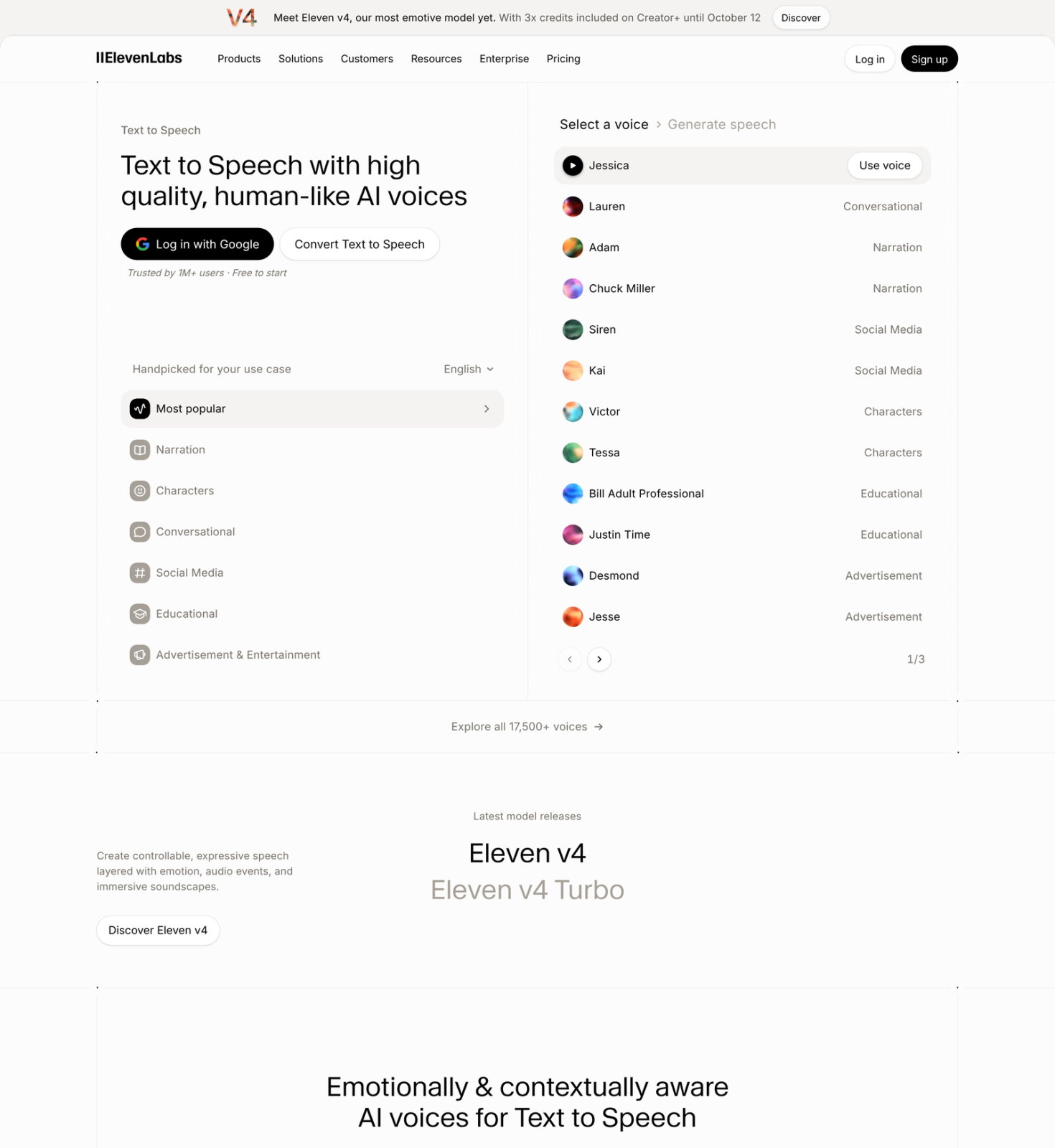
The page states the platform is trusted by over a million users. That is a vendor claim, not an audited figure, and we have not independently verified it.
Voice cloning: two tiers that are not the same thing
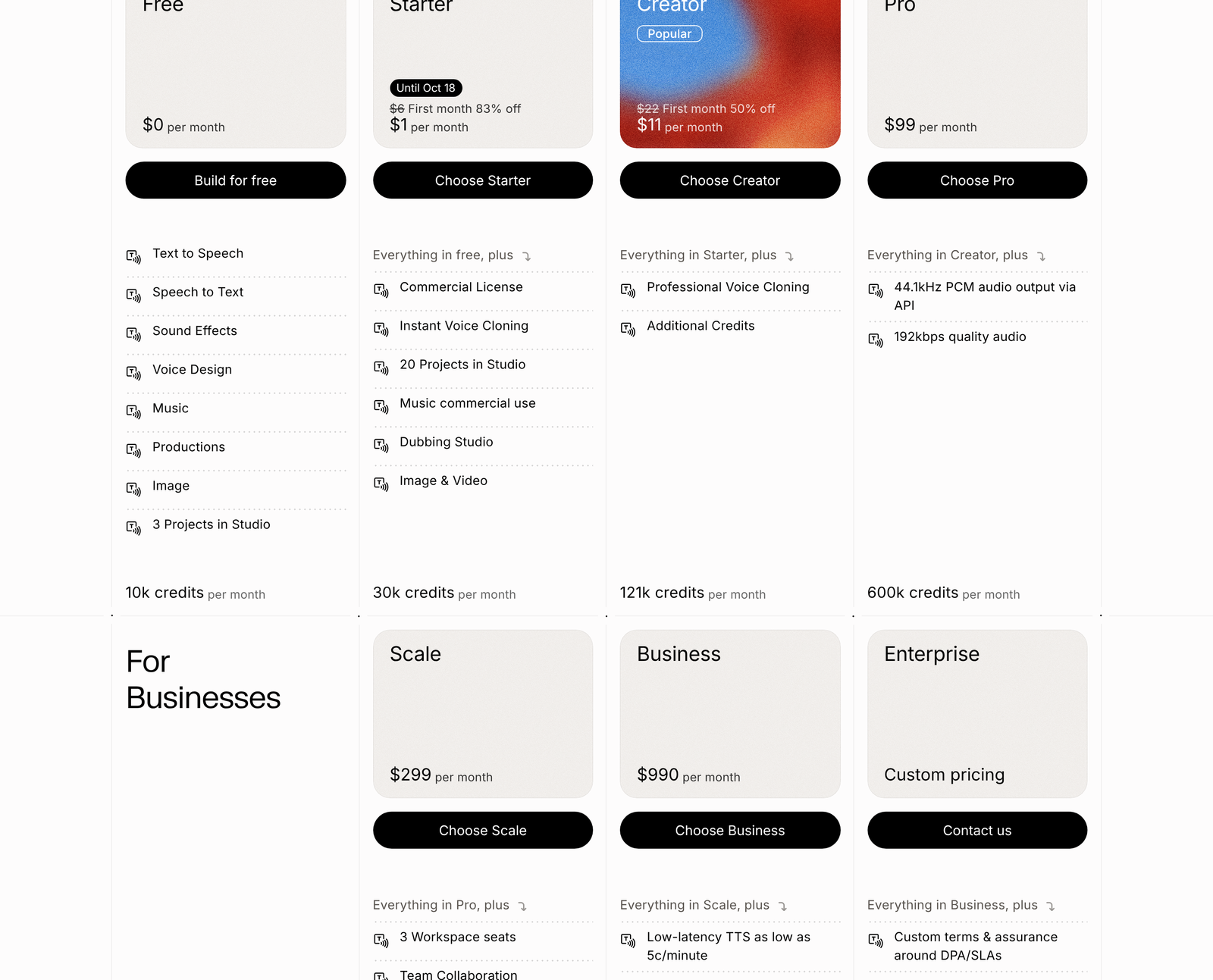
ElevenLabs sells cloning twice, and conflating the two is the most common mistake in buying decisions. Instant voice cloning appears at Starter, the $6 tier. Professional voice cloning appears at Creator, $22. The professional version requires a longer training sample and is the one you would use for a branded voice you intend to ship repeatedly.
What matters commercially is that professional clones are allocated as slots, not charged per clone. Scale at $299 includes three professional voice clones; Business at $990 includes ten. Managing voices for several brands or several characters, the slot count rather than the credit allowance is what forces you up a tier. That is worth modelling before you commit, because it is the one dimension where the next tier up is nearly a 3.3× price jump.
The credit system, and why it decides everything
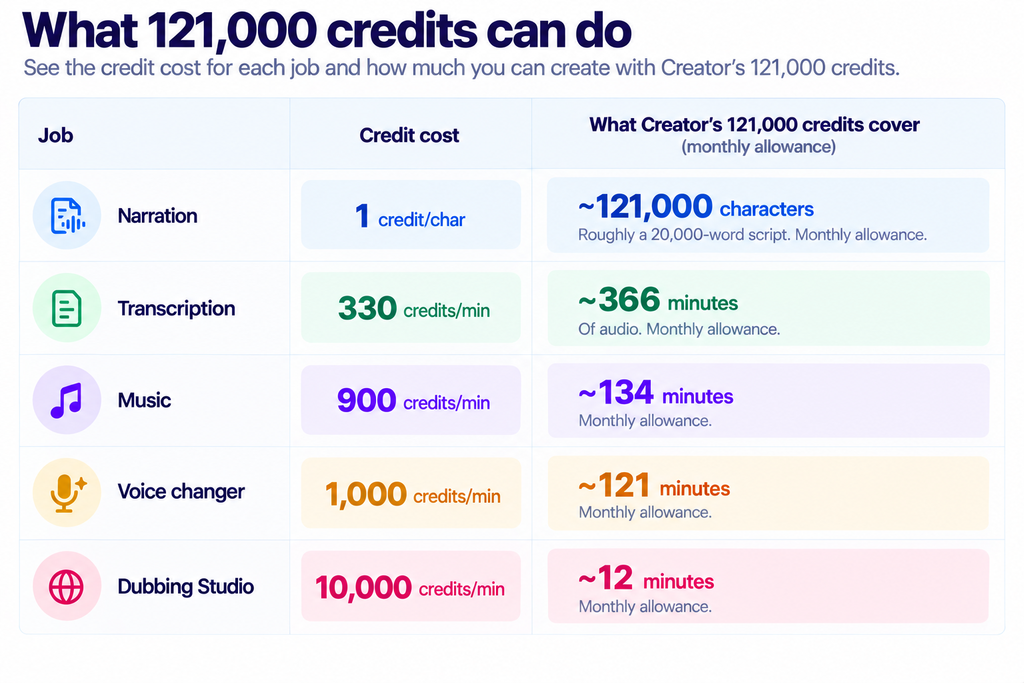
There is one monthly credit pool and every product draws on it. Published approximate costs: Text-to-Speech is 1 credit per character on the V2 Multilingual models, with the V2 Flash and Turbo English and V2.5 Flash and Turbo Multilingual models discounted to between 0.5 and 1 credit per character for API use. Speech-to-Text costs 330 credits a minute. Eleven Music costs 900 credits per minute. Sound effects cost 200 credits per generation. The voice changer and voice isolator each cost 1,000 credits a minute. Dubbing ranges from 2,000 credits a minute for automatic output with a watermark up to 10,000 for Dubbing Studio without one.
Those numbers span four orders of magnitude, which is the point. The Creator plan’s 121,000 credits is a generous narration budget and a derisory dubbing budget:
Credits roll over for up to two months on paid plans, capping a balance at three times the monthly quota. They do not roll over on Free, and downgrading or cancelling forfeits them at the end of the cycle. Upgrading, by contrast, carries unused credits forward. Charges land per generation request rather than per download, so a regeneration normally costs again, though ElevenLabs states a limited number of free regenerations may be available when the content and settings are unchanged, and the interface indicates this before you generate.
The practical consequence: size your plan on your dominant job, then check the second-most-common job does not quietly eat it. A team that bought Creator for narration and then started dubbing twenty minutes of video a month would blow through the allowance twice over.
Pricing in brief
The full breakdown is in our ElevenLabs pricing analysis; the short version, verified on both billing toggles:
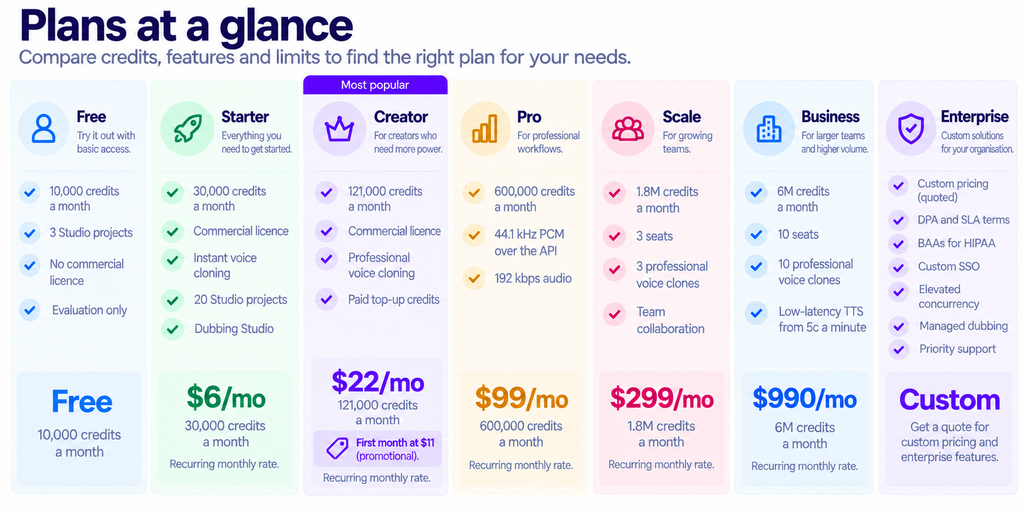
Annual billing is the monthly price multiplied by ten, a flat 16.7% saving at every tier. Taxes are excluded from all figures. Dividing price by credits puts text-to-speech at roughly $0.20 per 1,000 characters on Starter, $0.18 on Creator and $0.165 on Pro and above.
Integrations and the Agents side
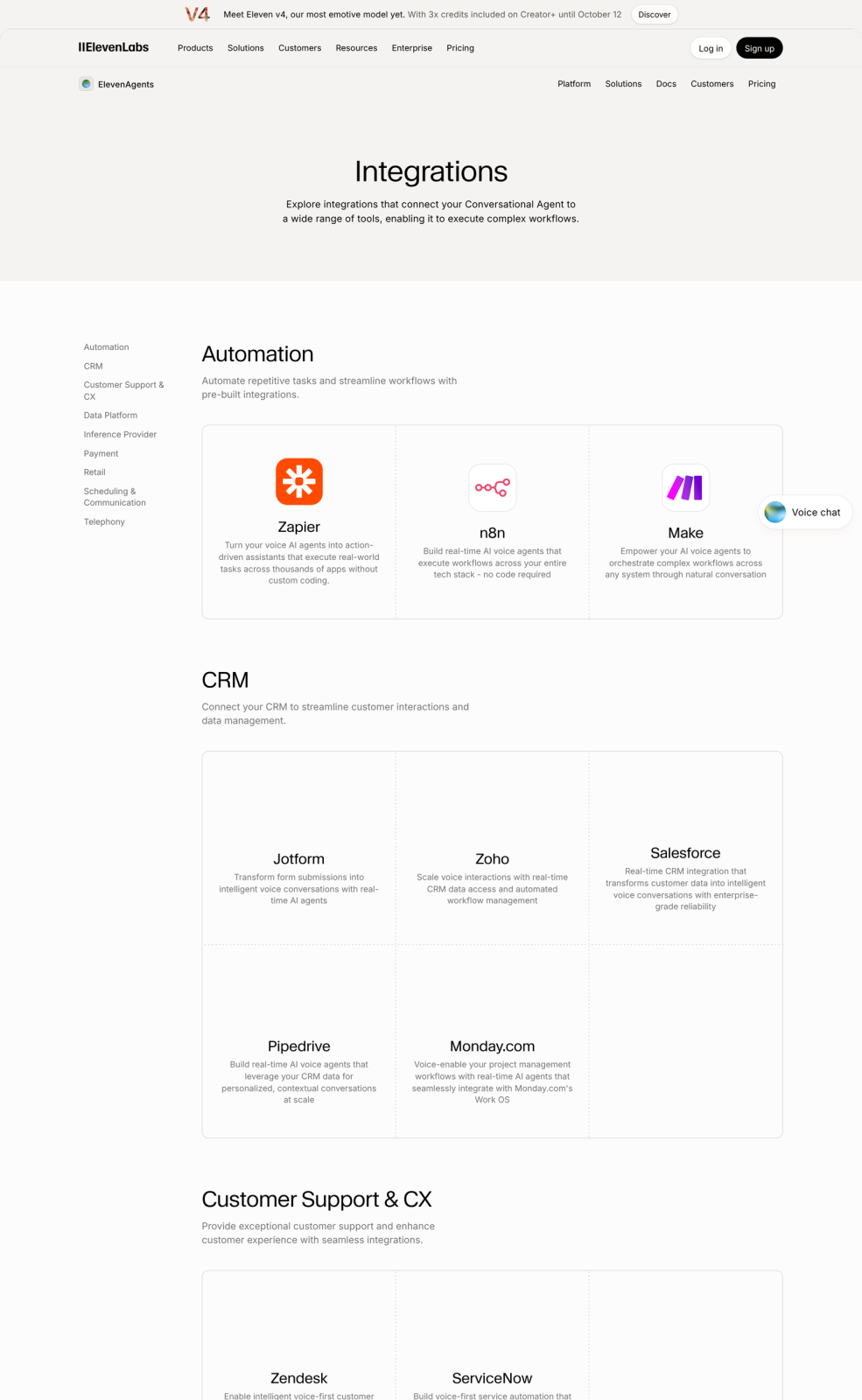
The Agents product ships a published integrations directory organised by category: automation, CRM, customer support and CX, data platform, inference provider, payment, retail, scheduling and communication, and telephony.
Named connectors include Zapier, n8n and Make for automation; Jotform, Zoho, Salesforce, Pipedrive and Monday.com for CRM; and Zendesk and ServiceNow for support. The Zapier, n8n and Make connections matter most for small teams, because they turn an agent into something that can act across other tools without custom code.
Our ElevenLabs integrations guide covers how these connect in practice. One point worth raising here: agent usage draws on the same credit pool as everything else, and a production voice agent is a continuous consumer. The Business tier advertises low-latency TTS from 5c a minute precisely because agent economics are measured in minutes of conversation, not characters of script. If you are evaluating ElevenLabs for agents rather than content, model it on conversation minutes and ignore the per-character maths entirely.
How to run a useful evaluation in a week
Most people evaluate a voice platform badly: they open the demo, play the sample script the vendor wrote, decide it sounds impressive, and subscribe. The sample script is chosen because it sounds good. Yours is not. A week of structured testing on the free tier will tell you more than a month of reading comparisons, and it costs nothing.
- Day one, bring your own worst script. Take the hardest thing you actually publish: the one with product names, acronyms, numbers, a foreign surname, and a sentence that changes meaning depending on where the stress lands. Synthetic speech fails on proper nouns and emphasis long before it fails on general fluency. Ten thousand free credits is around ten thousand characters, which is plenty for this.
- Day two, test the language you actually need, not English. Localising? The English output tells you nothing about the Polish, Tagalog, or Hausa output. Breadth of language support is a count of supported languages, not a guarantee of equal quality in each.
- Day three, watch the credit meter, not the clock. Do a representative hour of real work and then read the usage page. The number you want is credits consumed per unit of output you ship, per video, per episode, per article. That single ratio sizes your plan correctly; nothing else does.
- Day four, test your second job. If you will ever transcribe, dub or generate music, do a small amount of it and note the credit cost. This is where plans get mis-sized, because the second job is usually ten to ten-thousand times more expensive per unit than the first.
- Day five, check the licence and the seats. Confirm the commercial licence covers your actual distribution, and count how many people in your team will need their own login. Seats start at Scale. Discovering that after you have standardised on the platform is an expensive surprise.
At the end of that week you will know your credits-per-deliverable ratio, which tier it implies, and whether the voices hold up on your material. Then compare prices. Doing it in the other order is how teams end up on a plan that is simultaneously too expensive and too small.
How it compares, briefly
A fuller treatment is in our alternatives comparison, but the shape of the market is worth stating here, because it explains the pricing.
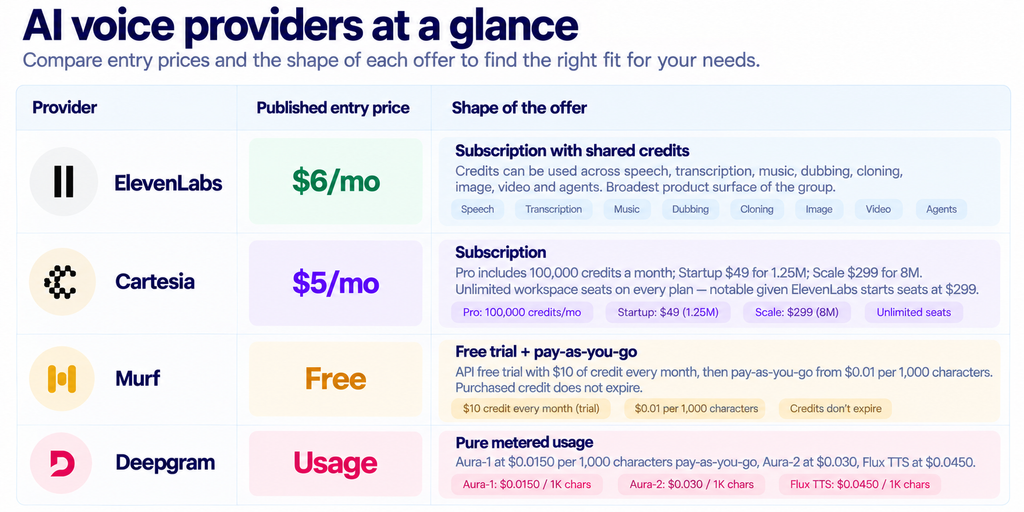
Two things fall out of that table. The seat limit is the sharpest competitive weakness, Cartesia gives unlimited workspace seats on a $5 plan where ElevenLabs withholds a second seat until $299. And the metered providers are not competing for the same buyer: they sell synthesis to engineers, not a studio to creators. Choosing between them is a question about what you are building, not which is better value per character.
Where it falls short
- Per-character cost against metered providers. Deepgram publishes $0.0150 per 1,000 characters for Aura-1 on pay-as-you-go and $0.0135 on its Growth plan; Murf publishes $0.03 per 1,000 characters for studio-quality API output and $0.01 for its lower-latency Falcon model. Against the roughly $0.18 implied by the Creator plan, that is a wide gap. You are paying for a platform, but if you only use one corner of it the premium is real.
- Shared credits make budgeting harder, not easier. A single pool is convenient until two teams share an account and one of them starts dubbing. There is no per-product allocation to protect a budget.
- Seats start late. Nothing below Scale at $299 includes a second seat. For a two-person studio, the jump from Creator at $22 to Scale at $299 to get one extra login is steep, and sharing a login is the obvious but unwise workaround.
- Starter has no top-up. Additional credits are available from Creator upward. Starter’s 30,000 credits a month is a hard ceiling, so a busy month forces an upgrade rather than a one-off purchase.
- Downgrade forfeits credits. Rollover sounds generous until you read that cancelling or downgrading wipes the accumulated balance at the end of the cycle. Banked credits are not an asset you can cash out.
Where it is clearly the right choice
- Multilingual work. Seventy-plus languages in one product, including a long tail that most competitors do not touch, with dubbing in the same account. If localisation is your job, the breadth is decisive.
- Mixed-media production. If one project needs narration, sound effects, a music bed, and a transcript, doing all four on one balance in one interface removes four separate procurement conversations.
- Branded voice work. Professional voice cloning plus the slot allocations at Scale and Business is a coherent story for an agency managing several client voices.
- Regulated buyers. The Enterprise tier exists for exactly the things a security review asks about, custom DPA and SLA terms, BAAs for HIPAA customers, custom SSO, elevated concurrency. Those are contract terms you cannot buy at any credit volume on a lower tier.
Company standing
Worth knowing if you are putting ElevenLabs into a dependency chain. The company raised a $500m Series D at an $11bn valuation in February 2026, led by Sequoia Capital with Andreessen Horowitz, Iconiq, Lightspeed, Evantic Capital and Bond participating, according to Silicon Republic. ElevenLabs has since published that an employee tender valued the company at $22bn. The research firm Sacra estimates it reached $600m ARR in June 2026, up from an estimated $330m at the end of 2025. An estimate, not a disclosure, and should be read as one.
The company has also been the subject of litigation over voice impersonation, and has since launched a marketplace of licensed celebrity voices. Cloning a voice that is not yours means reading the licensing terms carefully rather than relying on the product being available.
Verdict
ElevenLabs is the strongest general-purpose AI audio platform available to a small team, and it is not the cheapest way to do any single thing it does. Both of those statements are true at once, and which one matters depends entirely on how many of its products you will actually open.
Buy it if your work spans more than one audio job, if you localise, or if you need professional voice cloning with managed slots. Look at metered providers if you need synthesis through an API and nothing else. Look at the Enterprise tier, not a bigger subscription, if your blocker is a DPA or a BAA.
The sensible way to decide costs nothing: the Free tier gives 10,000 credits without a card. Run your own script (not a demo script) through the voices you would ship, and watch which product consumes the credits. That single test answers both the quality question and the sizing question. Start on the ElevenLabs free tier and upgrade when the usage page tells you which tier you need.
Frequently asked questions
Is ElevenLabs free?
There is a genuinely free tier with 10,000 credits a month and no card required, covering text to speech, speech to text, sound effects, voice design, music, Productions, image and 3 Studio projects. It carries no commercial licence, so output cannot be used in paid work. Starter at $6 a month is the cheapest tier that does.
How many languages does ElevenLabs support?
The text-to-speech language selector lists seventy or more, spanning the major European and Asian languages plus a long tail including Armenian, Assamese, Cebuano, Chichewa, Galician, Hausa, Igbo and Javanese.
What is the difference between instant and professional voice cloning?
Instant voice cloning is available from the Starter tier and works from a short sample. Professional voice cloning starts at Creator, needs a longer training sample, and is allocated as slots on the team tiers, three on Scale, ten on Business.
Does ElevenLabs charge per character or per subscription?
Per subscription, with bundled credits. Text-to-speech consumes roughly 1 credit per character on the V2 Multilingual models. Dividing a plan’s price by its credits gives an effective rate of about $0.18 per 1,000 characters on Creator.
Can two people share an ElevenLabs account?
Not without the team tiers. Workspace seats begin at Scale ($299 a month, 3 seats); Business includes 10. Free, Starter, Creator, and Pro are single-user plans.
Is ElevenLabs HIPAA compliant?
Business Associate Agreements for HIPAA customers are listed as an Enterprise feature, alongside custom DPA and SLA terms and custom SSO. They are not available on the self-serve tiers.
What happens to unused credits?
On paid plans, they roll over for up to two months, capping a balance at three times the monthly quota. They do not roll over on Free. Downgrading or cancelling forfeits them at the end of the billing cycle. Pay-as-you-go top-up credits sit outside that cap.
Is ElevenLabs good for voice agents?
It has a dedicated Agents product with a published integrations directory covering Zapier, n8n, Make, Salesforce, Pipedrive, Zoho, Monday.com, Zendesk and ServiceNow. Price it on conversation minutes rather than characters; the Business tier advertises low-latency TTS from 5c a minute for exactly this workload.
Sources
- Plan prices, credits, per-product credit costs and rollover terms: elevenlabs.io/pricing, both billing toggles captured 2 October 2026.
- Product list and language coverage: elevenlabs.io/text-to-speech.
- Integrations directory: ElevenLabs Agents integrations.
- Funding and investors: Silicon Republic, 5 February 2026.
- Revenue estimates: Sacra, independent estimate, not a company disclosure.
- Competitor rate cards cited in the weaknesses section: Deepgram pricing and Murf pricing, both captured 2 October 2026.
- Affiliate link used on this page: ElevenLabs.
We have not conducted a blind listening test of ElevenLabs against its competitors, and we do not publish subjective audio-quality scores we cannot reproduce. The assessment above is of the offering, its economics and its documented constraints. Verify prices before you commit; they change.