


Quick answer: Gushwork is sold as one system rather than a feature menu. Every plan includes the full agent suite, and the company names nine agents on its homepage: Memory, Research, Strategy, Content, Authority, Refresh, Design and Development, Follow-up, and Paid Boost. Underneath them sit three products you can inspect individually: Brand Memory, the Page Creation Engine, and the lead dashboard. Pricing starts at $900 a month, billed monthly, with no feature tiering to decide between.
Disclosure: Stack99 earns a commission if you buy through links on this page. It costs you nothing extra and never changes our assessment.
There is only one feature set
Most software comparisons start by mapping features to tiers. Gushwork removes that exercise. Its pricing page states that every plan includes the full system, and the only published figure is a starting price of $900 a month billed monthly, cancel anytime. Our breakdown of what $900 a month buys covers the commercial side.

So the useful question is not which features you get. It is what the agents do, which of them you will actually lean on, and where the published material stops short of telling you.
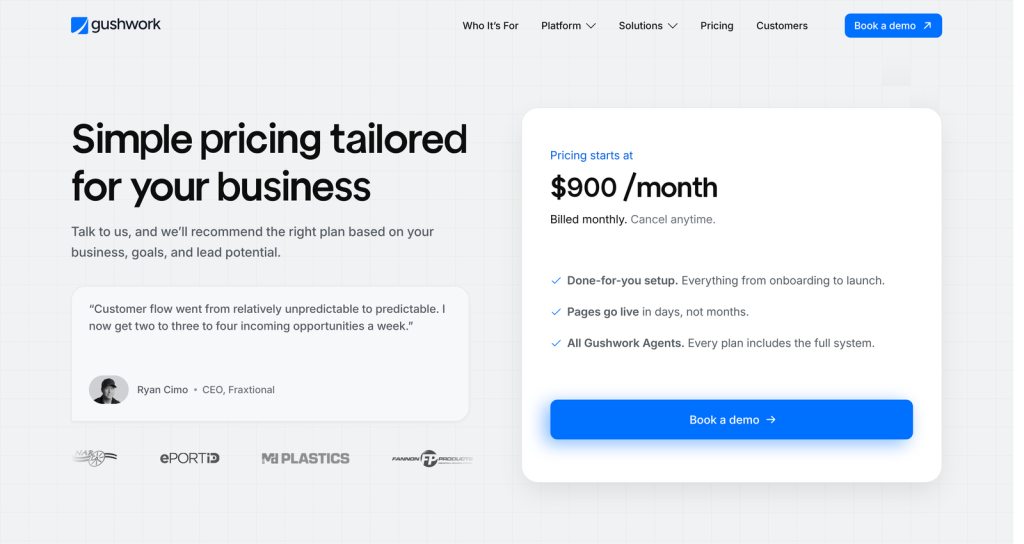
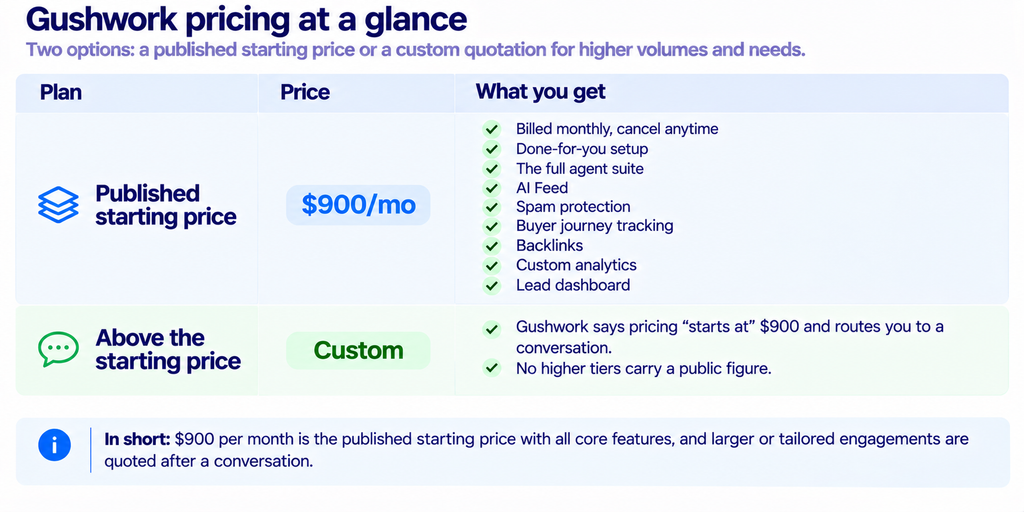
Captured from Gushwork’s pricing page on 5 November 2026. Unlike most vendors, there is no billing toggle or feature ladder, so the only variable the public page shows is where you land above the floor.
The nine agents, and what each one is for
Gushwork’s homepage describes each agent in a sentence. Paraphrasing loses the precision, so here is what the company says each one handles, with our reading of what that means for a buyer.
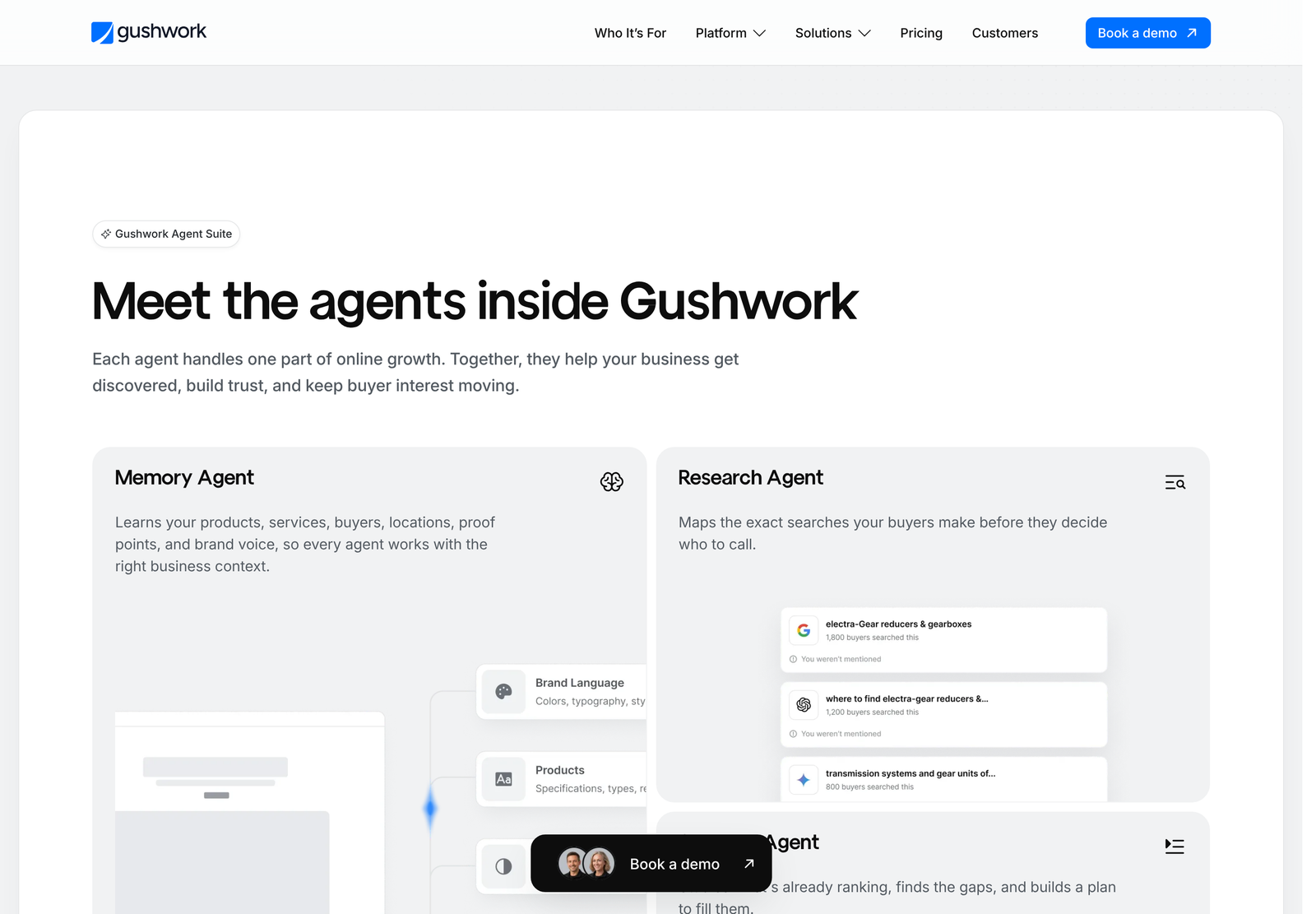
- Memory Agent. Learns your products, services, buyers, locations, proof points, and brand voice so the other agents work with the right context. This is the dependency everything else sits on.
- Research Agent. Maps the searches your buyers make before they decide who to call. Keyword discovery, framed around purchase intent rather than volume.
- Strategy Agent. Studies what already ranks, finds the gaps, and builds a plan to fill them. Competitive gap analysis turned into a publishing queue.
- Content Agent. Creates pages around real buyer searches and publishes them to your site automatically. The automatic publishing step is the one to interrogate, covered below.
- Authority Agent. Builds backlinks and citations. Link acquisition is the part of this suite with the most variable quality across the industry, and the public pages do not describe the method.
- Refresh Agent. Keeps improving pages after they go live as buyer searches and AI answers change. Maintenance rather than production, and arguably the most valuable agent for anyone who has watched a content programme decay.
- Design and Development Agent. Builds and optimises the website itself so visitors understand the offer and act on it.
- Follow-up Agent. Helps interested buyers get faster responses and keeps conversations from going cold.
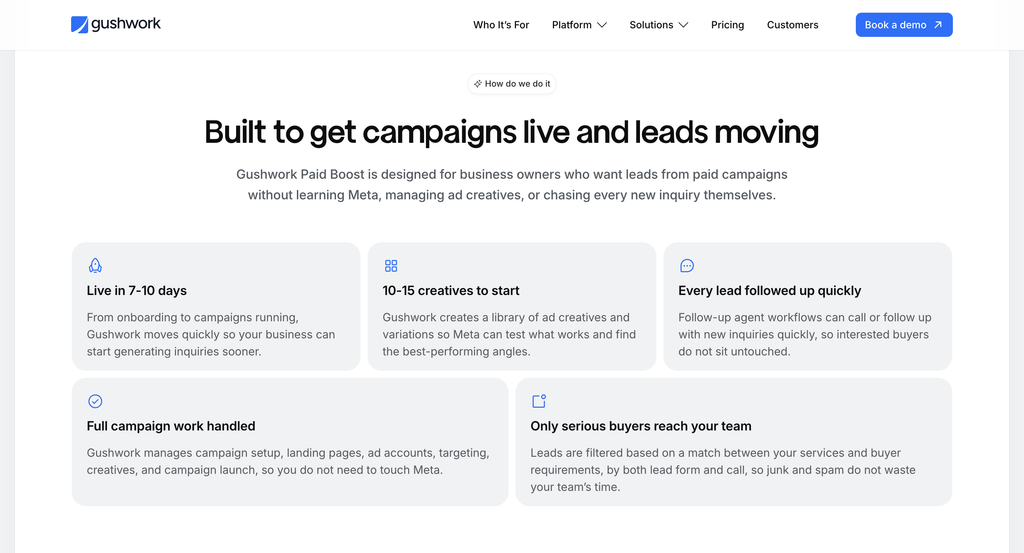
- Paid Boost Agent. Runs paid campaigns so pipeline keeps moving while organic presence builds.
A tenth is referenced separately: a Lead Qualification Agent that marks each inbound lead as qualified or spam. Gushwork also uses slightly different names in different places, with Design and Developer listed as two agents in one section and merged in another, and Lead Conversion appearing where Follow-up does elsewhere. The naming is not settled. Ask for the current list during a demo rather than counting from the homepage.
Brand Memory is the feature that makes the rest work
Gushwork gives Brand Memory its own page and describes the problem it solves bluntly: most AI tools start from scratch every time, so you explain your business over and over. Four components store that context once.
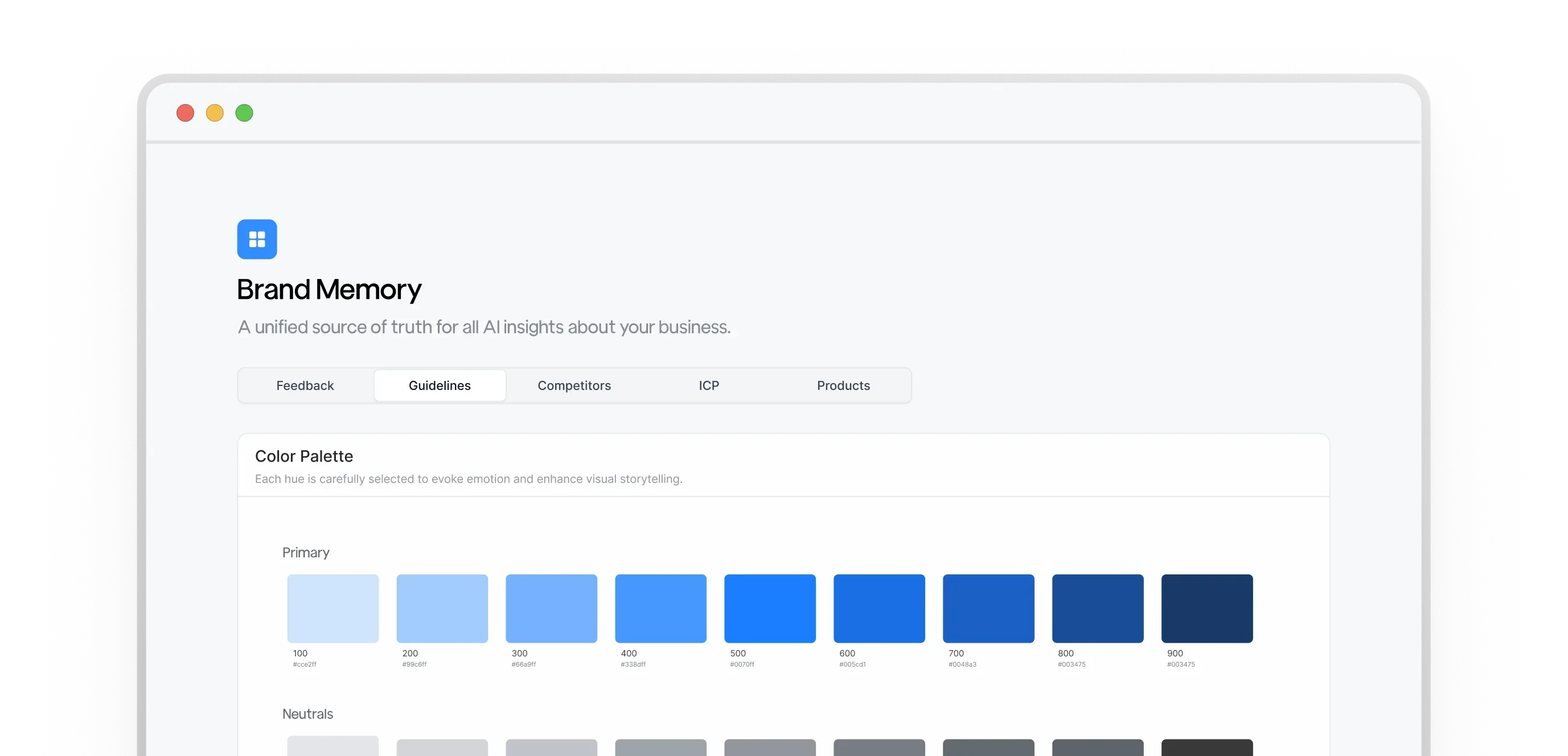
- Product and Service Library. Your full list of products, services, features and pricing, structured so the AI does not invent details.
- Buyer Profile. Job titles, industries, pain points and buying triggers, stored once and applied to every piece of content.
- Brand Kit. Fonts, colours, tone of voice and terminology preferences, so output matches the brand without manual review.
- Feedback Memory. Corrections you make are saved permanently. Fix something once and it stays fixed everywhere.
Feedback Memory deserves attention from anyone who has run an AI content programme before. The usual failure mode is not bad first drafts; it is correcting the same mistake in draft after draft until somebody quietly stops reviewing. A system that commits corrections permanently addresses the thing that actually kills these programmes.
The claim that structuring your products stops the AI inventing details is a claim about grounding, and it is the right ambition. Whether it holds at volume is something to test against your own technical specifications during onboarding, particularly if you sell products where a wrong number has consequences.
The Page Creation Engine, step by step
Gushwork numbers the stages of its content pipeline on a dedicated page, framing the goal as pages built for AI crawlers and human readers at the same time.
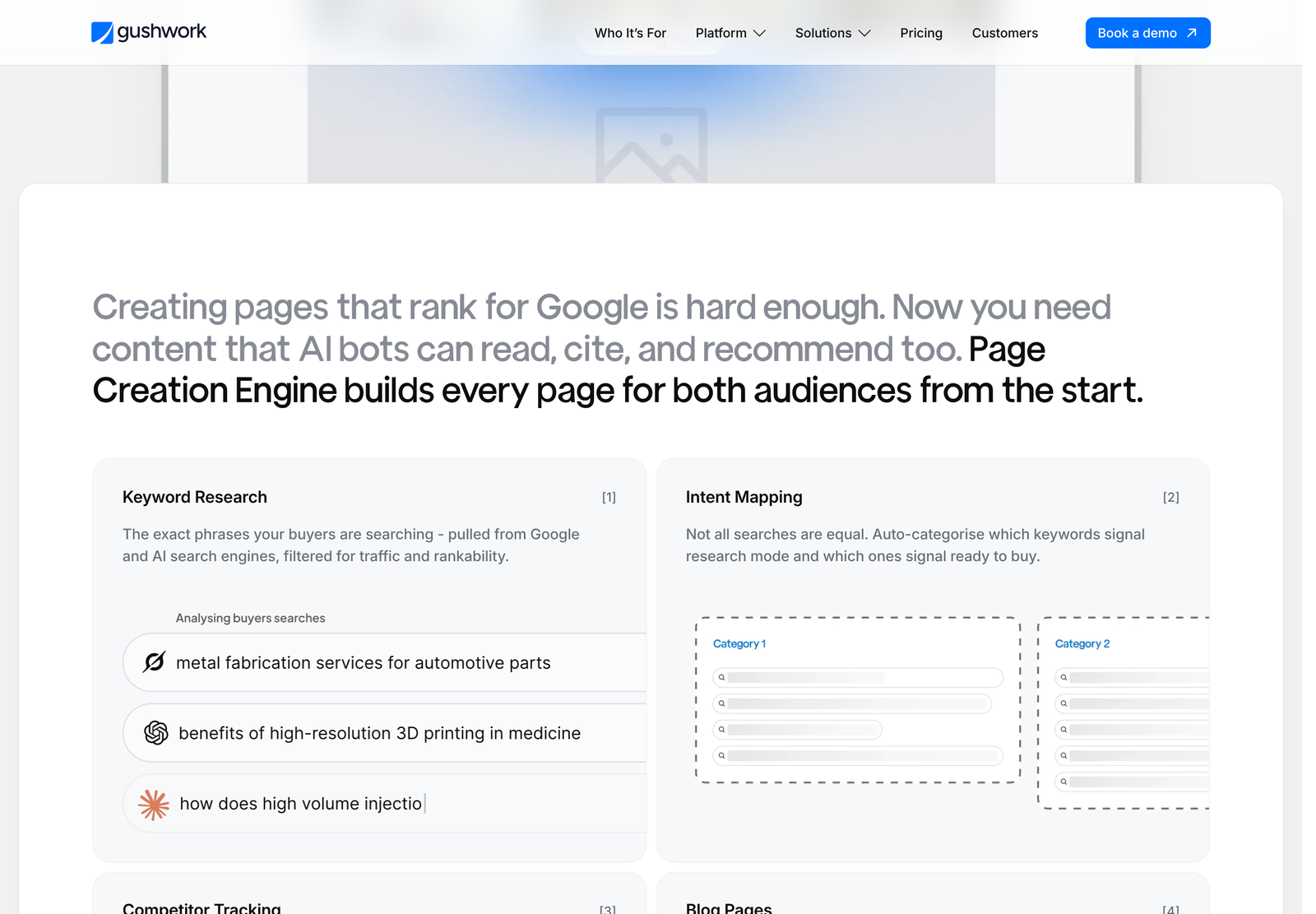
- Keyword Research. Phrases pulled from Google and from AI search engines, filtered for traffic and rankability.
- Intent Mapping. Automatic categorisation of which searches signal research mode and which signal readiness to buy.
- Competitor Tracking. What competitors rank for, what drives their traffic and where they are vulnerable.
- Blog Pages. Long-form articles built on the keyword research.
- Service Pages. A dedicated page per service, benefit-focused and structured for AI comprehension.
- Infographics. Visual assets produced alongside the written pages.
Pulling keywords from AI search engines as well as Google is the differentiating claim here. Buyers increasingly ask a model rather than a search box, and a programme optimising only for classic blue links is solving last decade’s problem. Gushwork sells a free AI Search Grader on a separate page if you want to see how your site currently fares before committing to anything.
The volume claim, and what it implies
Gushwork’s pricing page lists “100+ high-quality pages published in 6 months” as something included with every plan. Divide it out, and that is roughly seventeen pages a month, or four a week.
Against $900 a month, 100 pages over six months works out to near $54 a page on the $5,400 total. Agency rates for a researched service page sit well above that in most markets, so the arithmetic is the pitch. Against an in-house writer, the comparison depends entirely on whether those pages rank and convert, which no vendor can promise, and this one does not.
Four pages a week published automatically to your site is also a governance question. Ask who approves before publication, whether approval can be made mandatory, and how a page is pulled if it is wrong. The Content Agent’s description says it publishes automatically. For a regulated business, or one where a factual error carries liability, that default needs checking before contracts are signed.

What ships with every plan
Beyond the agents, the pricing page names six inclusions.
- AI Feed. The publishing stream behind the 100+ pages figure.
- Spam protection. Junk filtered before it reaches your team.
- Buyer journey tracking. Visibility into what each lead read before they got in touch.
- High-quality backlinks. Authority signals, method unstated.
- Custom analytics views. Reporting configured to your numbers.
- Lead dashboard. Every inquiry, lead status, and buyer journey in one place.
Buyer journey tracking paired with the lead dashboard is the part that separates this from a content service. Knowing a lead read three service pages and a case study before calling changes the first conversation, and it is the evidence you need to judge whether the publishing is working at all.
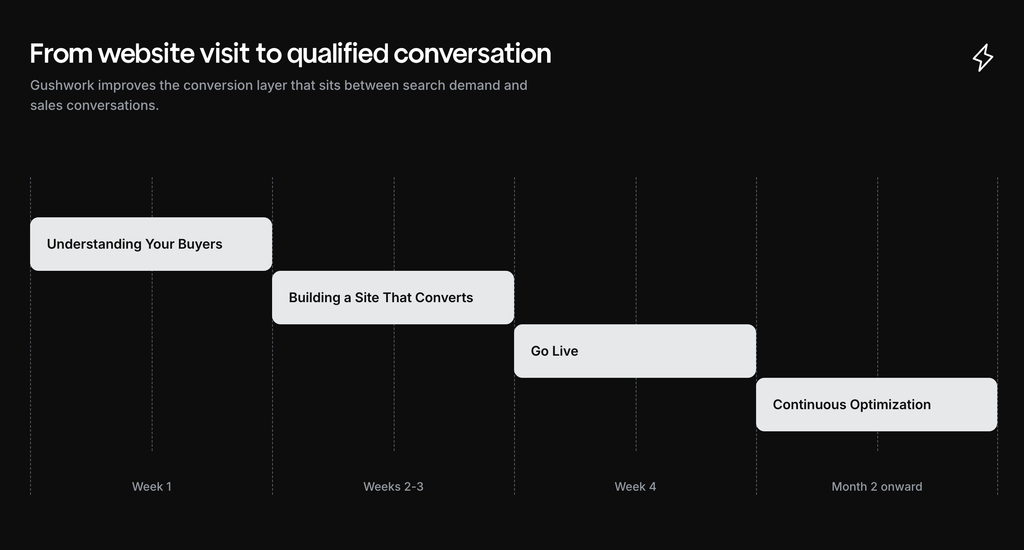
Done-for-you setup is also listed, covering onboarding through to launch, with pages going live in days rather than months. Treat that as the vendor’s stated intent rather than a service level, since no timeline is contractual on a public web page.
The results Gushwork publishes
Three headline figures sit on the homepage: more than 1,000 companies, more than 8,000 leads generated a month, and more than $10 million in revenue influenced. These are company claims, not audited figures, and “revenue influenced” is a marketing attribution term rather than an accounting one.
Named customers appear with named outcomes. Greg Jones, President of Midwest Power Products, is quoted on twelve leads in the first month. Ryan Cimo, CEO of Fraxtional, says the first deal more than paid for the annual investment. Gushwork attaches its own disclaimer: these are individual customer outcomes, and results vary with market, competition, and available search demand.
Credit where it is due for printing that caveat. It also points at the real qualifying question. The whole system depends on buyers searching for what you sell. If your category has thin search demand, no number of published pages fixes that, and the agents have nothing to work with.
Who the feature set fits
Gushwork’s own positioning is businesses that want marketing output without hiring a team or retaining an agency. Its published case studies skew towards industrial and service companies: plasma cutting, packaging, equipment supply, manufacturing.
That skew makes sense. A specialist manufacturer has real buyers running specific searches, no marketing department, and a website nobody has touched in four years. Memory, Research and Content together address exactly that gap, and the Design and Development Agent matters more for such a business than it would for a software company with a competent site already.
Teams with an existing content function will find the overlap awkward. You are buying a system that wants to own research, production, publication, and refresh. Handing it only part of that chain removes most of the argument for the price.
Businesses selling something nobody searches for are the clearest mismatch, and so are those needing approval workflows the public pages never mention. Demand has to exist before a system can capture it, and no amount of publishing conjures searches that nobody performs. Run the free AI Search Grader against your own domain first. If it surfaces almost nothing, the constraint is your category rather than your content, and $900 a month will not move it.
The rest of the product surface
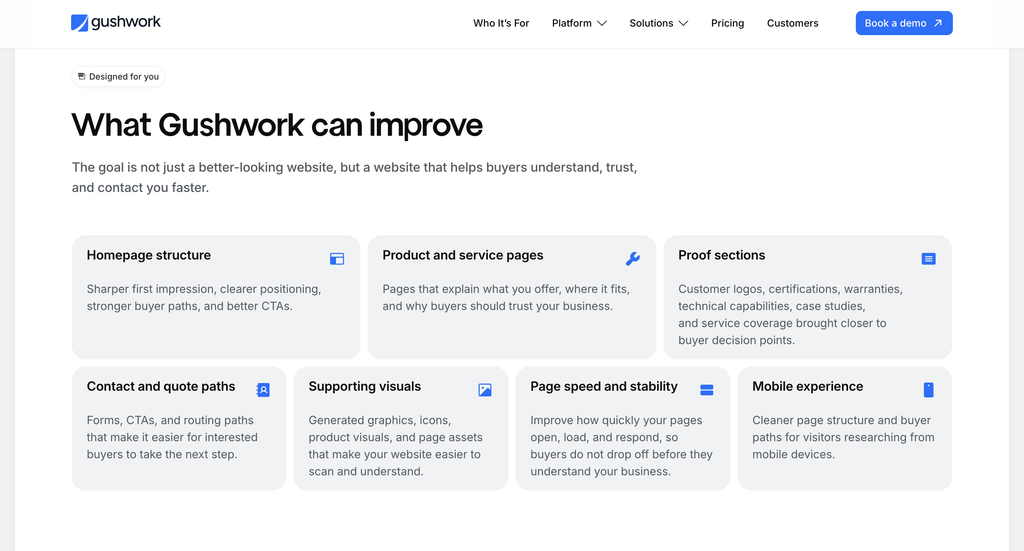
Beyond the agent suite, Gushwork maintains separate pages for several named components. They reveal where the product is heading, which matters more than the feature list itself.
- AI Feeds. The publishing stream itself, referenced on the pricing page as the mechanism behind the page volume.
- AI-first CMS. Gushwork’s own content management layer. Its existence raises the question of whether the publishing step works equally well against a site you already run.
- AI Search Grader. A free benchmarking tool, usable before you buy anything.
- Analytics and Leads Dashboard. Two separate pages covering reporting and lead tracking.
- Website Security Check. Another free tool, sitting slightly apart from the core proposition.
- Solutions pages. Three named motions: AI search, lead conversion, and paid boost.
Two free tools at the top of the funnel and a proprietary CMS at the bottom is a recognisable shape. Use the graders by all means. Ask about the CMS early, because migrating a site is a far larger commitment than buying a content programme.
How this compares with the alternatives in approach
Three ways to buy this outcome, and Gushwork is explicit about which it is replacing.
An agency retainer buys judgement and accountability. Someone answers the phone when a page says the wrong thing, and strategy is argued rather than generated. You pay several times $900 a month in most markets, and you wait longer for output.
An in-house hire buys context no system can hold. A marketer who understands the product catches errors a Brand Memory entry never will. One salary dwarfs this price and arrives with recruitment risk and a ramp period.
A tool stack buys control and costs coordination. Research in one product, writing in another, publishing in a third, reporting in a fourth, and a person stitching them together. Gushwork’s marketing names this directly as the scattered tool stack it wants to replace.
What the agent model actually offers is consistency without headcount. Pages keep appearing, old ones keep getting refreshed, and nobody has to remember to do it. What it gives up is the judgement call. A manufacturer with no marketing function at all should read that trade favourably, because the realistic alternative is nothing happening. For a company that already has someone good doing this work, the same trade reads as a downgrade.
Price it against your actual counterfactual rather than against the best case. If the honest comparison is an empty blog and a website last touched in 2022, $900 a month is a different proposition than if it is a competent marketer you already employ.
What we could not verify
Several things the public pages leave open, which we have not filled in with assumptions.
- What sits above the $900 starting price. Gushwork says “starts at” and routes you to a conversation, so tiers above it exist but carry no published figures.
- How the Authority Agent acquires backlinks. No method is described anywhere publicly, and link building is where quality varies most.
- Whether content approval can be made mandatory before publication.
- Which CMS platforms the publishing step supports. An AI-first CMS has its own page, which suggests Gushwork may prefer you on its own stack.
- Contract length. Cancel anytime is stated against the monthly price, while one testimonial references an annual investment.
Each is a sensible demo question. You can book a Gushwork demo to put them directly, and we would push hardest on approval controls and backlink method.
Frequently asked questions
How many agents does Gushwork have?
Nine are named with descriptions on the homepage agent suite: Memory, Research, Strategy, Content, Authority, Refresh, Design and Development, Follow-up, and Paid Boost. A Lead Qualification Agent is referenced separately, and the naming varies between sections of the site.
Do cheaper Gushwork plans have fewer features?
No. Gushwork states that every plan includes the full system, so the agent suite does not vary by tier. Pricing starts at $900 a month and is billed monthly.
How many pages does Gushwork publish?
The pricing page states 100+ high-quality pages published in six months as an inclusion on every plan, which averages roughly seventeen a month.
What is Brand Memory in Gushwork?
A stored context layer holding your product and service library, buyer profile, brand kit and a feedback memory that keeps corrections permanent. Every other agent reads from it so you do not re-explain your business each time.
Does Gushwork run paid ads as well as SEO?
Yes. The Paid Boost Agent runs paid campaigns so pipeline keeps moving while organic presence builds, and Gushwork publishes a separate paid boost solution page.
Does Gushwork optimise for AI search?
That is its stated positioning. The Page Creation Engine pulls keywords from AI search engines as well as Google and builds pages for AI crawlers and human readers. Gushwork publishes a free AI Search Grader to benchmark a site.
Sources
- Gushwork homepage, agent suite descriptions and headline claims, captured 5 November 2026.
- Gushwork pricing, the $900 starting price and the per-plan inclusions.
- Gushwork Brand Memory, the four stored context components.
- Gushwork Page Creation Engine, the numbered content pipeline.
- Gushwork case studies, including the named customer outcomes and the company’s own results disclaimer.