


Quick answer: Pingtree is a lead generation platform built around distribution: capturing traffic, validating it, then routing each lead to buyers through ping-post waterfalls with caps and filters. Entry is $499 a month for self-service, with a managed option starting at $2,500. An AI copilot called Ivy drafts funnels and routing from plain English prompts, with approval required before anything goes live. The platform aims squarely at regulated verticals, and its documentation lists a Blacklist and DNC API alongside credit-pull and consent integrations. At $499 a month, this is a volume product, so the price only works if you are moving leads in real quantity.
Disclosure: Stack99 earns a commission if you buy through links on this page. It costs you nothing extra and never changes our assessment.
What Pingtree is for
Pingtree’s own documentation opens by calling it an all-in-one lead generation platform that simplifies traffic capture, validation, routing, and analytics in one place. The name tells you where the weight sits. A ping tree is the mechanism lead sellers use to offer a lead to buyers in sequence, pinging each in turn until one accepts and the lead is posted across.
That makes this a different animal from the tools most marketing teams know. A CRM stores the people you have. A marketing automation platform nurtures them. Pingtree exists to decide, in the moment a form is submitted, which buyer should receive that lead and at what price.
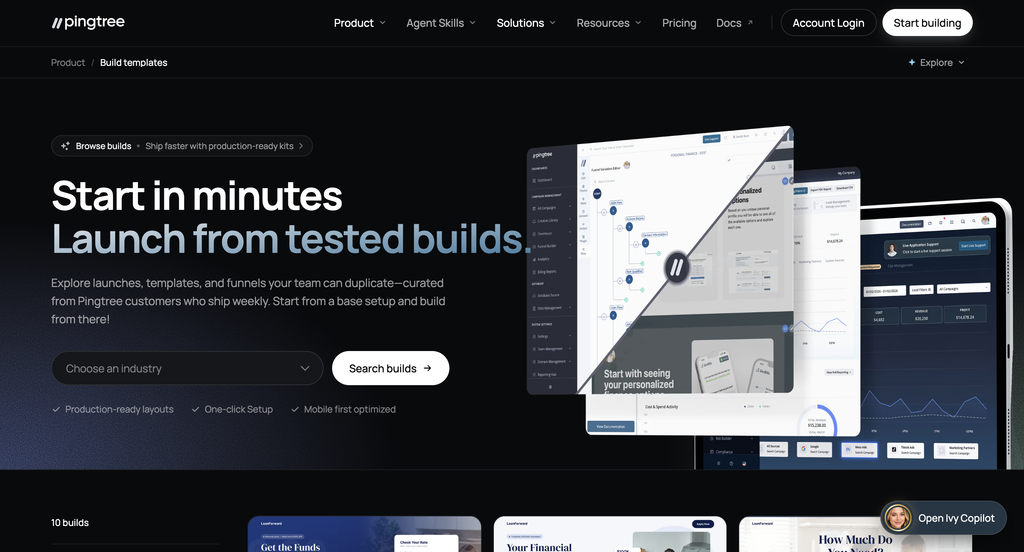
The documented use cases confirm the audience. One covers sourcing traffic as an affiliate or marketing partner. The other covers buying and monetising leads as an advertiser. Both sides of a lead marketplace, in other words, running on the same software.
How the pieces fit
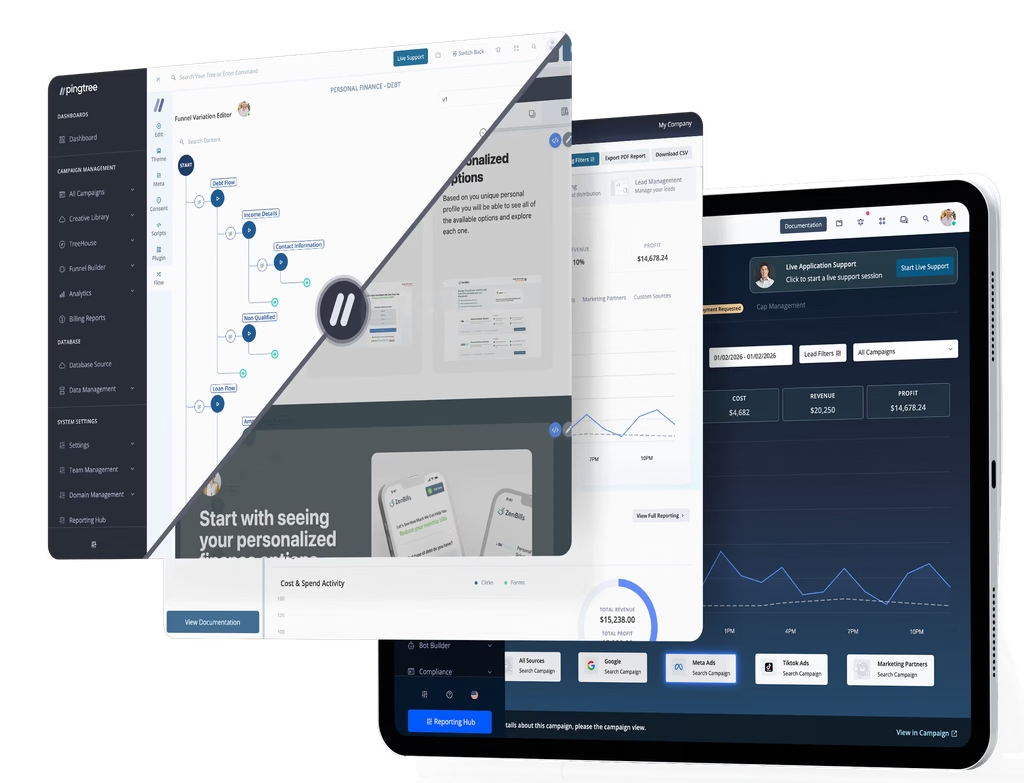
The product page sets out a three-stage flow. Your sources feed in at one end: paid media across Meta, Google, TikTok and others, affiliate and publisher traffic, plus owned channels covering forms, calls as well as direct mail. Pingtree sits in the middle as what it calls an intelligence layer, mapping and validating, then routing and optimising, then monetising. Your own ecosystem sits at the far end, with CRM sync, workflows, APIs, and attribution.
Five modules carry that flow:
- Funnel builder. Multi-step forms and landing pages on a drag-and-drop canvas, with mobile-ready templates and A/B splits built in.
- Media tracking. Cross-channel pixels, UTM parameters and click IDs, with real-time event sync, so routing and reporting draw on the same source data.
- Distribution. Ping and post leads to buyers in a waterfall, with caps, filters plus what Pingtree describes as contract-safe routing.
- Analytics. Attribution across spend, creative plus conversions, with creative fatigue signals and reports the company positions as finance-ready.
- Copilot. Prompt-driven building, with a human approval step before anything ships.
Distribution is the module that justifies the platform. Everything else has credible standalone competitors; relatively few tools will run a real-time buyer waterfall with per-buyer caps and contract rules attached.
What a ping-post waterfall actually does
Anyone evaluating this platform without a lead generation background should understand the mechanism the product is named after, because it explains why the software costs what it does.
A consumer submits a form. Rather than selling that lead to one predetermined buyer, the platform pings a queue of buyers in order, passing a partial record so each can decide whether it wants the lead and what it will pay. The first buyer to accept at an acceptable price gets the full record posted across. All of this happens while the consumer is still on the thank-you page.
Ordering the queue is where the money is. Suppose one buyer pays $42 but accepts only 30% of what you send, while another pays $31 and accepts 70%. Ping the first and your expected value is $12.60 a lead; ping the second and it is $21.70. Sequence them properly, offering to the first and falling through to the second, and the expected value climbs to about $27.79, since 49% of all leads reach the second buyer and convert there. Those figures are illustrative rather than anything Pingtree publishes, but the shape is real, and it is why waterfall ordering is worth paying software to manage.
Caps and filters exist because buyers impose them. A buyer might take 200 leads a day from three states and nothing more, and breaching that is a contractual problem rather than a technical one. Pingtree’s phrase contract-safe routing describes encoding those limits so the system cannot sell what a buyer will not honour.
This also explains the compliance tooling. Running a suppression check after a lead has already been posted to a buyer is useless, so scrubbing has to sit inside the same real-time path as the routing decision.
What the documentation reveals
Marketing pages describe ambitions. Documentation describes what was actually built, which is why we read it.
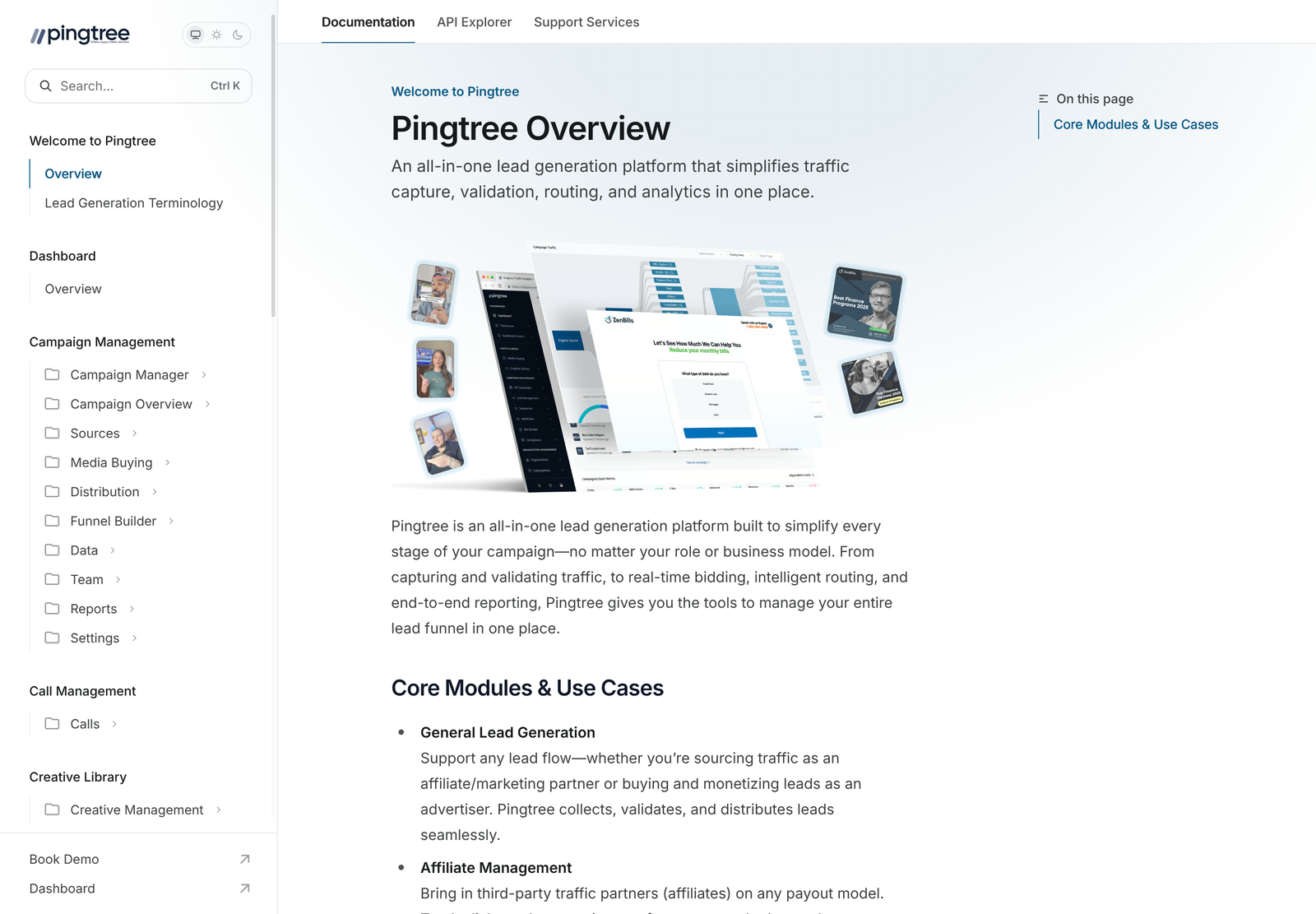
Pingtree’s docs are organised into campaign management covering sources, media buying, distribution, funnels, data, teams and reports; call management; a creative library; analytics with pivot and hourly reports; account billing; a system database; a reporting hub; a marketing partner portal with its own partner dashboard; and domain management.
Two entries stand out. A separate partner portal with its own dashboard means affiliates get their own login rather than emailed reports, which matters if publishers are a real part of your supply. Domain management as a first-class module suggests customers run many landing domains at once, which is normal in this industry and awkward in generic page builders.
The integrations list is the most revealing part. Four entries appear: Array Credit Pull, an eConsent integration, Spinwheel Credit Pull by SMS Verification, and a Blacklist and DNC API. Two credit bureau pulls and a consent record tell you plainly which verticals this was built for. Pingtree names them on its own site as financial services, insurance, home improvement, and legal and accounting.
The compliance surface
Lead generation in those verticals carries obligations that generic marketing tools ignore. Anyone buying this platform should understand what the shipped integrations are there to support.
The Federal Trade Commission’s Telemarketing Sales Rule sets out the framework United States telemarketers work within. Its provisions cover the National Do Not Call Registry, an entity-specific do-not-call obligation requiring sellers to honour direct requests, a safe harbour for sellers who meet defined conditions, and exemptions including one for an established business relationship.
Pingtree shipping a Blacklist and DNC API is therefore a substantive feature rather than a checkbox. Scrubbing against suppression lists before a lead is routed is the mechanism by which those obligations get met at machine speed. The eConsent integration points the same way, toward recording what a consumer agreed to and when.
Our caution: shipping an API is not the same as being compliant. The platform gives you the hooks; your legal obligations stay yours, and the rules governing consent for regulated lead generation have moved repeatedly in recent years. Treat the integration list as evidence the vendor understands the category, then take your own counsel on the specifics.
Ivy, the copilot
Pingtree puts heavy emphasis on an AI copilot named Ivy, pitched on the homepage as a CMO available around the clock that creates ads, monitors performance, makes recommendations and reports on campaigns.
Strip the framing away and the documented behaviour is narrower, which is to its credit. Describe a funnel, form or route in plain English and Copilot drafts it for review. Pages, forms and buyer routing arrive with tracking already wired in. Nothing goes live until you approve it, a constraint Pingtree states explicitly rather than burying.
Drafting is a sensible place to put a language model in this category. Routing logic has money attached to every branch, and a wrong rule sends leads to the wrong buyer at the wrong price. Keeping a person on the approval step is the right call, and we would be more sceptical of a vendor claiming otherwise. What we cannot tell you from the outside is draft quality, which is exactly the thing a trial would settle.
What it costs
Pingtree publishes two commercial routes rather than a plan ladder.
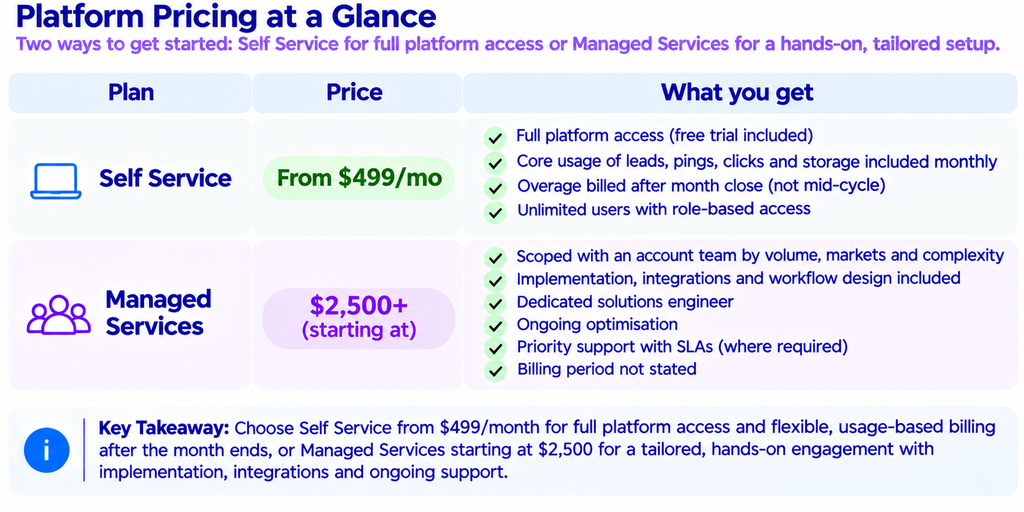
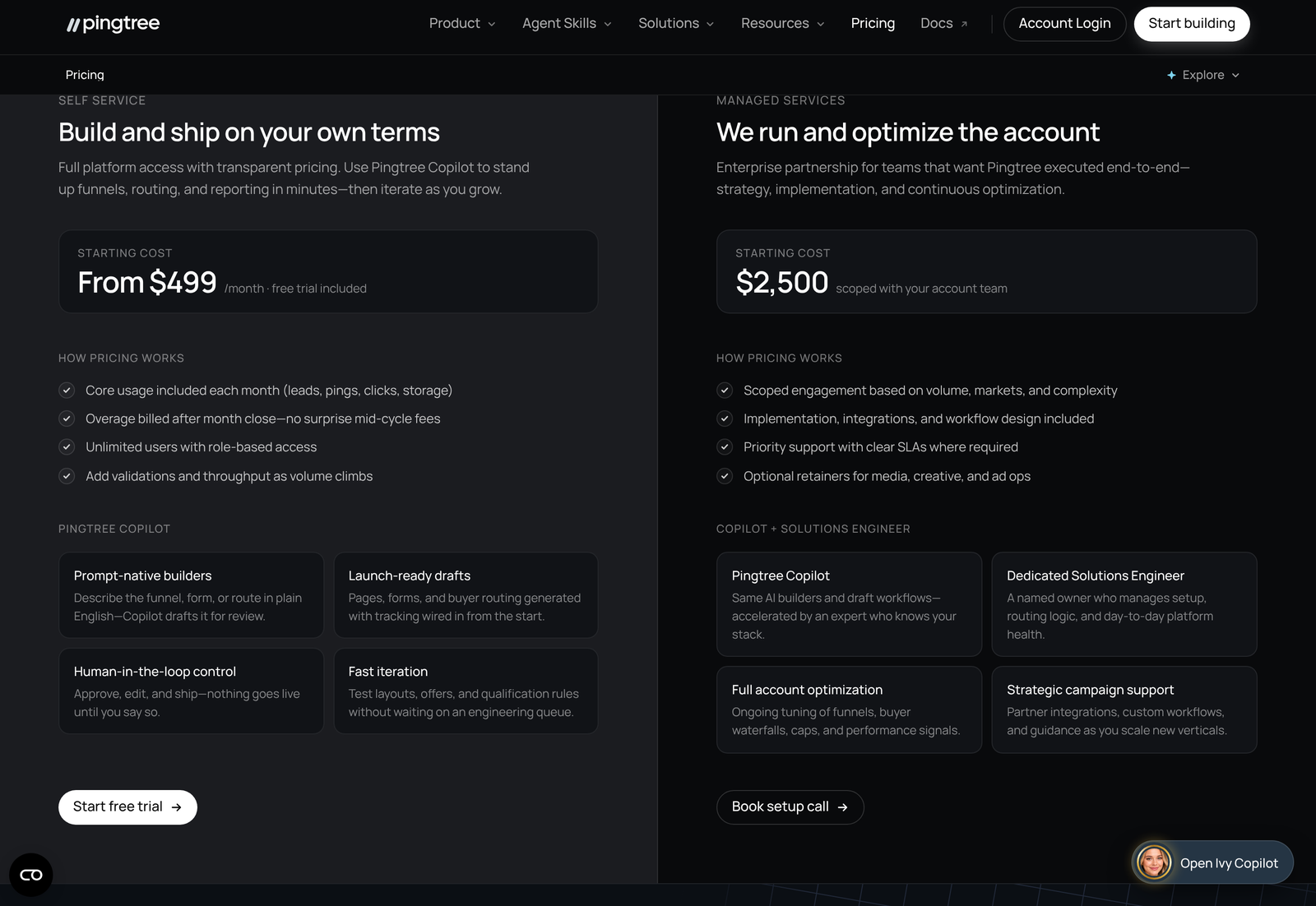
The unlimited-users policy deserves a mention, because per-seat pricing punishes exactly the teams this software suits. Media buyers, compliance reviewers, account managers plus finance all need visibility into the same campaigns, and charging per head would make that expensive.
Volume is what makes the floor defensible. Run 1,000 leads a month through the platform and the $499 minimum works out at roughly 50 cents a lead before any overage. Run 10,000 and it falls to about 5 cents. Run 100,000 and the subscription becomes a rounding error against media spend. Those are our calculations on the published floor, not figures Pingtree quotes, and they ignore overage entirely because the included allowances are not published.
Billing overage after month close rather than mid-cycle is a genuine operational nicety. Mid-cycle overage charges have a habit of suspending campaigns at the worst moment, and avoiding that is worth something to anyone running always-on acquisition.
Who it fits
Pingtree makes sense for a lead generation business rather than a company that happens to generate leads. The distinction decides whether the price is reasonable or absurd.
Good fits: lead sellers routing volume to multiple buyers under contracts with caps and filters; performance agencies running acquisition across several regulated verticals at once; advertisers buying leads from many sources who want validation and attribution in the same place the leads arrive. Any of these can absorb $499 a month without flinching, and all three need the distribution module nobody else in their stack provides.
Poor fits are easier to name. A business collecting a few hundred enquiries a month for its own sales team needs a form and a CRM, not a buyer waterfall. Teams whose real problem is identifying anonymous website visitors are describing something closer to what we covered in our Leadfeeder pricing breakdown, and teams wanting attribution for inbound calls and forms without any routing layer should look at our WhatConverts review instead. Outbound prospecting is a different category again, which our Apollo.io review covers.
The managed tier belongs to a familiar pattern: software with people attached, sold to buyers who lack the internal capacity to run it. We have examined the same trade in our Quartile review. The question to ask is always whether you are buying expertise you genuinely lack or paying someone to operate software you could run yourself.
What we could not verify
Several things stayed out of this review because we could not confirm them from primary sources.
- The $2,500 managed figure carries no period. Monthly, quarterly, and one-off scoping fees are all plausible, and the difference between the first and the last is $30,000 a year.
- What the included allowances actually are. Core usage covering leads, pings, clicks, and storage is described without a single number attached, so nobody can model a real bill from the published page.
- Overage rates. The timing of overage billing is published; the price is not.
- How the $499 floor scales. Whether it is a true flat entry or a figure that rises with volume tiers is not stated.
- Customer counts, volumes processed, and performance claims. Pingtree publishes none we could cite, and we have not invented any.
- Independent review scores, because the major aggregators refuse our crawler. We would rather report nothing than figures we cannot see for ourselves.
The verdict
Pingtree reads as a serious platform for a narrow audience. The module structure matches how lead businesses actually operate, the compliance integrations show real category knowledge, unlimited users is the right pricing decision, and keeping human approval on AI-drafted routing is sound judgement rather than caution for show.
The weakness is commercial transparency. A platform whose entire value proposition is precise, metered control over lead flow publishes a starting price, an unlabelled second figure, and no allowances at all. You cannot model your bill before talking to sales, which is a curious gap for a product sold on measurement.
Shortlist it if you run lead distribution at volume in a regulated vertical. Use the free trial to settle the two things a pricing page cannot answer: how good Ivy’s drafts are, and what your actual monthly bill looks like once your real volume runs through it.
Frequently asked questions
What does Pingtree actually do?
It captures leads through funnels and forms, validates them, then routes each one to buyers using ping-post waterfalls with caps and filters, while tracking sources and reporting on performance in the same system.
How much does Pingtree cost?
Self-service starts at $499 a month with a free trial included. Managed services start at $2,500, scoped with an account team, though the pricing page does not say what period that figure covers.
Is there a free trial?
Yes. The self-service card states a free trial is included, and the page carries a start free trial action. No trial length is published.
Does Pingtree charge per user?
No. Unlimited users with role-based access is listed under how pricing works, so adding compliance reviewers or finance staff to an account carries no extra seat cost.
Which industries is it built for?
Pingtree names financial services, insurance, home improvement, and legal and accounting. Its credit-pull and consent integrations line up with those verticals.
Can it handle inbound calls as well as form leads?
Call management appears as its own documentation module, and calls are listed among the owned channels feeding the platform. Start a Pingtree trial here if call routing is central to your setup and you want to test it directly.
Sources
- Pingtree’s pricing page, read on 23 October 2026, for the $499 self-service floor, the $2,500 managed starting cost, the free trial, the unlimited users policy, and the description of overage billed after month close.
- Pingtree’s product page, read on 23 October 2026, for the three-stage flow, the five modules and the named traffic sources.
- Pingtree’s documentation, read on 23 October 2026, for the platform overview, the module structure, the partner portal and domain management entries, and the four listed integrations including the Blacklist and DNC API.
- The FTC guidance on complying with the Telemarketing Sales Rule, read on 23 October 2026, for the National Do Not Call Registry requirements, the entity-specific provision, the safe harbour, and the established business relationship exemption.
All vendor claims were read from Pingtree’s own pages and documentation on 23 October 2026. Cost-per-lead figures in this article are our arithmetic on the published floor rather than numbers Pingtree quotes, and nothing here is legal advice.