


Quick answer: Quartile is a retail media advertising platform sold with a managed service attached, covering Amazon PPC and DSP, Walmart, Google, Meta, Microsoft, Criteo, Instacart, and ads inside ChatGPT. It publishes no prices anywhere, has no pricing page, and routes every call to action to a demo request. Its own figures put $2 billion of annual ad spend under management across 5,300 customers, which implies an average customer spending roughly $377,000 a year on ads. That number tells you more about the intended buyer than the small business page does. The company says it holds ISO/IEC 27001 certification.
Disclosure: Stack99 earns a commission if you buy through links on this page. It costs you nothing extra and never changes our assessment.
Software with people bolted on, by design
Most advertising tools sell you a dashboard and leave the work to you. Quartile sells a hybrid and says so plainly: the only solution combining cutting-edge AI with full, white-glove service. Every customer gets a dedicated account team described as working proactively to strategise, find opportunities, and optimise.
That positioning matters more than any feature list, because it determines what you are actually buying. A pure software purchase fails when nobody internally has time to run it. A pure agency engagement fails when the agency has no technology edge. Quartile’s pitch is that neither failure mode applies, and the trade is that you cannot buy the software without the service or the service without the software.
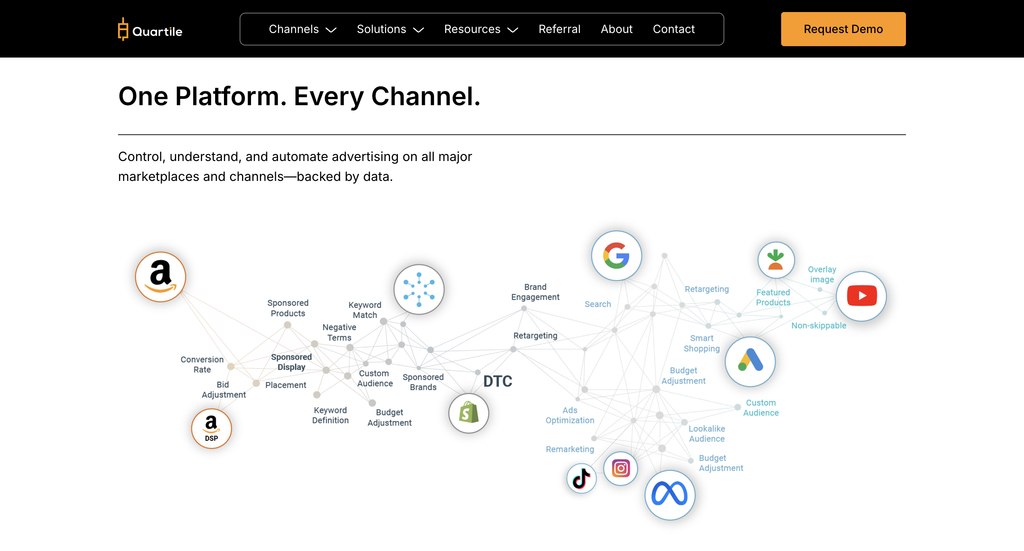
Underneath, the described method runs in four stages. The system ingests signals and historical performance from every connected channel, digging into each product’s results. That raw data feeds proprietary algorithms that turn it into insights. Those insights inform strategies that the account team then shapes. Results follow, measured against whichever goal you set.
One technical detail carries real weight. Quartile builds campaigns per ASIN rather than per product group, arguing the traditional funnel and a linear path to purchase are oversimplified. Granular campaign structures are standard practice among serious Amazon agencies, and doing it per ASIN across thousands of products is precisely the kind of work that needs automation. Bidding adjusts dynamically on real-time data, and placements adjust by the hour.
Nine channels, and one of them is new
Quartile maintains a dedicated page for each channel it supports: Amazon PPC, Amazon DSP, Walmart, Google Ads, Meta, Microsoft, Criteo, Instacart, and ChatGPT.
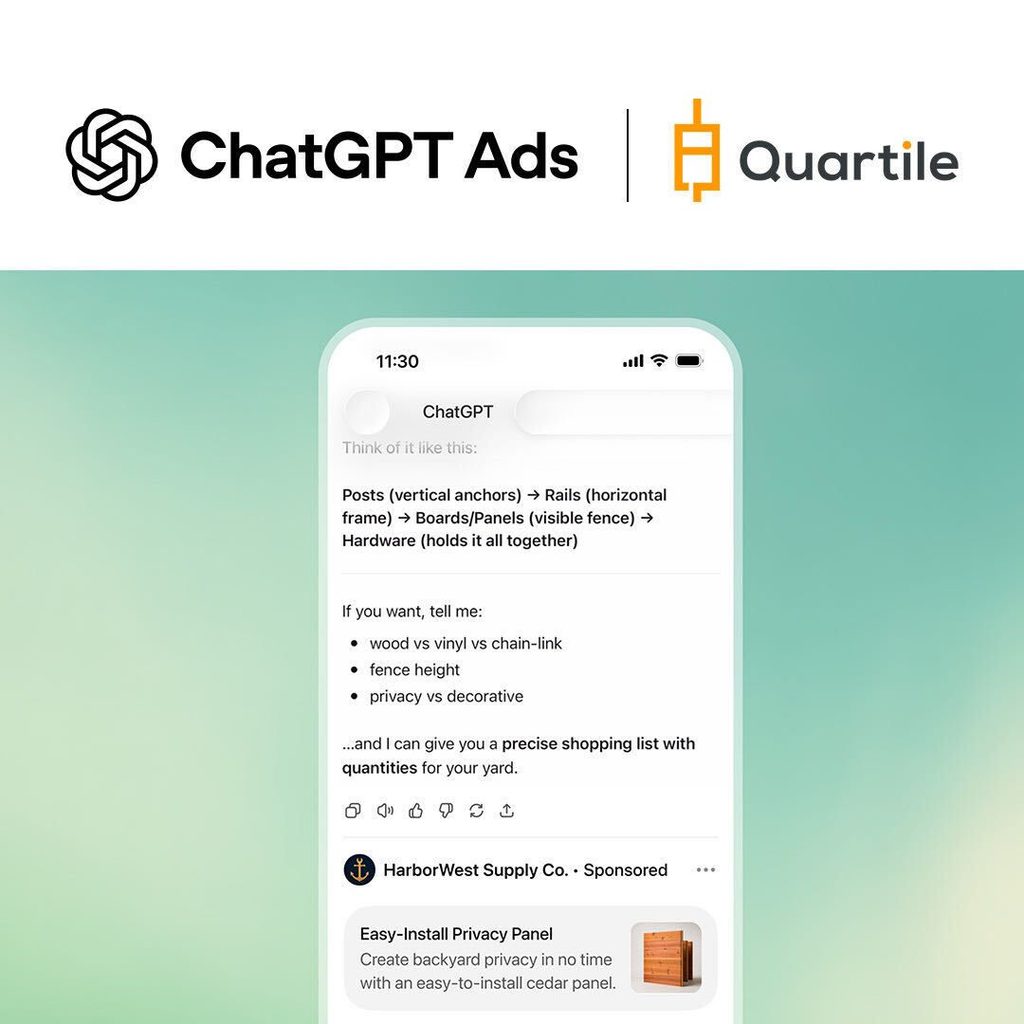
Eight of those are unremarkable for a retail media platform in 2026. The ninth is not. Advertising inside ChatGPT is new enough that most agencies have no established practice around it, and Quartile has both a channel page and a published case study claiming a 153 percent ROAS improvement for a technical lighting brand using it.
Treat that as an early signal rather than a proven capability. A single case study on a channel this young proves somebody ran a campaign and liked the result. It does not prove repeatability. Still, a vendor with a named channel page and a worked example is further along than one with a blog post about the trend.

Two solution pages sit alongside the channels and reveal where the product actually earns its keep. Amazon Promotion Management addresses deal planning and deadlines. Google to Amazon addresses driving external traffic into Amazon listings, which Amazon rewards through its own attribution programmes. Both are specific operational problems rather than marketing categories.
The published numbers, and what they are worth
Three figures sit on the homepage under a heading about driving results for brands of every size: over $2 billion in annual retail ad spend managed, over $25 billion in annual managed sales, and more than 5,300 customers globally across over 32 countries.
None carries a source, a date or an auditor. They are vendor claims and should be read as such. Divide them against each other, though, and two useful things fall out.
Twenty-five billion in sales against two billion in ad spend gives a blended ratio of 12.5 to one across the entire book of business. Anyone evaluating a ROAS promise now has a benchmark drawn from Quartile’s own numbers rather than from a case study it chose to publish.
More revealing: two billion dollars spread across 5,300 customers averages about $377,000 of annual ad spend each. A brand spending $2,000 a month on Amazon ads is roughly one sixteenth of the average customer here. Quartile runs a page headed “Small Businesses. Massive Growth.” and its real centre of gravity sits well above what most people mean by small business.
That average is a mean rather than a median, so a handful of very large accounts could be lifting it. The caveat is real. The order of magnitude still tells a prospective buyer something the marketing copy does not.
The performance claims are averages without a denominator
Quartile’s small business page carries five performance figures: 18 percent more orders, 33 percent better conversion rate, 41 percent higher ROAS, 38 percent more revenue and 11 percent more impressions. An asterisked note says these reflect average performance gains among brands partnering with Quartile.
Read the set together, and it holds up internally, which is a point in its favour. Impressions rise only 11 percent while conversion rate rises 33 percent, so the story being told is better targeting rather than more spending. Revenue up 38 percent on orders up 18 percent implies larger average orders too. A vendor inventing numbers rarely bothers making them consistent with each other.

What the note omits is everything needed to check the claim. No sample size appears, no measurement window, no baseline definition, and no statement of whether underperforming accounts were included. Averaged across how many brands, over what period, against what starting point? None of that is published.
Ask for the denominator during a sales conversation. Any vendor publishing an average can produce the sample behind it, and the answer will tell you more than the percentage does.
No price, anywhere
Quartile publishes nothing about what it costs. No pricing page exists; requesting one returns the homepage rather than a 404, which is worse than an honest error because it looks like a page that simply has no prices on it. Every button across the site says Request Demo or Contact Us.
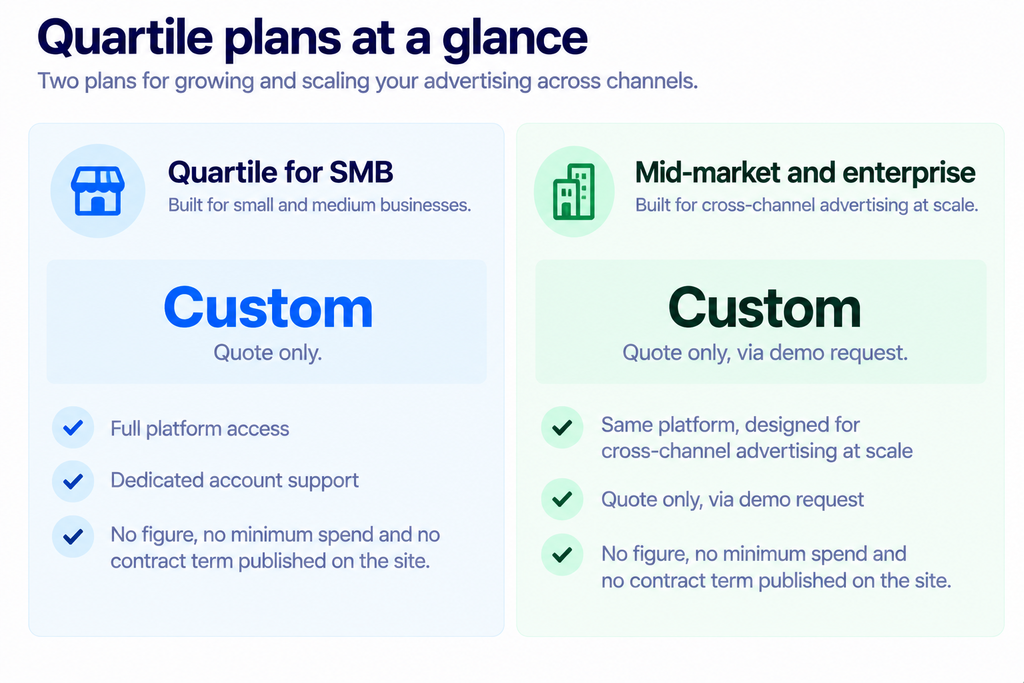
Quote-only pricing is normal for managed services, and it still costs you something concrete. You cannot compare Quartile against an in-house hire or a traditional agency retainer without booking a call, and you cannot tell before that call whether your budget clears whatever minimum exists.
Use the $377,000 average as a rough filter. If your annual ad spend is an order of magnitude below it, open the conversation by asking directly about minimum spend thresholds before anybody builds you a proposal.
The case studies name real brands
Eleven case studies are published, and they are better than the genre usually manages because the companies are named rather than anonymised into “a leading supplements brand”.
AFA Stores, Valvomax, Green Sprouts, Harpex, The Rag Company, XMondo, Zen Ginseng, Runners Plus and AnewVita all appear by name with a headline result attached. Valvomax is credited with 94 percent sales growth from focusing on what converts. Zen Ginseng with 86 percent more orders through listing optimisation. The Rag Company with 30 percent growth from Amazon SEO. Runners Plus with 22 percent higher net profit.
Net profit is the interesting one. Most advertising vendors report ROAS or revenue because both improve when you simply spend more. Profit does not, and a vendor leading with it on at least one study is making a harder claim than the category norm.
Several studies cover search optimisation rather than paid placement, which is a useful signal about scope. Listing and SEO work appearing repeatedly suggests the service extends past bid management into the organic side of a marketplace presence.
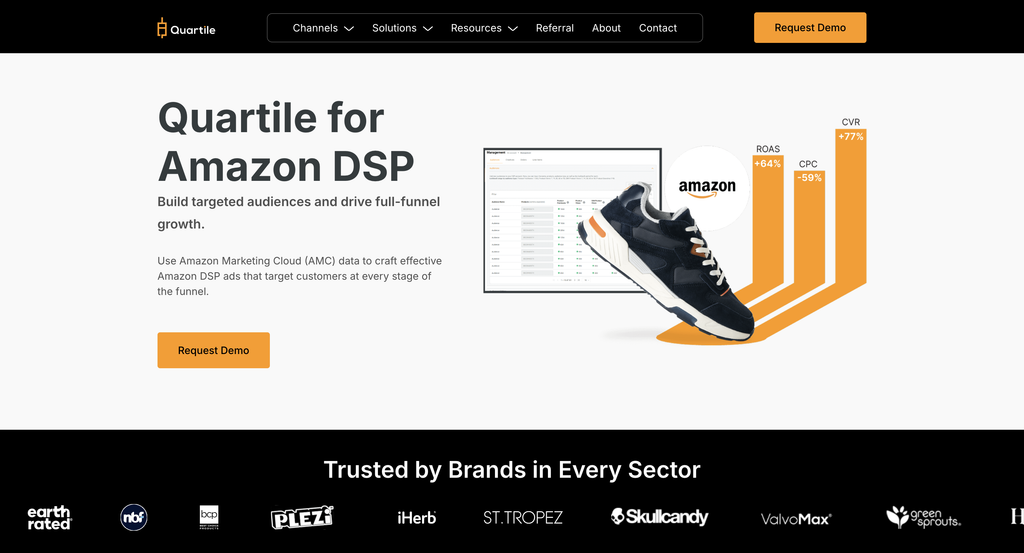
Two named individuals give testimonials. Justin Silverman, co-founder of The Warming Store, cites improved ad spend efficiency and trust in the team and technology. Julio Versolato, Head of Artificial Intelligence at Earth Rated, describes the product as “an add-on to your strategy, not a replacement”, which reads as unusually candid for a quote a vendor chose to feature.
Named brands and named people make verification possible in a way anonymous studies never do. Pick two from the list, find them on the relevant marketplace and ask Quartile to arrange a reference call. Sellers running their own Amazon research will recognise this as the same discipline applied to vendor claims; our guide to Jungle Scout for Amazon startups covers the research side of the same problem.
The blog is a better currency check than the brochure
Marketplace advertising changes faster than almost any other channel, and a vendor whose published thinking has gone stale is a vendor whose playbooks have too. Quartile’s resource output turns out to be a usable proxy for how current the operation is.
Recent pieces cover Amazon’s 2026 holiday deal deadlines and whether a promotion strategy is ready for them, a change to Amazon’s product title rules and what it means for listings, how to turn that title change into a listing upgrade, an Amazon SEO playbook for 2026, an inventory forecast download, and a piece noting that Walmart ad revenue grew 46 percent last year.
Notice the texture of those topics. Deal deadlines, title rule changes, and inventory forecasting are operational problems a seller hits on a specific date, not evergreen thought leadership. Two separate articles on a single Amazon title rule change suggest somebody is tracking policy as it moves rather than publishing on a quarterly content calendar.
The Walmart piece matters for a different reason. Quartile sells nine channels, and a vendor that only ever writes about Amazon while listing eight other channels is telling you where its competence actually sits. Coverage spreading beyond Amazon supports the cross-channel claim in a small way that marketing pages cannot.
Nothing here says the advice is good. Checking publication dates and subject matter before a demo is still cheap, and it gives you something concrete to probe during the call.
Security and the standards backdrop
A public Information Security Statement sits in the legal section, classified as Public and written around three principles: confidentiality, integrity and availability. Policies apply equally to all staff and to contracted parties accessing information or processing systems, and the statement commits to reviewing them as requirements change.
A line in the site footer declares Quartile an ISO/IEC 27001 certified company. We were unable to corroborate that at the standards body, whose site refuses our declared user agent, so the certification is reported here as the vendor states it. Ask for the certificate and its scope during procurement, because an ISO claim without a stated scope can cover far less of a business than a buyer assumes.

Worth setting against a wider backdrop. Retail media has moved from an emerging line item to a category with formal standards work behind it, and the IAB now maintains a dedicated retail media programme covering in-store definitions and measurement standards, a retail media buyer’s guide and guidance on data clean rooms in commerce. Any platform handling your sales and advertising data across nine channels is operating inside that emerging framework, and asking how a vendor measures attribution against published standards is a fair question.
Recognition from third parties is easier to check. Quartile displays a 2026 Strategic Localization Award from the Amazon Ads Partner Awards, a Gartner Digital Market Leader badge via Capterra, a G2 Best Software Top 50 Commerce Products placement for 2026, and a run of G2 badges for E-Commerce Leader, Best Relationship and Best Usability across the Spring and Summer 2026 reports. A 2023 Technology Innovation finalist place at the Amazon Ads Partner Awards sits further back. Award badges prove participation and peer review rather than performance, though an Amazon Ads partner award does require standing within Amazon’s own programme.
What we could not verify
- Any price, minimum spend, contract term or notice period. Nothing is published and no pricing page exists.
- The $2 billion, $25 billion and 5,300 figures, and the 41 percent ROAS claim. All are vendor statements carrying no source or date.
- The sample size, measurement window, and baseline behind the five SMB performance averages.
- The ISO/IEC 27001 certification and its scope. The standards body refuses our declared user agent.
- G2 and Capterra ratings at source. Both refuse our declared user agent, so the badges are reported as Quartile displays them.
- Whether the dedicated account team is named staff or a shared pool, and what response times apply.
- Which marketplaces are covered in the 32-plus countries claim, and whether channel availability varies by region.
Who it suits
Choose it if: you sell a large catalogue on Amazon and campaign granularity has become unmanageable by hand. Per-ASIN structures across thousands of products are exactly what this platform exists to automate.
Choose it if: you already advertise across several marketplaces and currently reconcile them in a spreadsheet. Nine channels on one data layer is the core argument, and the Google to Amazon solution page shows the cross-channel thinking is real rather than decorative.
Choose it if: you want expertise without a headcount. The managed component is not an upsell here; it is the product, and for a brand with nobody in-house, that is the whole proposition.
Look elsewhere if: your monthly ad spend is in the low thousands. The average account here spends over $370,000 a year, and a service-heavy model rarely flexes down that far without a minimum that makes it uneconomic for you.
Look elsewhere if you want to keep hands on the bidding yourself. Nothing on the site suggests a self-serve tier, and the entire pitch assumes a team working alongside you.
Go into the demo with three questions ready: what is the minimum spend, what is the sample behind the 41 percent ROAS figure, and can you speak to two of the named case study brands. Answers to those will settle the fit faster than any feature walkthrough.
FAQ
How much does Quartile cost?
Quartile publishes no prices. There is no pricing page, and every call to action requests a demo. Expect a quote based on your spend and catalogue size, and ask about minimum spend early. Checked 21 October 2026.
Which advertising channels does Quartile support?
Amazon PPC, Amazon DSP, Walmart, Google Ads, Meta, Microsoft, Criteo, Instacart and ChatGPT, each with its own dedicated page on the site.
Is Quartile software or an agency?
Both, deliberately. It describes itself as combining an AI platform with full white-glove service, and says every customer receives a dedicated account team. The two parts are not sold separately.
Can small businesses use Quartile?
A dedicated small business page exists. Its own aggregate figures imply an average customer spending roughly $377,000 a year on ads, so confirm the minimum before assuming a small budget qualifies.
Does Quartile run ads in ChatGPT?
It maintains a ChatGPT channel page and publishes a case study claiming a 153 percent ROAS improvement for a technical lighting brand. One study is an early indication rather than evidence of a repeatable practice.
Is Quartile ISO 27001 certified?
Quartile states it is an ISO/IEC 27001 certified company in its site footer, and publishes a public Information Security Statement. We could not corroborate this with the standards body. Request the certificate and its scope during procurement.
How big is Quartile?
By its own account, more than 5,300 customers in over 32 countries, managing over $2 billion in annual retail ad spend and over $25 billion in annual managed sales. None of those figures is independently sourced.
Sources
- Quartile’s homepage, read on 21 October 2026, for the platform and service positioning, the four-stage method, the per-ASIN campaign claim, the hourly placement adjustments, the three aggregate figures and the award badges.
- Quartile for SMB, read on 21 October 2026, for the five performance averages, the asterisked note describing them and The Warming Store testimonial.
- Quartile for mid-market and enterprise, read on 21 October 2026, for the enterprise positioning and the Earth Rated testimonial.
- Quartile’s Information Security Statement, read on 21 October 2026, for the public classification, the three security principles and the scope covering staff and contracted parties.
- The IAB retail media programme, read on 21 October 2026, for the standards and guidance work this category now sits inside, including in-store definitions and measurement standards, the retail media buyer’s guide and data clean rooms in commerce.
All vendor claims were read from Quartile’s own site on 21 October 2026. Figures attributed to Quartile are unaudited company statements, and derived ratios in this article are our arithmetic on those statements rather than figures Quartile publishes.