


Quick answer: Nouswise is a research agent that answers from a library you give it rather than from the open web. The $19.99 Essential plan has no web search, no MCP tools, and no workspace, all three of which begin on the $49.99 Pro plan. Want an assistant that reads your documents and cites them? Essential does that well. Did you expect it to search the internet too? You are shopping for Pro.
Disclosure: Stack99 earns a commission if you buy through links on this page. It costs you nothing extra and never changes our assessment.
What Nouswise is trying to be
The product describes itself as an autonomous thinking partner, which tells you nothing. Strip the phrasing away, and a clear idea sits underneath: an answer engine pointed at a curated library instead of the open internet, where every response traces back to a source you supplied.
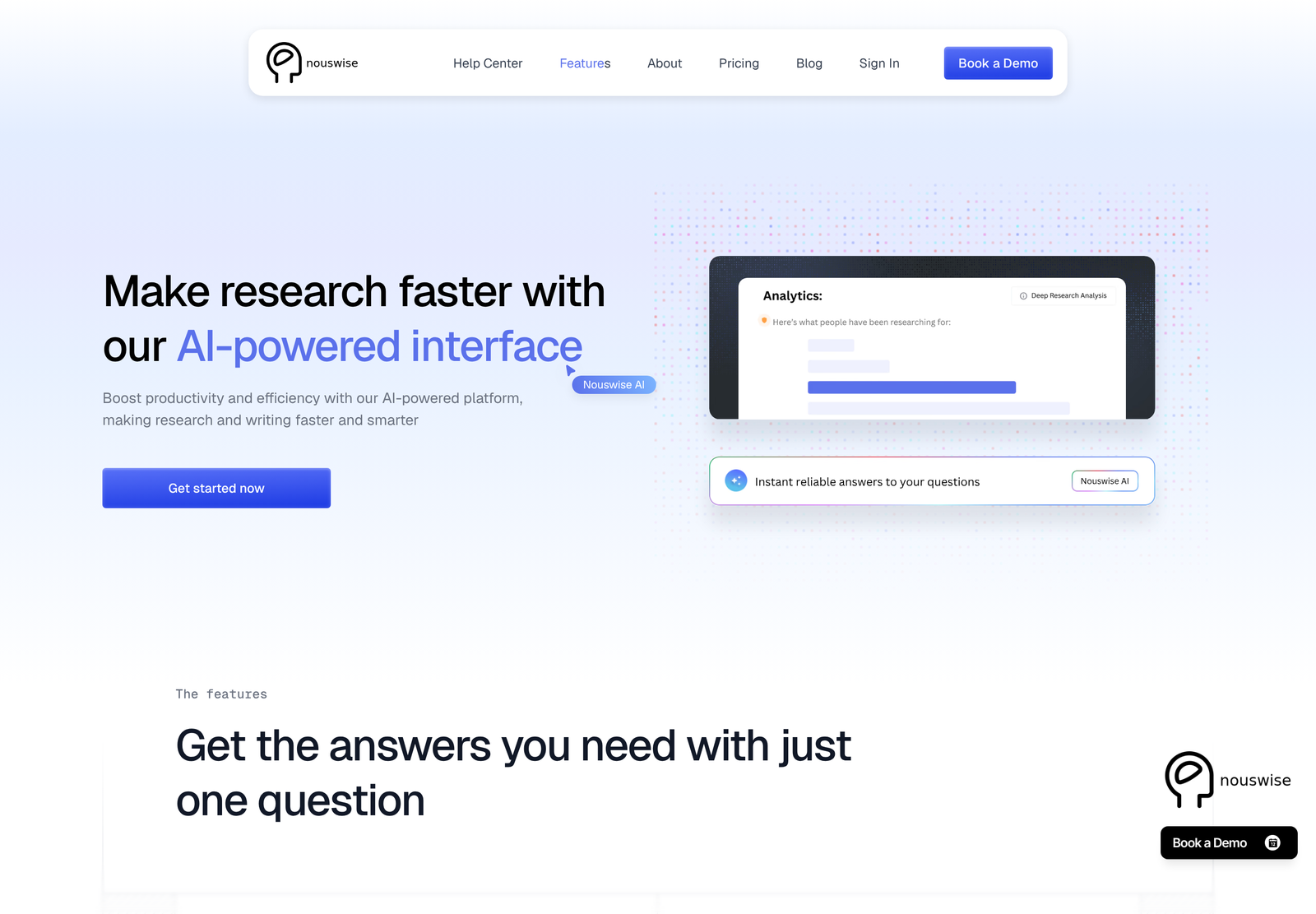
Nouswise splits its own product into four modes. Ask takes files, links, videos, and audio and returns cited answers. Research takes connectors, documents, data, and websites and returns reports, infographics, podcasts, or video. Automate runs multi-step digital tasks from goals and instructions. Build produces websites, dashboards and documents from requirements you describe.
Four modes is an ambitious span for a company this size. Most products that claim both deep research and task automation are strong at one of them. We cannot tell you from the outside which half Nouswise does better, because the product sits behind a signup and the marketing pages make the same confident noises about each. What we can do is read the plan matrix closely, and that turns out to be more revealing than the feature copy.
The plan matrix says more than the pitch
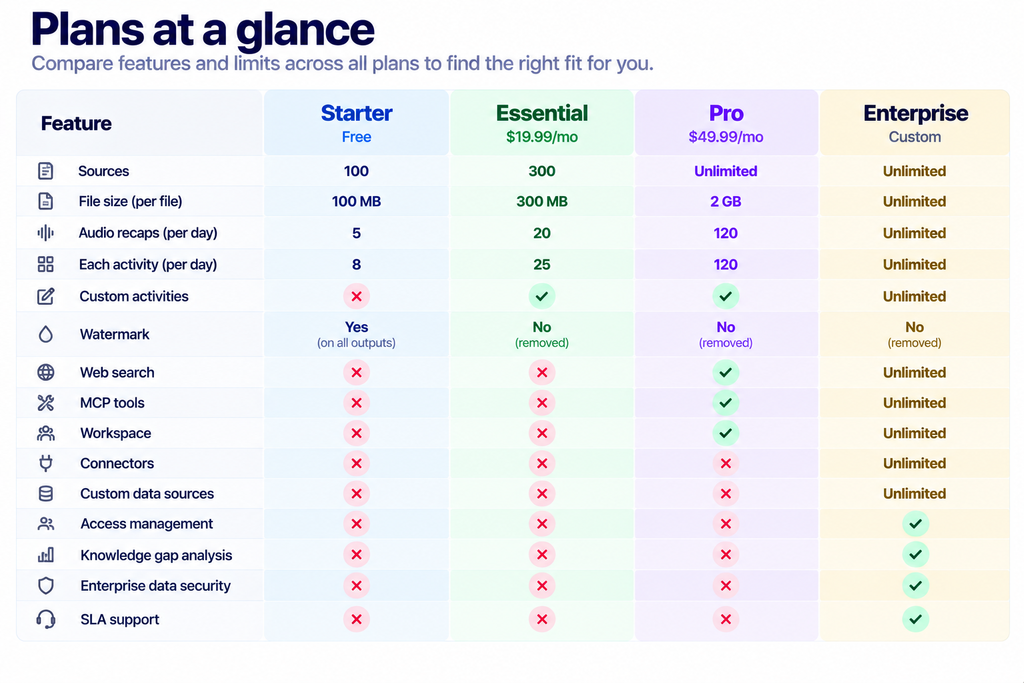
Nouswise publishes a detailed comparison table under its pricing cards, and it is unusually candid for a vendor table. Crosses appear where other companies would leave a blank.
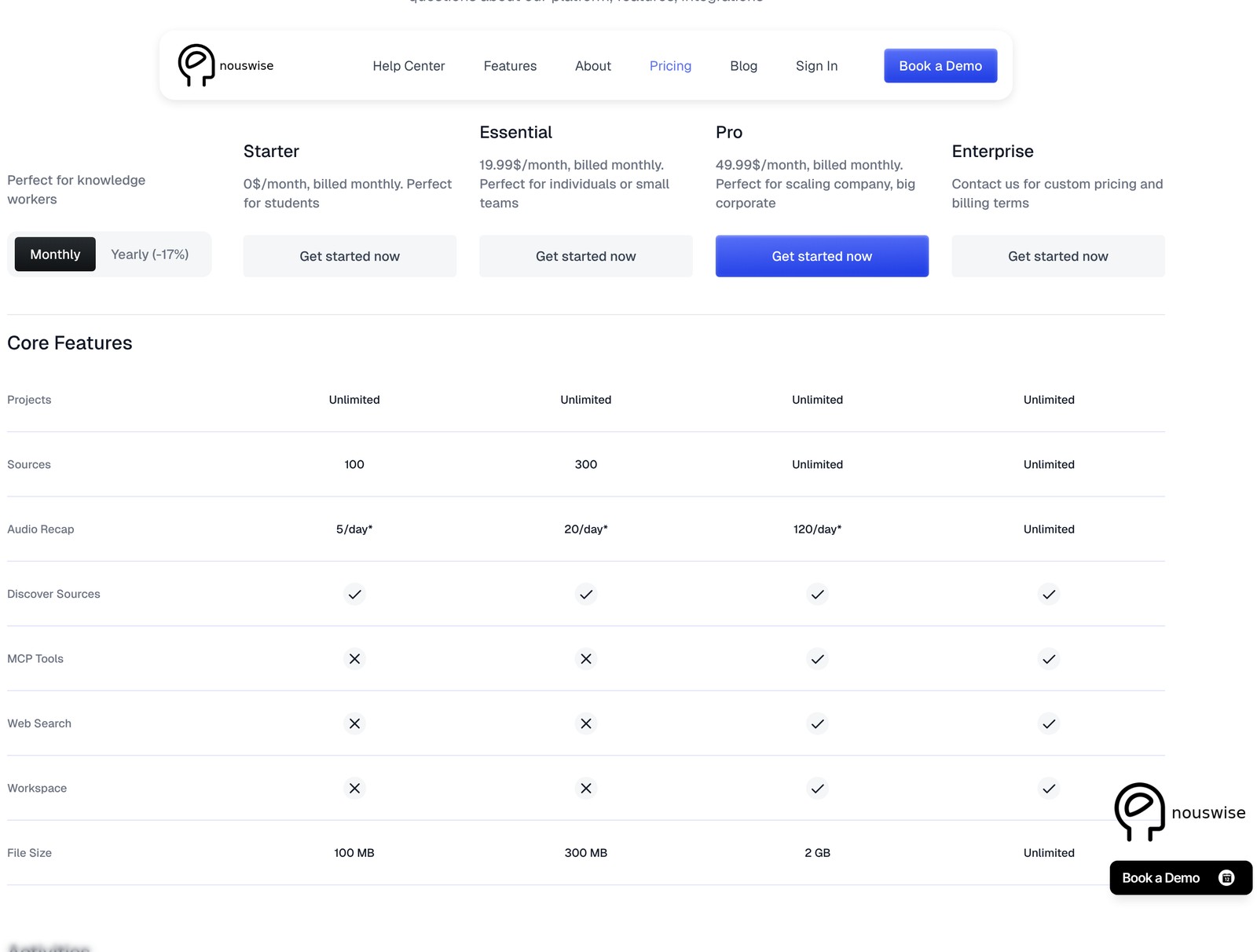
Those are the rates with the Monthly toggle selected, and each card states “billed monthly” in its own description. Beside the monthly view sits a Yearly toggle advertising 17% off. Clicking it did not change any price shown on the page during our checks on 25 October 2026, so we are not publishing an annual figure we could not read. Ask the vendor for the yearly rate rather than assuming 17% off the monthly one.
The three crosses that define the product
Web Search, MCP Tools, and Workspace all carry a cross on Starter and on Essential, and a tick on Pro and Enterprise. Read that row carefully, because it changes what the cheaper plan actually is.
Without web search, Essential answers only from material you have uploaded or connected. That is a coherent product and arguably the point of the whole thing: a research agent grounded in vetted sources cannot drift into whatever a search engine surfaced this morning. The limitation only becomes a problem when a buyer assumes otherwise, which at $19.99 against the price of a general assistant is easy to do.

MCP Tools matter more than the plain label suggests. The Model Context Protocol specification defines an open standard for connecting LLM applications to external data sources and tools, and a product supporting it can reach systems its vendor never built a connector for. Gating that at $49.99 is a legitimate commercial choice. Knowing it is gated before you buy matters, because MCP support is exactly the feature that makes a tool extensible rather than a silo.
Workspace is the least documented of the three and the hardest to evaluate. The pricing table lists it without explaining it. Treat anything you plan to use collaboratively as a Pro requirement until the vendor tells you otherwise.
Daily caps, and how fast you hit them
Nouswise meters output types rather than queries. Reports, flashcards, quizzes, mind maps, data tables, infographics and slide decks each carry a per-day allowance: 8 on Starter, 25 on Essential, 120 on Pro, unlimited on Enterprise. A footnote states that limits are cumulative.
Twenty-five of each activity a day on Essential is generous for one person and awkward for a team sharing an account. Pro’s 120 is effectively unlimited for individual work. Starter’s 8 is a trial allowance dressed as a plan.

Source count moves on a different axis: 100 on Starter, 300 on Essential, unlimited on Pro. A researcher building a literature library passes 300 documents quickly. Someone maintaining a company handbook may never get close. Count your actual corpus before you pick, because this ceiling is the one most likely to force an upgrade you did not plan for.
File size per upload runs 100 MB, 300 MB, then 2 GB. A 2 GB ceiling on Pro handles video and large scanned archives. The 100 MB on the free plan rules out most video, which sits oddly beside a product advertising video and audio as supported inputs.
The free plan watermarks your work
The comparison table puts a cross against watermark removal on Starter and a tick on all three paid plans. Custom Activities follows the same pattern.
That is fair commercial practice, and it has a practical consequence. Starter exists for evaluating whether the answers are any good, not for producing anything you will hand to a colleague. Anyone planning to put a Nouswise infographic into a client deck is on a paid plan from the first week.
Almost everything interesting is Enterprise
The Advanced Benefits section of the comparison table is where the self-serve plans run out of road.
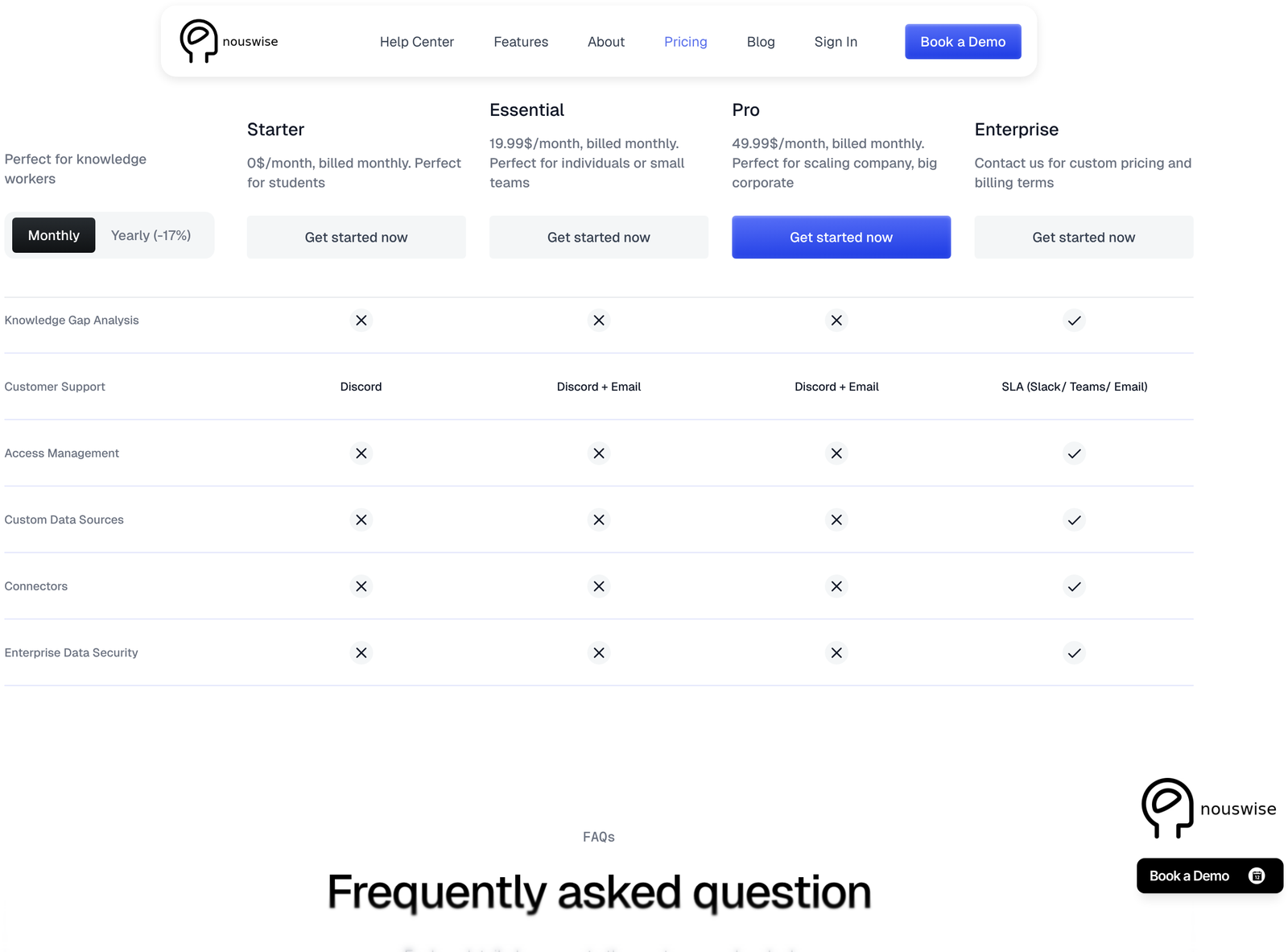
Knowledge Gap Analysis, Access Management, Custom Data Sources, Connectors and Enterprise Data Security each carry a cross on Starter, Essential and Pro. Only the Enterprise column ticks. Workflow customisation reads Limited on the three self-serve plans and Custom on Enterprise.
Connectors sitting in that group is the consequential one. The Research mode advertises connectors among its inputs, and the plan table puts connectors behind a sales conversation. A buyer reading the features page and then the pricing page in that order will form two different impressions of the same product.
Access Management being Enterprise-only also rules out Pro for most regulated teams. Controlling who sees which documents is not something you buy here with a credit card.
Support is Discord until you pay
The customer support row reads Discord on Starter, Discord and email on Essential, the same on Pro, and an SLA covering Slack, Teams or email on Enterprise.
Paying $49.99 a month and still getting the same support channel as the $19.99 plan is a conscious choice by the vendor, and an honest one to publish. Teams accustomed to a response-time commitment should note that no SLA exists below Enterprise, whatever you are paying monthly.

Security and deployment claims
Nouswise answers several security questions directly in its own FAQ, which is more than many companies at this stage manage.
Data is encrypted in transit and at rest on cloud infrastructure hosted in servers located within Europe and the United States. On-premises deployment is offered for organisations handling confidential data, and dedicated data centres in a chosen region are offered as an alternative to the default cloud. Those statements come from the vendor and we could not independently verify any of them, so treat them as the starting point of a procurement conversation rather than the conclusion of one.
No certification is named anywhere we looked. A SOC 2 report or an ISO 27001 certificate is the thing to ask for, and the absence of a named certification on a page that otherwise discusses encryption and jurisdiction is worth asking about rather than assuming. Frameworks like the NIST AI Risk Management Framework give a structured vocabulary for that conversation if your organisation needs one.
What we could not verify
Three things, stated plainly rather than papered over.
The annual pricing. That 17% yearly toggle changed no displayed price when we clicked it. The monthly rates above are solid; the annual ones are not published in a form we could read.
The headline statistics. Nouswise’s features page carries three large counters labelled verifiable, documents and languages. They render as 0.00%, 0+ and 0+ to a visitor who does not trigger the animation, so no figure exists for us to quote. Any number you see in a competitor’s review of this product did not come from that page in a readable state.
Answer quality. Grounded citation is the entire promise, and testing it properly means running your own corpus through it and checking whether the citations support the sentences they are attached to. No pricing table can answer that. The vendor claims teams save up to 3.9 hours a week, which is a vendor claim and nothing more until you measure your own.
Where it sits against the obvious alternatives
A general assistant costs about the same as Essential and will happily search the web, though it answers from everything rather than from your vetted set. Nouswise is making the opposite bet: narrow the inputs, and the citations become checkable.
Document question-and-answer tools occupy the same shelf, and most of them stop at answering. What Nouswise adds is the output layer, turning a corpus into slide decks, mind maps, data tables, and audio recaps rather than only into prose. Whether seven output formats beat one good one depends entirely on what you do after the research finishes.

Enterprise knowledge platforms cover the connectors and access control that sit in the Enterprise column here, and they cost considerably more than $49.99. Pro occupies a genuine middle ground for a single researcher who needs web search and extensibility without a procurement cycle.
A thirty-minute test before you pay
Grounded citation is the whole proposition, so test the citations rather than the interface. The free Starter plan gives you eight activities a day, which is enough for a deliberate evaluation if you spend them carefully.
Upload five documents you know intimately. Pick ones where you can tell immediately whether an answer is right, and include at least one pair that disagree with each other. A contract and its amendment work well. Two internal reports from different quarters work equally well.
Ask a question whose answer appears in exactly one of the five. Follow the citation. Does it point at the passage that actually supports the claim, or at the document generally? A system that cites the right file but the wrong paragraph is still better than one citing nothing, and it is not the same product the marketing describes.
Then ask the question your two conflicting documents answer differently. Nouswise says its agentic search cross-checks sources and resolves conflicts, which is a strong claim and a testable one. Watch whether the answer notices the disagreement, picks a side silently, or blends both into something neither document says. The third outcome is the failure mode that matters most in research work.
Finish with a question none of the five documents can answer. On Essential and below, with no web search available, the honest response is to say so. A confident answer to an unanswerable question tells you everything about how much you can trust the other replies.
That sequence costs four activities and half an hour. It will tell you more than any feature table, this one included.

Who should buy which plan
Choose Starter if: you want to find out whether the citations hold up. Eight activities a day and a watermark are enough to judge quality and not enough to do work.
Choose Essential if: your sources are documents you own, your library sits under 300 items, and you genuinely do not need the open web. Students and solo analysts working from a fixed corpus fit here cleanly at $19.99.
Choose Pro if: you need web search, MCP tools or a workspace. All three arrive together at $49.99 and none of them can be bought separately, so the decision is a single yes or no.
Talk to sales if: you need connectors, access control, custom data sources or any security commitment. Those are not available at any self-serve price.
Two things reduce the risk of getting it wrong. Booking a demo currently opens a 30-day free trial of the enterprise plan, which is the only way to see the Enterprise-only rows working. A first paid plan carries a 7-day refund window with cancellation at any time.
Our breakdown of what each Nouswise plan unlocks goes through the feature matrix row by row. To try it against your own documents, start on the free Starter plan and upload the five sources you care about most before paying anyone.
Frequently asked questions
Does Nouswise search the web?
Only on Pro and Enterprise. The Web Search row carries a cross on both Starter and the $19.99 Essential plan, and a tick from $49.99 Pro upward. Below Pro, answers come from the sources you have uploaded or connected.
How much does Nouswise cost?
Starter is free, Essential is $19.99 a month and Pro is $49.99 a month, all stated as billed monthly on the plan cards. Enterprise is quote-only. A yearly toggle advertises 17% off, though the page did not display annual figures when we checked on 25 October 2026.
How many documents can I upload?
Sources are capped at 100 on Starter and 300 on Essential, and are unlimited on Pro and Enterprise. Per-file size runs 100 MB, 300 MB and 2 GB across those same three plans, with no stated ceiling on Enterprise.
Does the free plan watermark outputs?
Yes. Watermark removal is marked unavailable on Starter and available on Essential, Pro and Enterprise. Custom activities follow the same split.
Can Nouswise run on our own servers?
The vendor FAQ states that on-premises installation is available for organisations with strict security or compliance requirements, as is storage in a dedicated data centre in a region you choose. Both arrangements sit on the Enterprise path rather than on any published price.
What are MCP tools and why do they matter?
Model Context Protocol is an open standard for connecting LLM applications to outside data sources and tools. Support for it means a product can reach systems its vendor never wrote a specific connector for. Nouswise lists MCP Tools as a Pro feature, unavailable on Starter and Essential.
Sources
- Nouswise pricing and plan comparison, captured 25 October 2026
- Nouswise features
- Model Context Protocol specification, version 2025-06-18
- NIST AI Risk Management Framework (AI 100-1)