



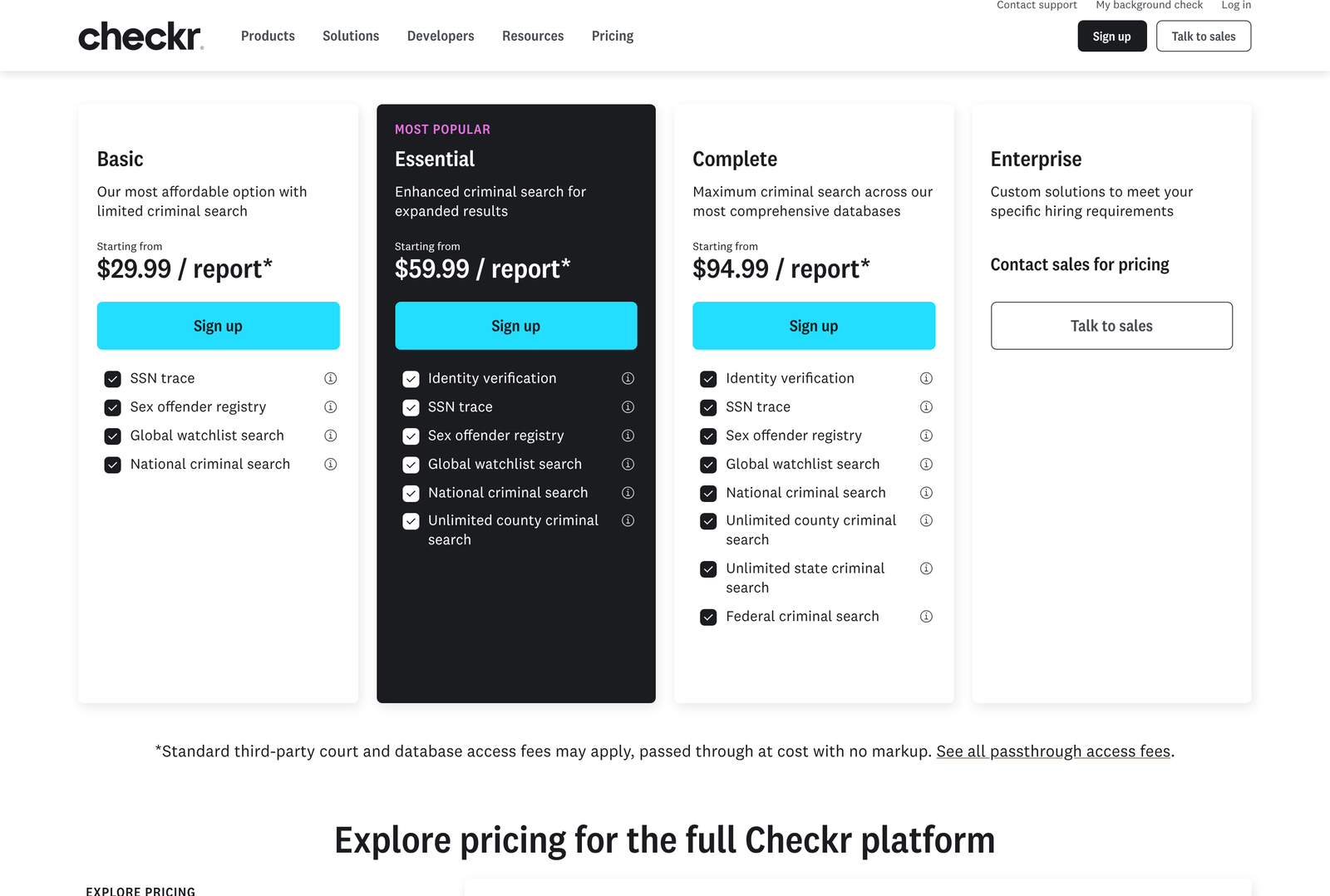
Quick answer: Checkr sells background screening per report rather than per seat per month. A Workforce report runs $29.99, $59.99 or $94.99 depending on how deep the criminal search goes, and court access fees sit on top at cost. The headline number is a floor. Price a real hire with its add-ons and a $59.99 report lands nearer $100. There is no monthly minimum and no contract on the published plans, which makes it unusually workable for employers who hire in bursts.
Disclosure: Stack99 earns a commission if you buy through links on this page. It costs you nothing extra and never changes our assessment.
Checkr is five price lists wearing one logo
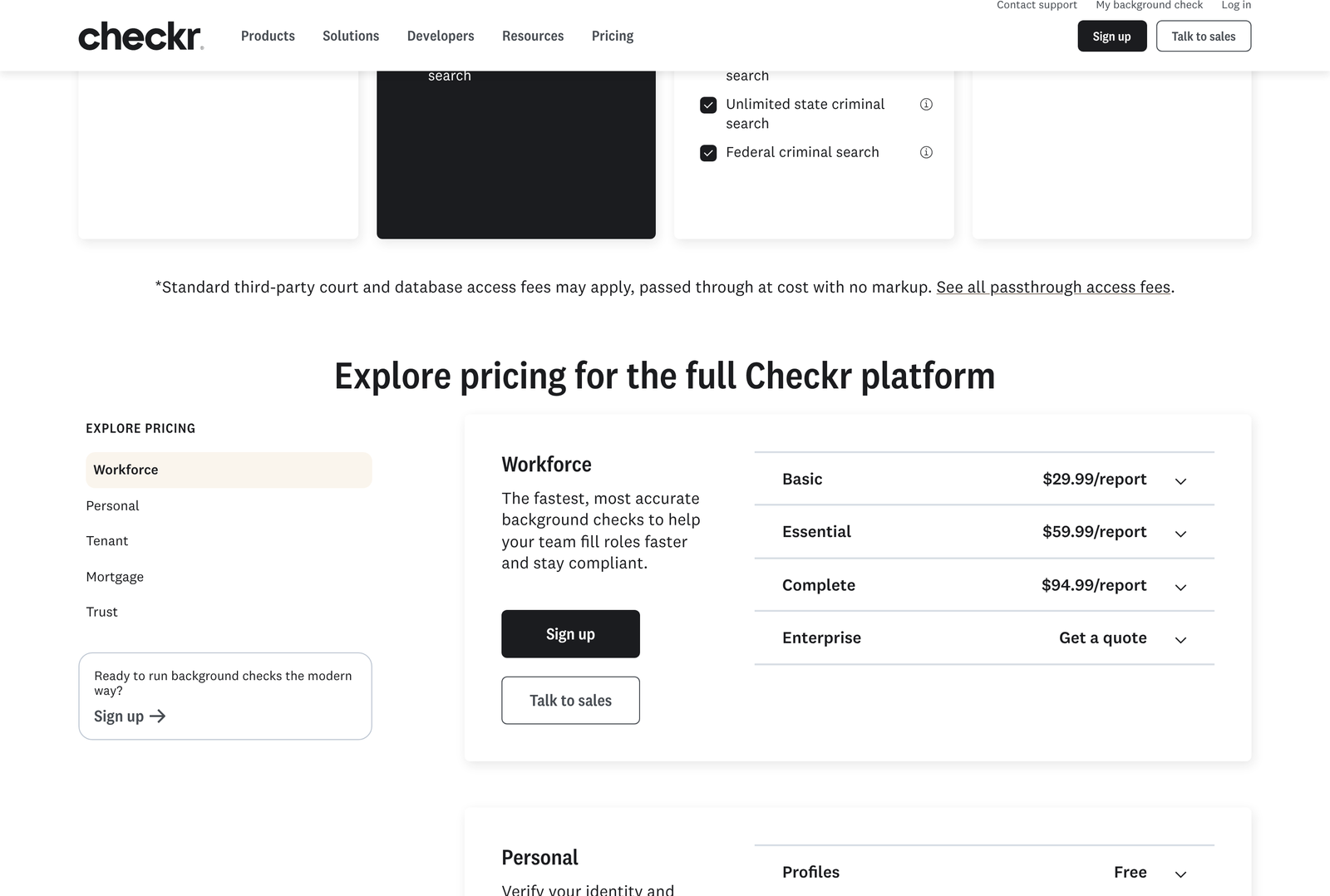
Most reviews treat Checkr as a single product with three tiers. Open the pricing page, and you find five separate lines, each with its own ladder: Workforce for hiring, Personal for individuals checking themselves, Tenant for landlords, Mortgage for lenders verifying income, and Trust for platforms screening users at speed.

Which one you are shopping changes the price by a factor of four. A tenant criminal check starts at $24.99. A mortgage income and employment verification is $64.95. Quoting “Checkr costs $29.99” without saying which list you read is how buyers end up surprised by an invoice.
This review covers Workforce in depth, because that is what most readers mean, then summarises the other four.
Workforce pricing, and what each tier actually searches
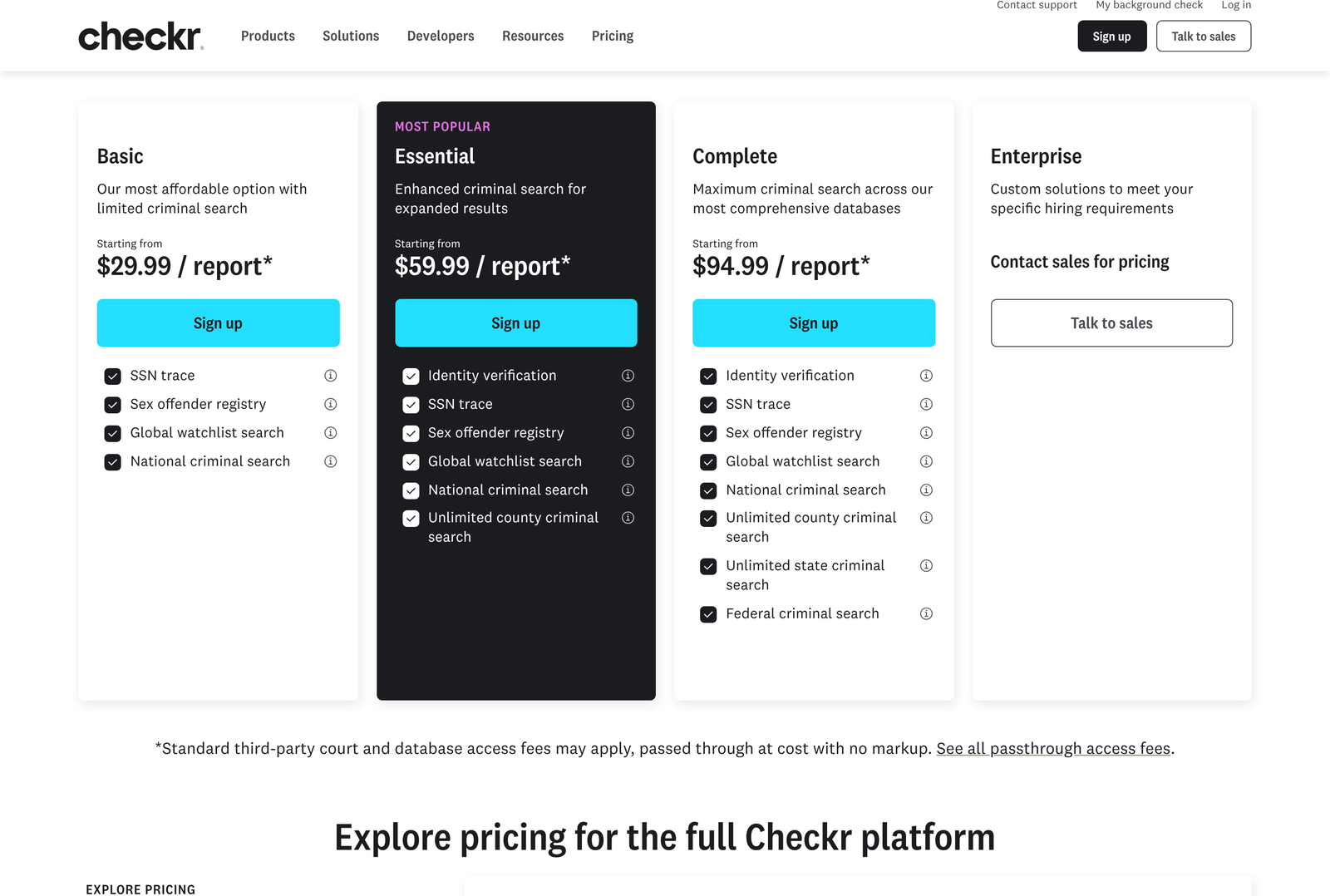
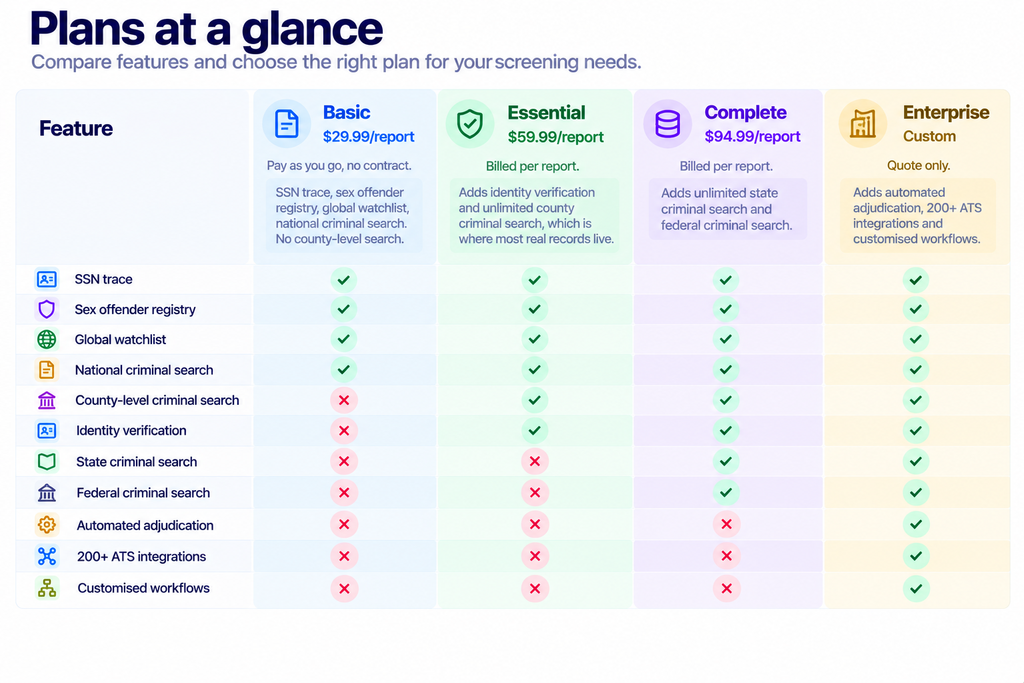
Note the unit. None of these is a monthly subscription. You are charged when a report runs, so an employer who hires nine people in March and nobody in April pays for nine reports and then pays nothing.
The jump from Basic to Essential is $30 a report, and it buys the single most important line on the list: unlimited county criminal search. United States criminal records are held at county level. A national database search is an index built from whatever counties chose to contribute, and gaps in it are normal rather than exceptional. Basic is a screen, not a search.
The asterisk is doing a lot of work
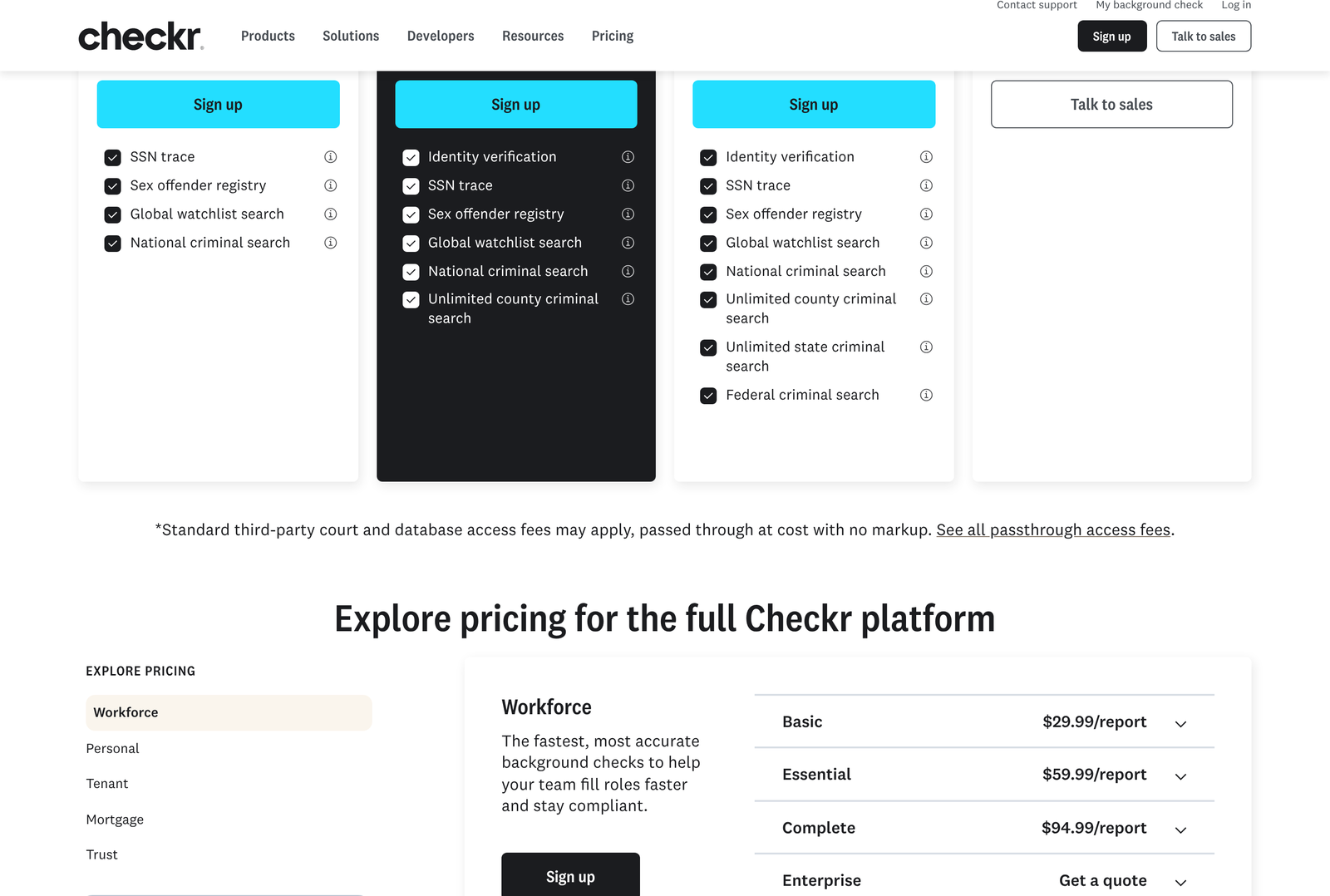
Under the four cards sits this line: “Standard third-party court and database access fees may apply, passed through at cost with no markup.”
Courts charge for record access. Those charges vary by county and by state, they are not published by Checkr because Checkr does not set them, and they are not included in $29.99 or $59.99 or $94.99. An unlimited county search across a candidate who has lived in six counties pulls six sets of fees.
Passing them through at cost with no markup is the honest way to handle this, and we would rather see it than a padded flat rate. Budget accordingly: treat every published figure on this page as a floor and ask your rep for a blended per-report average based on the states you actually hire in.
The add-on list is where the real cost lives
Checkr publishes an unusually complete price list for add-ons. Here are the ones that change a quote most often:
- Motor vehicle record report, $9.50 a check, plus state DMV fees at cost. Continuous MVR monitoring is $2.50 a month per enrolled driver.
- Identity verification, $4.99 a check. Included in Essential and Complete already.
- Employment verification, priced by depth: current employer $12.50, last three years $15, five years $25, seven years $35, ten years $50.
- Education verification: $12.50 for one degree, $18.75 for two, $25 for three.
- County criminal search as a standalone: $25 per check. Federal criminal, $10. State criminal, from $10. Federal civil, $15. County civil, $40.
- Global watchlist search, $9. Aliases, from $8 per candidate. Professional licence verification, $12.
- Continuous criminal monitoring, $1.70 per individual per month.
- Social media search, $29.99 per check, with every flagged report reviewed by a human analyst.
- Drug and health testing: clinic-based from $60 per test, onsite from $37, occupational health assessment from $23, random testing from $10 plus a per-test fee. A $90 after-hours fee applies for tests run between 7 pm and 7 am on weekdays, or at any time at weekends.
- Commercial driver screening: commercial MVR with CDLIS search $14.50, subsequent MVRs $9.50, DOT employment verification from $19.50, DOT drug and alcohol test from $72, DOT physical from $110, clearinghouse search $20.
- International reports: Basic from $32 per check, Professional from $102, with pricing varying by country.
Now price three realistic hires.
A delivery driver. Essential at $59.99, an MVR at $9.50, and a DOT employment verification going back three years at $22. That is $91.49 before court fees. Add the DOT drug and alcohol test at $72, and you are at $163.49, more than two and a half times the headline.
A warehouse picker. Basic at $29.99, identity verification at $4.99, an onsite drug test from $37. Total $71.98, again more than double the card price.
An office hire with a degree requirement. Essential at $59.99, one degree verified at $12.50, employment history back five years at $25. That comes to $97.49.
Hire forty people a year on Essential, and the reports alone cost $2,399.60. Put fifty staff on continuous criminal monitoring at $1.70 a month, and that is another $1,020 a year. The per-report model is genuinely cheap for low-volume hiring and stops being cheap the moment monitoring enters the picture.
Build the tier yourself and see which one wins
Because Checkr publishes standalone prices for the same searches that make up its packages, you can test whether a tier is good value instead of taking the ladder on faith. The answer flips depending on how settled your candidates are.
Start at Basic, $29.99. Identity verification costs $4.99 as an add-on, and it is included from Essential upwards. One county criminal search costs $25. Add those to Basic and you reach $59.98. Essential costs $59.99 and gives you identity verification plus unlimited county searches rather than one.
A penny separates them, so the comparison is clean. Essential wins outright for any candidate who has lived in two or more counties in the past seven years, which describes most renters, most graduates and nearly everyone who has relocated for work. Basic only wins where a candidate has genuinely stayed put, and you will not know that until the SSN trace returns an address history, by which point you have already bought the report.
Run the same test on Complete. Take Essential at $59.99, add a federal criminal search at $10, plus one state criminal search at $10, comes to $79.99 against Complete at $94.99. Buying the pieces saves $15 when one state is enough. Complete earns its $35 premium when a candidate has state-level history in more than one state, since the state search is unlimited there and $10 a go on its own.

Two rules of thumb come out of that arithmetic. Hiring locally from a stable workforce, Basic plus targeted add-ons can be the cheaper route. Hiring people who have moved around: Essential is the floor and Complete is the one that stops you buying searches one at a time. Either way, the pass-through court fees apply on top of whichever path you pick, and they scale with the number of jurisdictions rather than with the tier.
Adjudication is priced per report, not bundled
Checkr sells three tiers of automated record filtering. Assess Lite is included and is claimed to cut manual review by up to 40%. Assess Standard costs $2.49 per report and filters across 55 criminal record categories, claiming up to 70%. Assess Premium costs $4 per report across 235 categories, claiming up to 85%.
At forty hires a year, Premium adds $160. For a team drowning in manual review, that is trivially worth it. The claimed percentages come from Checkr and carry no published methodology, so weigh them as marketing rather than as measurement.
The $7 letter tells you what you have actually signed up for
One line on the add-on list is more informative than the rest put together. Postal Adverse Action costs $7 a letter, and it exists because in some jurisdictions pre-adverse and post-adverse action notices must go by physical mail.
That line is a compliance obligation with a price tag attached. Checkr is a consumer reporting agency, which makes you, the employer, a user of consumer reports under the Fair Credit Reporting Act. The joint FTC and EEOC guidance for employers sets out what that requires, and none of it is optional:
- Before you order. Tell the candidate in writing that you may use a report for employment decisions. The notice has to be a stand-alone document and cannot be buried inside the application form.
- Written permission. Get their authorisation. If you want it to cover checks during employment as well as before it, say so clearly and conspicuously.
- Certification. You must certify to the screening company that you notified the person, got permission, complied with the FCRA, and will not misuse the information in violation of equal opportunity laws.
- Pre-adverse action. Before you reject anyone on the strength of a report, send a notice that includes a copy of the report itself and a copy of “A Summary of Your Rights Under the Fair Credit Reporting Act”.
- Adverse action. After the decision, tell them they were rejected because of information in the report, name the screening company with its address and phone number, state that the company did not make the decision and cannot explain it, and tell them they may dispute the report and get another free copy within 60 days.
- Retention and disposal. Keep hiring records for one year under EEOC rules, two years for educational institutions, state and local government, and for federal contractors meeting the size thresholds. Dispose of reports securely afterwards.
The EEOC side adds a constraint Checkr cannot help you with. You may not run or apply background checks in a way that discriminates on race, national origin, colour, sex, religion, disability, genetic information or age over 40. A blanket rule rejecting every candidate with any record is the classic way employers walk into that.
Checkr automates the mechanics of this well, which is a genuine part of its value. The legal exposure stays with you.
The other four price lists, briefly
- Tenant. Starter $24.99 a report for criminal history. Essential $34.99 adds full eviction history, credit score, and credit report. Complete $44.99 adds employment verification, income information, and an assets and bank report. A Business and Partner tier is quote-only and brings API access and dedicated support.
- Personal. A free Checkr Profile covers identity verification, a sex offender registry check and a national criminal search, which you can share with employers. Running a full check on yourself or someone else starts at $49.99.
- Mortgage. Pay as you go with no commitment: employment verification $59.95, income and employment together $64.95. Enterprise is quote only.
- Trust. Aimed at marketplaces, screening users in under a second. Public records checks and driver checks are both quote-only, so there is no published price to compare.
What we could not verify
- Typical pass-through court fees. They vary by jurisdiction, and Checkr publishes a separate access fee schedule rather than an average, so we have not invented a figure.
- Turnaround times. The marketing describes faster hiring without naming a median, and we have no way to measure it from outside an account.
- The Assess accuracy claims of 40%, 70%, and 85% manual review reduction, which come from the vendor with no published methodology.
- Aggregate ratings. G2, Capterra and Trustpilot all refuse our declared crawler, so this review carries no star rating.
- Enterprise pricing of any kind, on Workforce, Tenant, Mortgage or Trust.

Who Checkr fits
It fits you if hiring is lumpy. Paying per report with no monthly floor is a real advantage over screening vendors that want a platform fee whether you hire or not. It fits high-volume hourly hiring, gig and marketplace operators, and anyone running drivers, because the DOT and MVR catalogue is deep and priced in public.
It fits less well if you hire a handful of senior people a year and want advisory support rather than a self-serve API. It also fits poorly if you need a predictable annual number, since pass-through fees and per-hire add-ons make the invoice move.
Skip Basic unless you have a specific reason to avoid county records. The $30 saving against Essential buys you a search with known gaps, and an incomplete check that you acted on is a worse outcome than a slightly more expensive complete one.
Screening sits next to your applicant tracking system rather than replacing it, so if that part of the stack is unsettled our Breezy HR pricing breakdown is the natural companion, and the Rippling review covers the all-in-one end of the same decision.
Want to price your own mix of searches? Open Checkr’s pricing here.
Frequently asked questions
How much does a Checkr background check cost?
Workforce reports are $29.99 for Basic, $59.99 for Essential, and $94.99 for Complete. Enterprise is quoted. Those prices exclude third-party court and database access fees, which Checkr passes through at cost.
Is Checkr a subscription?
Not on the published plans. You pay per report with no commitment or contract. Continuous monitoring products are the exception: continuous criminal search is $1.70 per individual per month and continuous MVR is $2.50 per driver per month.
What is the difference between Basic and Essential?
Essential adds identity verification and unlimited county criminal searches for $30 more. County courts are where most United States criminal records sit, so Essential is the first tier that searches rather than screens.
Does Checkr include drug testing?
Not in the report price. Clinic-based tests start at $60, onsite tests at $37, occupational health assessments at $23, and random testing at $10 plus a per-test fee. A $90 after-hours fee applies outside standard clinic hours.

What does Checkr cost for drivers?
Add a motor vehicle record at $9.50 to whichever report tier you choose. Commercial drivers need the $14.50 MVR with CDLIS search, and DOT employment verification starts at $19.50, the DOT drug and alcohol test at $72 and the DOT physical at $110.
Who is responsible for FCRA compliance, Checkr or me?
Both, in different places. Checkr carries the obligations of a consumer reporting agency. You carry the obligations of a report user: stand-alone written disclosure, written authorisation, certification, the two-step adverse action process, and secure disposal. The FTC and EEOC publish joint guidance setting this out.
Can I run a background check on myself through Checkr?
Yes. A free Checkr Profile covers identity verification, a sex offender registry check, and a national criminal search. A fuller personal check starts at $49.99.
Does Checkr screen candidates outside the United States?
Yes, with pricing that varies by country. International Basic starts at $32 a check and International Professional, which adds employment and education verification, starts at $102.
Sources
- Checkr pricing, including the full add-on and pass-through schedule, captured 26 October 2026
- FTC and EEOC, Background Checks: What Employers Need to Know
- EEOC, Background Checks: What Employers Need to Know