


Quick answer: Keap routes almost all of its third-party connectivity through Zapier, claiming 5,000 or more apps, and fills the remaining gaps with an open REST API and a free developer partner programme. Zapier lists Keap twice, as Keap and as Keap Max Classic, and those are separate apps with separate triggers. Most Keap triggers fire instantly; two are gated behind the Ultimate plan. From 8 June 2026, the API carries a published ceiling of roughly 10,000 requests per minute per application instance and 250,000 requests per day. Keap’s own integrations page advertises ten app categories but served us no catalogue at all, so the app list cannot be checked from the vendor’s site.
Disclosure: Stack99 earns a commission if you buy through links on this page. It costs you nothing extra and never changes our assessment.
What the vendor’s own page will tell you
Keap’s integrations page makes four promises and shows almost nothing. Reading top to bottom, you get a Zapier pitch, a certified-expert pitch, an open-API pitch, and a category filter.
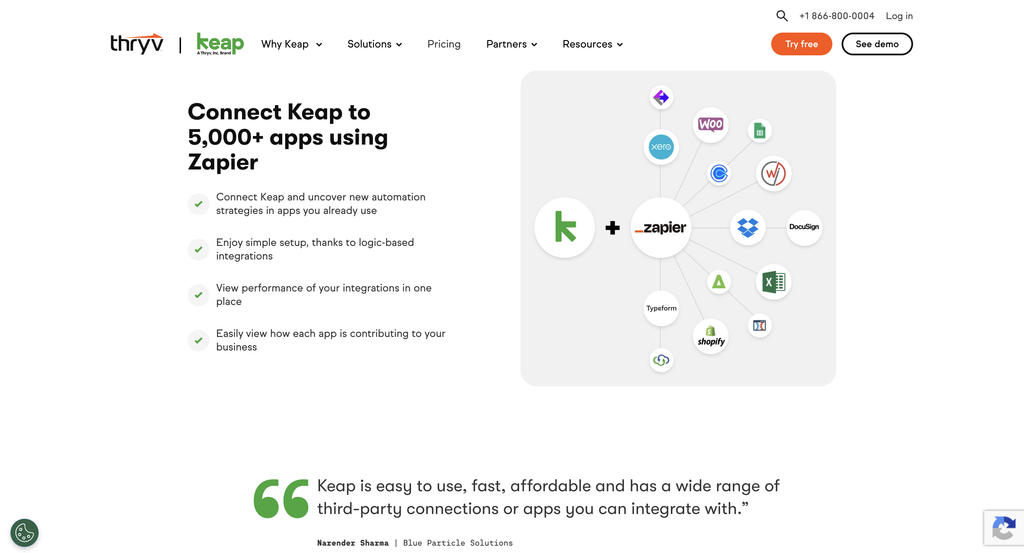
The headline claim is blunt: connect Keap to 5,000 or more apps using Zapier. Beneath it sit three supporting lines about simple logic-based setup, viewing integration performance in one place, and seeing how each app contributes to the business.
A second block covers people rather than software. Keap points you at specialised apps built by Keap-certified experts and at Keap Certified Developer Partners who will build custom work. Underneath that comes the flexibility section, which says you can create custom integrations for apps without Zapier support, get email support from Keap at no extra cost, and use the free developer partner programme.
Then the page offers to show you everything it supports, with a filter listing ten categories: Popular, Connector, ECommerce, Landing Pages and Forms, Lead Gen, Mail, Membership, Other, Reporting and Scheduling.
No apps appeared below that filter. We loaded the page with a declared bot user agent in a full browser, dismissed the cookie dialog, scrolled the entire document, and waited. Zero integration cards rendered, and zero links containing an integration path existed in the finished markup. The same thing happened at marketplace.keap.com, which drew its Experts and Apps tabs and then sat on the word “Loading” indefinitely.
That is a reporting problem rather than a product problem. Keap may well support hundreds of named apps. Nobody can confirm the list from Keap’s own website without executing whatever the catalogue needs, and a buyer checking whether their invoicing tool is supported will hit the same wall we did.
Zapier is doing the heavy lifting, and it lists Keap twice
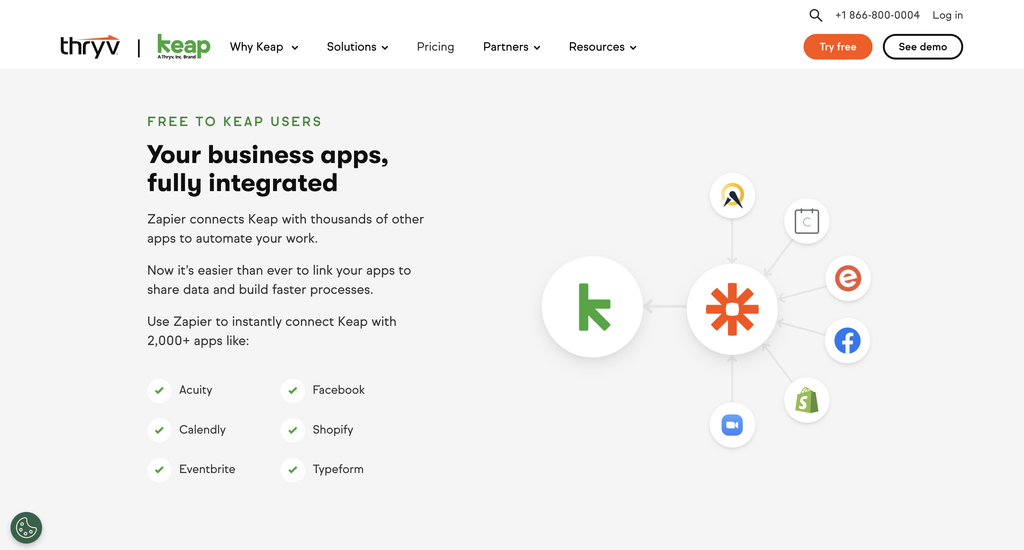
Zapier’s own directory page for Keap is where the detail lives, and the first thing it reveals is a split Keap’s marketing never mentions. Two distinct apps carry the name. One is Keap. The other is Keap Max Classic, the lineage that traces back to Infusionsoft.
Prebuilt workflows on the page come in matched pairs because of it. Creating or updating a contact from a new Calendly event exists once for Keap and again for Keap Max Classic. Anyone wiring up automation needs to know which product their account actually is, because picking the wrong app produces a Zap that authenticates and then finds nothing.
Zapier also contradicts Keap’s headline number. Keap says 5,000 or more apps; Zapier advertises 9,000 or more apps plus 450 or more AI tools on the same page. Both can be true at different moments, and the gap tells you Keap’s figure has not been refreshed recently.
Apps Zapier suggests pairing with Keap include ClickFunnels Classic, Typeform, GetResponse, Gravity Forms, Kajabi, Instapage, Google Forms, Circle and Acuity Scheduling. Prebuilt templates cover Calendly, Facebook Lead Ads, Gravity Forms, Typeform, and Google Sheets. Facebook Lead Ads carries a Premium badge, meaning it sits on Zapier’s paid tiers rather than the free one.
Instant triggers, polling triggers, and two you may not have
Every trigger on the list carries one of two badges, and the difference decides how your automation behaves under time pressure.
Instant triggers start a Zap the moment the event happens. New Contact is instant. So are New Note Event, New Company Event, New Invoice Event, New Opportunity Event, and New Appointment Event. The Opportunity trigger is the most useful of them, because it fires on creation, deletion, editing, and on a stage move, which covers pipeline progression without any extra plumbing.
Polling triggers behave differently. New Action Sequence and New Affiliate both poll, and Zapier spells out the cadence: it checks for new data every 15 minutes on the Free plan. Ninety-six checks a day, with up to a quarter of an hour of latency on each. A lead-routing rule built on a polling trigger will feel broken to a sales team even though it is working exactly as documented.
Two triggers carry a plan qualifier written into their descriptions rather than shown as a badge. New Appointment Event says “For Ultimate users,” and New Affiliate says the same. Affiliate tracking and appointment automation therefore depend on which Keap plan you hold, and you will discover that inside Zapier rather than on Keap’s pricing page.
Below the trigger list, Zapier pitches two newer routes into Keap. One exposes Keap actions to an AI agent through Zapier MCP, authenticating once and letting you control which actions the agent may touch. The other is a code path through the Zapier SDK, which handles OAuth and scoped permissions for backend services, scripts or agent code. Neither is a Keap feature, and both matter if an agent sits anywhere in your roadmap.
The open API now has a published ceiling
Keap’s developer portal opens with a notice that changes how anyone should design a Keap integration.
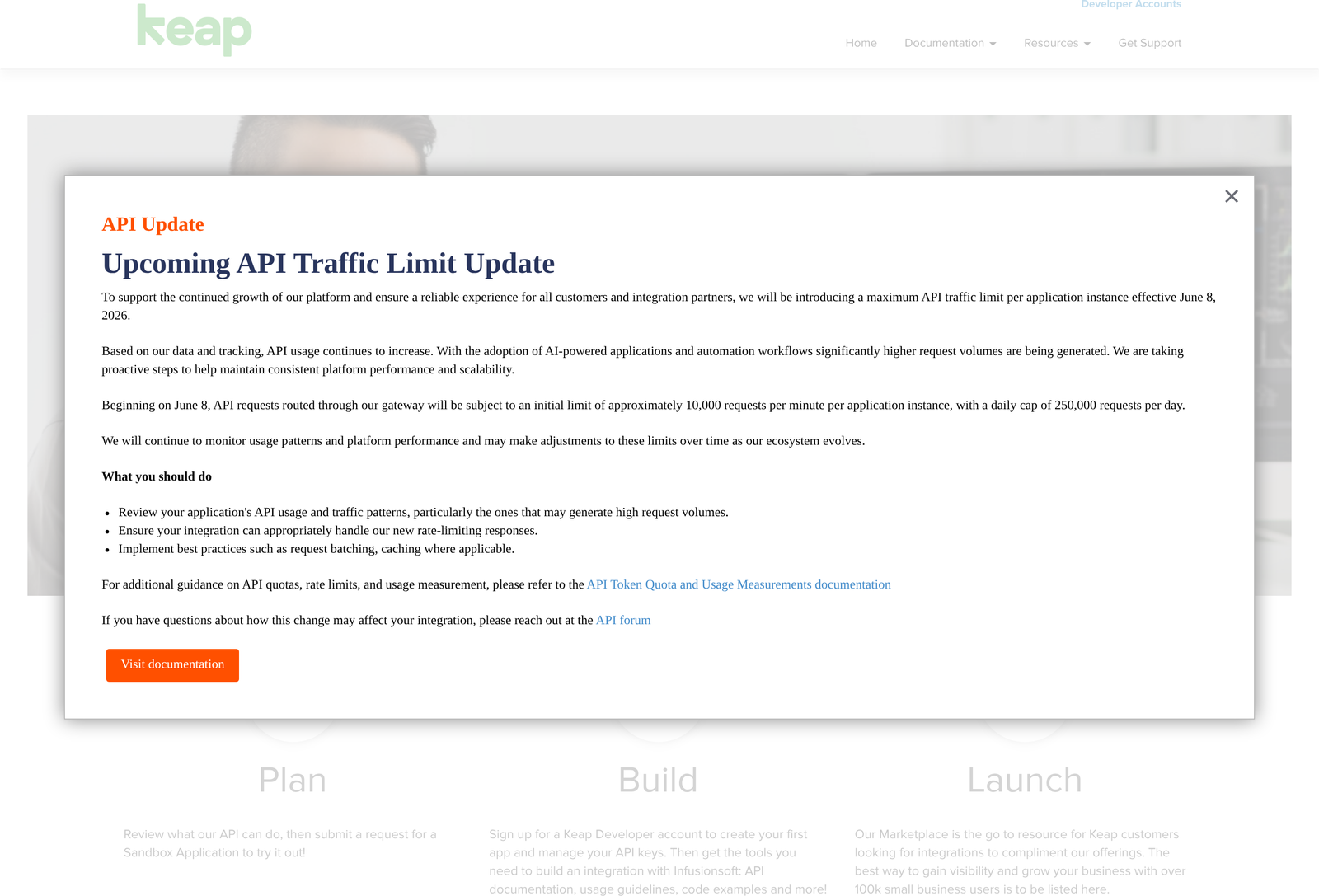
Effective 8 June 2026, requests routed through Keap’s gateway face an initial limit of approximately 10,000 requests per minute per application instance, with a daily cap of 250,000 requests per day. Keap attributes the change to rising volumes from AI-powered applications and automation workflows, and says it may adjust the limits as the ecosystem evolves.
Put those two numbers next to each other and something jumps out. Sustaining 10,000 requests a minute would exhaust the 250,000 daily allowance in 25 minutes. Spread evenly across 24 hours, the daily cap works out at roughly 174 requests a minute. The per-minute ceiling is therefore about 57 times the rate you can actually sustain all day, which makes it a burst allowance rather than a throughput figure.
Anyone planning a nightly sync of a large contact database should do the arithmetic before committing. A one-off import of 250,000 records at one request each consumes the entire day’s budget, and a migration touching multiple endpoints per record will not fit in a single day at all.
The advice Keap gives is sensible and specific: review usage patterns for anything generating high volumes, make sure the integration handles rate-limiting responses properly, and adopt request batching and caching where applicable. It points to documentation on API token quotas and usage measurement for details.
The rest of the developer portal is conventional. You request a sandbox application to try the API, create a developer account to manage API keys, register integration keys, and authenticate with OAuth2. One detail dates the material: the build instructions still describe building an integration with Infusionsoft, a name Keap retired years ago and now carries only in the Max Classic product line.
Getting an app listed takes five steps
If you are building something to sell rather than to use internally, Keap publishes the route. Create a Keap ID, register your company, wait for that registration to be approved, submit your listing to the Marketplace, then wait again until the listing is approved and live. Two approval gates, neither with a stated turnaround.
The incentive Keap offers is reach. Its developer pages describe the Marketplace as the destination for customers looking for integrations and put the audience at over 100,000 small business users. Co-marketing opportunities get a mention alongside it. No listing fee appears anywhere, consistent with the free developer partner programme the integrations page advertises.
Platform cost while you integrate with it
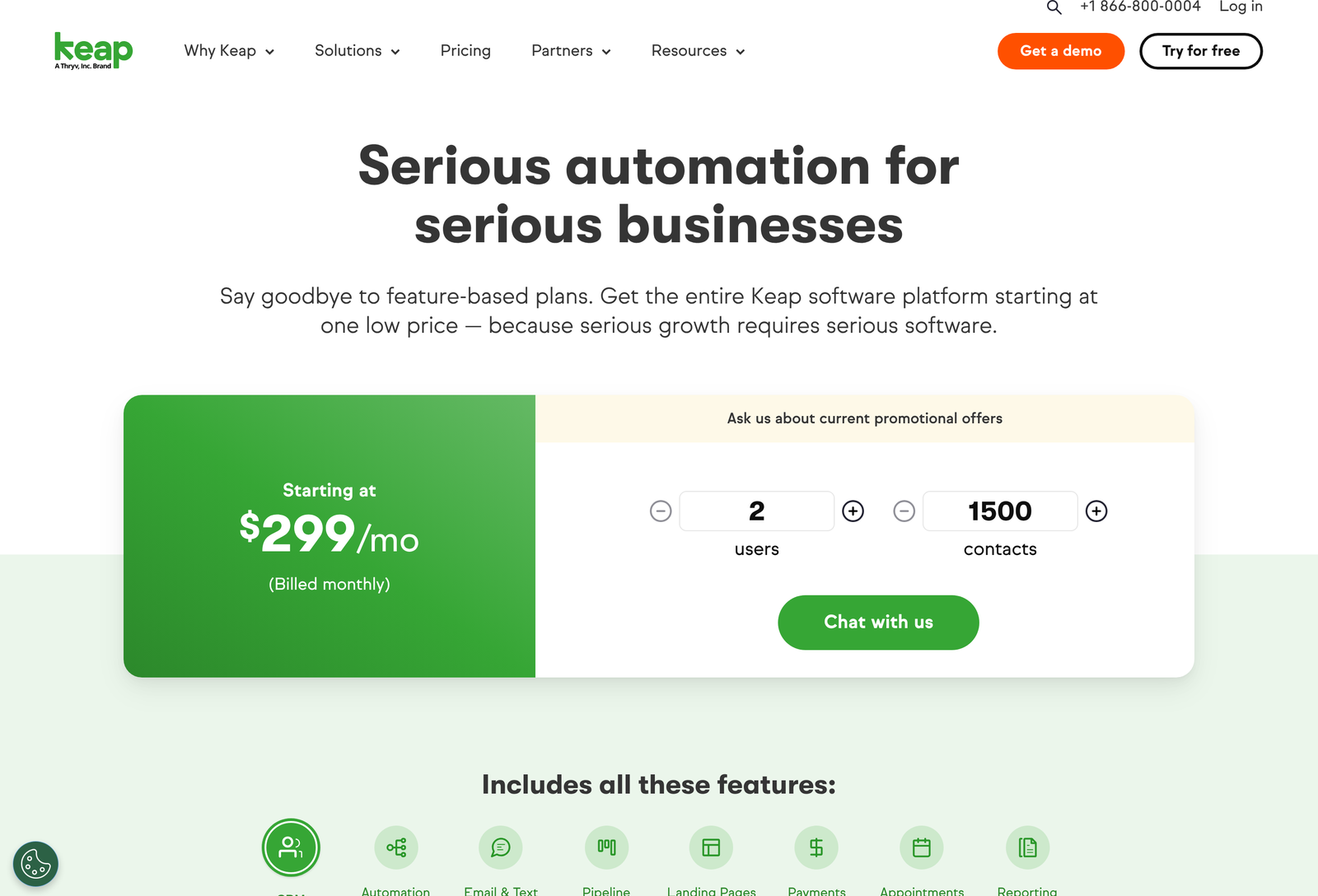
Keap sells one platform rather than a feature ladder, which removes the usual question of whether integrations are gated behind a higher tier. Its pricing page says so directly: no feature-based plans, the entire platform from one price.
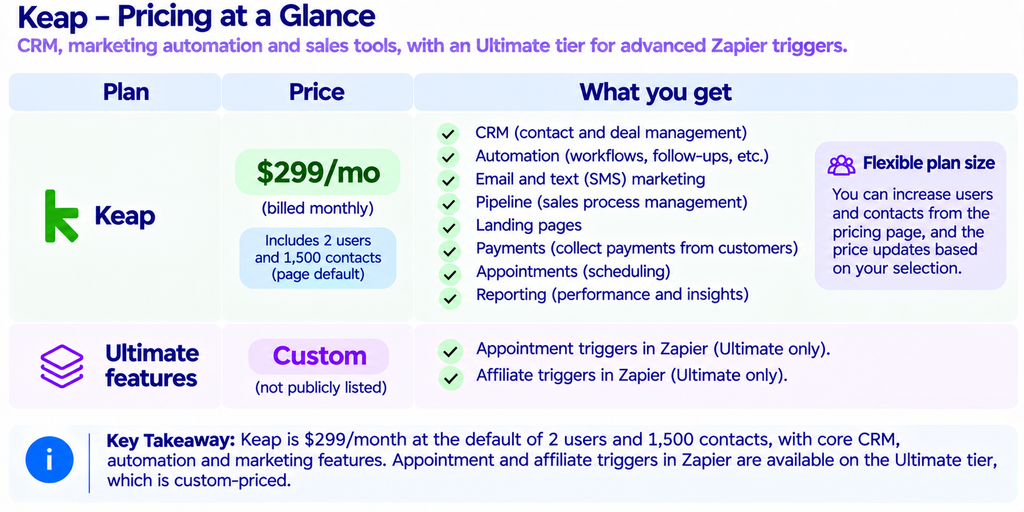
That $299 is a floor and the page says “Starting at” above it. A banner invites you to ask about current promotional offers, which is a reliable sign that the published figure is negotiable. A 14-day free trial runs without a credit card. Our breakdown of who Keap is for at $299 a month works through the contact and seat mechanics, and the fuller Keap review covers the platform itself.
Annualised, $299 a month is $3,588. Set that against the integration work: Zapier’s own subscription sits on top, and anything outside Zapier means building against the API yourself or hiring a certified partner.
The third route runs through people
Zapier and the API are the two routes most buyers consider. Keap pushes a third one hard enough that it deserves examining, because it changes the cost shape of an integration project considerably.
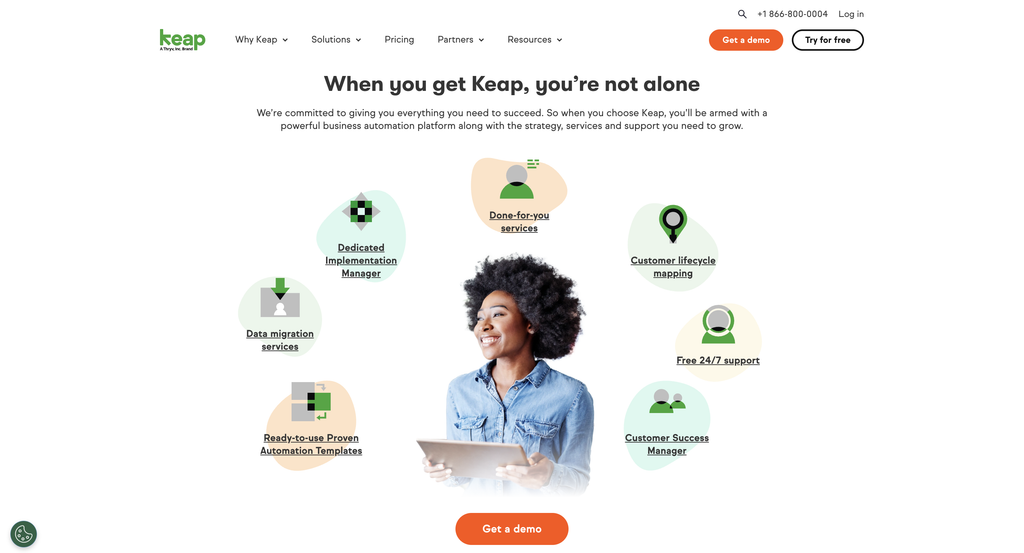
Keap Certified Partners are independent specialists the vendor vets and then lists. Its Marketplace page sets out what they take on: setting up an automated campaign, building out a sales pipeline, automating new customer onboarding, integrating Keap with other software, writing sales and marketing copy, designing email templates and producing promotional video.
Three ways in are offered. Post a project on the job board and let experts bid for it, which requires you to be logged in. Browse the partner directory and approach somebody directly. Or go to the app marketplace and connect something prebuilt.
Treating this as a genuine third option rather than filler is the right call for a small business without a developer. A connector that does not exist in Zapier leaves you with two choices: write against the REST API yourself, or pay somebody who has done it before. Keap has built a directory around the second, and it reduces the risk of discovering mid-project that the integration you assumed existed never did.
Nothing on these pages puts a number on partner work, which is expected for bespoke engagements and still leaves a hole in any budget built from the vendor’s published material. Treat the $299 platform fee as the floor of a project rather than its total, and get a partner quote before assuming an unusual connector is affordable.
Keap is now a Thryv brand
Ownership changed, and it shows on every page. The logo now reads “A Thryv, Inc. Brand”, the integrations page carries a Thryv wordmark beside the Keap one in the header, and the footer links out to Thryv terms, Thryv Academy, and a Thryv acquisition page.
The FAQ Keap publishes on the deal is headed “Keap Is Now Part of Thryv!” and carries quotes from both sides. Clate Mask, co-founder of Keap, frames it as accelerating innovation on a shared vision for small businesses. Joe Walsh, Chairman and CEO of Thryv, describes bringing an expanded, integrated set of marketing and sales solutions to a growing subscriber base.
Thryv itself is described as rooted in the small business industry for 125 years, selling three products: Command Center for communication, Business Center for daily operations and Marketing Center for growth. The FAQ carries a section headed “Choosing a Platform”, which is the part worth reading before you commit engineering time. Two overlapping small-business platforms under one owner rarely both receive the same investment, and anyone writing against the Keap API should want to know where that investment is going.
What we could not verify
- The app catalogue itself. Neither keap.com/product/integrations nor marketplace.keap.com rendered a single app card to a declared bot user agent, so the 5,000-app claim could not be checked, sampled or categorised.
- How many apps sit in each of the ten categories. The filter exists; the contents do not render.
- What the Ultimate plan costs, or which other capabilities it gates. Zapier names it; Keap’s pricing page does not.
- Whether the new API limits apply per Keap account, per integration or per deployed copy of an application. The notice says “per application instance” without defining the term.
- Turnaround times for either Marketplace approval gate.
- Thryv’s own statements about the acquisition. Every thryv.com address we requested returned a 403 to our declared user agent, so this section rests entirely on what Keap publishes.
- Keap’s full pricing curve. Only the default state of 2 users and 1,500 contacts was captured.
Who this integration surface suits
Choose it if: your stack is mainstream and already lives in Zapier. Forms, scheduling, course platforms and landing page builders are well covered; the common Zaps are prebuilt, and the contact and opportunity triggers fire instantly.
Choose it if: you want a single platform price with no integration tier above it. Paying $299 and knowing the API is included removes a negotiation that other vendors force.
Think twice if: you need to confirm a specific niche app before buying. You cannot do that from Keap’s website, and a sales call is the only route to an answer.
Think twice if: your integration moves large volumes. The daily cap of 250,000 requests is generous for day-to-day sync and tight for bulk migration, and it arrived in June 2026 rather than being there from the start.
Before signing anything, establish which Keap you are buying. The Zapier split between Keap and Keap Max Classic is the single most consequential detail on this page, and it determines which triggers, which prebuilt workflows, and which documentation apply to you.
FAQ
How many apps does Keap integrate with?
Keap’s integrations page claims 5,000 or more through Zapier. Zapier’s own Keap page advertises 9,000 or more apps. Neither figure could be verified against a visible catalogue, because Keap’s app list did not render for us.
Does Keap have an open API?
Yes. Keap publishes a developer portal with sandbox applications, integration keys and OAuth2 authentication, and advertises a free developer partner programme with email support at no additional cost.
What are Keap’s API rate limits?
From 8 June 2026, approximately 10,000 requests per minute per application instance with a daily cap of 250,000 requests. Keap says it may adjust these over time and recommends batching and caching.
Why does Zapier list two Keap apps?
One is Keap and the other is Keap Max Classic, the older Infusionsoft lineage. They are separate Zapier apps with their own triggers and templates, so you must connect the one matching your account.
Which Keap triggers are instant?
New Contact, New Note Event, New Company Event, New Invoice Event, New Opportunity Event and New Appointment Event. New Action Sequence and New Affiliate poll instead, every 15 minutes on Zapier’s Free plan.
Are integrations included in the $299 plan?
Keap sells one platform rather than feature tiers, so no separate integrations tier exists. Two Zapier triggers are marked for Ultimate users, and Ultimate is not priced on the pricing page. A Zapier subscription is a separate cost.
Who owns Keap now?
Thryv. Keap’s own FAQ is headed “Keap Is Now Part of Thryv,” and the Keap logo carries an “A Thryv, Inc. Brand” lockup. Thryv sells Command Center, Business Center and Marketing Center alongside it.
Sources
- Keap’s integrations page, read on 21 October 2026, for the 5,000-app Zapier claim, the certified expert and developer partner programmes, the open API section and the ten-category filter that rendered no catalogue.
- Zapier’s Keap app directory, read on 21 October 2026, for the Keap and Keap Max Classic split, the instant and polling trigger badges, the 15-minute polling cadence on the Free plan, the Ultimate-user qualifiers, the suggested app pairings and the Zapier MCP and SDK routes.
- The Keap developer portal, read on 21 October 2026, for the API traffic limit notice effective 8 June 2026, the sandbox and OAuth2 onboarding steps, the five-step Marketplace listing route and the 100,000 small business user figure.
- Keap pricing, read on 21 October 2026, for the $299 a month starting price billed monthly at the default two users and 1,500 contacts, the included feature list and the 14-day trial.
- Keap’s Thryv FAQ, read on 21 October 2026, for the acquisition statement, the quotes from Clate Mask and Joe Walsh and the description of Thryv’s three products.
Prices and limits were read from Keap’s own pages and from Zapier on 21 October 2026. Both vendors change them without notice, so confirm before you budget or build.