


Keap does something almost no CRM does anymore. It sells one product at one price, with no feature tiers to climb. The page says so directly: “Say goodbye to feature-based plans.” Everything the platform can do is switched on from the first invoice.
That makes the fit question unusually clean. Nothing here is a tier choice. The question is whether a $299 monthly floor plus a required onboarding fee makes sense for the shape of your business.
Disclosure: Stack99 earns a commission if you buy through links on this page. It costs you nothing extra and never changes our assessment.
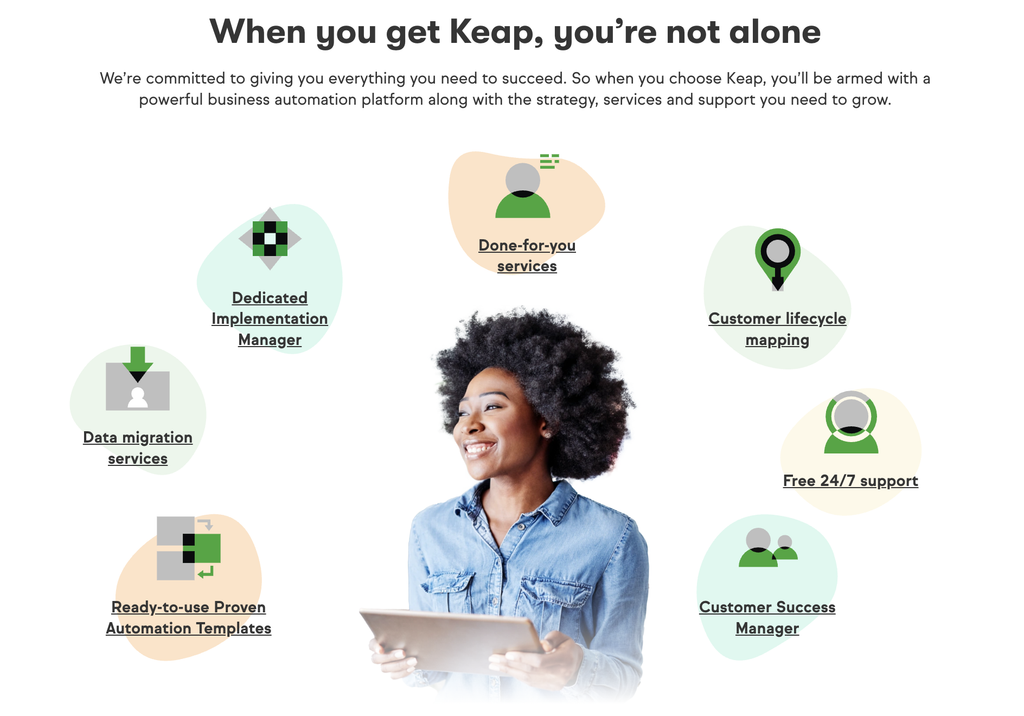
What $299 a month actually covers
Two user licences and 1,500 contacts. The figure is labelled “(Billed monthly)” directly under the price, so it is the true recurring monthly rate rather than an annual rate shown per month. We checked that label in the page markup rather than trusting the layout, because this is the single most common way pricing pages mislead.
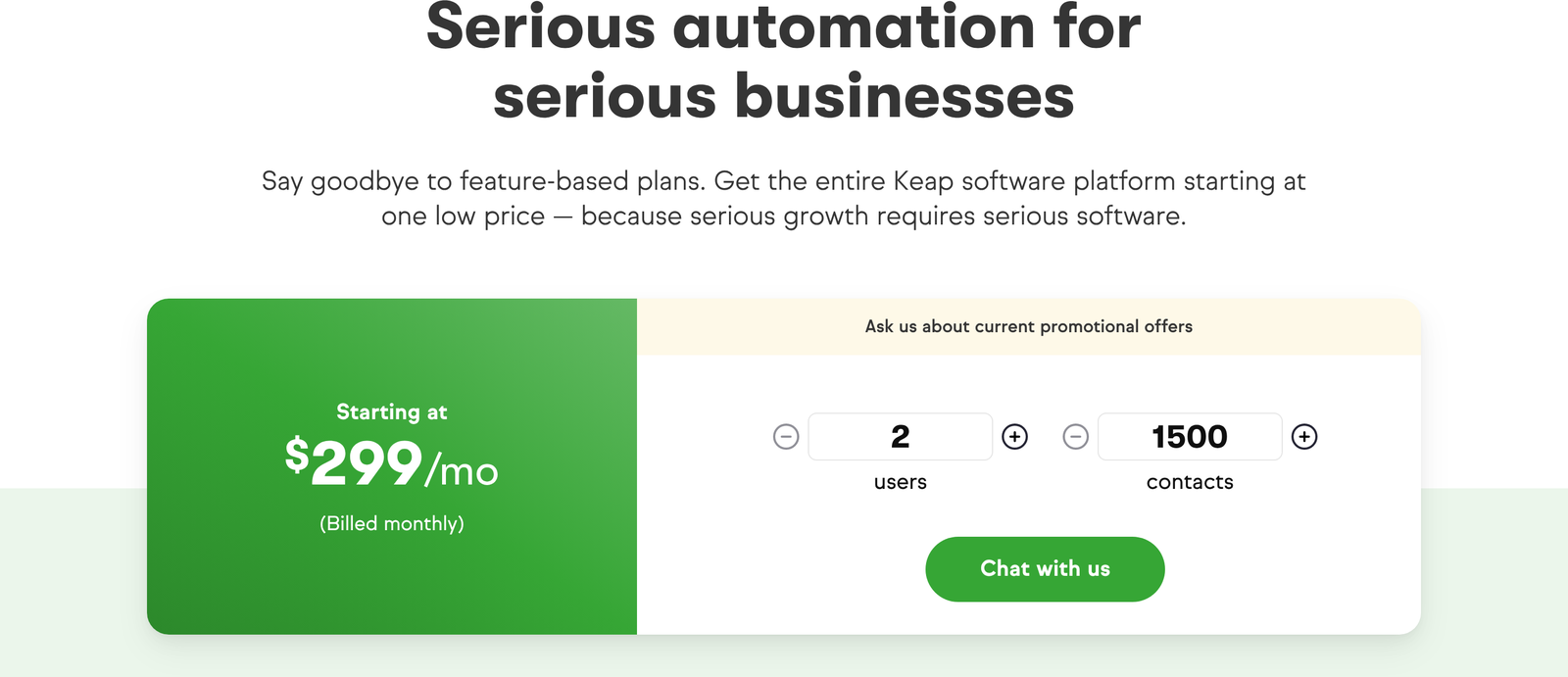
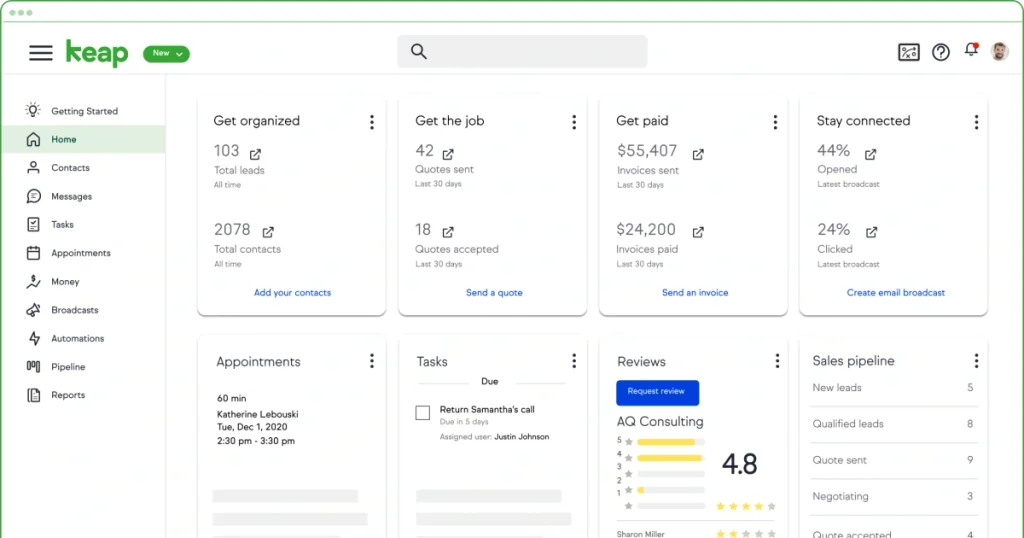
Included at that price: CRM, automation, email and text, pipeline, landing pages, payments, appointments, and reporting. No upsell path exists for any of them, which is the whole pitch.
The two dials that decide your real price
Keap’s configurator has exactly two inputs, and they behave completely differently.
Seats are linear and unforgiving
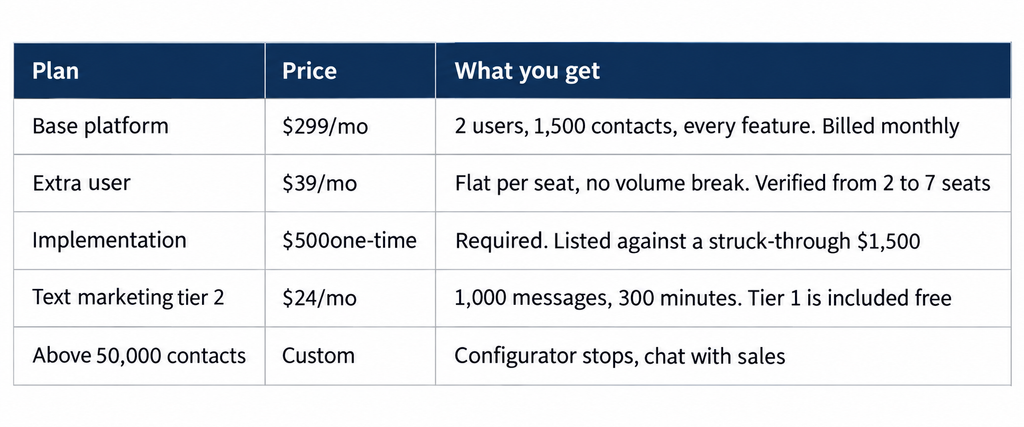
Each user past the included two costs $39 a month, flat. Stepping the configurator from 2 to 7 seats produced $299, $338, $377, $416, $455, and $494. No discount appears at any point. A ten-person team pays $299 plus eight seats at $39, so $611 a month before contacts.
Compare that to seat-priced competitors, and the structure inverts the usual logic. Most CRMs give you a low per-seat price and charge more for capability. Keap gives you every capability and charges steadily for people. Few operators running a lot of processes do very well here. Many light users do not.
Contacts are banded and get cheaper fast
The contact dial moves in bands, not per record. Verified band pricing at the base seat count:
- 1,500 contacts: $299 a month
- 2,500 contacts: $335
- 4,000 contacts: $383
- 6,500 contacts: $449
- 11,500 contacts: $539
- 16,500 contacts: $629
- 26,500 contacts: $719
- Above 50,000: chat with sales
The band increments are $36, $48, $66, $90, $90, and $90. Marginal cost per thousand contacts falls from $36 between the first two bands to $9 between the last two. Average cost per contact per month drops from 19.9 cents at 1,500 to 2.7 cents at 26,500.
Read that curve carefully, because it is the clearest signal about fit. Keap is expensive per contact at small list sizes and cheap at large ones. A 1,500-contact list at $299 is paying a platform fee dressed as a contact charge. The same platform at 26,500 contacts costs $719, which is 2.4 times the price for 17.7 times the list.
The implementation fee nobody budgets for
Keap requires an implementation package. The pricing page links to it without stating a figure; the implementation services page carries $500, shown against a struck-through $1,500.
Treat it as part of year one rather than an optional extra. At the base configuration, the first twelve months are $3,588 of subscription plus $500, so $4,088. Against a $299 headline, that is a 14 percent uplift, and it lands in month one when cash is tightest.
Whether it is good value depends on what you bring. Migrating from spreadsheets with no existing automation, you get real work out of a guided setup. Arriving from another CRM with mapped fields and documented sequences, you are paying for help you may not need, and have no way to decline.
Text marketing, and the border it stops at
Text sits on its own ladder above the base price. Tier 1 is included and covers 500 messages and 100 voice minutes a month. Above that: tier 2 at $24 for 1,000 messages and 300 minutes, tier 3 at $39 for 2,500 and 500, tier 4 at $79 for 5,000 and 800, tier 5 at $139 for 10,000 and 1,000, tier 6 at $279 for 25,000 and 2,000.
Overages run $0.015 per message and $0.01 per voice minute. A 500-text add-on costs $6 a month, a local number is $10 a month, and a toll-free number is included.
Now the constraint that disqualifies a whole category of buyers. Keap’s text marketing is US-only. One-to-one texting extends to Canada. Everything else is out of scope. An agency with clients in the UK, Australia, or the EU cannot use the texting half of the platform at all, and should price Keap as a CRM with email rather than the multi-channel system the marketing describes.
Message volume also shapes the fit more than list size does. Twenty-five thousand messages at tier 6 against a 26,500-contact list is roughly one text per contact per month. Anyone running a genuine SMS cadence will exceed that and should model overages at $0.015 before signing.
Contract terms that favour the vendor
Two terms deserve attention before you commit. Annual contracts carry a $299 early termination fee, equal to one month of the base platform. And cancellation is not self-service: you phone support at least ten days before your next invoice.
Neither is unusual in small-business software, but together they raise the cost of being wrong. A tool you can cancel in two clicks can be trialled casually. A tool requiring a phone call on a ten-day notice window needs a decision made properly up front. Put a calendar reminder on the renewal date the day you sign.
On the ownership question: Keap is a Thryv, Inc. brand, which the site states under its logo and documents in a dedicated FAQ page. Thryv is publicly listed and files with the SEC under CIK 0001556739, so its financial position is a matter of public record rather than guesswork. For a platform you are wiring your sales process into, that visibility matters.
What flat feature access changes in day-to-day use
Tiered pricing has a hidden operating cost that rarely shows up in a comparison spreadsheet. Someone on the team wants to build a sequence, discovers the trigger they need sits one plan up, and the work stops while an upgrade gets approved. Repeat that four times a year, and the delay costs more than the price difference.
Keap removes that loop entirely. Pipeline, landing pages, appointment booking, payments, and reporting are all live from day one, so the only constraint on what you build is your time, not your plan. For a small operator wearing several hats, that is a genuine advantage, and it is the strongest argument for the $299 floor.
The trade is obvious once stated. You pay for the whole platform whether or not you use the payments module or the landing page builder. A team that only wants a contact database and a sequencing tool is buying six products and running two. Count how many of the eight included modules you will genuinely turn on; if the answer is two, the flat price stops being a feature and starts being a surcharge.
There is a second-order effect too. Platforms that bundle everything tend to be deep in none, and buyers who need a best-in-class version of one module usually leave eventually. Keap suits businesses whose requirements are broad and shallow rather than narrow and demanding.
Who Keap fits
Choose it if: you run a service business with two to five people doing the selling, a list somewhere between 1,500 and 10,000, and a follow-up process that repeats. Home services, clinics, consultancies, agencies with retainer clients. The automation pays for itself when the same sequence runs hundreds of times.
Choose it if: you want every capability on day one without a procurement conversation about which tier unlocks what. Flat feature access genuinely removes a category of friction, and teams that have been burned by discovering a needed feature two tiers up will recognise the value.
Choose it if: your operation is US-based and texting is part of how you follow up. The included 500 messages and the cheap step up to 1,000 at $24 make SMS a normal part of the workflow rather than a bolt-on.
Who it does not fit
Solo operators. Two seats get billed, and one gets used. At $299 plus $500 setup, a one-person consultancy is spending $4,088 in year one on infrastructure. The per-contact maths is brutal at the bottom: 1,500 contacts works out to nearly 20 cents each a month.
Large teams of light users. Twelve people who each need occasional access cost $299 plus ten seats at $39, so $689 a month, with no volume break anywhere on that curve. Seat-priced tools with a cheap viewer licence will beat that comfortably.
Anyone outside the US who wants the texting. Covered above, and it is a hard boundary rather than a limitation you can work around.
Big lists with thin margins. Ecommerce stores with 40,000 low-value subscribers are in the band where Keap starts looking reasonable per contact, but the platform is built around sales follow-up rather than broadcast. A dedicated email platform costs a fraction for that job.
Size the configurator before you import
The contact bands create a trap at migration time. Most businesses import everything they have, including every address collected since 2019, and land two bands higher than their working list requires.
Work the numbers. A consultancy with 1,400 active contacts and 1,300 dormant ones imports 2,700 records and sits in the 4,000 band at $383. Clean first, and the same business fits the 1,500 band at $299. That $84 a month is $1,008 a year for records nobody will ever email.
The band edges are where this bites hardest. Crossing from 1,500 to 2,500 costs $36 for the first extra contact and nothing for the next 999. Crossing from 6,500 to 11,500 costs $90 at the boundary. Sitting at 1,520 contacts is the worst possible position on the whole curve, paying a full band step for twenty records.
Three practical steps. Export your list and count contacts with any engagement in the past eighteen months. Suppress the rest rather than importing them, because dormant records cost the same as active ones. Then check where that number sits against the band edges and decide whether a prune gets you under the nearest one.
Seats deserve the same discipline. Every licence is $39 a month forever, so a seat created for a contractor who left is $468 a year of pure waste. Review the user list quarterly; the configurator makes seats trivially easy to add and gives you no prompt to remove them.
The break-even worth running
Here is a calculation that settles the decision faster than any feature comparison. Take your average deal value and your current close rate on inbound enquiries. Keap costs $4,088 in year one at the base configuration. Divide that by your average deal value to get the number of extra closed deals the system needs to produce.
A roofing contractor at $8,000 a job needs roughly half an extra job a year. That is trivially achievable with automated follow-up on quotes that currently go cold. A bookkeeper at $300 a month per client needs about 1.1 extra retained clients for the year, also reasonable. A course creator selling at $49 needs 83 extra sales, which is a different conversation entirely.
Average deal value, more than list size or team size, is what separates businesses Keap suits from businesses it drains. High-ticket and consultative wins. Low-ticket and high-volume losses.
You can check the current configurator at Keap, since both dials move the price and promotional offers appear and disappear. Our full Keap review covers the platform itself in more depth.
What we left out
Keap’s markup contains an annual billing figure that the page does not display. Because it is hidden rather than offered, we have not published it or used it in any calculation here. Every figure above reflects the monthly rate the page actually shows. If an annual option matters to you, ask sales directly rather than relying on a number scraped from a page that will not render it.
Contact bands above 26,500 are also unverified. The configurator offers them up to 50,000 but we captured figures only to the 26,500 band.
FAQ
How much does Keap cost to start?
$299 a month billed monthly, covering 2 users and 1,500 contacts, plus a required implementation package at $500 one-time. First-year total at that configuration is $4,088.
Does Keap have a cheaper plan?
No. There is one product at one price with every feature included. The only way the price moves is up, by adding seats at $39 each or stepping into a higher contact band.
Is the implementation fee optional?
No. The pricing page states a Keap implementation package is required. It is listed at $500 against a struck-through $1,500.
Can I use Keap outside the United States?
The CRM and email side, yes. Text marketing is US only, with one-to-one texting extending to Canada. Budget Keap as an email-and-CRM platform if you operate elsewhere.
How do I cancel?
By phone, at least ten days before your next invoice. Cancellation is not self-service, and annual contracts carry a $299 early termination fee.
Who owns Keap?
Thryv, Inc. The site carries “A Thryv, Inc. Brand” under its logo and maintains a FAQ page about the relationship. Thryv files with the SEC under CIK 0001556739.
Bottom line
Keap is built for a specific business and makes little effort to hide it. Small team, meaningful deal values, US operations, follow-up that repeats often enough to automate. Inside that profile, the flat feature access removes a lot of friction, and the contact curve rewards you for growing. Outside it, the $299 floor and the $500 setup are a tax on capability you will not use. Run the break-even against your average deal value before you look at a single feature.
Figures were read from keap.com on 8 October 2026 and the configurator changes. Verify before you commit.