


Quick answer
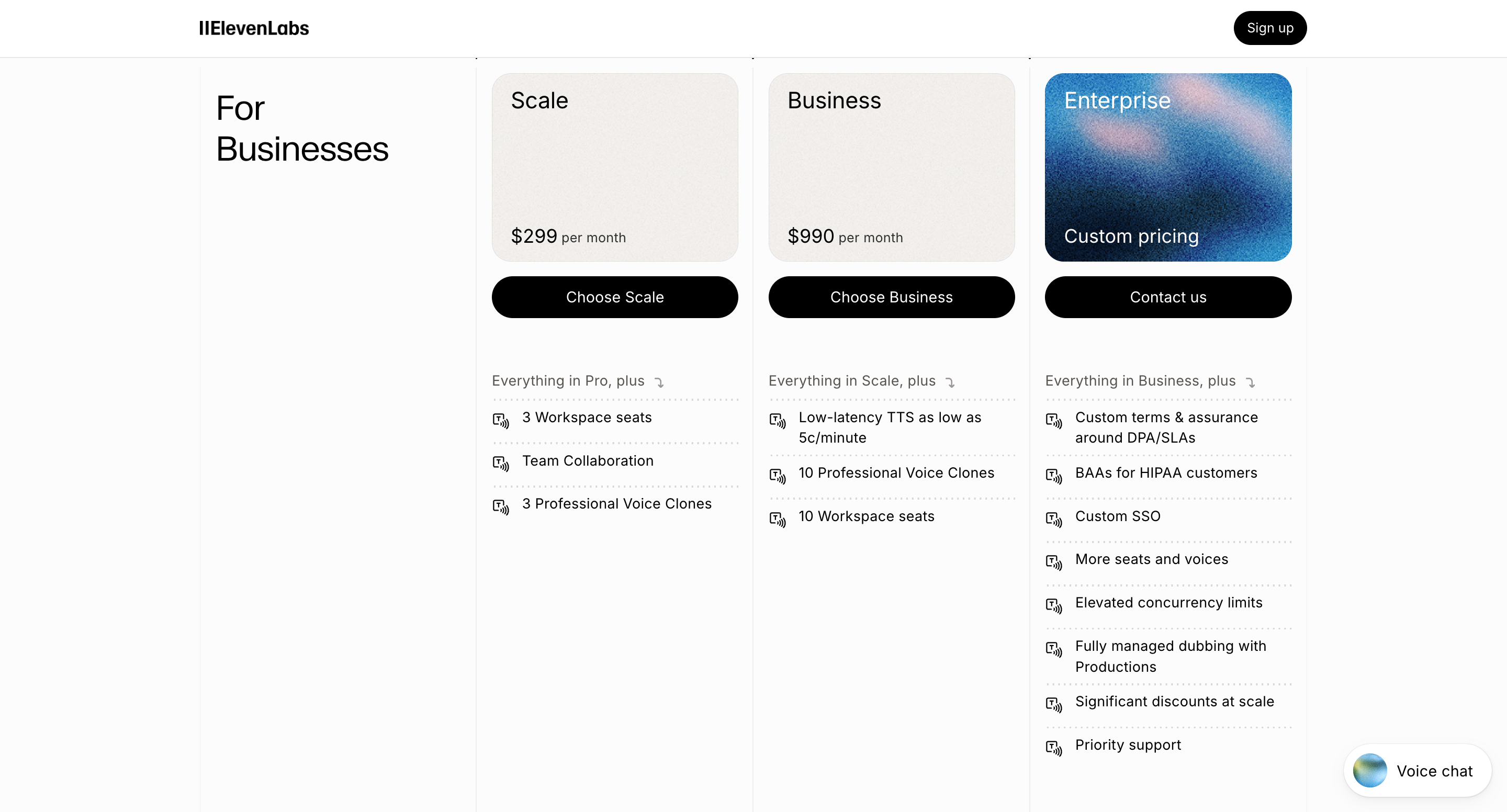
What it costs: ElevenLabs bills monthly at $0 (Free), $6 (Starter), $22 (Creator), $99 (Pro), $299 (Scale), and $990 (Business), with Enterprise quoted. Annual billing is the monthly price × 10, so you pay for ten months and get twelve.
What you are actually buying: A single pool of credits, shared across every ElevenLabs product. Text-to-speech burns roughly 1 credit per character; dubbing can burn 10,000 credits a minute.
The number that matters: Cost per 1,000 characters of speech. On Creator, that works out to about $0.18. On Pro, Scale, and Business, it settles near $0.165.
Watch out for: A promotional first-month price on Starter and Creator that is not the recurring rate, and credits that expire if you downgrade.
Disclosure: Stack99 earns a commission if you buy through links on this page. It costs you nothing extra and never changes our assessment.
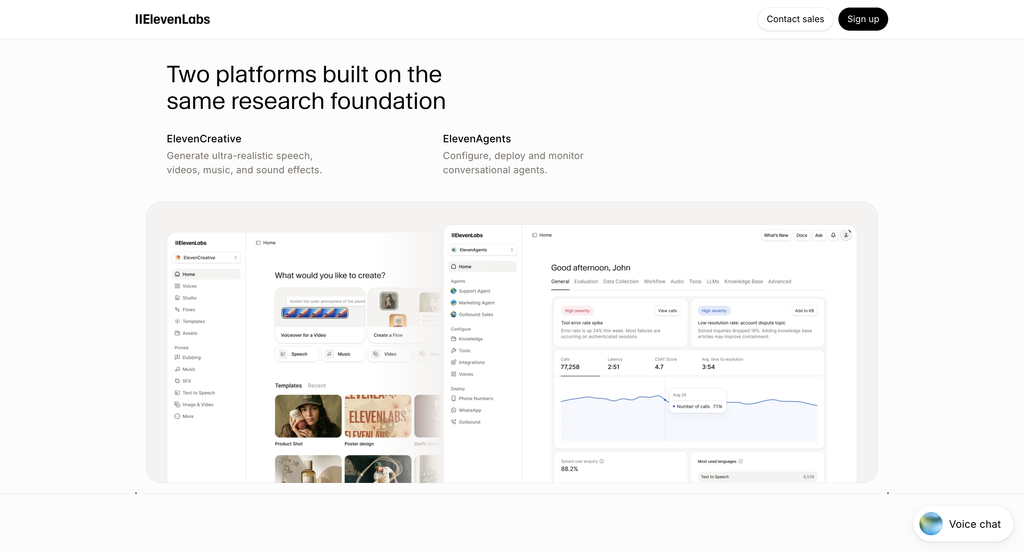
Most write-ups of ElevenLabs pricing stop at the plan names. It is the least useful part. ElevenLabs does not sell you minutes of audio or several voices; it sells you credits, and every product on the platform draws from the same pool. Whether a $22 plan is generous or thin depends entirely on what you point those credits at. Transcribe with them and 121,000 credits buys you a few hundred minutes. Dub with them and the same balance buys you about twelve.
This page does the arithmetic. Every figure below was read off the vendor’s own pricing page on 2 October 2026, with both billing toggles captured so there is no ambiguity about which number recurs.
ElevenLabs pricing at a glance
The ElevenLabs pricing page opens on the monthly toggle, which is worth saying because many vendors default to the annual rate and quietly present it as a monthly price. ElevenLabs does not. What you see first is what you pay every month.
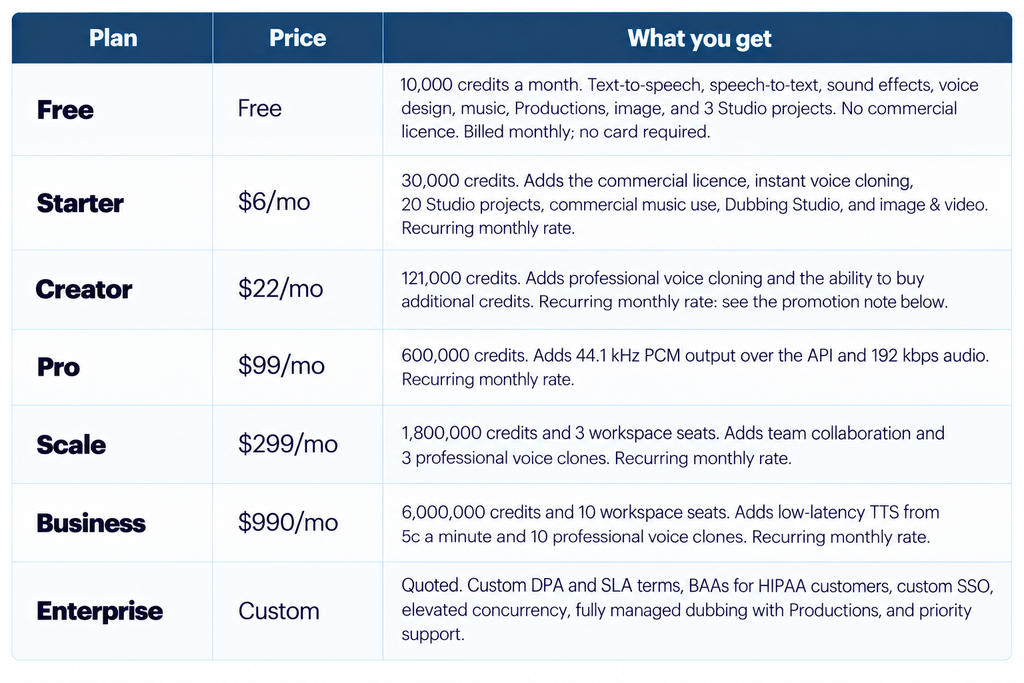
Prices exclude taxes, levies, and duties, which the pricing page states directly. Buying from the EU, UK or UAE? Add your local rate on top of every figure in that table.
The promotional price is not the recurring price
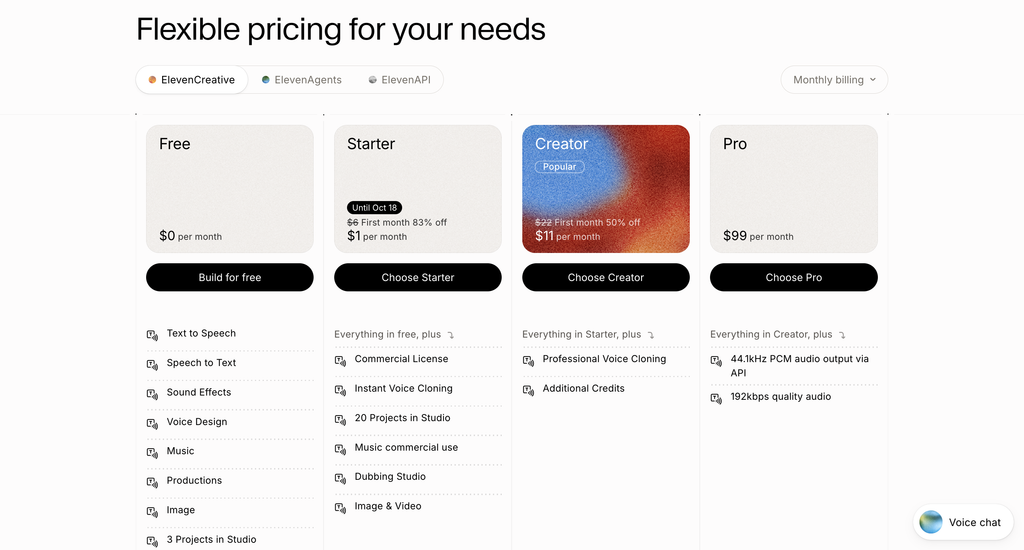
Two tiers currently show two numbers. Starter displays a struck-through $6 above a large $1, labelled “first month 83% off,” with an “until Oct 18” badge. Creator displays a struck-through $22 above a large $11, labelled “first month 50% off.”
The large number is the introductory price for month one. The struck-through number is what you pay from month two onward. This is easy to get wrong, because text extracted from the page loses the strikethrough and leaves you with two bare figures. Switch to yearly, and Starter reads $5 a month against a struck-through $6, Creator reads $18.33 against $22. Annual billing is ten months’ cost spread over twelve, so $22 × 10 ÷ 12 = $18.33. The arithmetic only works if $22 is the recurring rate.
For budgeting, use $6 and $22. If you are deciding whether to start this month, the $1 and $11 entry prices are real and the Starter promotion is dated to 18 October 2026.
Annual billing: two months free, and that is all
ElevenLabs is unusually plain about this. The pricing FAQ states that the annual price is the monthly price multiplied by ten, and lists the equivalent monthly figures: $5 for Starter, $18.33 for Creator, $82.50 for Pro, $249.17 for Scale and $825 for Business.
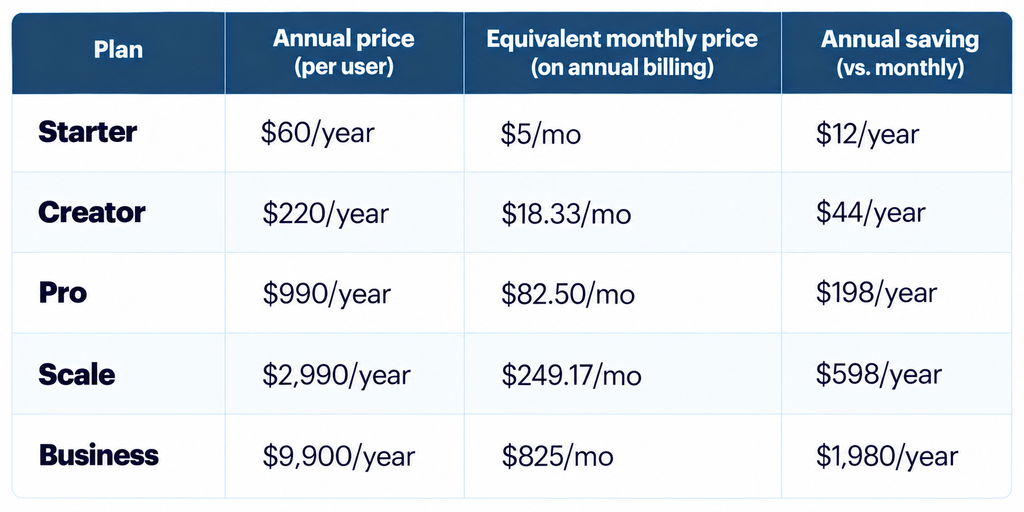
A flat 16.7% discount applies at every tier. There is no extra volume break for paying up front, and no tier where the annual maths is better than another. The only question is whether you are confident enough in twelve months of usage to pre-pay for ten.
How credits actually work
This is the part that decides whether a plan is cheap or expensive for you. Credits are a single monthly pool, and every product spends from it. Using one product leaves fewer credits for the others.
The published approximate costs:
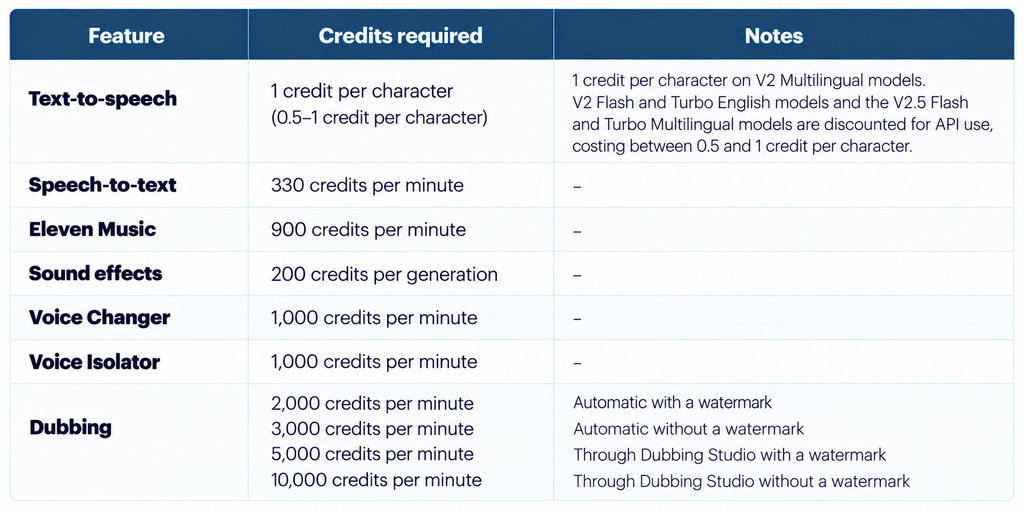
Put Creator’s 121,000 credits against those rates and the plan looks completely different depending on the job:
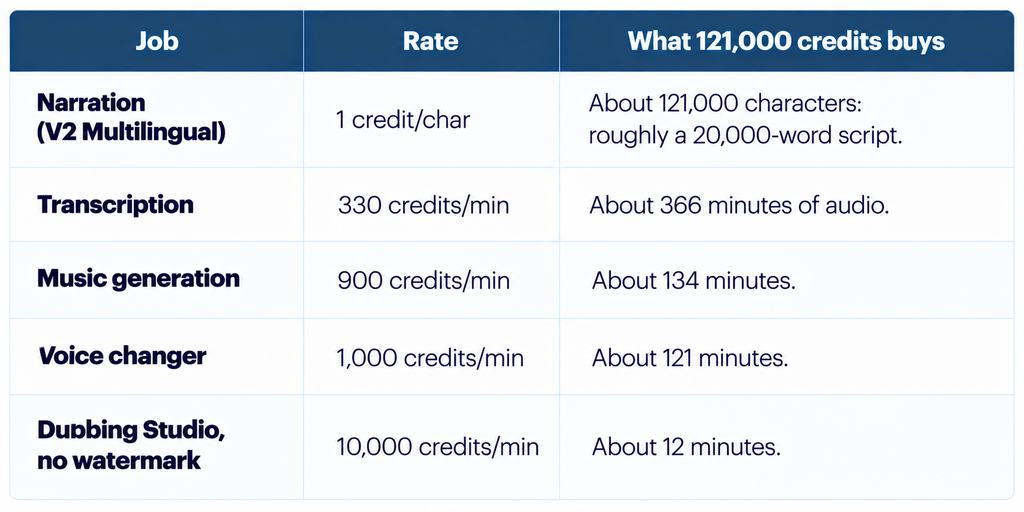
A podcaster transcribing six hours a month and a localisation team dubbing twenty minutes a month will reach wildly different conclusions about the same $22. Work out your dominant job first, then pick the tier.
Cost per 1,000 characters, by tier
For text-to-speech at the headline, 1 credit per character, dividing the monthly price by the included credits gives a clean comparison across tiers:
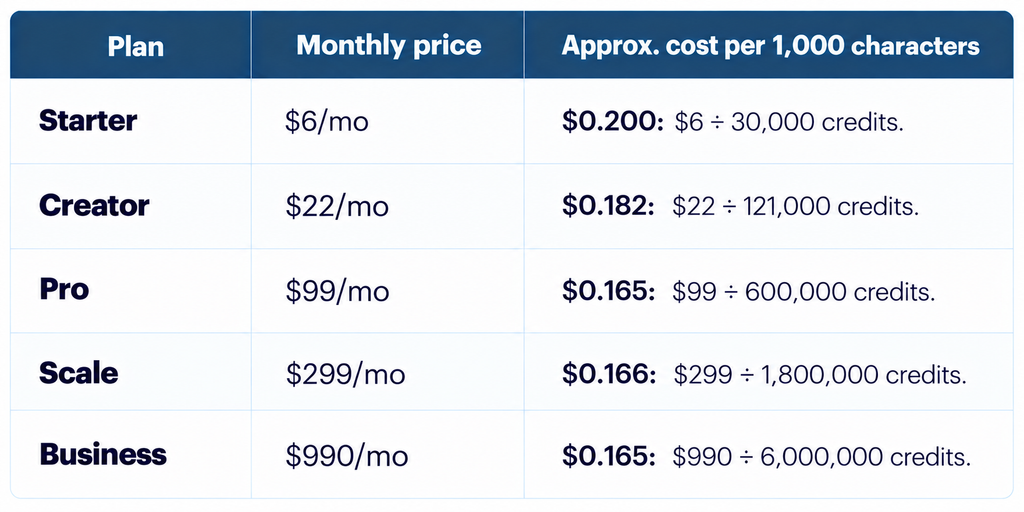
The curve flattens hard after Pro. Moving from Starter to Creator cuts your effective rate by about 9%; moving from Creator to Pro cuts it by another 9%; after that, the per-character cost barely moves. Above Pro, you are buying seats, concurrency, professional voice clone slots, and contractual terms, not cheaper audio. That is a useful thing to know before someone in procurement argues for Business on cost-per-unit grounds.
These are derived figures, not quoted ones. They assume the 1 credit per character rate and ignore the API discount on the Flash and Turbo models, which can halve the cost for high-volume API work.
Rollover, expiry and the fine print worth reading
Three rules in the pricing FAQ change the real value of a plan:
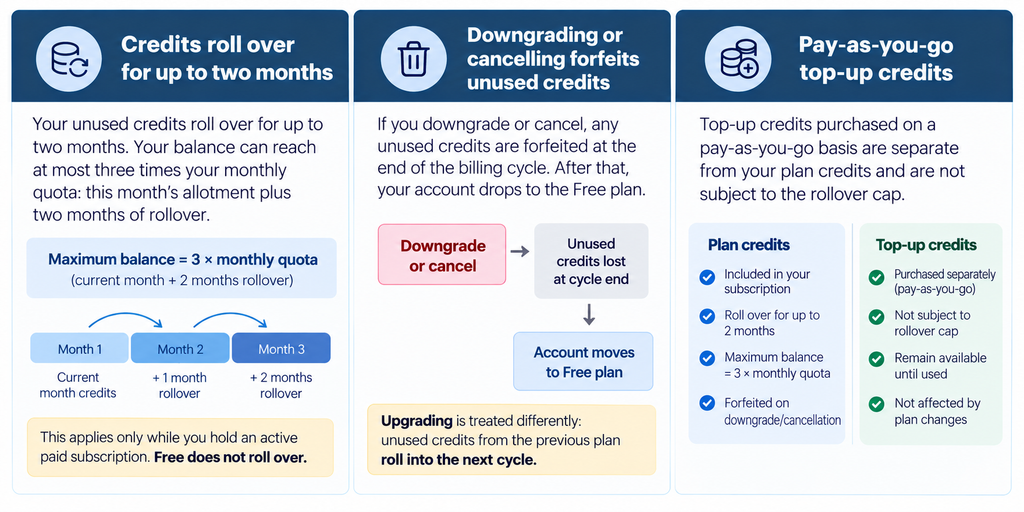
Credits are charged per generation request rather than per download, so a regeneration normally costs again. ElevenLabs states that a limited number of free regenerations may be available when the content and certain settings are unchanged, and that the interface tells you before you generate whether a given regeneration is free. A cap also applies to how many credits a single request can consume, which differs between the Free tier and paid subscriptions.
Cancellation is straightforward: you can cancel at any time, and the subscription stays live until the end of the current billing cycle, then does not renew.
Which tier fits which job
Mapping the plans onto realistic situations rather than feature lists:
- Free is for evaluation and nothing else. No commercial licence comes with it, so anything you generate cannot be used in work you are paid for. 10,000 credits is roughly 10,000 characters of narration, enough to judge voice quality on your own script, which is the only way to judge it.
- Starter at $6 is the cheapest tier you can legally ship from. It carries the commercial licence, instant voice cloning, and Dubbing Studio. 30,000 credits a month suits short-form work: product videos, ad reads, a weekly podcast intro.
- Creator at $22 is where most individual creators land, and the jump in credits is the reason: four times the Starter allowance for under four times the price. Professional voice cloning, which needs a longer training sample and produces a noticeably better clone than the instant version, starts here.
- Pro at $99 is an API tier. The 44.1 kHz PCM output and 192 kbps audio matter if you are feeding a broadcast or post-production chain; if you are publishing to YouTube or a podcast host that re-encodes anyway, they matter less than the 600,000 credits.
- Scale at $299 is the first tier with real team support: 3 workspace seats, shared collaboration, and 3 professional voice clone slots. If two or more people need their own login, this is the floor.
- Business at $990 adds 10 seats, 10 clone slots, and low-latency TTS from 5c a minute, the tier for production voice agents where response time is the product.
- Enterprise exists for the contractual items: custom DPA and SLA terms, BAAs for HIPAA customers, custom SSO, elevated concurrency, and managed dubbing. Where a security review requires any of those, no amount of credits on a lower tier will substitute.
What is not in the price
A few things to budget for separately. Taxes are excluded from every listed figure. Additional credits beyond your monthly allowance are a paid top-up and are only available from Creator upward, so Starter has a hard ceiling. Professional voice clone slots are capped per tier (three on Scale, ten on Business) and they are slots, not a per-clone charge, so planning around them matters if you manage many branded voices.
The platform also runs time-limited model promotions. At the time of writing, a banner offers 3× credits on Creator and above for the Eleven v4 model until 12 October 2026, and the pricing page notes that up to 2× your monthly TTS credits used on v4 will not count against your balance for two weeks, in the web and mobile apps only. Useful if your evaluation window lines up with it; not something to build a budget on.
How ElevenLabs pricing compares to usage-based rivals
ElevenLabs sells subscriptions with bundled credits. Several competitors sell metered usage with no monthly commitment, and the two models are hard to compare without converting them to a common basis. Using the derived per-1,000-character figures above as the ElevenLabs side:
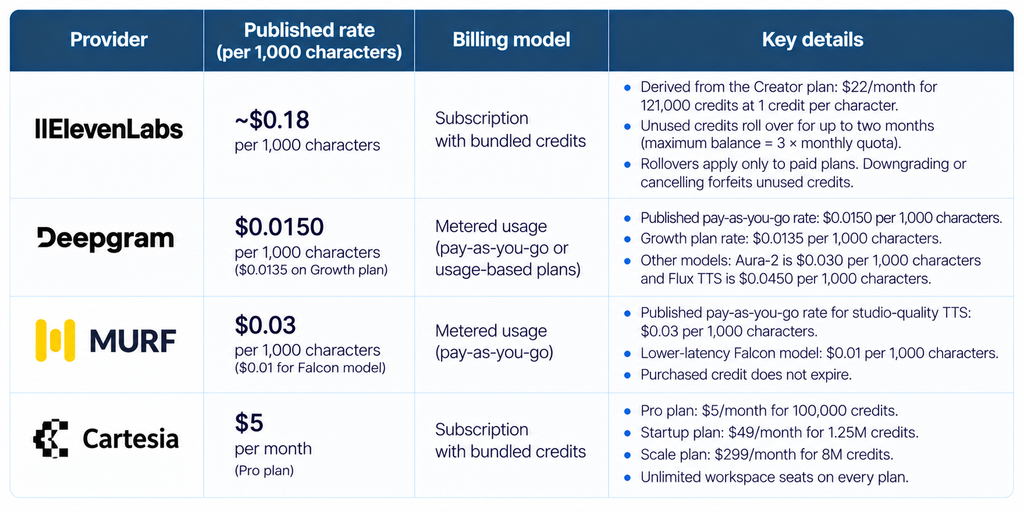
Read that table carefully before concluding it. The metered rates buy raw synthesis through an API. The ElevenLabs figure buys synthesis plus the voice library, professional cloning, Studio, Dubbing Studio, music, sound effects, speech-to-text, and the Agents platform, all from one balance. Comparing them like for like on cost per character flatters the metered providers and understates what you would have to assemble to replace the bundle.
The comparison does tell you something real, though: if your workload is plain narration pushed through an API at volume, and you need none of the surrounding platform, you are paying a substantial premium for software you are not opening. That premium is defensible for a creator studio and hard to defend for a backend service that only needs a voice.
Four ways to cut an ElevenLabs bill
If the tier you need is more than you want to pay, these are the levers that actually move the number:
- Use the discounted models for API work. The V2 Flash and Turbo English models and the V2.5 Flash and Turbo Multilingual models cost between 0.5 and 1 credit per character over the API, against a flat 1 credit on V2 Multilingual. At the bottom of that range, you halve your text-to-speech spend for the same word count.
- Keep dubbing off the main balance where you can. Dubbing Studio without a watermark is 10,000 credits a minute, ten thousand times the cost of a character of narration. A twenty-minute dub consumes 200,000 credits, more than the entire Creator allowance. If dubbing is occasional, it may be cheaper to buy top-up credits in the month you need it than to hold a higher tier all year.
- Exploit rollover deliberately. Paid plans accumulate up to two months of unused credits, so a balance can reach three times the monthly quota. Seasonal work is the case for a steady mid-tier subscription, which can absorb a heavy month without an upgrade. The catch is that it only works while the subscription stays active and not downgraded.
- Do not pay annually until you have three months of real usage data. A flat 16.7% off at every tier is not enough to justify locking in before you know which product is consuming your credits. Run monthly first, read the usage page, then commit.
Is it worth it?
ElevenLabs is not the cheapest way to turn text into audio and has not been for a while. Usage-priced competitors publish rates an order of magnitude below the subscription maths above. What the subscription buys is the voice library, the cloning quality, Studio, dubbing, and the fact that one credit balance covers all of it without separate contracts.
That bundle is worth paying for if you use more than one of those products. If you only need plain narration at volume through an API, you are paying for a lot of platform you will not touch, and the per-character rate reflects it. Our comparison of the alternatives works through what you give up by leaving.
The honest test is cheap: the Free tier gives you 10,000 credits with no card, which is enough to run your own script through the voices you would actually use. Do that before you compare price tables. You can start on the ElevenLabs free plan and upgrade once you know which product is eating your credits.
Frequently asked questions
Is ElevenLabs Creator $11 or $22 a month?
$22 is the recurring monthly rate. $11 is a promotional first-month price at 50% off. The annual toggle confirms it: Creator on annual billing shows $18.33 a month, which is $22 × 10 ÷ 12.
Does ElevenLabs have a free plan?
Yes. Free costs nothing, needs no card, and includes 10,000 credits a month plus access to text-to-speech, speech-to-text, sound effects, voice design, music, Productions, image, and 3 Studio projects. It does not include a commercial licence, so output cannot be used commercially.
How much does ElevenLabs cost per character?
Text-to-speech on the V2 Multilingual models costs about 1 credit per character. Dividing each plan’s price by its included credits gives roughly $0.20 per 1,000 characters on Starter, $0.18 on Creator, and $0.165 on Pro, Scale, and Business. API use of the Flash and Turbo models is discounted to between 0.5 and 1 credit per character.
Do unused ElevenLabs credits roll over?
On paid plans, yes, for up to two months, capping your balance at three times your monthly quota. Rollover does not apply to the Free plan, and downgrading or cancelling forfeits unused credits at the end of the cycle.
How much do you save with annual billing?
Two months, or about 16.7%. Yearly billing charges ten months for twelve. The discount is the same at every tier.
Which plan do I need for commercial use?
Starter at $6 a month is the lowest tier that carries the commercial licence. The Free plan does not.
How many seats come with each plan?
Scale includes 3 workspace seats, and Business includes 10. Free, Starter, Creator, and Pro are single-user. Enterprise is negotiated.
Can I buy extra credits if I run out?
Additional credits are available from Creator upward as a pay-as-you-go top-up. Those top-up credits sit outside the normal rollover cap. Starter and Free have no top-up option.
Sources
- Plan prices, included credits, per-product credit costs, rollover rules and annual billing terms: elevenlabs.io/pricing, both billing toggles captured 2 October 2026.
- Funding and company scale: Silicon Republic, 5 February 2026, $500m Series D at an $11bn valuation, led by Sequoia Capital.
- Revenue estimates: Sacra, which estimates ElevenLabs reached $600m ARR in June 2026. Treat as an independent estimate, not a company disclosure.
- Affiliate link used on this page: ElevenLabs.
Prices change. Everything above was verified on 2 October 2026 against the vendor’s own page; check it before you commit a budget.