


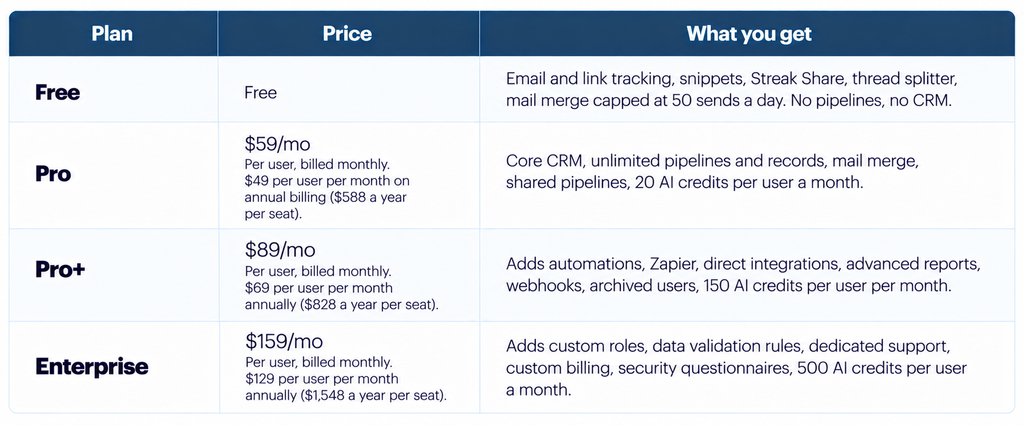
Quick answer: Streak charges $59, $89, and $159 per user per month on Pro, Pro+, and Enterprise. The $49, $69, and $129 figures you see when the pricing page loads are the annual rates, because the billing toggle arrives already switched to annual. A free tier exists but has no CRM in it at all, only the Gmail email tools. Paying yearly saves $120 to $360 per user per year depending on tier.
Disclosure: Stack99 earns a commission if you buy through links on this page. It costs you nothing extra and never changes our assessment.
Most pricing pages make you hunt for the real number. Streak makes you notice a toggle. Load streak.com/pricing and three cards greet you at $49, $69, and $129 per user per month. Those are real prices. They are also not what you pay unless you commit to a year up front, because the Monthly/Annually switch sitting above the cards is already pushed to Annually when the page renders.
Flip it back, and the cards redraw: $59, $89, $159. Streak’s own FAQ further down the same page confirms the split in plain words, which is more than many vendors bother to do. The gap between the two states is where most budget mistakes on this product start.
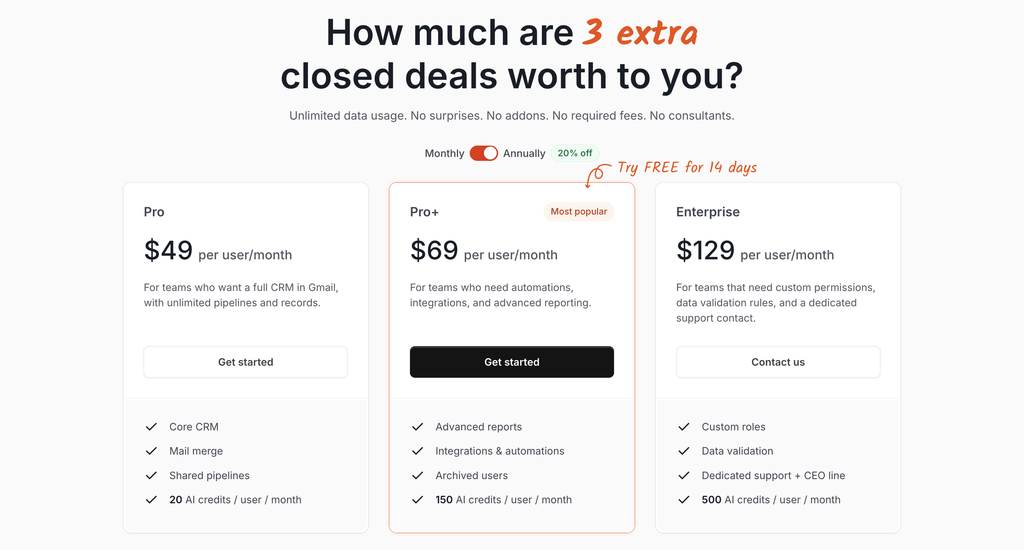
Streak pricing per user per month, both ways
Every figure above came off the vendor’s page in both toggle states on 7 October 2026, captured in US dollars. Taxes sit outside these numbers.
What the annual commitment is actually worth
Streak’s badge says 20% off. The arithmetic per tier says something slightly messier:
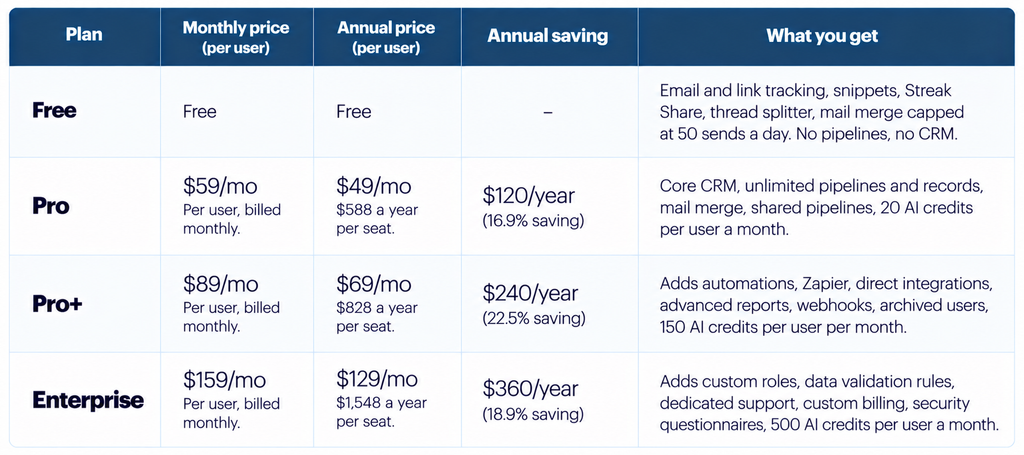
So the discount is deepest on Pro+ and shallowest on Pro. A five-person sales team on Pro+ pays $5,340 a year monthly, or $4,140 annually. The $1,200 difference buys roughly fourteen extra seat-months. For a team that has already run Streak for a year and knows it works, committing is easy money. For a team three weeks into a trial, locking in $4,140 to save $1,200 is a different proposition, and the monthly rate is the honest comparison point against any rival you are also testing.
One detail that rarely makes it into comparison tables: Streak sells seats, not tiers of contacts. Records, pipelines, and shared contacts are unlimited on all three paid plans. A two-person agency on Pro pays $118 a month and can store a million deals. A twenty-person team pays $1,180 for the same storage. Your bill scales with headcount and nothing else, which makes Streak cheap for data-heavy, people-light operations and expensive the other way round.
Where the tier boundaries really sit
Tier names tell you very little. The comparison grid tells you a lot. Reading it against the three cards, the boundaries fall in specific places.
Pro gives you the whole CRM
Unlimited private and shared pipelines. Custom fields and magic fields, the ones that update themselves with values like last reply and time in stage. Automatic email sharing, so a colleague opening a deal sees the whole thread history without anyone forwarding anything. Contact enrichment, tasks, file attachments pulled from Gmail or Drive, call logs, formula columns, native mobile apps. Standard report dashboards and basic permissions. Streak’s REST API is on this tier too.
Nothing about Pro feels like a stripped starter plan. A solo consultant or a three-person team running deals out of Gmail will find very little missing.
Pro+ is the automation tier, and that is the real jump
Four things move at $89. Automations, meaning rules that create tasks, post comments, fire notifications, update boxes, or send email without a human. Zapier, which Streak describes as reaching 9,000-plus apps. Direct integrations with Calendly, Google Forms, Typeform, and Slack. Webhooks on top of the standard API.
Advanced report dashboards and archived users round it out. Archived users is an underrated line: it keeps a departed employee’s email history searchable in Streak without paying for their Streak seat or their Google licence. Companies with steady staff turnover can recover the upgrade cost on that line alone.
Teams whose workflow reads “capture a form submission, create a deal, assign a task, notify the channel” need Pro+. The $30 a seat a month gap between the two tiers is the price of not doing that by hand.
Enterprise is about control, not capability
Custom permission roles rather than basic ones. Data validation rules that enforce clean fields at entry. Custom billing terms across multiple teams. A security questionnaire process for IT review. A dedicated support contact, described on the page as including a line to the CEO, plus a quarterly strategy meeting.
None of that makes the CRM do more. All of it makes the CRM survive an audit and a hundred-person rollout. Buy Enterprise when procurement asks questions, not when you want features.
AI credits: the part of the bill that moves with use
Streak bundles AI credits per seat per month: 20 on Pro, 150 on Pro+, 500 on Enterprise. Credits pool across the team, so a five person Pro+ team shares 750 a month rather than each person being capped at 150.
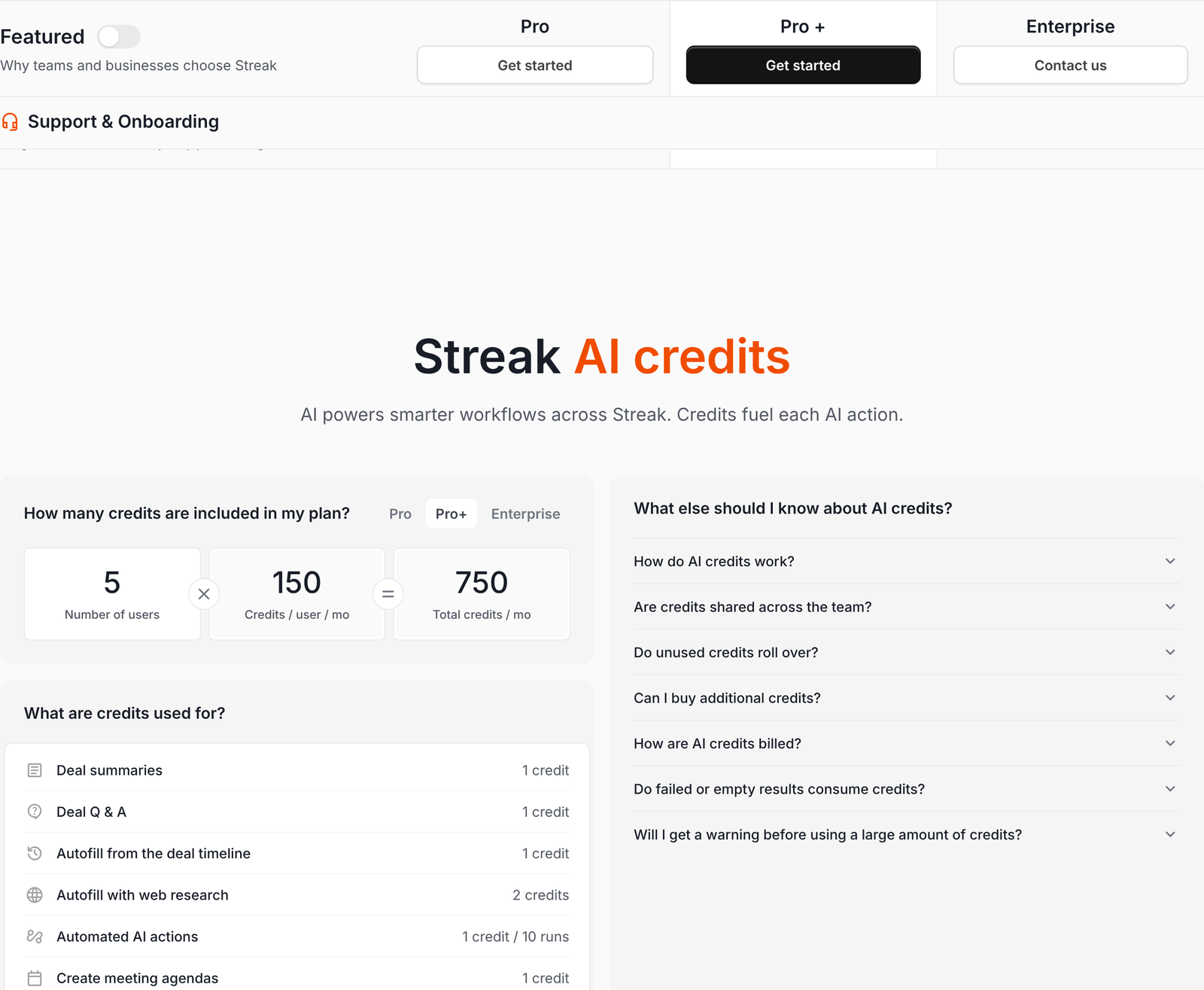
Each action has a published price. Deal summaries, deal Q&A, autofill from the deal timeline, and auto-created meeting agendas cost one credit. Autofill that runs a web search costs two. Automated AI actions cost one credit per ten runs.
Twenty credits on Pro is thin. A rep who asks for a deal summary before every call and lets autofill do a web lookup on each new lead burns through twenty in two working days. Streak’s answer is top-ups, sold as a separate recurring add-on on the same billing cycle: 1,000 credits for $100 a month, 2,500 for $200, 10,000 for $500, 25,000 for $1,000.
Run that against the tiers. A five-person team on Pro pays $295 a month and gets 100 pooled credits. The same team on Pro+ pays $445 and gets 750. Buying 1,000 extra credits on Pro costs $100, taking the bill to $395 for 1,100 credits. Upgrading to Pro+ costs $150 more than Pro and delivers 650 extra credits plus automations, Zapier, and advanced reporting. For almost any team that wants AI at all, the upgrade beats the top-up.
Three rules shape the budget here. Credits refresh each billing period, and unused ones do not carry over. Only team admins can buy more. Failed or empty AI results are not charged, and Streak shows a confirmation prompt before any action that would consume a large block.
The free plan is not a free CRM
Streak’s free tier is genuinely free and genuinely useful, and it contains no CRM. Read the vendor’s own wording: email and link tracking, snippets, 50 mail merge sends a day, Streak Share for generating a public link to a Gmail thread, and the thread splitter. Pipelines are absent. So are boxes, shared contacts, and every reporting feature.
Treat it as a Gmail power-tools extension that happens to be made by a CRM company. On that basis, it is excellent, and plenty of people run it for years without ever opening a pipeline. Anyone evaluating Streak as a CRM should use the 14-day Pro+ trial instead, which the pricing page offers on the middle card.
Mail merge, and the ceiling Streak does not control
Paid plans lift mail merge to 1,500 sends a day. That number is not Streak’s choice. Google caps mail merge in Google Workspace at 1,500 recipients a day per user, against a general daily sending limit of 2,000 messages and 10,000 total recipients, with trial accounts cut to 500. The figures sit in Google’s published Workspace sending limits.
Because Streak sends through your own Gmail account rather than its own infrastructure, no Streak tier can exceed that. Nor can any competing Gmail-native tool. If your outbound plan needs 5,000 sends a day from one address, the constraint is Google, and the fix is a dedicated sending platform rather than a bigger CRM plan.
The limits apply on a rolling 24-hour window, not a calendar day, which catches teams who schedule a big send at 9am and another at 11 pm.
Four worked bills
Prices mean more attached to a team shape.
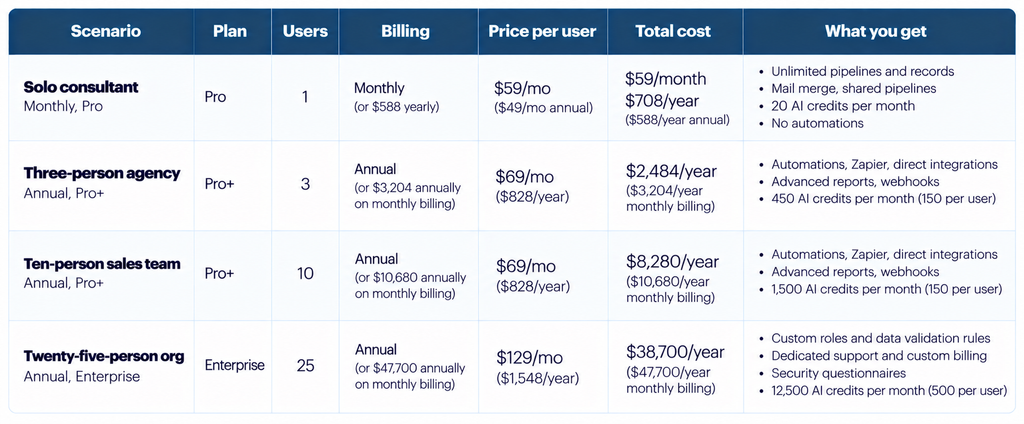
Add-on credits sit on top of every line above. Onboarding and training are included on all paid tiers, but advanced implementation carries a fee on Pro and Pro+ and is only free on Enterprise. That fee is not published, so budget for a conversation rather than a number.
What Streak does not charge for
Worth listing, because several rivals do charge for these. Records are unlimited on every paid tier. Pipelines are unlimited. Shared contacts are unlimited. Import and export to Sheets, CSV or Excel sits on all three plans. Mobile apps for iOS, iPad, and Android are included rather than sold as a mobile add-on. Onboarding, pipeline setup help, data import assistance, and team training are listed as included on Pro and above.
The marketing line above the cards reads “unlimited data usage, no surprises, no add-ons, no required fees, no consultants”. AI credits are an add-on, so that claim is not quite airtight. The storage and record claims hold up against the comparison grid.
Support, onboarding and getting your data back out
Support climbs with the tier. Pro buys live chat. Pro+ upgrades that to priority. Enterprise assigns a named contact and adds a quarterly strategy session, with the pricing page describing a direct line to the CEO as part of the package.
Onboarding sits differently. Pipeline setup, data import help, and team training are listed as included from Pro upward, which is unusual at $59 a seat. The separate advanced implementation service, where Streak staff build custom workflows for you, carries a fee on Pro and Pro+ and comes free only on Enterprise. Streak notes it is available to teams on an annual plan or teams of three or more. No figure is published for that fee, so treat it as a quote rather than a line item.
Data portability matters more than most buyers check at signup. Import and export to Google Sheets, CSV or Excel appears on all three paid plans, so your pipeline is never hostage to the tier you chose. The REST API ships on Pro. Webhooks, which let an external system react the moment a box changes rather than polling for it, start at Pro+. Anyone planning to pipe Streak data into a warehouse or an internal tool should price that difference in before settling on Pro.
Who the price suits
Streak’s model rewards small teams managing lots of records inside Gmail. A four-person recruitment firm tracking 8,000 candidates pays $236 a month on Pro and never thinks about a record limit. A CRM priced per contact would charge that firm several times more.
It punishes large teams with light data. Thirty people who each touch forty deals a year still pay thirty seats. At Pro+ annual, that is $24,840, and a tool priced on usage rather than headcount would likely come in lower.
There is also a hard prerequisite. Streak runs inside Gmail as a browser extension, with native apps on top. The Chrome Web Store listing records 700,000 users and a 4.5 rating from about 6,500 ratings, so the install base is real. If your company runs Outlook, none of this pricing applies to you, because the product does not run there.
Already comparing options? Our Streak alternatives roundup covers the rivals, and the Streak integrations guide goes deeper on what connects at each tier. New to the product entirely? Start with the beginner’s guide.
You can check current rates and start the 14-day Pro+ trial on Streak’s site.
Frequently asked questions
How much does Streak cost per user per month?
$59 on Pro, $89 on Pro+, and $159 on Enterprise when billed monthly. Billed annually, those fall to $49, $69, and $129 per user per month, charged as $588, $828, and $1,548 per seat per year.
Why does the pricing page show $49 when the plan costs $59?
The billing toggle loads already set to Annually. $49 is the annual rate expressed per month. Click Monthly and the card redraws at $59. Clicking the word “Monthly” next to the switch does nothing on its own; you have to move the switch itself.
Does Streak have a free plan?
Yes, and it excludes the CRM. Free covers email and link tracking, snippets, Streak Share, thread splitter, and 50 mail merge sends a day. Pipelines, boxes, and shared contacts require a paid plan.
Are AI credits included or extra?
Both. Each plan bundles credits per user per month at 20, 150, and 500. Those pool across the team and expire at the end of each billing period. Admins can buy more in blocks starting at 1,000 credits for $100 a month.
Which tier do I need for Zapier and automations?
Pro+. Zapier, automations, webhooks, and the direct integrations with Calendly, Google Forms, Typeform, and Slack all sit above the Pro line. Pro includes the standard REST API but not webhooks.
Is there a limit on contacts or deals?
No. Records, pipelines, and shared contacts are unlimited on Pro, Pro+, and Enterprise. Your bill moves with seat count alone.
Can I trial a paid plan?
The pricing page offers a 14-day free trial on Pro+. Streak’s billing documentation covers adding a card before the trial ends and what happens if you cancel during it.
Sources
- Streak pricing page, read in both billing states on 7 October 2026, in US dollars.
- Streak billing documentation on upgrading, invoices, trials and cancellation.
- Gmail sending limits in Google Workspace, Google Workspace Help, for the 1,500 mail merge and 2,000 message daily caps.
- Streak CRM for Gmail on the Chrome Web Store, for user count and aggregate rating.