



FullEnrich sells contact data by the credit, not by the seat. That single choice changes how you should budget for it, because two teams on the same plan can burn through a month’s allowance at completely different speeds depending on what they ask for.
Disclosure: Stack99 earns a commission if you buy through links on this page. It costs you nothing extra and never changes our assessment.
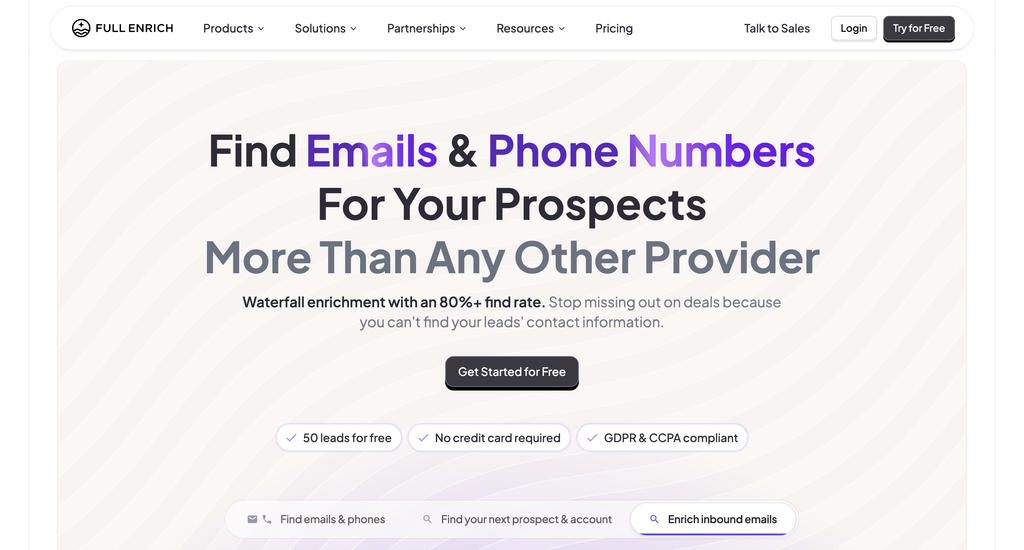
The pricing page is a slider, not a plan list
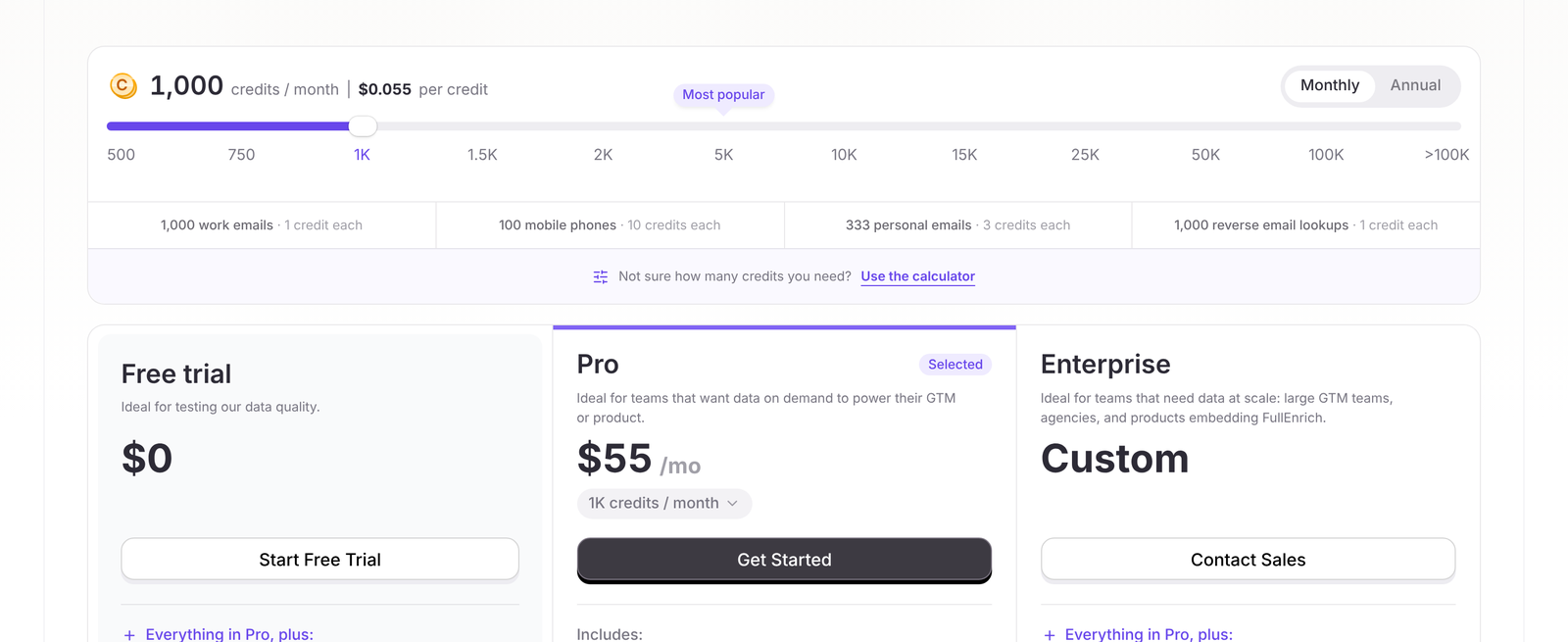
Most B2B data vendors publish three or four named tiers with a feature gate between them. FullEnrich does something different. The pricing page hands you a single slider and a billing toggle, and every rung on that slider is the same product at a different volume. There is no Starter edition missing the phone numbers. You are buying a monthly credit allowance and nothing else.
The slider ladder runs from 1,000 credits a month up to 100,000, with a final stop beyond that which routes you to sales. Each rung carries its own per-credit rate, and the rate falls as volume rises. Here is the monthly-billing ladder as the page displayed it on 8 October 2026.
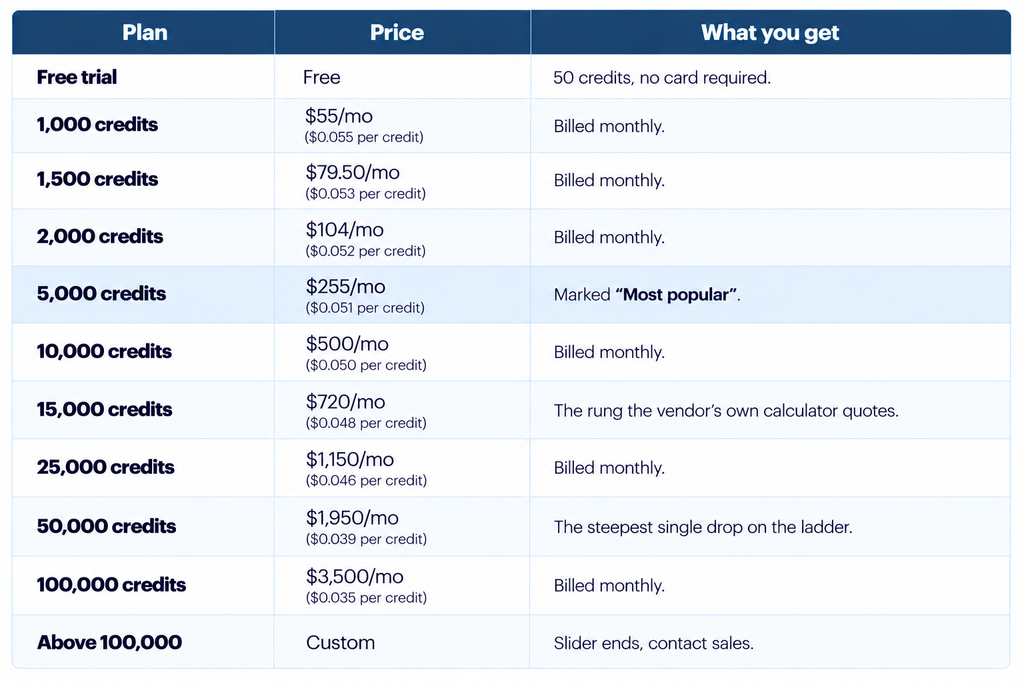
One caveat on those dollar figures. FullEnrich publishes the per-credit rate and the credit volume directly, and renders the monthly total through an animated digit widget that resists text extraction. The totals above are the published rate multiplied by the published volume. We checked that arithmetic against the one total the page states in plain text, a recommendation of “Pro, 15K credits, $720/mo”, and 15,000 at $0.048 lands on exactly $720. The method holds.
A credit is not a contact
This is the part that wrecks budgets. FullEnrich prices each data point separately, and the spread between the cheapest and the dearest is tenfold.
- Work email: 1 credit
- Reverse email lookup: 1 credit
- Personal email: 3 credits
- Mobile phone number: 10 credits
- B2B profile and company data: included with any enrichment, or 0.25 credit on its own
Run that against the entry rung. A thousand credits a month is 1,000 work emails. The same allowance is only 100 mobile numbers. If your sequence is email-first and you pull a phone number only for accounts that reply, your effective cost per contact stays near five and a half cents. Build a cold-calling list instead, with a mobile for every record, and your effective cost per contact is 55 cents, and the $55 plan covers a hundred people.
Work out your own mix before you pick a rung. A team pulling 500 work emails and 150 mobile numbers a month needs 500 plus 1,500, so 2,000 credits, and lands on the $104 rung rather than the $55 one. The vendor’s page does this maths for you in a calculator block, and the illustrative splits it shows at the 12,000-credit level are 12,000 work emails, or 1,200 mobile phones, or 4,000 personal emails, or 12,000 reverse email lookups.
Annual billing restates the volume in years
Flip the toggle, and the slider stops talking about months. The entry rung becomes “12K credits/year” at $0.049 per credit. Same 1,000 credits a month, lower rate. Read quickly and you might think the plan got twelve times bigger.
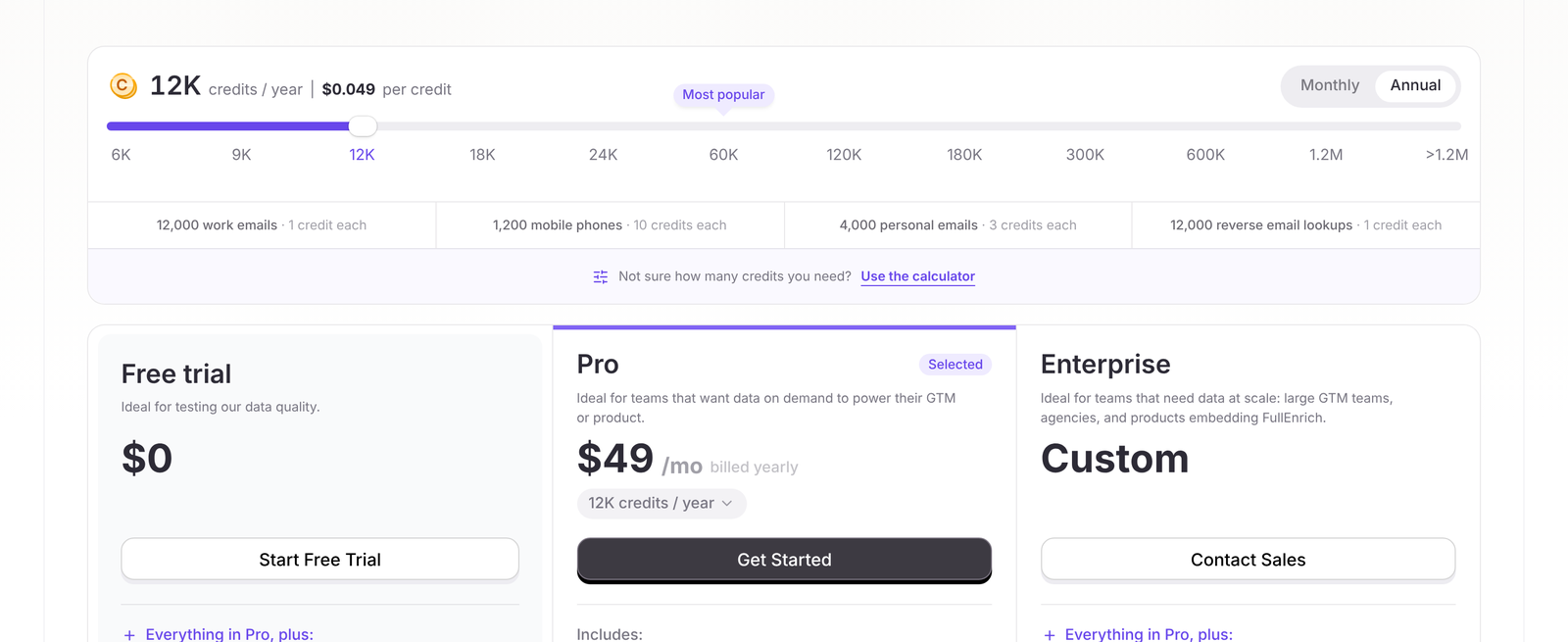
The annual ladder, by per-credit rate: 12K a year at $0.049, 18K at $0.047, 24K at $0.047, 60K at $0.046, 120K at $0.045, 180K at $0.044, 300K at $0.042, 600K at $0.035, and 1.2M at $0.032. Multiply through, and the entry commitment is $588 for the year against $660 if you pay monthly, so the annual discount at the bottom of the ladder is about 11 percent.
That discount is not uniform. At the 180K rung, annual works out to $7,920 a year against $8,640 on monthly billing, again roughly 8 percent. But look at 600K a year, which is 50,000 a month: annual charges $0.035 per credit while monthly charges $0.039. Compare the top rungs, and the annual rate of $0.032 undercuts the monthly $0.035 by under 9 percent. The committed discount is real and modest. Nobody is halving their bill by signing a year.
Rollover softens a bad volume guess
Unused credits do not vanish at month end. FullEnrich states a rollover window of “3 months monthly, 12 months yearly”. Pay by the month, and a credit you buy in January is still good in April. Commit annually and the whole year’s allowance stays live for twelve months.
This matters more than it sounds. Outbound volume is lumpy. You hire two SDRs in March and your credit burn triples; the quarter closes, and it drops back. A three-month window lets a quiet February fund a busy April without you resizing the plan twice. It also removes most of the penalty for buying one rung too high, which is the usual anxiety with credit pricing.
No published top-up or overage rate exists. When you run dry, the page points you to two options: renew early, or move up a rung to a lower per-credit price. Treat that as a hard stop rather than a soft one, and leave headroom if a missed week would hurt.
The “verified or it’s free” promise, and why it is priced in
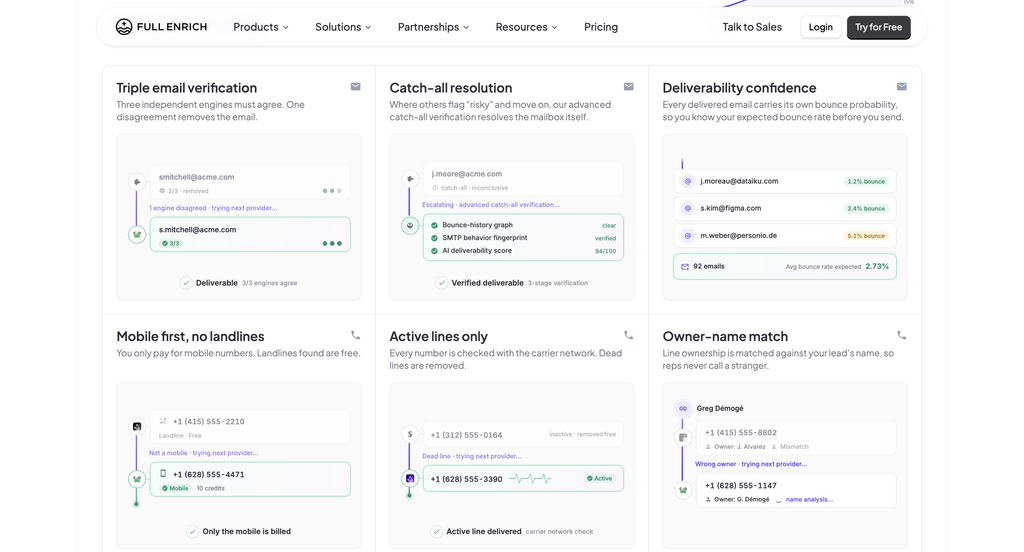
FullEnrich leads its pricing page with “Only Pay For Data You Actually Find. Verified, Or It’s Free.” Under a credit model that claim does real work, because the alternative is paying for a lookup that returns nothing. The page also advertises verification layers: advanced verification that it says strips roughly 30 percent of raw data, and catch-all verification it describes as resolving 80 percent of catch-all addresses.
Catch-all domains are the hard case. A catch-all mail server accepts anything at the domain, so an ordinary SMTP check cannot tell a real mailbox from a typo. Vendors that count those as valid inflate their hit rate and hand you bounces. A vendor that marks them unknown looks worse on paper and costs you less in sender reputation.
Sender reputation is where the money actually is. Google’s bulk sender guidance tells senders to keep the spam rate reported in Postmaster Tools below 0.10 percent and to “avoid ever reaching a spam rate of 0.30% or higher”, and it tells senders to automatically unsubscribe recipients with multiple bounced messages (Google Workspace Admin Help). Those thresholds are unforgiving. A list that bounces hard enough to trip them costs you far more than the credits you saved buying cheaper data.
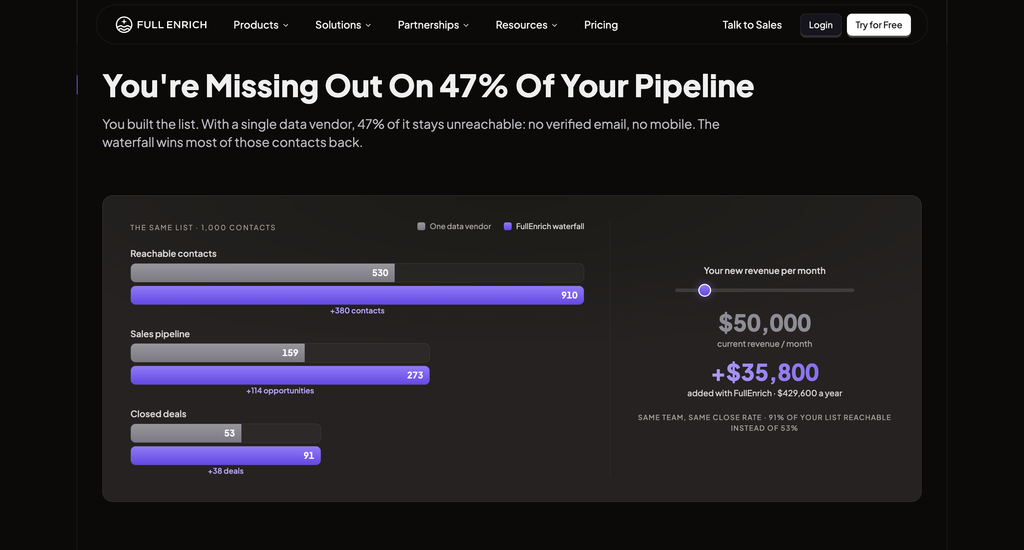
So the pricing question is not only cents per credit. It is cents per usable credit. A provider at $0.04 with a 60 percent verified hit rate costs you more per usable record than one at $0.055 with a 90 percent rate. The vendor quotes customer claims of an 84 percent find rate against Apollo and connect rates moving from 6 percent to 30 percent on a pilot, but those are testimonials on a vendor page rather than independent measurement, and we are not presenting them as verified figures. Run your own sample against your own ICP before you commit to a rung.
What the free trial actually tells you
Fifty credits, no credit card, plus extra credits for inviting teammates. Fifty is a careful number. Fifty credits is 50 work emails, or 5 mobile numbers, or 16 personal emails. You cannot evaluate phone coverage on it in any meaningful way, which is a shame because phone coverage is where enrichment vendors differ most.
Spend the trial deliberately. Pick 40 accounts you already have verified contact data for, ideally from a CRM export where you know which numbers connected. Run work emails on all 40 and mobiles on 5 of the hardest ones. You are measuring agreement with ground truth, not raw fill rate. A vendor that returns something for every row is not better than one that returns nothing for the rows it cannot resolve.
Cost per usable record, not cost per credit
Run the comparison the way your finance team eventually will. Take two vendors: one charges $0.040 a credit and resolves 60 percent of your list, the other charges $0.055 and resolves 85 percent. On a 1,000-contact batch of work emails, the cheap vendor bills $40 and hands back 600 usable records, so $0.067 each. The dearer one bills $55 for 850 records, so $0.065 each. The headline rate said one thing and the delivered cost said another.
Push the hit rates further apart, and the gap widens fast. At 50 percent against 90 percent, the cheap vendor costs $0.080 a usable record against $0.061, a 31 percent premium on the option that looked 27 percent cheaper. None of this argues that FullEnrich wins that comparison, only that per-credit rates are not comparable across vendors until you have measured resolution on your own list. Credit pricing makes the input cost transparent and tells you nothing about the output.
Two practical consequences follow. Size your trial to produce a hit rate you trust rather than a list you can use, and keep the sample biased toward your hardest segments, because that is where vendors separate. Enrichment on well-known enterprise contacts resolves nearly everywhere. Seed-stage founders in non-English markets are the test.
Where FullEnrich sits against the usual comparisons
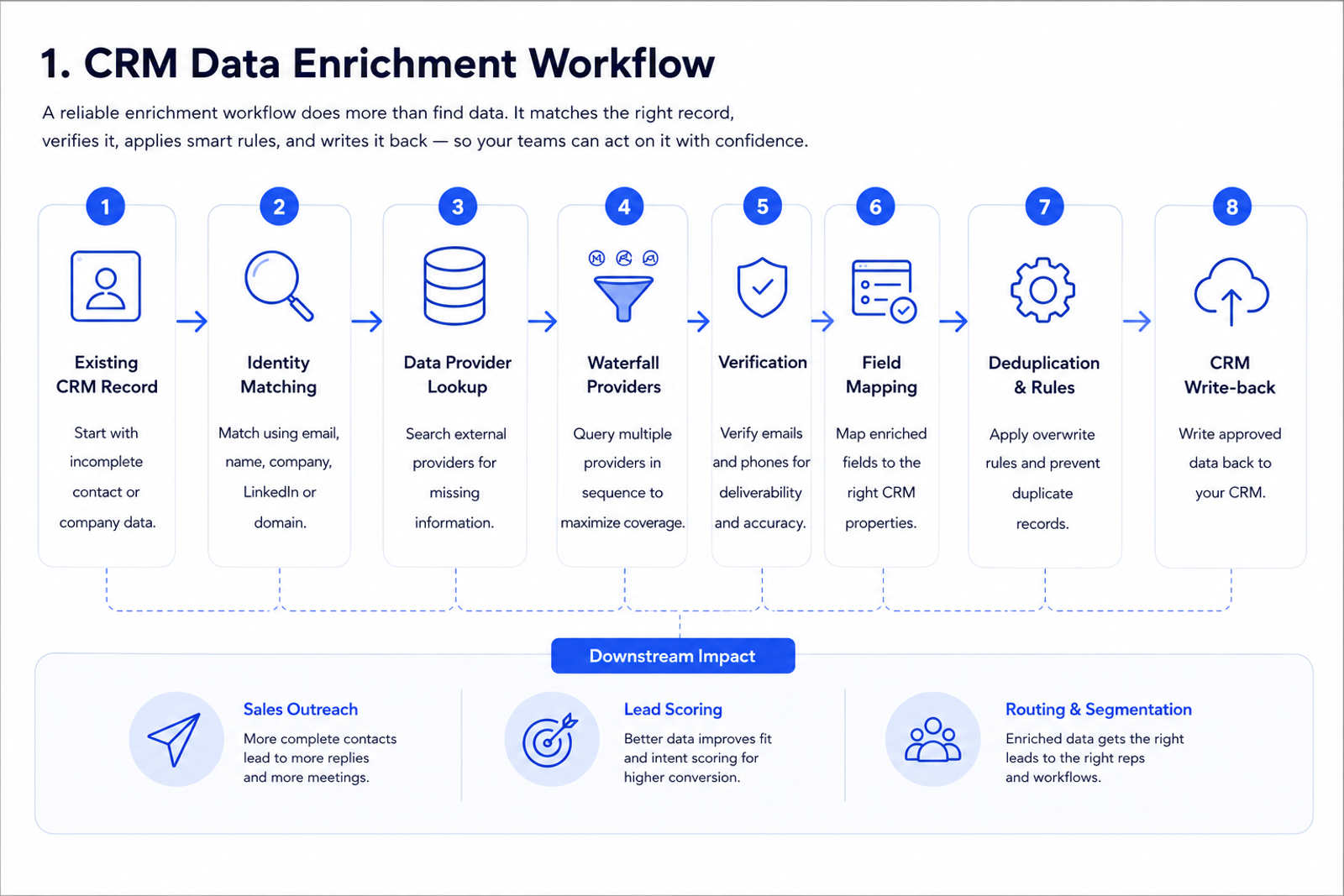
Buyers who land on FullEnrich are usually also looking at seat-priced platforms. The difference is structural. A seat-priced tool charges whether or not your reps enrich anything that month, and usually bundles sequencing and a dialer. A credit-priced waterfall charges only for lookups and expects you to bring your own outreach stack.
If you already pay for sequencing elsewhere, the credit model is cheaper, and the arithmetic is transparent. With no outreach tooling in place, you are comparing a $55 data line against a platform subscription that includes a lot more, and the comparison is not like-for-like. Our write-ups on Kaspr pricing and Apollo.io cover the seat-priced side of that trade, and the Amplemarket fit guide looks at the all-in-one end.
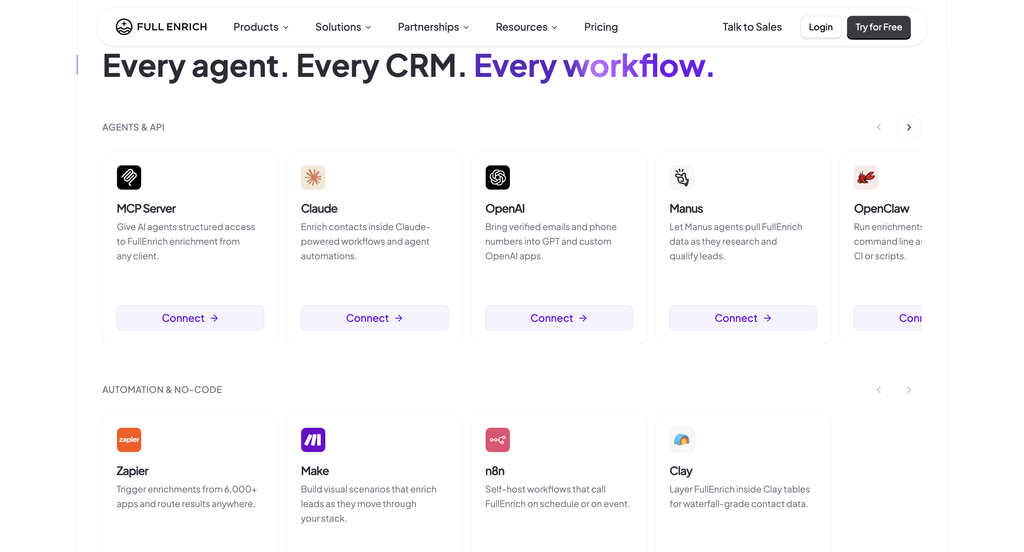
One more structural note. FullEnrich describes itself as built for “GTM Teams, AI Agents, Agencies and API Resellers”. The API reseller framing is unusual on a self-serve pricing page, and it explains why the ladder keeps climbing to 1.2 million credits a year. Teams embedding enrichment in their own product should read the volume rungs first, because they matter more than the feature list. After all, there is no feature list to speak of.
Picking a rung without guessing
Work backwards from contacts, not from budget.
- Count the new contacts you need enriched per month. Be honest; most teams overestimate by half.
- Decide what you need for each one. Work email only, or email plus mobile.
- Multiply: emails at 1 credit, mobiles at 10, personal emails at 3.
- Add 20 percent headroom for retries and bad rows.
- Pick the rung above that number, then let rollover absorb the variance.
A worked example. You enrich 800 new contacts a month; you want a work email for all of them and a mobile for the 150 that reach a second touch. That is 800 plus 1,500, so 2,300 credits, plus headroom gives roughly 2,800. The 5,000-credit rung at $255 is the safe pick, and the three-month rollover means the 2,200 you do not spend are still there next quarter. Dropping to 2,000 credits at $104 would save $151 a month and leave you short in any month where calling picks up.
You can start the free allowance at FullEnrich and size the rung after you have measured your own mix.
What we could not verify
Two things, stated plainly. The slider renders tick marks for 500 and 750 credits below the 1,000 rung, but the control would not select either of them under keyboard, click, or drag, so we have no rate for those and have left them out rather than guess. And the Enterprise rung, past 100,000 credits a month, publishes no figure at all.
We also did not test data quality. Nothing in this piece is a measurement of FullEnrich’s accuracy, only of what it charges.
FAQ
How much is FullEnrich per month?
The cheapest paid rung is 1,000 credits at $0.055 per credit, which computes to $55 a month on monthly billing. The ladder climbs to 100,000 credits at $0.035 per credit, around $3,500 a month, before handing you to sales.
Is the price on the page monthly or annual?
Monthly. Monthly is the tab the page opens on, and we confirmed that state in the markup rather than reading it off the layout. Switching to Annual restates volumes per year and lowers the per-credit rate by roughly 8 to 11 percent depending on the rung.
What does one credit buy?
One work email or one reverse email lookup. A personal email costs 3 credits and a mobile phone number costs 10. B2B profile and company data come free with any enrichment, or 0.25 credit if you request it alone.
Do unused credits expire?
Not immediately. FullEnrich states rollover of 3 months on monthly billing and 12 months on yearly billing.
Is there a free plan?
A free trial of 50 credits runs with no card required, and the page offers additional credits for inviting team members. Nothing here is a permanent free tier.
What happens if I run out mid-month?
No overage rate is published. Instead, you are directed to renew early or move to a higher-volume plan with a lower price per credit, so plan to buy a rung above your expected burn.
Bottom line
FullEnrich is priced honestly and unusually simply: one product, one slider, a published rate per credit at every rung. The risk is not hidden fees. It is misreading what a credit buys, sizing against contacts when you should be sizing against data points, and discovering in week three that your mobile-heavy list drained a month’s allowance. Do the multiplication first, and the pricing stops being a surprise.
Figures on this page were read from fullenrich.com on 8 October 2026 and will drift. Check the slider before you commit.