



Quick answer: Bókun charges a flat monthly fee plus a percentage of your online booking value, and the percentage is what decides your plan. START is $49 a month with a 1.5% booking fee, PLUS is $149 with 1.25%, PREMIUM is $499 with 1%. Move up from START to PLUS once you pass about $40,000 a month in applicable bookings, and from PLUS to PREMIUM at about $140,000. Viator bookings and offline bookings carry no Bókun fee at all.
Disclosure: Stack99 earns a commission if you buy through links on this page. It costs you nothing extra and never changes our assessment.
A price with two halves
Most booking software quotes you a seat price and stops. Bókun quotes a subscription and a cut, and the cut is far more consequential than the subscription for anyone doing real volume. A tour operator selling $200,000 a month online pays Bókun $499 in subscription on the top plan and $2,000 in booking fees. Reading the $499 as the price would understate the bill by a factor of five.
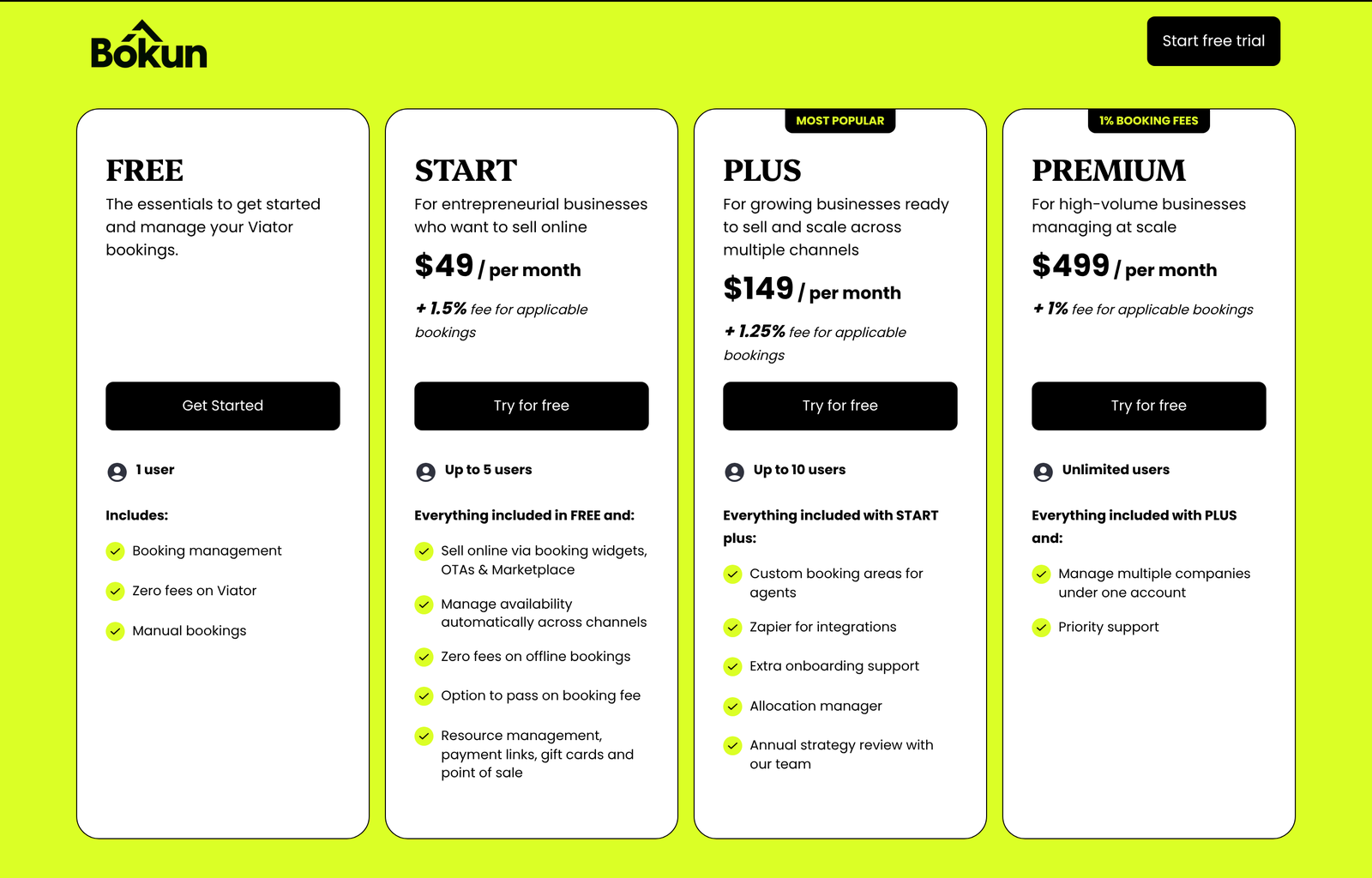
One small mercy: there is no monthly-versus-annual toggle on this page. The figures you see are month-to-month, with no prepayment discount hiding behind a switch and no annual rate masquerading as a monthly one. Among the pricing pages we audit, that puts Bókun in a small and honourable minority.
Which bookings the percentage actually touches
“Applicable bookings” does a lot of work on the pricing page and is defined nowhere on it. Bókun’s own documentation spells it out. The service fee applies to bookings made through online booking engines, websites, the Bókun API, the Marketplace and OTAs, with Viator excluded, and it is calculated as a percentage of your total online booking value for the month rather than per transaction.
Three categories therefore sit outside the meter entirely. Anything sold through Viator carries no Bókun fee. Offline bookings, meaning the ones you key in yourself from a phone call or a walk-up, carry none either. And anything you take on the FREE plan carries none, because that plan has no online selling to meter.
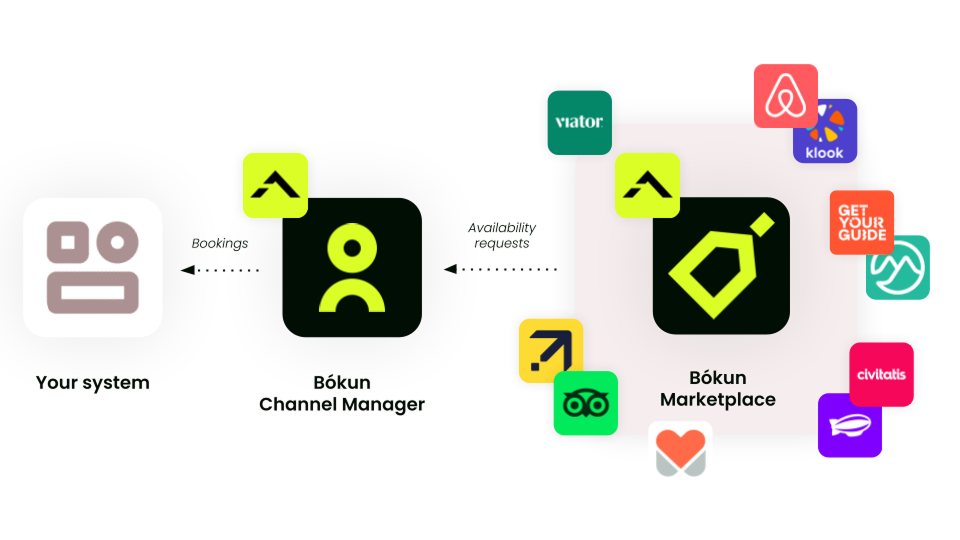
Work out your exempt share before you model anything. An operator whose revenue is 70% Viator and 30% direct has a much smaller taxable base than the headline percentage suggests, and may sit happily on START long past the point where gross revenue says otherwise. Run the split off last year’s numbers rather than an estimate.
The arithmetic that picks your plan
Each step up buys a 0.25 percentage point discount for a fixed monthly increase. Divide one by the other, and you get the volume at which the step pays for itself.
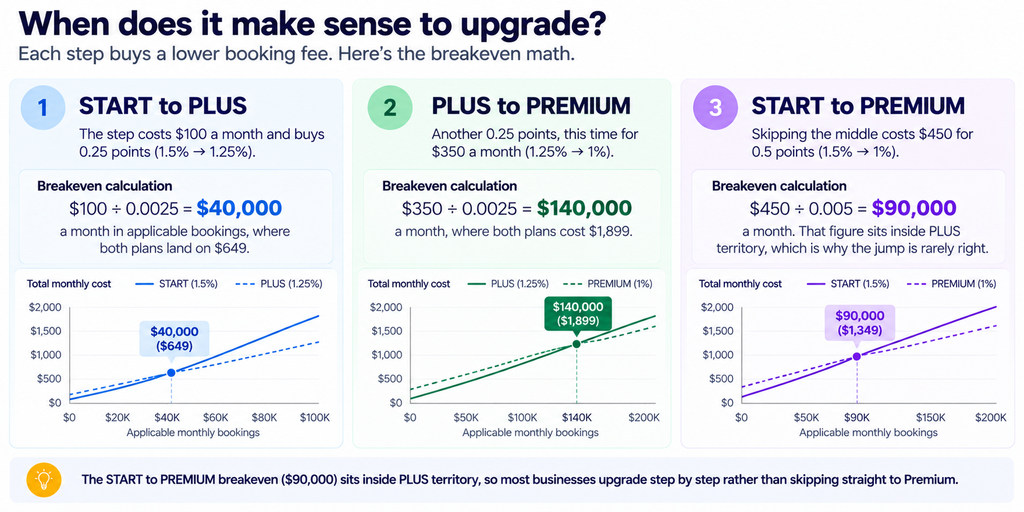
Those three numbers are internally consistent, which is a good sign for a pricing ladder. Below $40,000, take START. Between $40,000 and $140,000, take PLUS. Above $140,000, take PREMIUM.
Seeing it in money helps. Take $10,000 a month of applicable bookings: START costs $199 all in, PLUS $274, PREMIUM $599. Push that to $100,000 and START costs $1,549, PLUS $1,399, PREMIUM $1,499, so the middle plan wins by $150 against the cheap one and $100 against the expensive one. By $250,000, the order flips again, with PREMIUM at $2,999 against PLUS at $3,274.
Expressed as an effective rate, an operator doing $40,000 on START pays 1.62% of booking value to Bókun. Somebody doing $250,000 on PREMIUM pays 1.20%. The subscription component fades as you grow, which is the intended shape and worth confirming against whatever your current reservation system charges.
A worked example with a real channel split
Take a kayaking operator turning over $90,000 a month across all channels. Gross revenue alone would push them toward PLUS without much thought. Break the mix down and the answer changes.
Say $45,000 of that comes through Viator, $15,000 is walk-ups and phone bookings keyed in by hand, and the remaining $30,000 arrives through the operator’s own website and two other OTAs. Only that last $30,000 is applicable. On START, the bill is $49 plus 1.5% of $30,000, so $499. On PLUS it is $149 plus $375, so $524. START wins, on a business most people would describe as a $90,000-a-month operation.
Now grow the direct channel to $50,000 while Viator stays flat. Applicable volume crosses the threshold, and costs $774 against START at $799. The trigger was never total revenue. It was the direct and OTA share, which is the number to put on a dashboard if you are going to track one.
Worth checking against your own figures: operators heavy on Viator can stay on the cheapest paid plan far longer than the headline pricing implies, while a direct-booking-first business hits PLUS at a much lower turnover. Two operators with identical revenue can sit two tiers apart.
How the model compares with per-seat reservation software
Most reservation systems in adjacent markets charge per user or per location, which makes the bill predictable and indifferent to how well you trade. Bókun’s percentage does the opposite: it costs almost nothing in a quiet winter and scales in a strong summer.
For a seasonal operator, that shape is usually welcome. Six quiet months at $5,000 of applicable bookings cost $124 a month on START, against a per-seat system billing the same amount in February as in August. Six strong months at $60,000 cost $899 on PLUS. That annualises to $6,138, which is easier to carry than a flat fee sized for peak.
The trade is margin visibility. A percentage of booking value takes the same cut from a high-margin private charter as from a thin-margin shuttle transfer, so operators with mixed margins should check the fee against gross profit rather than revenue. On a product running 20% margin, a 1.5% fee on booking value is 7.5% of what you actually keep.
Who pays the fee: you or the traveller
Every paid plan lets you pass the service fee to the customer instead of absorbing it. Choose to pass it, and the percentage is added on top of your catalogue prices, so the traveller sees a slightly higher number and you receive what you set.
Bókun’s documentation gives a worked example on START. Set a catalogue price of $100.00, advertise $101.50, collect the $1.50 fee from the traveller, and receive $100.00. If you absorb it instead, the fee is charged to the card on your account at the start of each month, excluding bookings cancelled within the same month.
Two conditions apply. Using Bókun Pay means you always pass the fee; the choice disappears. And the fee charged on Marketplace bookings cannot be passed to the reseller, so that slice stays yours regardless of the setting. Operators selling heavily through resellers should model the Marketplace share as a genuine cost rather than something a toggle makes vanish.
What the free plan really is
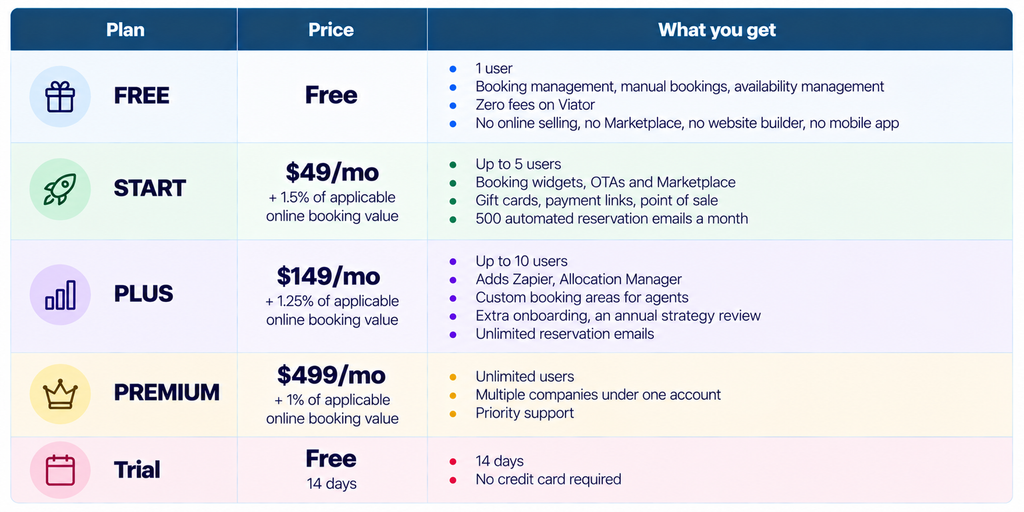
FREE is not a trial and not a starter tier in the usual sense. Read the comparison table and a specific shape appears: one user, booking management, manual bookings, availability management, and zero fees on Viator. Everything that sells online is switched off. No “Book now” button, no Marketplace access, no Google Things to do, no website builder, no mobile app, no gift cards.
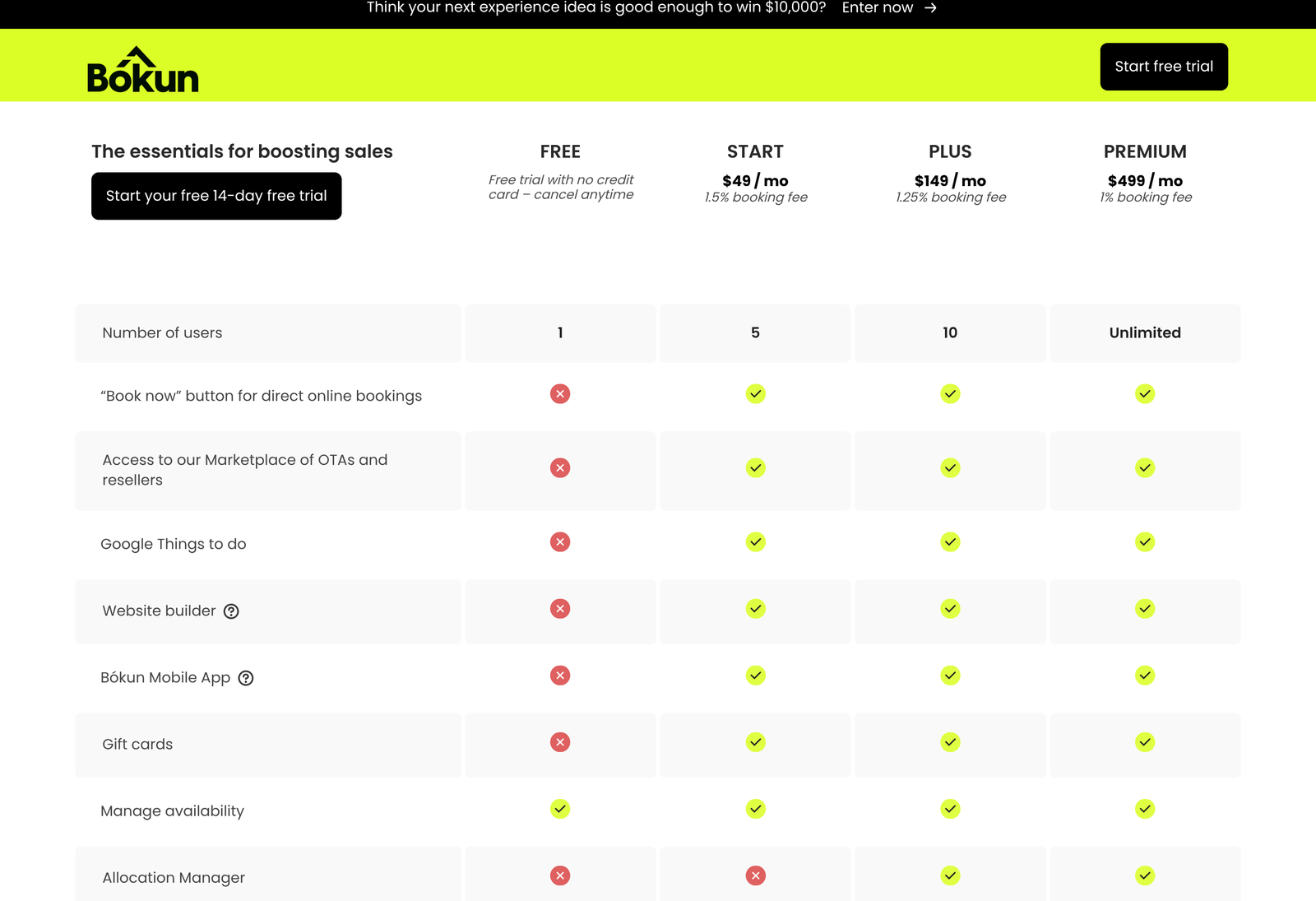
What that adds up to is a free operations console for a business whose demand already comes from Viator. You manage availability and reservations in one place, pay nothing, and sell nothing through Bókun itself. For an operator at that stage, the plan is genuinely useful. For anyone wanting a booking button on their own site, FREE is not a cheaper option; it is a different product.
The Viator exemption, and why it exists
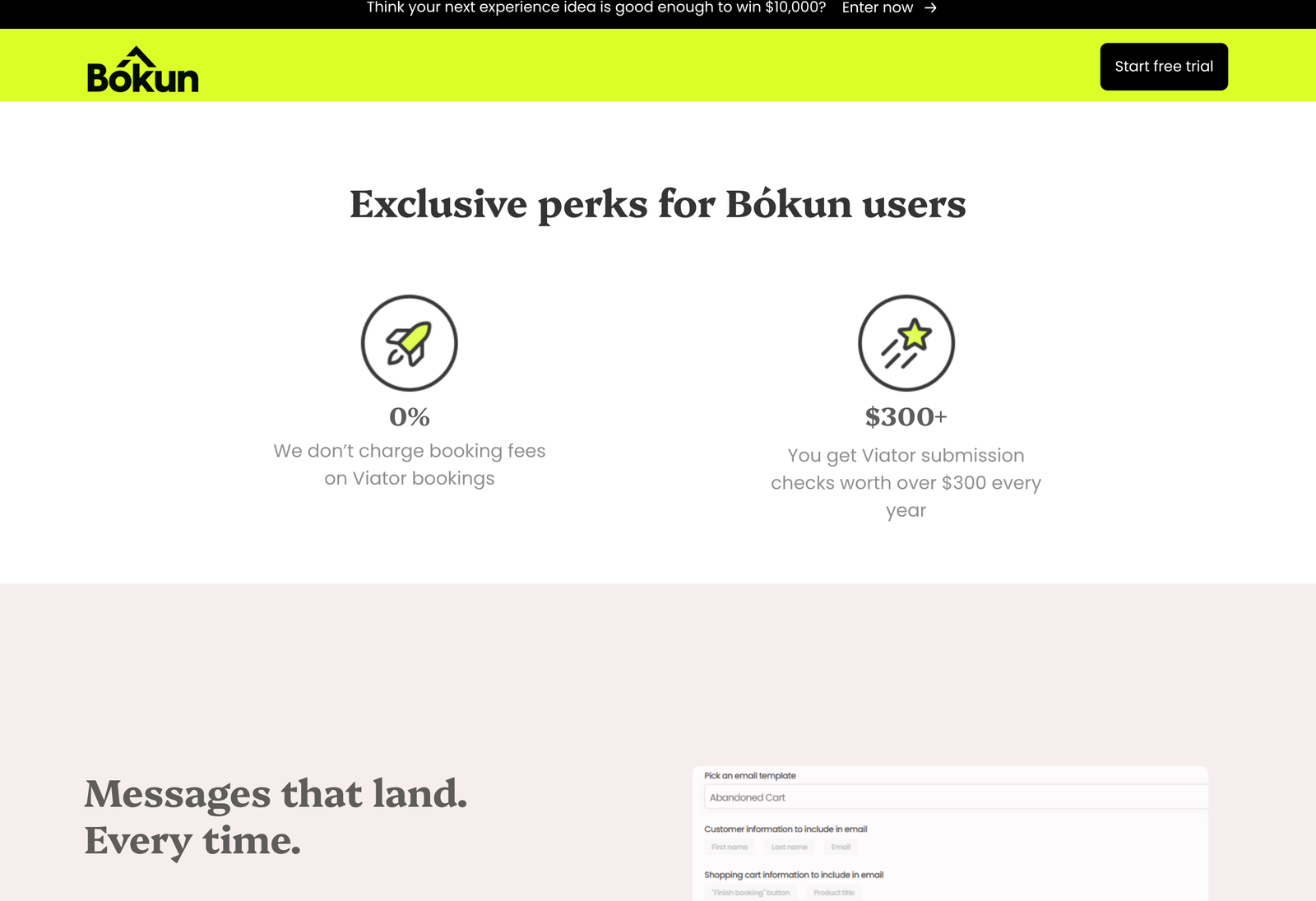
Bókun and Viator are both Tripadvisor companies, which explains the 0% line. Bókun also hands out free Viator product submission checks scaled by plan: 12 a year on START, 24 on PLUS, 48 on PREMIUM, which the page values at $348, $696 and $1,392 respectively. Divide any of those, and you get $29 per check, so the valuation is at least consistent.
Some context on the size of the channel you would be leaning on. Tripadvisor’s annual report filed with the SEC in February 2026 describes Viator as “a pure-play experiences online travel agency” and reports gross booking value through the Viator platform of $4.7 billion for 2025, up about 13% on $4.2 billion in 2024. The same filing notes that Tripadvisor reorganised its reporting segments in the fourth quarter of 2025 to combine Viator and brand Tripadvisor experiences operations into a single Experiences segment.
Read that as a strategic commitment rather than a promotion. A fee waiver that routes supply into the group’s primary growth engine is unlikely to be withdrawn next quarter. It is still a commercial decision by a parent company, not a contractual guarantee, so build your margins on the subscription and percentage you can read today.
Features that override the arithmetic
Volume picks your plan until a hard limit picks it for you. Four of these bite regularly.
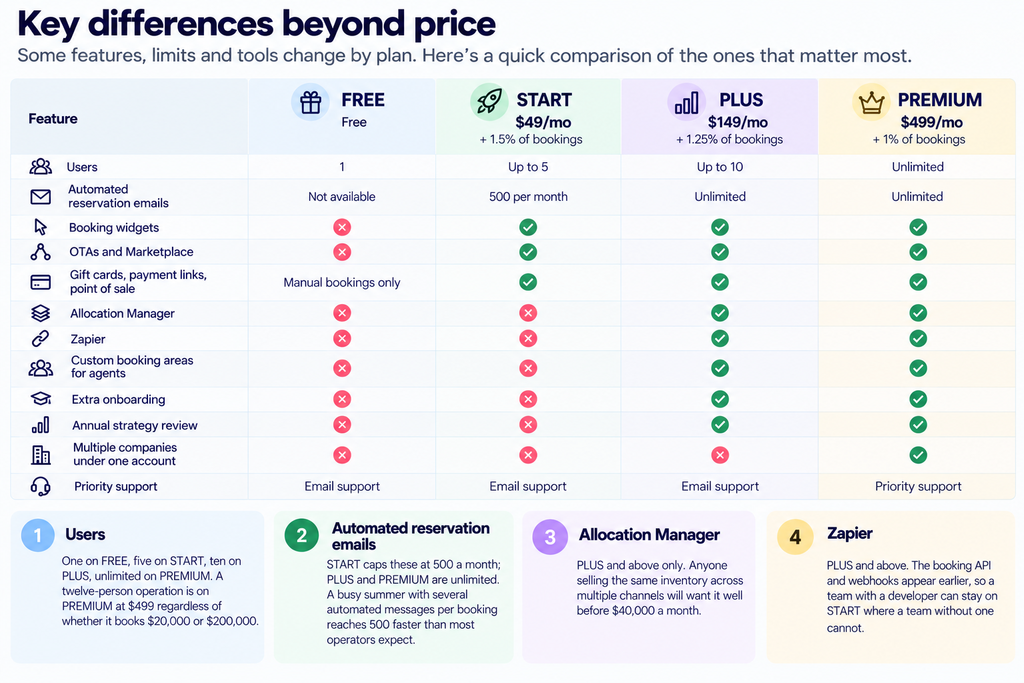
Google Things to do is included from START, and that row is worth understanding before you count it as a win. Google’s partner integration documentation describes a feed uploaded by SFTP in JSON, states that incremental updates are not supported so the full activity set is sent each time, and requires that the operator’s business be findable on Google Maps. Bókun handling that plumbing for $49 a month is a real saving, provided your listings qualify in the first place.
Picking a plan
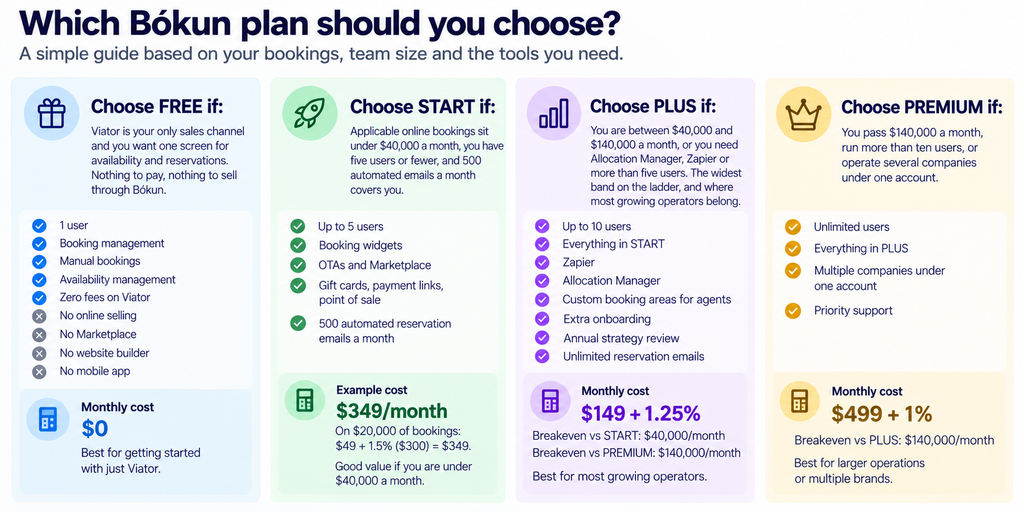
- Choose FREE if: Viator is your only sales channel and you want one screen for availability and reservations. Nothing to pay, nothing to sell through Bókun.
- Choose START if: applicable online bookings sit under $40,000 a month, you have five users or fewer, and 500 automated emails a month covers you. On $20,000 of bookings, the total comes to $349.
- Choose PLUS if: you are between $40,000 and $140,000 a month, or you need Allocation Manager, Zapier or more than five users. The widest band on the ladder, and where most growing operators belong.
- Choose PREMIUM if: you pass $140,000 a month, run more than ten users, or operate several companies under one account.
The 14-day trial needs no card, which makes it cheap to check the one thing arithmetic cannot settle: whether your products import cleanly and your availability rules survive the move. Start at Bókun and load your three most complicated products first rather than your three simplest.
FAQ
How much does Bókun cost in total?
Subscription plus a percentage. On $30,000 a month of applicable bookings, START costs $49 plus $450, so $499. PLUS at the same volume costs $149 plus $375, so $524. Always add both halves before comparing.
Does Bókun charge a fee on Viator bookings?
No. Sales through Viator are excluded from the service fee on every plan, as are offline bookings you enter manually. The percentage applies to online booking engines, websites, the Bókun API, the Marketplace and other OTAs.
Can I make the customer pay the Bókun fee?
Yes on any paid plan. The fee is added to your catalogue price and the traveller sees the higher figure. Bókun Pay users always pass it, and the fee on Marketplace bookings cannot be passed to the reseller.
Is there an annual discount?
None is published. The pricing page carries no monthly or annual toggle, and the rates shown are month-to-month. Bókun says you can switch plans or cancel at any time.
At what revenue should I move from START to PLUS?
Somewhere near $40,000 a month in applicable bookings, where both plans cost $649. Move earlier if you need Allocation Manager, Zapier, a sixth user, or more than 500 automated reservation emails a month.
What does the free plan leave out?
Everything that sells. No booking button for your own site, no Marketplace, no Google Things to do, no website builder, no mobile app, no gift cards, and one user only. Availability management and Viator booking management are included.
Where this leaves you
Bókun’s pricing is unusually legible once you separate the two halves and find the definition of “applicable bookings” in the documentation rather than on the pricing page. Three break-even figures, $40,000, $140,000, and $90,000, settle the choice for most operators in about five minutes with last year’s channel split to hand. The feature gates on users, Allocation Manager, and automated emails are what pull people up a tier early, so check those against your operation before trusting the arithmetic alone.
For adjacent reading, our Housecall Pro advanced guide covers scheduling software priced by seat rather than by booking, and Navan pricing looks at the travel side of the same market.
Sources
- Bókun pricing page, plan cards and full comparison table captured 9 October 2026.
- Bókun documentation on the service fee, for the channel definition, the monthly calculation basis and the worked $100 example.
- Tripadvisor, Inc. annual report on Form 10-K filed 13 February 2026, for Viator gross booking value and the Experiences segment reorganisation.
- Google Things to Do partner integration overview, for what the feed requires.