


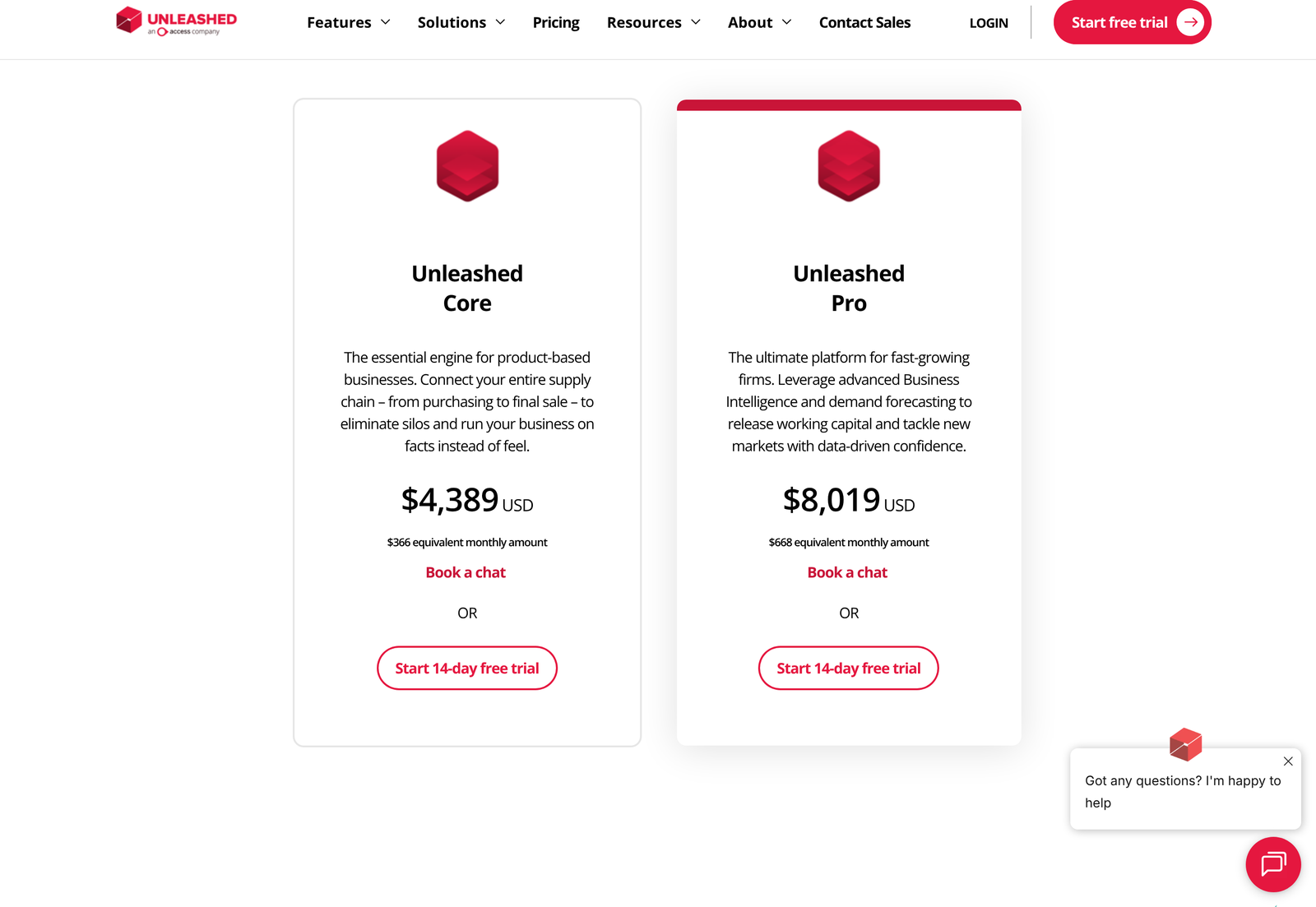
Quick answer: Unleashed connects to roughly 30 apps across accounting, eCommerce, CRM, point of sale, warehousing, and analytics, split into Native connectors that Unleashed builds and supports and 3rd Party ones built by partners. Integrations are metered, not unlimited: Unleashed Core includes three and Unleashed Pro includes five, with every additional one costing $39 a month. Core is $399 a month, and Pro is $729. A four-channel seller on Core therefore pays $438, not $399.
Disclosure: Stack99 earns a commission if you buy through links on this page. It costs you nothing extra and never changes our assessment.
Inventory software earns its keep at the edges. Stock levels only stay honest if the accounting ledger, the storefront, the till, and the warehouse app all agree, and that agreement is what an integration buys you. Unleashed, now part of The Access Group, sells this as a core pitch.
One thing to note before you go looking: unleashedsoftware.com/integrations returns a 404. The real catalogue lives at /app-marketplace/, which is where every figure below comes from, read on 7 October 2026.
Integrations are an allowance, and that changes the maths
Most inventory vendors treat connectors as a feature you either have or lack. Unleashed treats them as a consumable. Your plan includes a fixed number, and you buy more by the month.
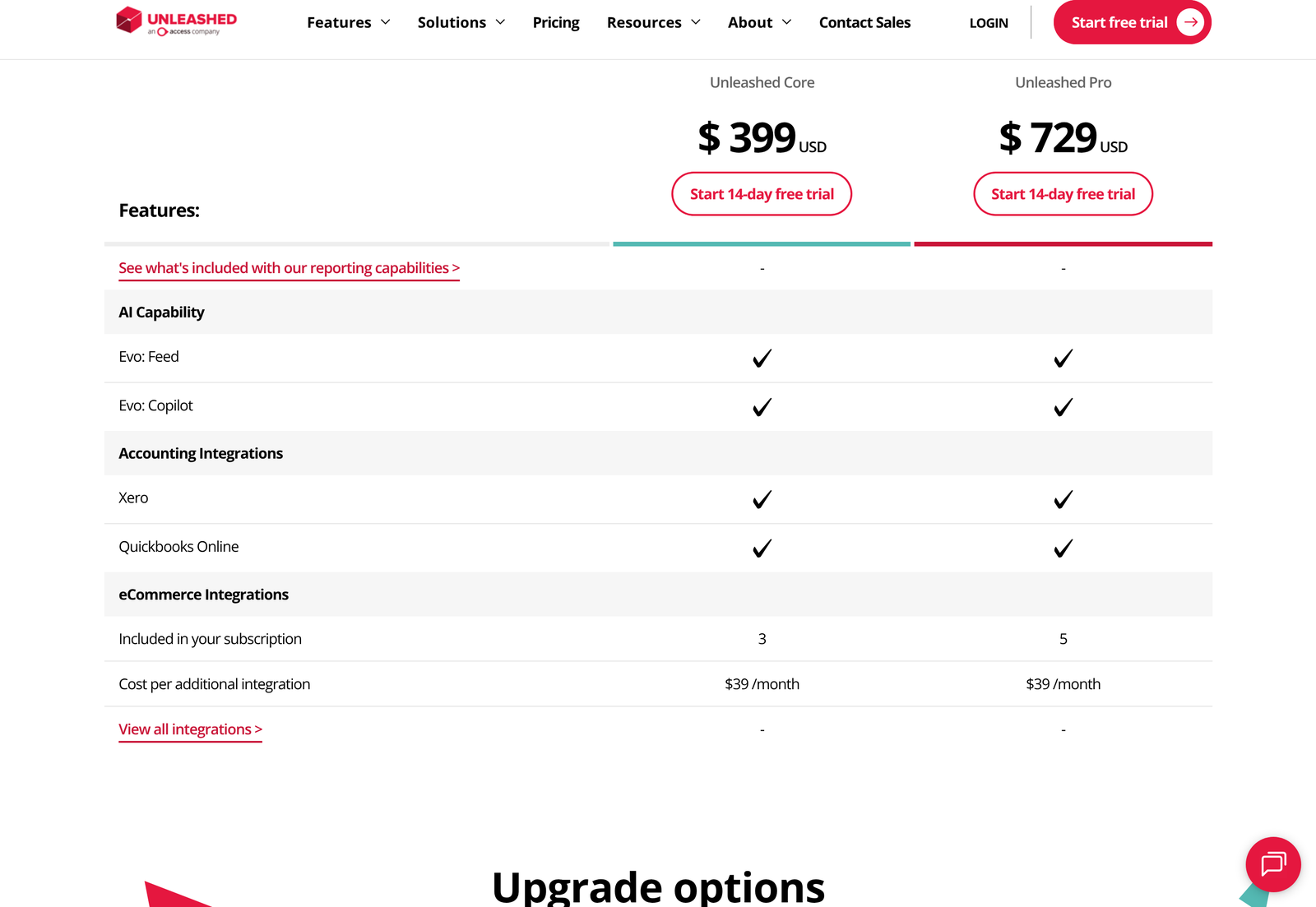
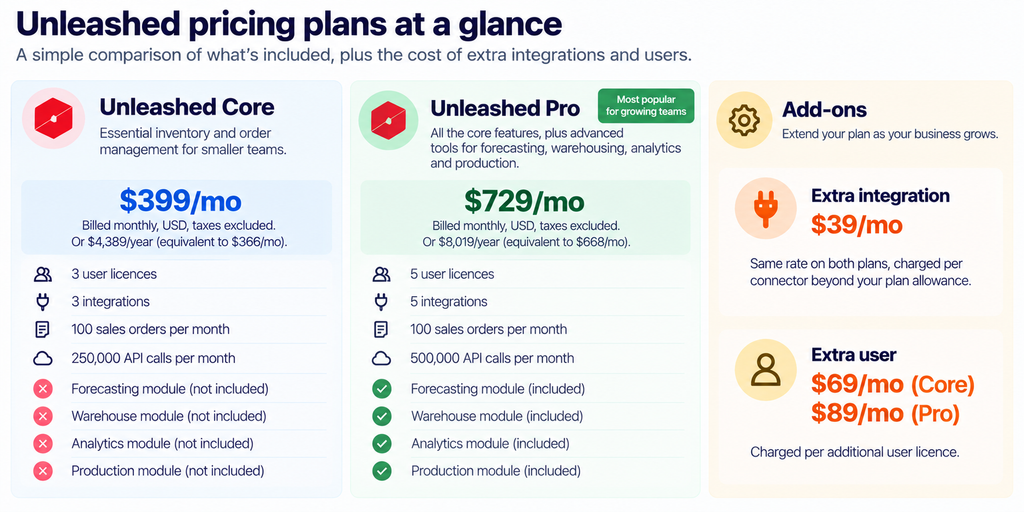
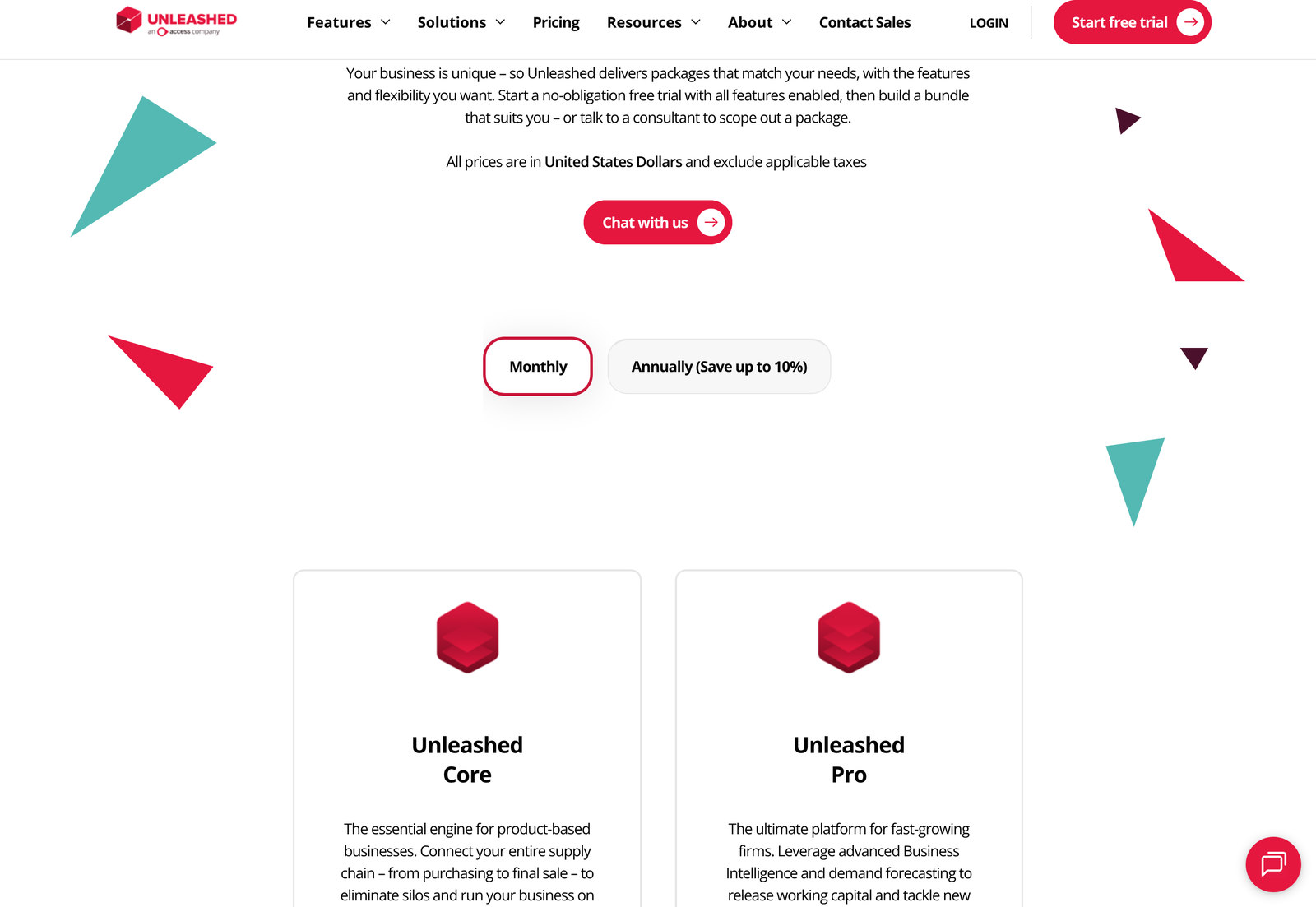
Unleashed’s pricing page opens on monthly billing rather than annual, which is more straightforward than most of the vendors we cover. Annual saves about 8.3% on both plans.
Three levels of integration, and why the label matters
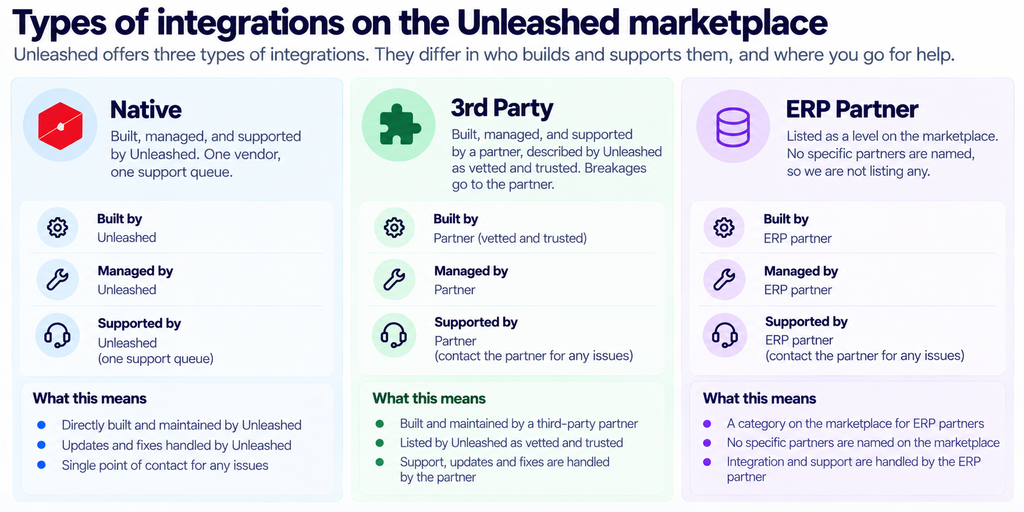
Unleashed sorts its catalogue into three tiers, and the tier tells you who answers the phone when a sync breaks.
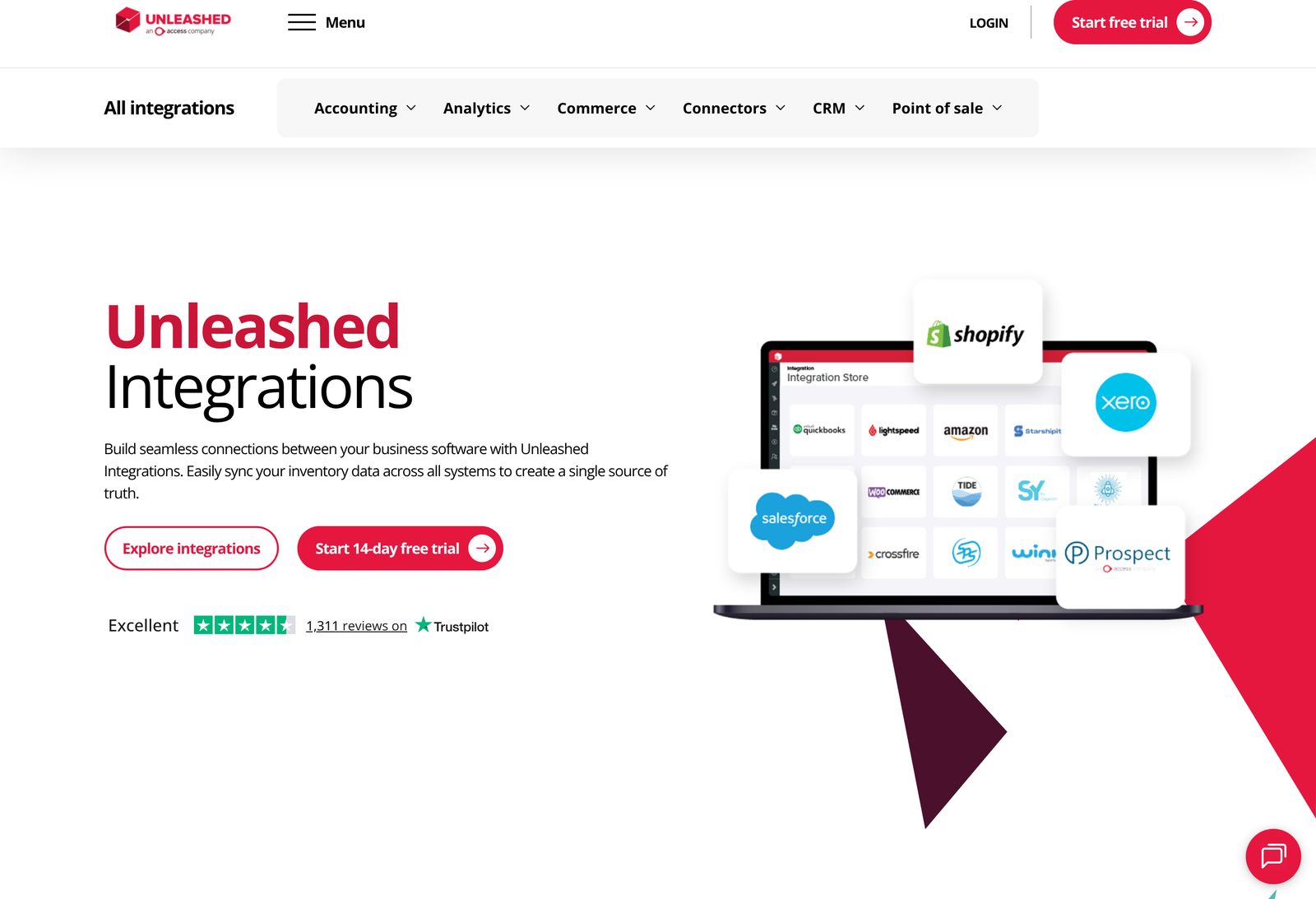
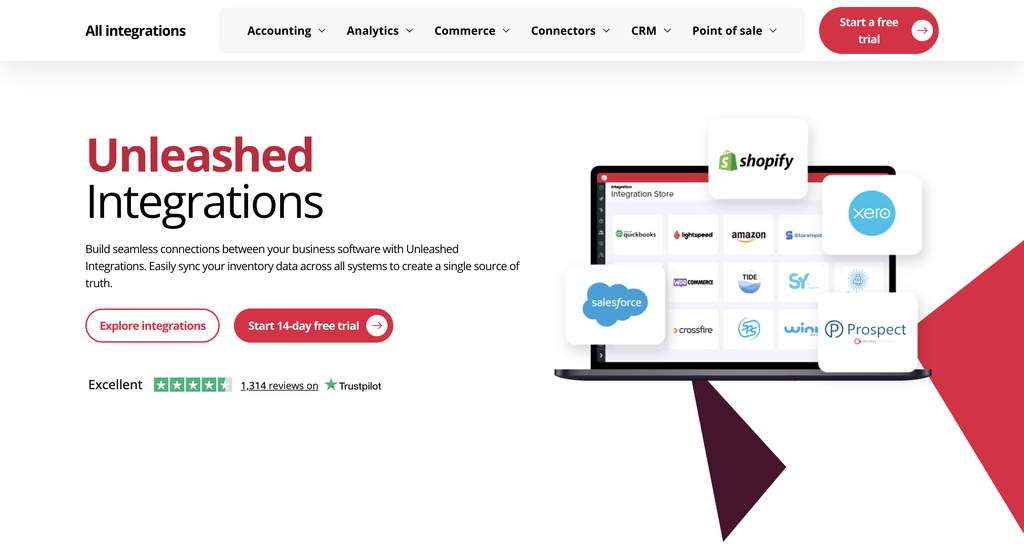
Eight connectors carry the Native badge: Xero, QuickBooks, Shopify, Amazon, WooCommerce, Prospect CRM, Mintsoft WMS and Lightspeed. Those cover the accounting ledger, the three biggest sales channels, a CRM, a warehouse system and a till. For a large share of product businesses, the whole stack sits inside that list.
Everything beyond it is partner-built. Salesforce is 3rd Party, which surprises people. So are BigCommerce, eBay, Squarespace, Walmart, Etsy, Maropost, Zoey, Zeald, SPS Commerce, Stock Sync, Upstock, Tide, Cegedim e-business, Hike, Shiptheory, Starshipit, Crossfire, Wink Reports and FeatureIT. A few more appear in category listings without an explicit level, including Lokad, Pencil, GMDH Streamline, Website World, ShipStation and Inventory Planner, so treat their support arrangement as something to confirm with sales.
The practical test before you commit: if the connector you depend on most is 3rd Party, you are buying a support relationship with two companies rather than one. That is survivable and extremely common. Knowing it before the first failed sync is better than learning it during one.
What each category actually connects
Accounting and finance
Xero and QuickBooks Online, both Native, plus Pencil. This is the integration Unleashed is best known for. The marketplace frames the job as keeping stock levels and financials accurate without manual reconciliation, which for an inventory business means cost of goods sold, stock-on-hand valuation, and purchase invoices flowing into the ledger rather than being retyped.
Xero’s own app store carries an Unleashed listing rated 4.55 out of 5 from 394 reviews, which is a meaningful sample for inventory software and comes from a platform with no stake in Unleashed’s subscription. The same listing describes Unleashed as having over 30 integrations plus an open API, which lines up with the count on the marketplace.
Commerce
Easily the biggest category. Shopify, Amazon, and WooCommerce are Native. BigCommerce, eBay, Squarespace, Walmart, Etsy, Maropost, Zoey, Zeald, Stock Sync, SPS Commerce, Tide, Cegedim e-business, Upstock, Website World and FeatureIT sit alongside them as partner builds.
Multichannel sellers should count carefully here, because each storefront is its own connector against the allowance. Selling on Shopify, Amazon and eBay plus syncing to Xero is four integrations. Core includes three, so the fourth takes $399 up to $438 a month.
Worth checking on the Shopify side: the Unleashed connector is listed as free to install on the Shopify App Store. No second subscription appears there. The cost sits entirely in your Unleashed plan, which is cleaner than arrangements where a connector carries its own monthly fee.
CRM
Prospect CRM is Native. Salesforce is 3rd Party. Unleashed also sells its own CRM as a module, priced separately at $450 a month, which is a different proposition from connecting one you already run.
The point of linking CRM to inventory is giving sales live stock visibility while they are quoting, so nobody promises a lead time the warehouse cannot meet. Running Salesforce already? Keep it and spend one allowance slot. Running nothing? Compare the $450 module against Prospect before assuming the in-house option wins on price.
Point of sale and warehousing
Lightspeed is Native on point of sale, with Hike and Etsy listed as partner options and Shopify appearing in this category as well as commerce. Mintsoft WMS is the Native warehousing connector.
Retailers running a physical shop alongside a storefront should expect at least two commerce-side connectors before the ledger even enters the picture.
Connectors, analytics and shipping
Crossfire, SPS Commerce, FeatureIT, Tide, ShipStation and Inventory Planner sit under Connectors, the category for bridging Unleashed to systems with no direct build. Analytics covers Lokad, Wink Reports and GMDH Streamline, all aimed at forecasting and demand planning. Starshipit and Shiptheory handle shipping labels and carrier selection.
Businesses with a 3PL or an EDI trading relationship generally end up here, and generally end up over the included allowance.
Shipping deserves a line of its own in your count. Starshipit and Shiptheory each consume a slot, and so does a label tool reached through a connector such as ShipStation. A seller who assumed shipping came bundled with the commerce connector will find an unplanned $39 on the invoice.
The API, and the limit nobody reads
Unleashed publishes an open REST API and offers documentation and technical help to anyone building against it. For systems with no listed connector, that is the route.
API access is metered too. Core allows 250,000 calls a month, and Pro allows 500,000, with more available to purchase. Those are generous ceilings for a business syncing orders and stock movements. They are not generous for a poorly written polling job that asks for the full product list every sixty seconds, which, at one call a minute per endpoint, will eat the Core allowance surprisingly fast once several endpoints are involved.
Anyone commissioning a custom build should hand the developer the call budget alongside the brief. Webhook-driven designs and batched reads cost a fraction of naive polling, and the difference shows up on the invoice rather than in the code review.
The three things on the marketplace that are not integrations
Scroll to the bottom of the app marketplace, and three more tiles appear under the heading “Unleashed add-ons”: B2B Store, Advanced Inventory Manager and BI Vision. They sit on the same page as the connectors, and they are a different thing entirely.
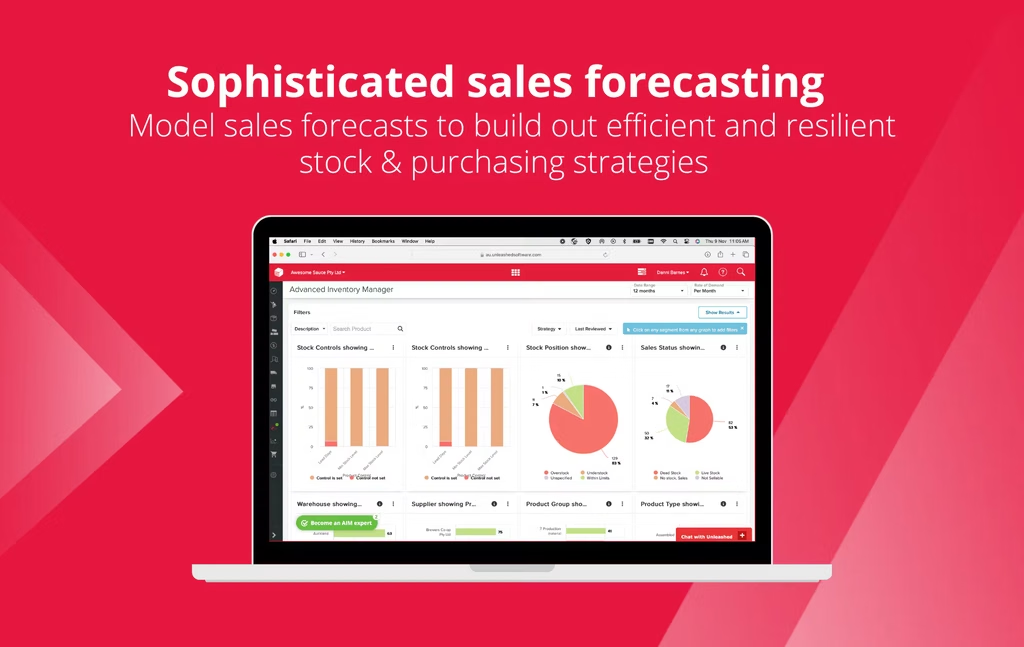
Each is Unleashed’s own software, sold as a module rather than a link to someone else’s system. B2B Store builds a customer-facing ordering site that reads live from your inventory, priced at $129 a month. Advanced Inventory Manager handles demand forecasting and min-max levels at $149. BI Vision is the business intelligence layer for KPI monitoring and cross-channel analysis.
None of them consumes an integration slot, because there is nothing external to connect. Buyers who budget them as connectors at $39 will be out by a factor of three or four. Reading the add-on tiles as part of the catalogue is an easy mistake given where they sit on the page.
Who sits behind the connectors now?
Unleashed is an Access company, and the footer carries The Access Group copyright. Its Xero App Store listing describes a business headquartered in Auckland with offices in the UK, Romania, Malaysia and Australia, more than 17 years of development behind the platform, and customers in over 80 countries.
Ownership by a larger group cuts both ways for integrations. Resources behind the Native connectors tend to be steadier, and the eight that exist are the ones most customers need. Partner-built connectors depend on the partner’s own commercial health, which no amount of group backing changes. Anyone whose operation hangs on a single 3rd Party connector should ask how long that partner has maintained it and what the support path looks like when something breaks at month end.
Four realistic bills
Allowances are easier to judge against actual stacks. All figures below use monthly billing.
- Single-channel brand: Shopify plus Xero. Two integrations against three included. Core at $399 a month, nothing extra. The spare slot covers a shipping tool later.
- Three-channel seller: Shopify, Amazon, eBay plus Xero. Four integrations, one over. $399 plus $39, so $438 a month on Core.
- Six-connector operation: Shopify, Amazon, WooCommerce, eBay, Xero, and Starshipit. Six integrations. On Core, that is three extra at $117, totalling $516. On Pro, one extra at $39, totalling $768. Core wins on connectors alone.
- Growing manufacturer: five integrations, eight users, 400 orders a month. On Core: $399, plus two extra integrations at $78, plus five extra users at $345, plus the 500-order upgrade at $70. That lands at $892. On Pro: $729, plus three extra users at $267, plus $70, which is $1,066, but forecasting, warehouse management, analytics, and production arrive free rather than at $149, $149, $69, and $69 on Core. Adding those four to the Core bill takes it past $1,300.
That last line is the pattern to internalise. Integrations rarely justify Pro on their own, because two extra connectors cost $78 against a $330 gap between the plans. Modules do. If forecasting or warehouse management is on your list, Pro is usually cheaper even though its headline price is almost double.
Costs that sit next to integrations
Several published line items shape the real total, and none appear on the plan cards.
- Sales order upgrades: 500 orders a month for $70, 1,500 for $200, 3,000 for $320, unlimited for $490. The 100 included on both plans is low for any real eCommerce volume, so most buyers pay one of these.
- Modules: Advanced Inventory Manager $149, Warehouse Management and Multi-Bin $149, B2B eCommerce Store $129, Sales Growth $119, Marketing Accelerator $262, CRM $450, Access Analytics $69, Production and Manufacturing $69. Four of those are free on Pro.
- Support plans: Standard $99 a month with live chat, phone, and a two-hour response for four support users; Premier $239 a month adding a dedicated success manager, account reviews, and eight support users.
- Onboarding, charged once: $449 self-service, $799 standard, $5,549 full consultative.
A realistic first-year total for a mid-sized multichannel seller is well north of the $4,788 that twelve months of Core suggests. Price the stack, not the plan.
How to choose your allowance before you sign
Four steps, in this order.
- Write down every system that must know your stock position. Count storefronts individually. Count the accounting ledger. Count the till, the shipping tool, and the 3PL bridge.
- Check each one against the Native list. Native connectors mean a single support queue; partner builds mean two.
- Subtract your plan’s allowance from that count and multiply the remainder by $39.
- Add the sales order upgrade you will actually need, then the modules, then support. Compare that total against the same exercise on the other plan before deciding.
Unleashed offers a 14-day free trial with all features enabled, which is the cheapest way to confirm a connector behaves before the allowance maths matters. Related reading on this site: our breakdown of QuickBooks features and who QuickBooks suits covers the accounting half of the most common Unleashed pairing, and the Increff, Unicommerce and Zoho Inventory comparison covers rival inventory platforms.
Current plan details and the trial are on Unleashed’s site.
Frequently asked questions
How many integrations does Unleashed have?
Around 30 listed on the app marketplace across accounting, analytics, commerce, connectors, CRM, point of sale and warehousing, plus an open API for anything not covered. Eight carry the Native badge.
How much does an extra Unleashed integration cost?
$39 a month per connector beyond your plan’s allowance, charged at the same rate on Core and Pro. Core includes three, Pro includes five.
Does Unleashed integrate with Xero?
Yes, and it is a Native integration built and supported by Unleashed rather than a partner. Unleashed’s listing on the Xero App Store holds 4.55 out of 5 from 394 reviews.
Is the Shopify connector an extra subscription?
No. The Shopify App Store lists it as free to install. It consumes one slot from your Unleashed integration allowance, and that is the only charge.
What is the difference between a Native and a 3rd Party integration?
Native connectors are built, managed, and supported by Unleashed. 3rd Party ones are built and supported by partners that Unleashed describes as vetted and trusted. Both consume an allowance slot; they differ in who fixes a broken sync.
Are there API call limits?
Yes. Core allows 250,000 calls a month, and Pro allows 500,000, with additional capacity available to purchase. Custom builds should be designed against that budget.
Which plan should a multichannel seller pick?
Count connectors first. Six connectors cost $516 a month on Core against $768 on Pro, so Core wins on that line alone. Pro only pulls ahead once you need the forecasting, warehouse, analytics, or production modules, which it bundles free and Core charges for.
Sources
- Unleashed app marketplace, for the catalogue, categories and the three integration levels, read 7 October 2026.
- Unleashed pricing, read in both billing states on the same date, in US dollars excluding taxes.
- Unleashed Software on the Xero App Store, for the aggregate rating and review count.
- Unleashed Inventory Management on the Shopify App Store, for the free-to-install pricing label.
- Xero Accounting API documentation, the interface behind the Native Xero connector.