



Quick answer: Rippling fits companies whose admin pain comes from spread rather than size. Hiring across several US states, employing people in countries where you hold no legal entity, or running HR and IT off the same two-person team are the three situations where it earns its keep. Nothing on the site carries a price, so every evaluation ends in a sales call, which rules it out if you need to compare numbers before you talk to anyone.
Disclosure: Stack99 earns a commission if you buy through links on this page. It costs you nothing extra and never changes our assessment.
Start with the missing number
Before any discussion of fit, one fact does more to decide it than any feature. Rippling publishes no prices. Not a starting rate, not a per-seat figure, not a range.
| Plan | Price | What you get |
|---|---|---|
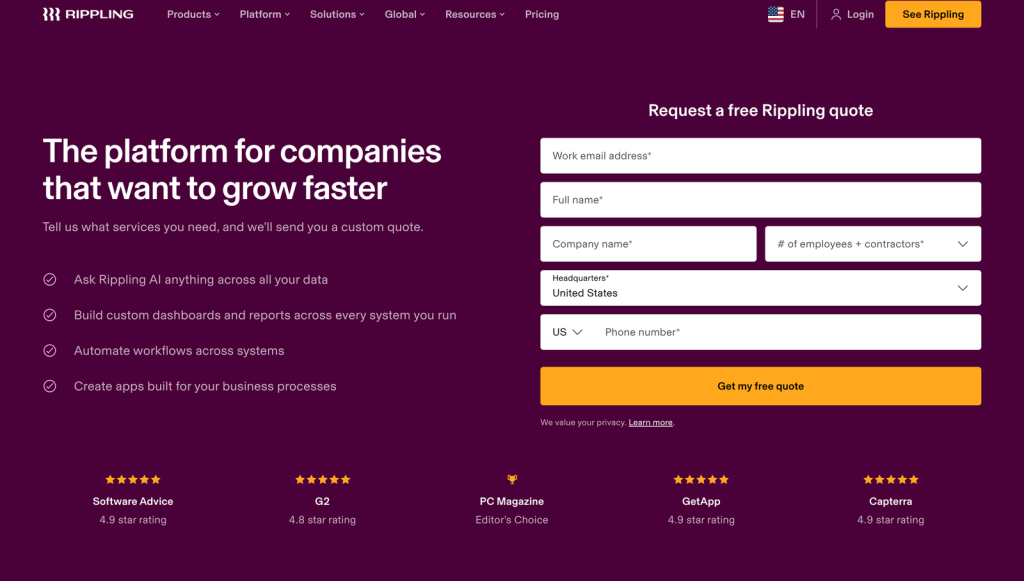
| Every configuration | Custom | Quote only. The form asks for headcount band (1-10, 11-50, 51-250, 251-1000, 1001+), headquarters country and which services you need, then returns a figure by email. No rate card is published on any page of the site. |
Those headcount bands tell you something useful on their own. A vendor that segments its quote form at 1-10 and again at 11-50 is willing to sell to very small companies, which is not true of every platform in this category. The country field being mandatory points the same way as the rest of the product, which is to say outward.
Budget for a sales cycle, then. If you are the kind of buyer who wants three quotes in a spreadsheet by Friday, Rippling will be the slow one.
The premise you are buying into
Rippling’s platform page makes an argument rather than a feature list. The claim is that your current systems carry incompatible data models even when one vendor sells them to you together, and that this is why you cannot build the report you want or automate the process you need.
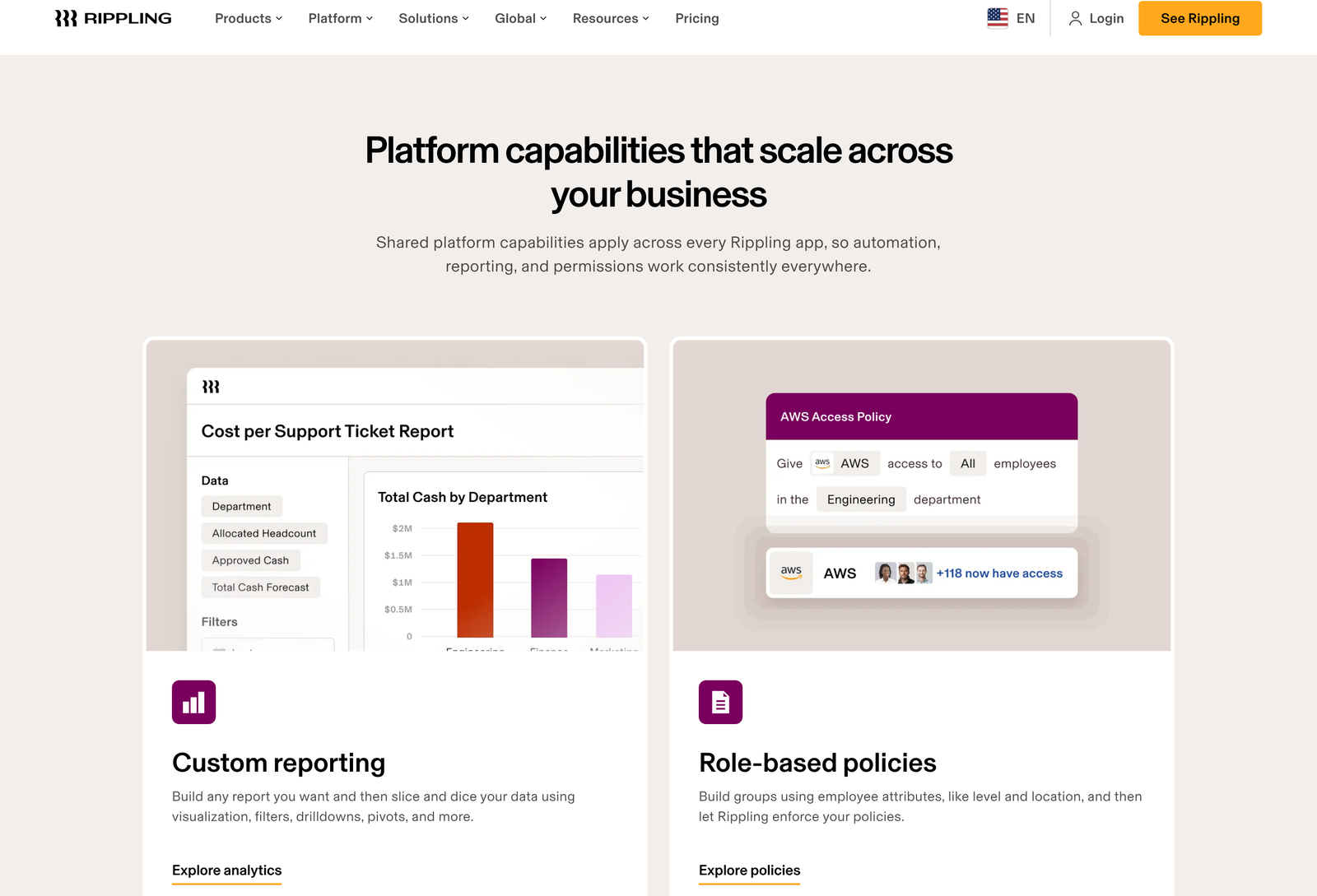
Two capabilities carry that argument. Custom reporting lets you slice across whatever apps you run, with visualisations, filters, drilldowns and pivots. Role-based policies let you define groups from employee attributes such as level and location, then have the system enforce rules against those groups everywhere.
Whether that premise is worth money to you is a question about your own mess, not about Rippling. Run one country, one employment type, and one HR system, and the unified data model solves a problem you do not have. The value appears when the combinations multiply.
Fit one: you hire across US state lines
This is the clearest case, and it is the one Rippling leans on hardest in its technology-sector material. Hiring an employee in a new state means registering with that state’s tax authorities before you can pay them legally. Rippling automates that registration.
Count your states before you weigh this. A company with staff in four states is doing a chore four times a year at most. A company hiring remotely across twenty is doing something closer to continuous compliance work, and the automation stops being a convenience.
Payroll sync is the second half. Rippling says its HR data flows into payroll directly, so PTO hours stop being manual entries, and so do 401(k), HSA, and FSA deductions. The failure mode this removes is the one where somebody changes an employee record in the HR system and forgets the payroll system exists.
Fit two: you employ people in countries where you have no entity
Employer of Record is the service that lets you hire in a country without incorporating there. Rippling runs its own, which puts it against Deel, Remote and the other specialists rather than against HR software.
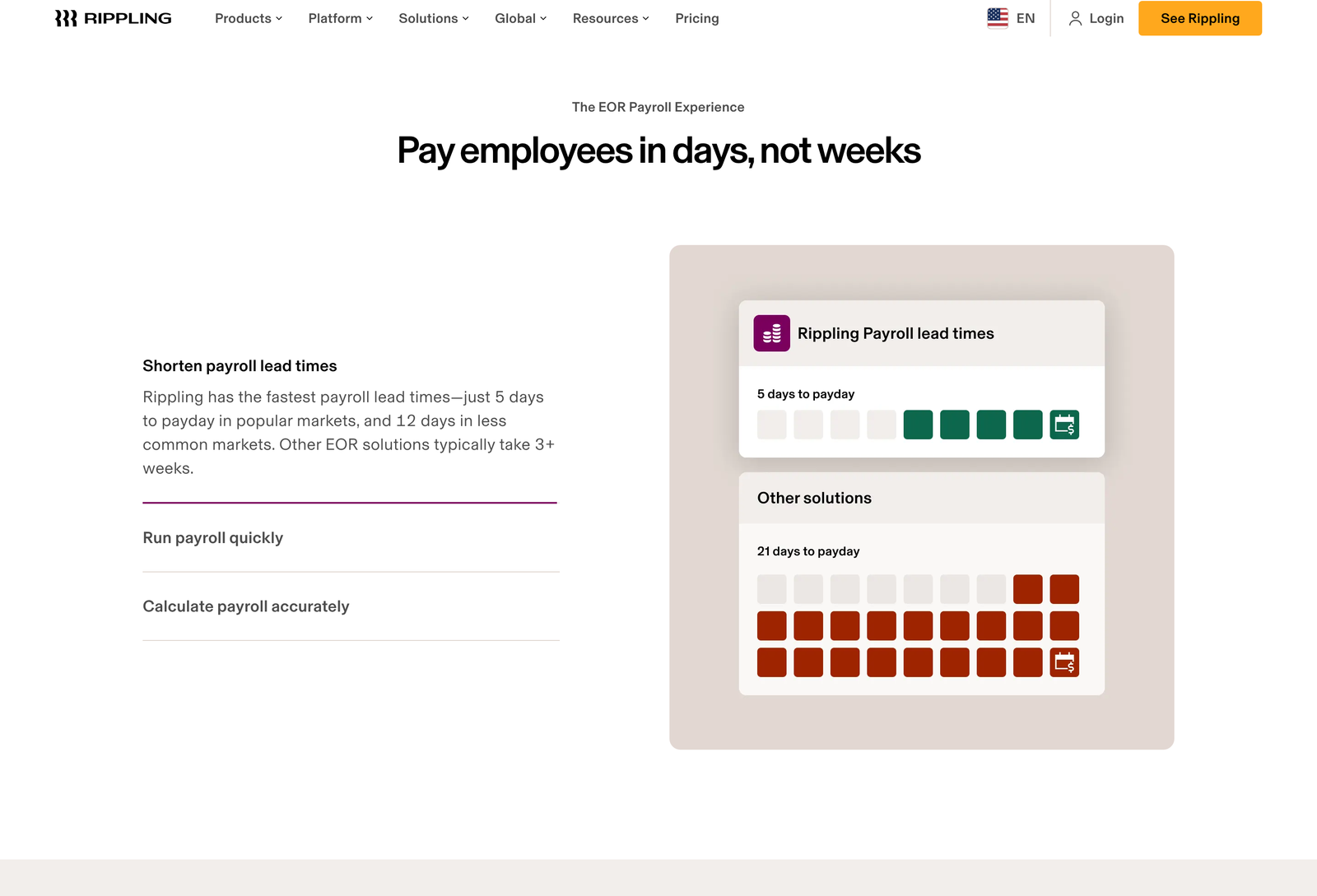
The specific claim is five days to payday in popular markets and twelve in less common ones, against three weeks or more for what it calls other EOR solutions. Treat the first two numbers as a commitment you can hold them to and the third as marketing, because no competitor is named and no methodology is given.
Lead time matters more than it sounds. An EOR with a three-week cycle means a candidate who signs on the 20th does not get paid until the following month, which is the sort of detail that turns a good hire into an awkward first impression. Shorter cycles also let you move a start date without renegotiating payroll.
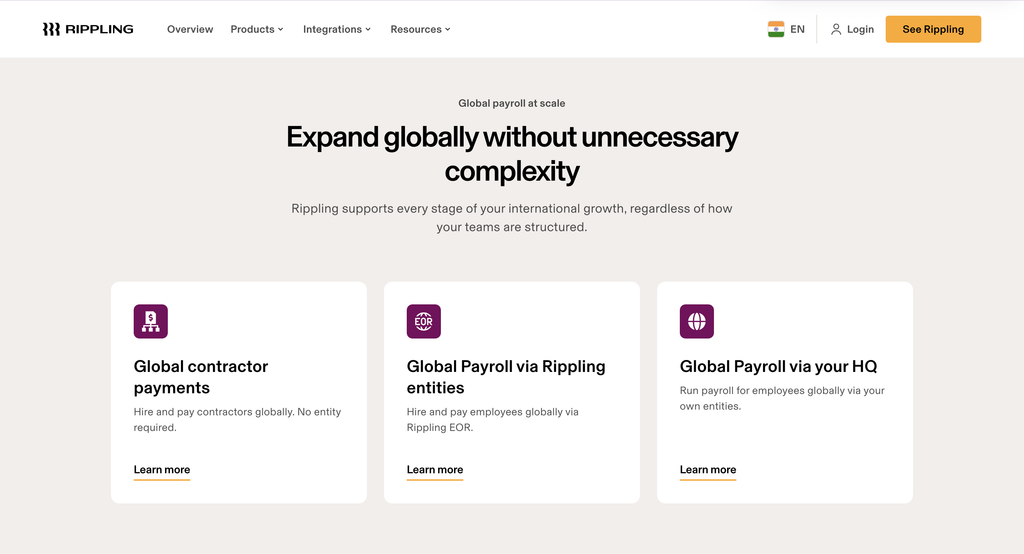
Rippling also sells Contractor of Record and global contractor payments, which is the distinction worth getting right before the sales call. Contractors and employees carry different risk, and misclassifying one as the other is the expensive mistake in this corner of the market.
Fit three: HR and IT are the same two people
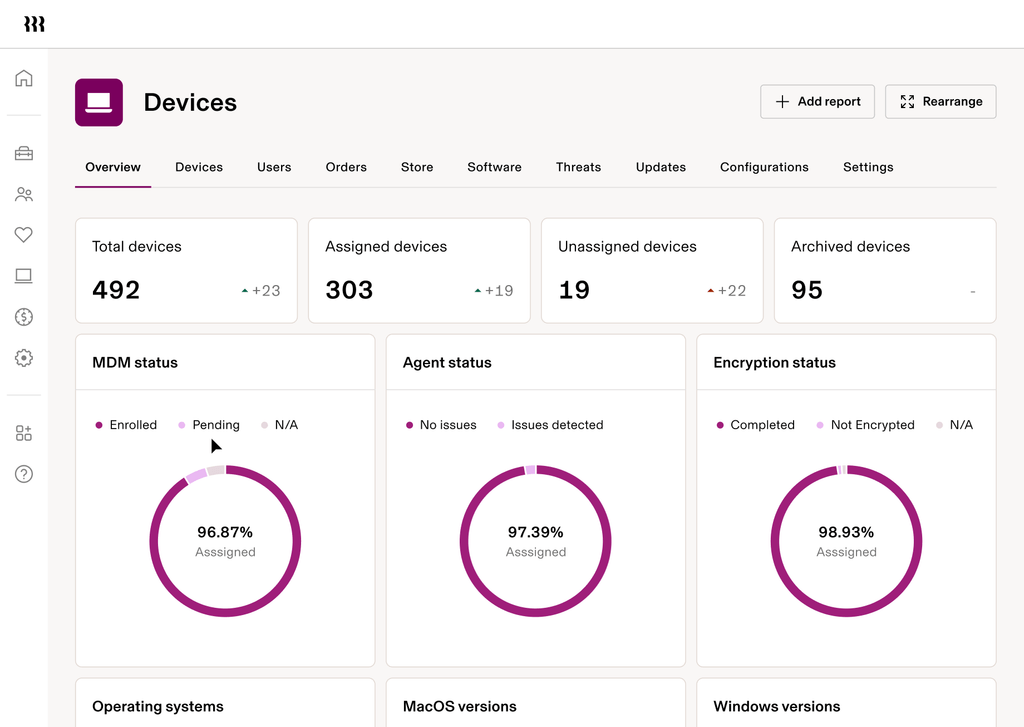
Device management sits inside the same product as payroll and benefits, alongside identity and access and inventory tracking. For a company of 200 with one ops generalist covering both functions, that overlap is the whole pitch.
Onboarding shows what it buys. A new hire triggers payroll setup, benefits enrolment, and account provisioning in the tools you use, with Microsoft 365, Slack, and Ironclad named as examples on the professional services page. Offboarding runs the same sequence backwards, which is the half most companies do badly and discover during an audit.
Promotion handling is the subtler version. Rippling describes permissions updating automatically when somebody moves into a management role, driven by the preconfigured settings for that role rather than by a ticket. Any company that has watched access creep upward for three years without ever creeping back will recognise the problem being solved.
Our breakdown of Rippling integrations covers how those app connections differ from each other, which matters if provisioning is the reason you are looking.
Fit four: your workforce clocks in
Shift-based employers get a different product surface, and the restaurant material is the most developed version of it.
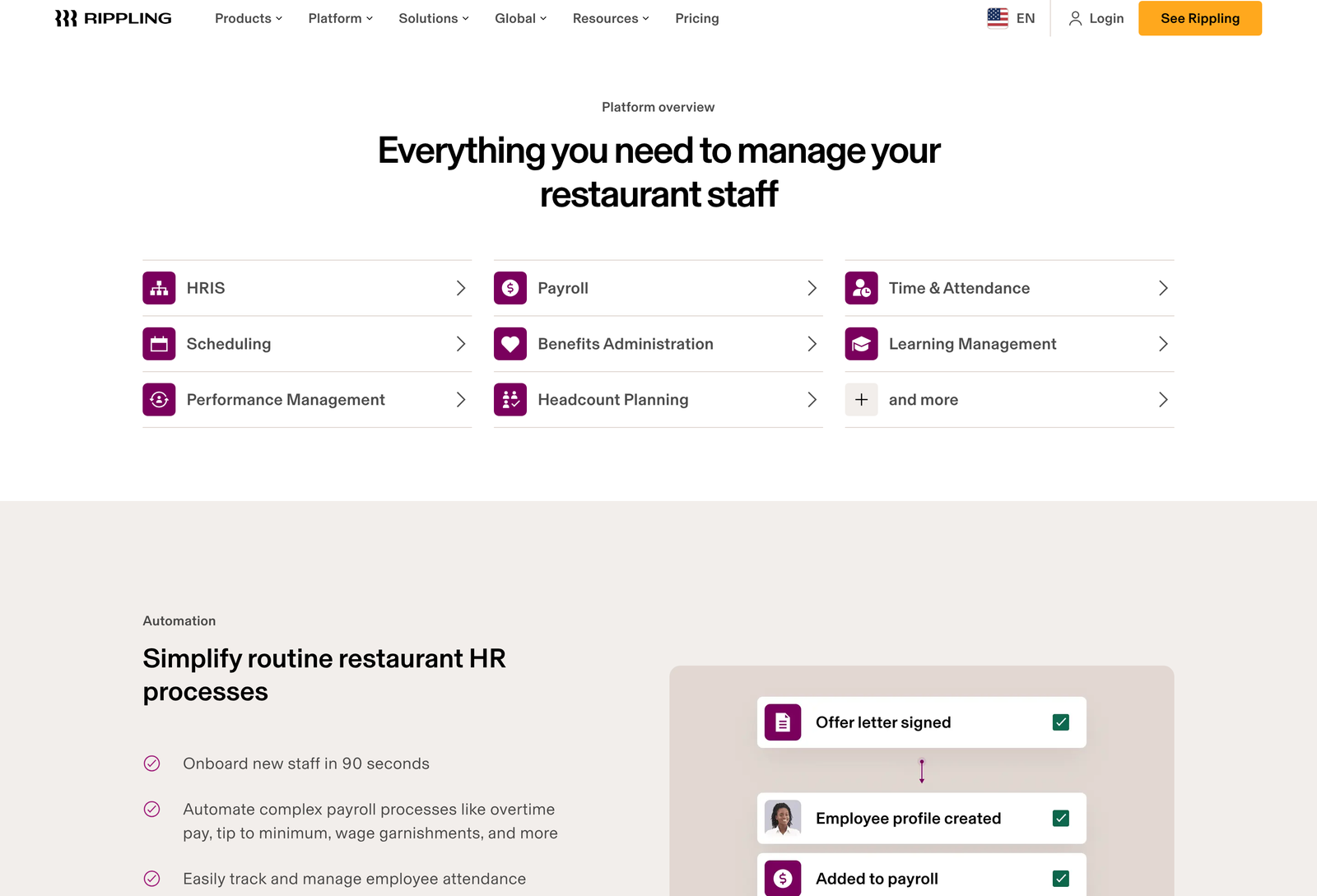
Scheduling runs on rules managers work inside rather than around. Staff swap shifts within parameters and approval chains you set, schedules respect stated availability, and attendance history can push your most reliable people onto the shifts that matter. Breaks can be scheduled into quiet periods instead of being hoped for.
Payroll carries the awkward calculations. Overtime, wage garnishments, and tip to minimum are all named as automated. That last one is doing real work: the Fair Labor Standards Act lets an employer take a tip credit against its minimum wage and overtime obligations, but only if the employee’s tips plus direct cash wages actually reach the minimum. Checking that per employee per period by hand is where restaurant payroll goes wrong.
Compliance alerting is the feature to probe hardest in a demo. Rippling says policies update as laws change and that schedules generate automated alerts for potential violations. Ask which jurisdictions those rules cover, because predictive scheduling law is city-level in several US markets and a generic alert is worth little.
Fit five: you bill time against projects
Construction and professional services get the same underlying capability pointed at two different questions.
For construction, it is job costing. Worker hours track against projects and assets, policies can require that worker skills match the job, and self check-in carries geolocation restrictions so the clock reflects somebody actually being on site. Attendance alerts and a points system sit alongside. Spanish is offered among the mobile app languages, which is a small detail with real consequences on a US site.
For professional services, the same hours answer a margin question instead. Rippling frames it as seeing where your teams’ time goes and what it costs you, which is the number that decides whether a client is worth keeping.
Both cases lean on overtime being calculated correctly, and that is less obvious than it looks. Federal rules require time and a half beyond 40 hours in a workweek, and a workweek is any fixed and regularly recurring period of seven consecutive 24-hour periods, which need not start on a Monday. Different groups of employees can sit on different workweeks. Systems that assume a calendar week quietly miscalculate for employers who do not use one.
Fit six: finance wants the same employee record
Expense management, corporate cards, bill pay and travel all sit in the product. The argument for taking them from the same vendor is that a card belongs to an employee, an employee belongs to a department, and the department owns a budget, so the approval chain can be derived rather than maintained.
Weigh this one carefully. Finance tools are the part of the suite competing against specialists with longer track records, and consolidation is worth less here than it is in the HR and IT overlap. Buy it because the reporting genuinely improves, not because it appears on the same invoice.
Two companies, same headcount, opposite answers
Put two 120-person companies side by side, and the fit question answers itself.
The first runs a single office in Ohio. Everyone is a salaried employee on one payroll calendar, IT is outsourced to a managed service provider, and nobody is hired outside the state. Count the combinations that Rippling’s data model is built to reconcile, and you get one country, one state, one employment type, and one pay cycle. A unified platform has almost nothing to unify. This company should be comparing published per-employee rates from payroll specialists and spending the saved budget elsewhere.
The second has 70 US employees spread over nine states, 20 contractors, 18 people employed through an EOR in Poland, Brazil, and Portugal, and a laptop fleet that follows all of them. That is nine state tax registrations, four payroll regimes, two worker classifications, and a device inventory with no office to sit in. Every one of those is a seam where data has to match, and every seam is a place where a spreadsheet currently lives.
Count your own seams before the call. Multiply states by employment types by countries, and if the product of those three numbers is in single figures, the platform argument is thin. Over the past twenty or so, the manual reconciliation you are doing today has a real cost you can put against the quote.

One caution on that arithmetic. Seams make the case for consolidation generally, not for Rippling specifically, so the same count should be taken to every vendor you talk to.
Who should look elsewhere?
Four profiles come out badly from everything above.
Single-state companies under about 30 people with no international plans are paying for optionality they will not use. Buyers who need a published price for a procurement process will stall at the first step. Teams that want one excellent module rather than a platform will find specialists who do that module better. And anyone replacing a system next month will find the implementation runs longer than that, because a unified data model has to be fed before it returns anything.
Worth noting too: Rippling sells a PEO alongside its standard payroll, and those are different commercial arrangements with different implications for your tax filings and benefits. Establish which one you are being quoted for early.
How to walk into the quote call
Since the number is set in conversation, the preparation matters more than usual. Bring four things.
Your real headcount split, separating employees from contractors and domestic from international, because the quote form asks for the combined figure and the price almost certainly is not blind to the mix. A list of the exact modules you want, since the form asks which services you need and an open-ended answer invites an expansive quote. Your renewal dates for the systems Rippling would replace, which is the only leverage you have on timing. And a written answer to what you will stop paying for, so the comparison is against a real stack rather than against zero.
For a priced comparison while you wait, our guide to who Deel fits covers the global hiring overlap, and Gusto pricing gives you a published US payroll benchmark to argue from.
Where this leaves you
Rippling is built for companies whose complexity comes from spread. More states, more countries, more employment types and more systems per employee all push value toward it. Headcount alone does not: a 500-person company in one office with one employment type is a weaker fit than a 60-person company across eight states and three countries.
The missing price is the real gate. You cannot shortlist on cost, which means the evaluation has to be run on fit first and negotiated on cost second. Decide which of the six situations above describes you before the call, and you will at least know what you are refusing to pay for.
Frequently asked questions
What does Rippling cost?
No published figure exists. The pricing page is a quote request form asking for headcount band, headquarters country and the services you want. Anyone quoting you a per-employee rate for Rippling from a blog post is guessing.
Is there a minimum company size?
None is stated, and the quote form offers a 1-10 employee band, so very small companies are served. Whether the pricing makes sense at that size is a separate question you can only answer by asking.
Can I buy only the HR part?
The homepage says you can start with the apps you need or run them all together, and the quote form asks which services you want. Modular purchasing is clearly supported. The platform argument about unified data gets weaker the fewer modules you take.
How does Rippling’s EOR compare on speed?
Rippling states five days to payday in popular markets and twelve in less common ones. It characterises other EOR providers as taking three weeks or more, without naming them. Use the first two figures as something to hold the vendor to, and verify any competitor against that competitor’s own documentation.
Does it handle hourly and shift work properly?
Scheduling, time and attendance, shift swapping, and tip-to-minimum payroll are all built in, with restaurant and retail configurations published. Press hard on which jurisdictions the compliance alerts actually cover, since scheduling law varies by city in several US markets.
How long does implementation take?
Not published. Rippling quotes 90 seconds for onboarding a new hire and running payroll, which describes steady-state operation rather than setup. Ask for a dated implementation plan with named milestones as part of the quote.
Sources
- Rippling pricing page, for the quote form fields, headcount bands and the absence of any published rate, read 15 October 2026.
- Rippling platform and the industry pages for restaurants, construction, technology and professional services, for the capability and use-case detail quoted above.
- Rippling Employer of Record, for the payroll lead time figures and the entity-free hiring description.
- US Department of Labor, tip regulations under the FLSA, for the tip credit condition that makes tip-to-minimum automation worth having.
- US Department of Labor, overtime pay, for the time-and-a-half threshold and the statutory definition of a workweek.