



Pick the wrong Emergent plan, and you overpay by $180 a month for capability you never touch. Pick it by credit volume alone, and you overpay more subtly, because Pro costs more per credit than Standard does. This article works through who each of the five tiers is actually built for, using the figures published on emergent.sh on 14 October 2026 and the arithmetic those figures imply.
Disclosure: Stack99 earns a commission if you buy through links on this page. It costs you nothing extra and never changes our assessment.
The short answer
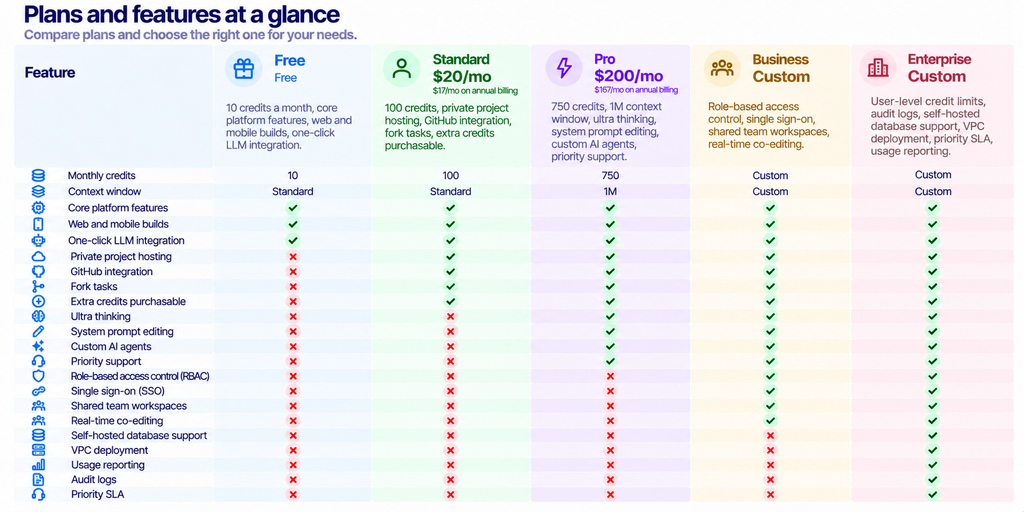
Free suits anyone evaluating the idea, at 10 credits a month. Standard at $20 suits solo builders shipping real projects, at 100 credits. Pro at $200 suits people who need the larger context window, custom agents and prompt-level control, at 750 credits. Business and Enterprise are quote-only and exist for access control, not for throughput.
Credits are the unit that decides everything, and Emergent does not publish what one credit buys. Standard works out at $0.20 a credit and Pro at $0.267, so buying Pro for volume alone costs you more per unit than buying Standard. Pro earns its price through capability.
The five tiers
Which number is the monthly one
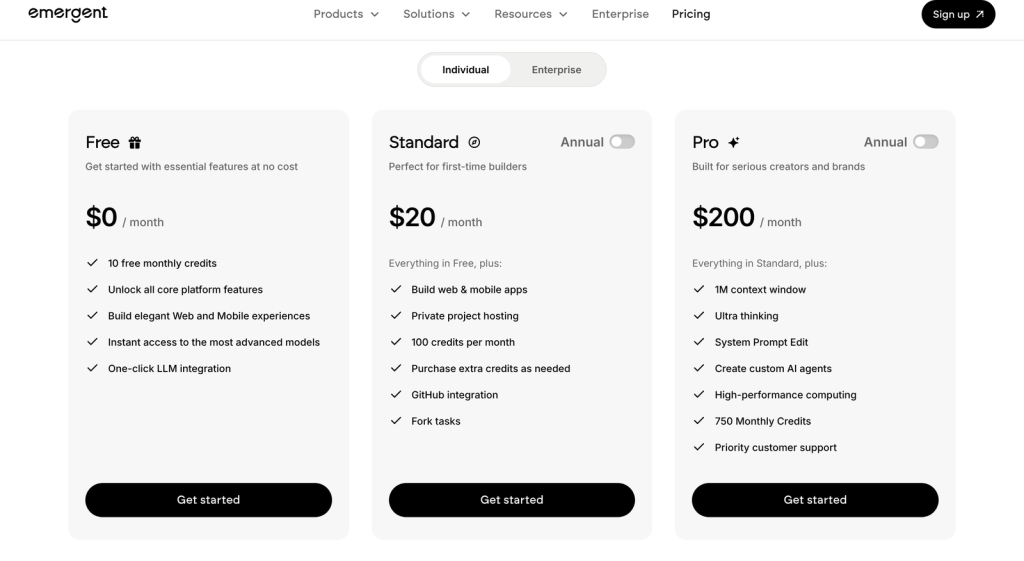
Plenty of vendors load their pricing page with the annual toggle already flipped, so the figure you see on arrival is a discounted rate labelled per month. Emergent does the opposite. The page loads showing $20 and $200, and each paid card has its own small Annual switch sitting beside the plan name, switched off.
Flip them, and the figures become $17 and $167, each with a saving badge. Those badges settle the question without any guesswork. Standard saves $36 a year, and $20 minus $17 is $3 across twelve months. Pro saves $396, and $200 minus $167 is $33 across twelve months. Both reconcile exactly, which confirms $20 and $200 as the real month-to-month prices.
One oddity deserves flagging. Each card toggles independently rather than the page switching as a whole, so a careless screenshot can show Standard annual beside Pro monthly. Check both cards before you quote a figure to anyone.
The credit arithmetic nobody runs
Credits are the only metered resource on the individual plans: 10 a month on Free, 100 on Standard, 750 on Pro. Most buyers read that ladder as better value at the top. Divide it out, and the opposite happens.
Standard gives 100 credits for $20, which is $0.20 a credit. Pro gives 750 for $200, which is $0.2667 a credit. Pro therefore charges about 33 percent more per credit than Standard does. Annual billing narrows the gap without closing it: $17 for 100 credits is $0.17 each, and $167 for 750 is $0.2227 each.
Stated another way, Pro costs ten times Standard and delivers seven and a half times the credits. Anyone upgrading purely because they ran out of credits is buying the worst unit rate. Standard lets you purchase extra credits as needed, and if that top-up price lands below $0.267 a credit, topping up Standard beats upgrading for volume reasons alone.
We cannot complete that calculation. Emergent publishes no price for extra credits and no definition of what a single credit buys. A credit might cover one message, one build step or one deployment, and the public site never says. Treat the per-credit figures above as a comparison between plans rather than a cost per unit of work.
The gap matters because the same word behaves differently across this category. Some vendors burn a credit per model call, others per successful build, others per minute of compute. Until Emergent says which it means, nobody can forecast a monthly bill from a description of their workload. You can only measure it after the fact, which is a reasonable thing to do on a $20 plan and an uncomfortable one on a $200 plan.
How rivals describe the same thing
This is where the missing definition starts to cost Emergent something, because two obvious comparisons publish their allowances in dollars.
Replit sells Core at $20 a month, or $18 billed annually, and describes the included allowance as $20 towards more powerful models. Its Pro tier runs $100 a month, $90 annually, carrying $100 towards the most powerful models. Vercel’s v0 prices Plus at $30 per user per month and states $30 of included monthly credits per user, plus $2 of free daily credits on login. Its Business tier is $100 per user per month with the same $30 of included credits.
Those vendors have chosen a unit their buyers already understand. Emergent has not. For a solo builder, the difference is academic, since you will discover your burn rate within a week either way. For anyone forecasting a team budget, a dollar-denominated allowance is far easier to defend to a finance lead than several credits with no published exchange rate.
Our older write-up of Emergent alternatives covers the wider field of builders if you want to see where it sits against more than two of them.
Who the free plan is for
Ten credits a month is an evaluation budget, not a working one. The Free card does list unlock all core platform features, building web and mobile experiences, instant access to the most advanced models, and one-click LLM integration, so the restriction is throughput rather than capability.
Two things are missing that matter the moment you get serious. Private project hosting appears first on Standard, which implies free projects are not private. Version control also starts at Standard, so on Free there is no documented route to get the generated code into version control, even though Emergent says you own that code and may host it anywhere.
Choose Free if: you want to see whether conversational app building suits how you think, and you are happy to rebuild anything worth keeping on a paid tier.
Who Standard is for
Standard multiplies your credit allowance by ten and adds the three things that turn an experiment into a project. Private hosting keeps work unpublished. GitHub integration gets the code off the platform. Fork tasks let you branch an approach without destroying the original.
At $240 a year, or $204 paid annually, this tier competes directly with Replit Core and sits below v0 Plus. Put plainly, Standard buys you the ability to keep what you build. Everything above it buys you a bigger or better-governed way of building.
Choose Standard if: you are one person shipping real projects, you want your code in GitHub, and 100 credits a month covers your pace. Most individual buyers belong here.
Who Pro is for
Pro is a capability tier wearing a volume tier’s clothing. Its 750 credits get the headline, yet four other items on the card are what actually separate it from Standard.
- A 1M context window, which matters when the model has to hold a large existing codebase in view rather than a single file.
- Ultra thinking, Emergent’s label for extended reasoning on harder tasks.
- System prompt editing, which hands you the instructions the agent runs under instead of leaving them fixed.
- Custom AI agents, so a repeated workflow becomes a reusable thing rather than a repeated conversation.
System prompt editing is the one to weigh hardest. Builders who have hit the ceiling of what prompting alone can fix usually find that control is worth more than any credit allowance. Builders who have not hit that ceiling will not miss it.
Choose Pro if: you work on a codebase large enough to need the bigger window, you want to shape the agent’s behaviour directly, or you are productising a repeated build pattern. Do not choose it simply because Standard ran dry.
What connects, and why it affects the tier
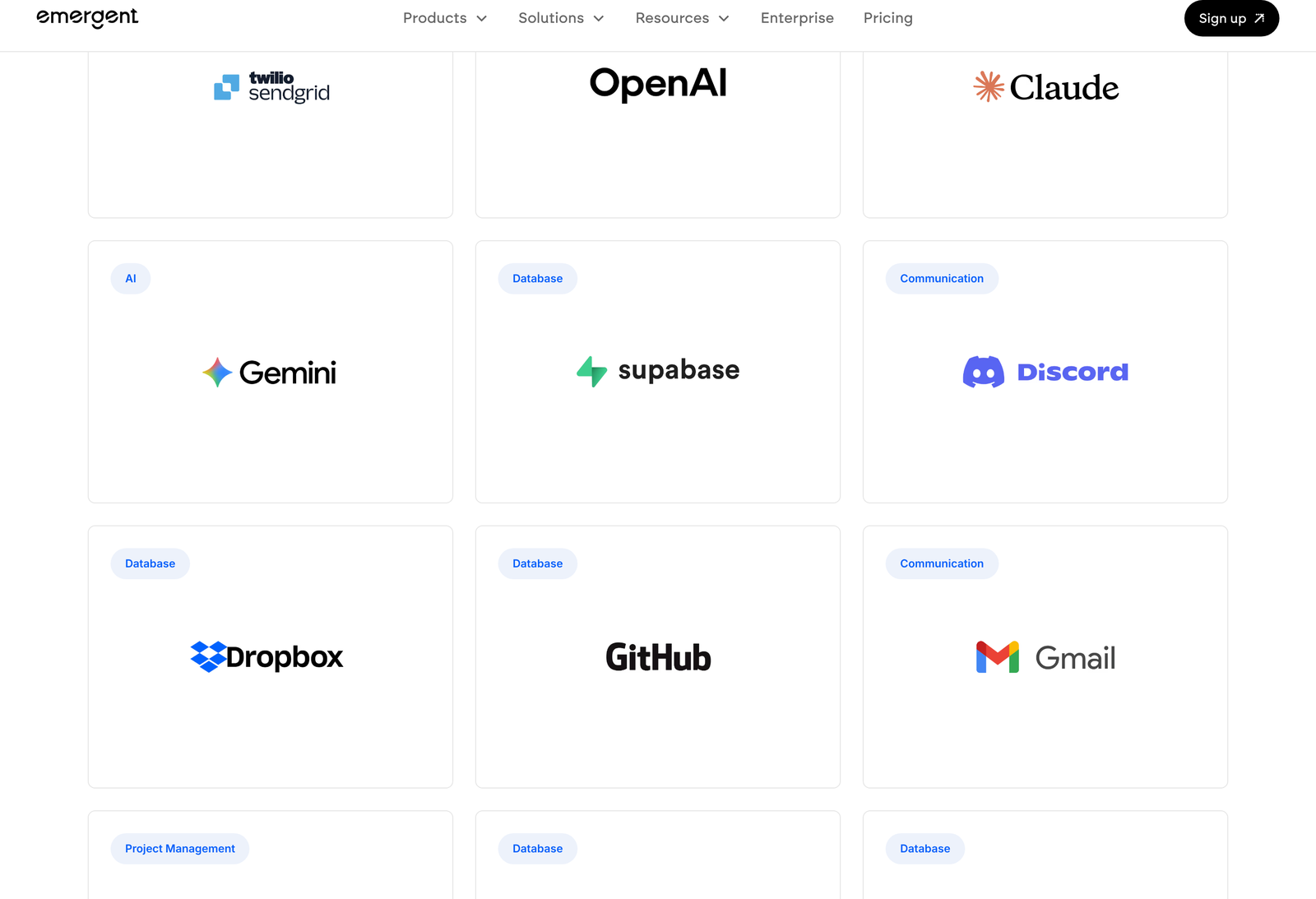
Emergent’s integrations directory lists the services a generated app can reach: GitHub, Supabase, Dropbox, Gmail, Discord, Twilio SendGrid and the major model providers, including OpenAI, Claude, and Gemini. Each card carries a category label such as AI, Database, or Communication.
Only one of those connections is gated by plan on the published cards, and it happens to be the important one. The GitHub connection is a Standard feature. Everything else in the directory describes what your finished application can talk to, which is a property of the app rather than of your subscription.
That split is useful when choosing a tier. Database and messaging connections do not push you up the ladder. Wanting your source code under version control does, and it does so at the very first paid step. Our earlier Emergent integrations guide goes through the directory in more depth.
A worked example over six months
Numbers make the tier question concrete. Consider a freelancer who builds two client applications a quarter and wants everything in GitHub.
Six months on Standard billed monthly costs $120. Billed annually, the same six months costs $102, although the commitment runs twelve months and totals $204. Six months on Pro billed monthly costs $1,200, which is $1,080 more than Standard for the same period.
That $1,080 has to buy something. Across six months, it represents 3,900 extra credits, the 1M context window, system prompt editing, and custom agents. If the freelancer uses none of the last three, the sensible comparison is 3,900 credits for $1,080, which is $0.277 each, slightly worse than Standard’s own rate and far worse than whatever a top-up costs.
Flip one assumption and the conclusion flips too. A freelancer whose clients hand over existing codebases needs the larger context window on day one, and the capability argument carries the whole decision regardless of credits. For a fuller breakdown of the raw figures, see our Emergent pricing write-up.
Who Business and Enterprise are for
Neither quote-only tier adds credits on the published card. Both add control.
Business lists role-based access control, single sign-on, shared team workspaces, and real-time co-editing. Read that as the moment more than one person touches the same build and your identity provider has to know about it. Enterprise lists user-level credit limits, audit logs, self-hosted database support, user groups, deployment into your own cloud through a VPC, a priority SLA, and credit usage reports with an analytics dashboard.
User-level credit limits is the interesting entry. It implies that at organisational scale credits are pooled and need rationing, which is a different billing shape from the individual plans. Anyone budgeting a team deployment should ask how the pool is sized before anything else.
Choose a quote if: you need SSO, audit trails, deployment inside your own cloud, or per-person spend caps. None of those appears anywhere below Business.
A $250 figure that only exists in the FAQ
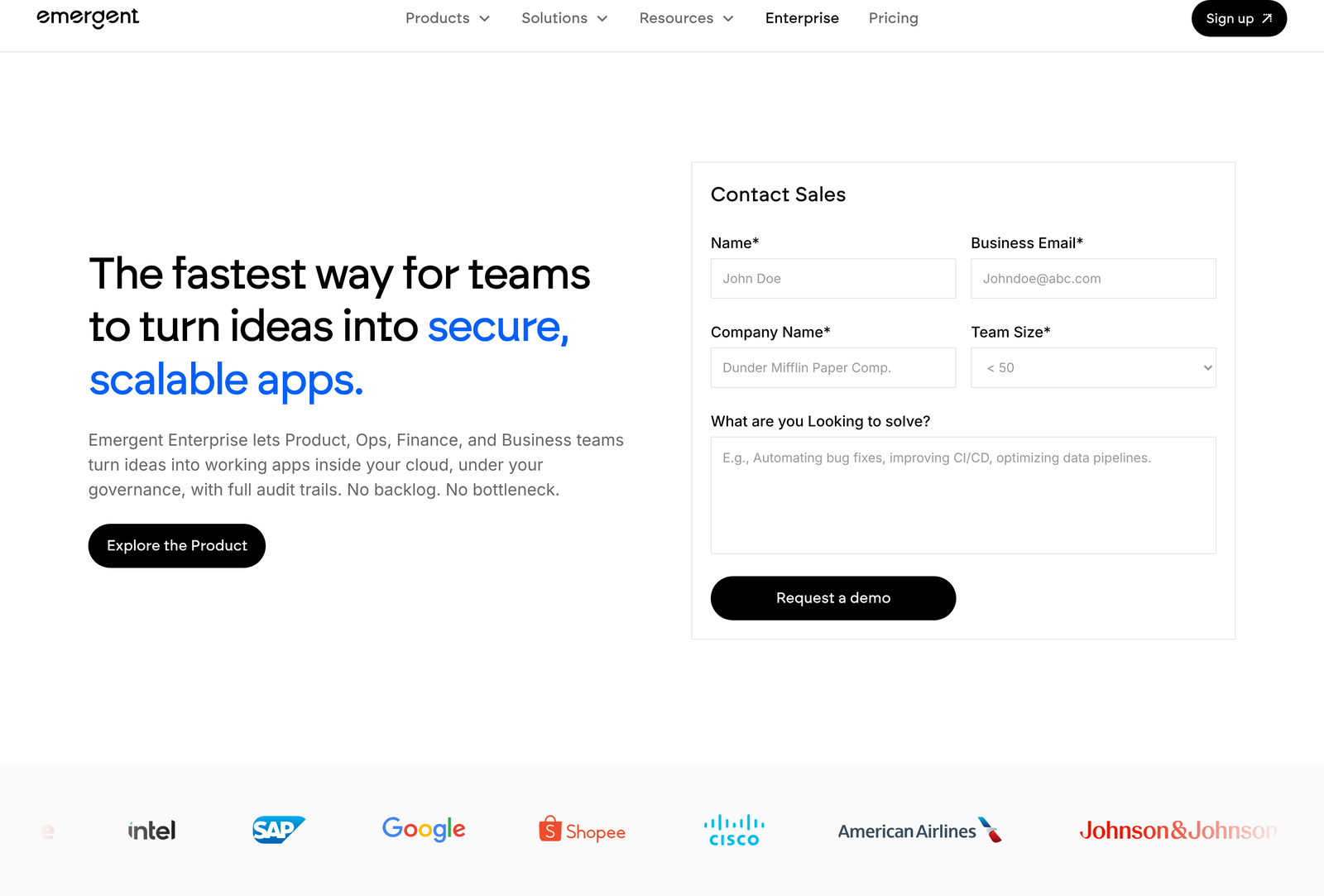
Emergent’s homepage FAQ answers the question of how pricing works by naming three numbers: $17 a month for individual builders, $167 a month for power users, and $250 a month for teams. The pricing page names no $250 tier at all. Business and Enterprise both show Custom.
Two things are going on. The FAQ quotes annual rates as though they were the headline prices, which understates monthly cost by $3 and $33. More usefully, it discloses a team price that the pricing page withholds. Whether $250 is per seat, per workspace, or per floor is not stated.
Take the figure into a sales conversation rather than into a budget. A number published in one place and absent from another is worth confirming before anyone plans around it.
The code ownership question
One claim on the homepage changes how much the plan choice matters. Emergent states that you own all the code it generates, that it integrates with GitHub for version control, and that you are free to download, modify or host your applications anywhere you choose.
Taken at face value, that caps your switching cost. A project built on Standard can leave with you. It also sharpens the earlier point about Free, where no GitHub route is listed, so the one tier that cannot easily export is the free one.
We could not read the terms of service to check how that claim is worded contractually. Emergent’s legal pages live on app.emergent.sh and render only through JavaScript, returning an identical page shell to our declared crawler for subprocessors, terms, and privacy alike. Anyone relying on the ownership claim should read those terms while signed in.
Questions people ask
Is $20 or $17 the real Standard price?
$20 is the month-to-month price. $17 is the per-month rate when you commit annually, and the card’s own Save $36 badge confirms it, since $3 saved across twelve months is $36.
What does one credit buy?
Emergent does not publish a definition anywhere on its public site, and we are not going to invent one. Plan with the per-credit comparison instead: Standard is $0.20 a credit, Pro is $0.267.
Should I upgrade to Pro when I run out of credits?
Not on volume grounds alone. Pro costs ten times Standard for seven and a half times the credits. Standard allows extra credit purchases, so compare that top-up rate first. Upgrade for the 1M context window, custom agents or system prompt editing.
Is there a team plan at $250 a month?
The homepage FAQ names that figure for teams. The pricing page shows Business and Enterprise as Custom with no number. Confirm it directly before budgeting.
Can I get my code out?
Emergent says you own the generated code and can host it anywhere, with GitHub integration available from Standard upward. No GitHub route is listed on the Free tier.
Sources
- Emergent pricing, read 14 October 2026, for all five tiers, the credit allowances, the monthly and annual figures and the saving badges.
- Emergent homepage FAQ, for the $17, $167 and $250 figures and the code ownership statement.
- Replit pricing, read 14 October 2026, for Core at $20 a month with $20 towards more powerful models and Pro at $100 a month.
- v0 pricing, read 14 October 2026, for Plus at $30 per user per month including $30 of monthly credits and Business at $100 per user per month.
Verified 14 October 2026. Every figure above is published by the vendor named beside it. Emergent publishes no definition of a credit and no price for additional credits, so neither is estimated here. The annual rates were read from the pricing page’s own hidden price elements and confirmed against the saving badges; the toggle itself did not respond to our automated browser, so the screenshot above shows the monthly state only. Emergent’s terms of service could not be read, as its legal pages render only through JavaScript.