


The pitch from Bókun rests on connection. The pitch is a network of 2,600 resellers, live availability across every channel and a single calendar behind all of it. Most of that is true, and some of it is included in your subscription. What the pricing page does not show is a separate App Store where several connections carry their own monthly fee, and where linking your own reservation system costs $199 a month plus 1.5% of the bookings it brings in.
Disclosure: Stack99 earns a commission if you buy through links on this page. It costs you nothing extra and never changes our assessment.
The short answer
Bókun has three separate integration layers and they are priced in three different ways. Reseller distribution through the Marketplace and Channel Manager comes with any paid plan. App Store add-ons range from free to $159 a month, and several are bundled into Start or Plus. Connecting your own in-house reservation system runs through the Channel Manager API, listed at $199 a month plus a 1.5% booking fee, on top of whatever plan you are already paying for.
Zapier is the one to watch. Installation costs nothing, but entitlement sits with the Plus plan at $149 a month, so generic automation effectively starts there rather than on the $49 Start plan.
Three layers, three price models
Treating Bókun’s integrations as one thing will cost you money. They divide cleanly into three groups once you know where to look.
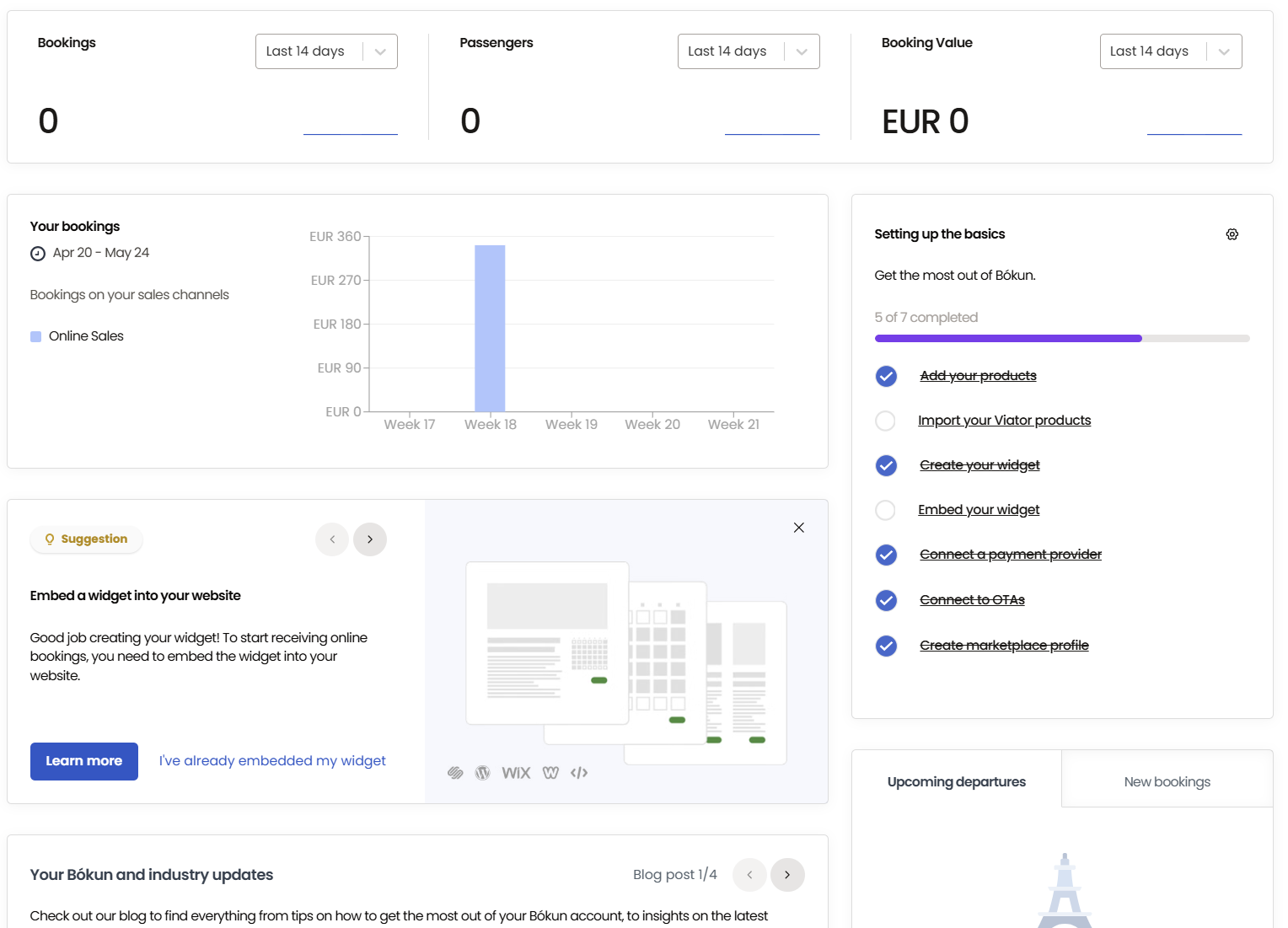
The first is distribution. Your products go out to online travel agents and resellers through the Marketplace, with availability kept in step by the Channel Manager. Any paid plan includes it, and this is the layer the marketing describes.
The second is the App Store at appstore.bokun.io, a catalogue of eighteen apps covering operations, messaging, waivers, reporting and automation. Some come from Bókun and some from third parties. Prices run from nothing to $159 a month.
The third is the developer surface: documented REST APIs, webhooks, an OCTO implementation and a Channel Manager API for plugging an external reservation system into the network. That last one is a paid app rather than a platform feature, which is easy to miss.
What your plan already includes
Every paid tier costs a subscription plus a percentage of applicable online bookings, and that percentage falls as the subscription rises. Those fees frame everything else, because an app that adds a booking fee stacks onto a fee you already pay.
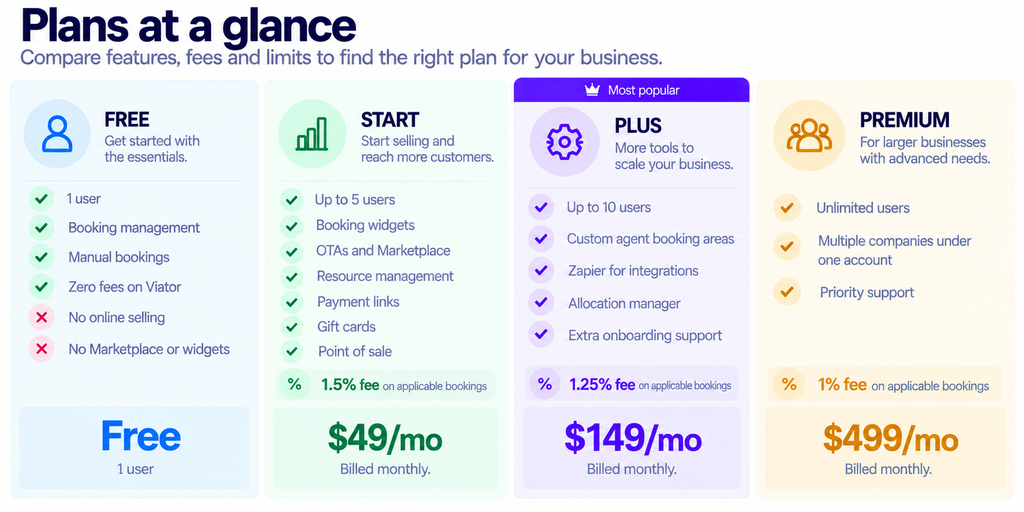
No annual option is offered and no toggle exists on the pricing page, so these are straightforward month-to-month figures. We took the fee structure apart separately in our look at the fee behind the $49 plan, including where each tier breaks even against the next.
One line in that table is an integration decision rather than a pricing one. Zapier appears in the Plus feature list, which means the cheapest route to generic automation is $149 a month even though the Zapier app itself costs nothing to install.
The App Store and what it charges
Eighteen apps are listed. Four pricing patterns run through them, and the labels repay careful reading.
Free, with no strings
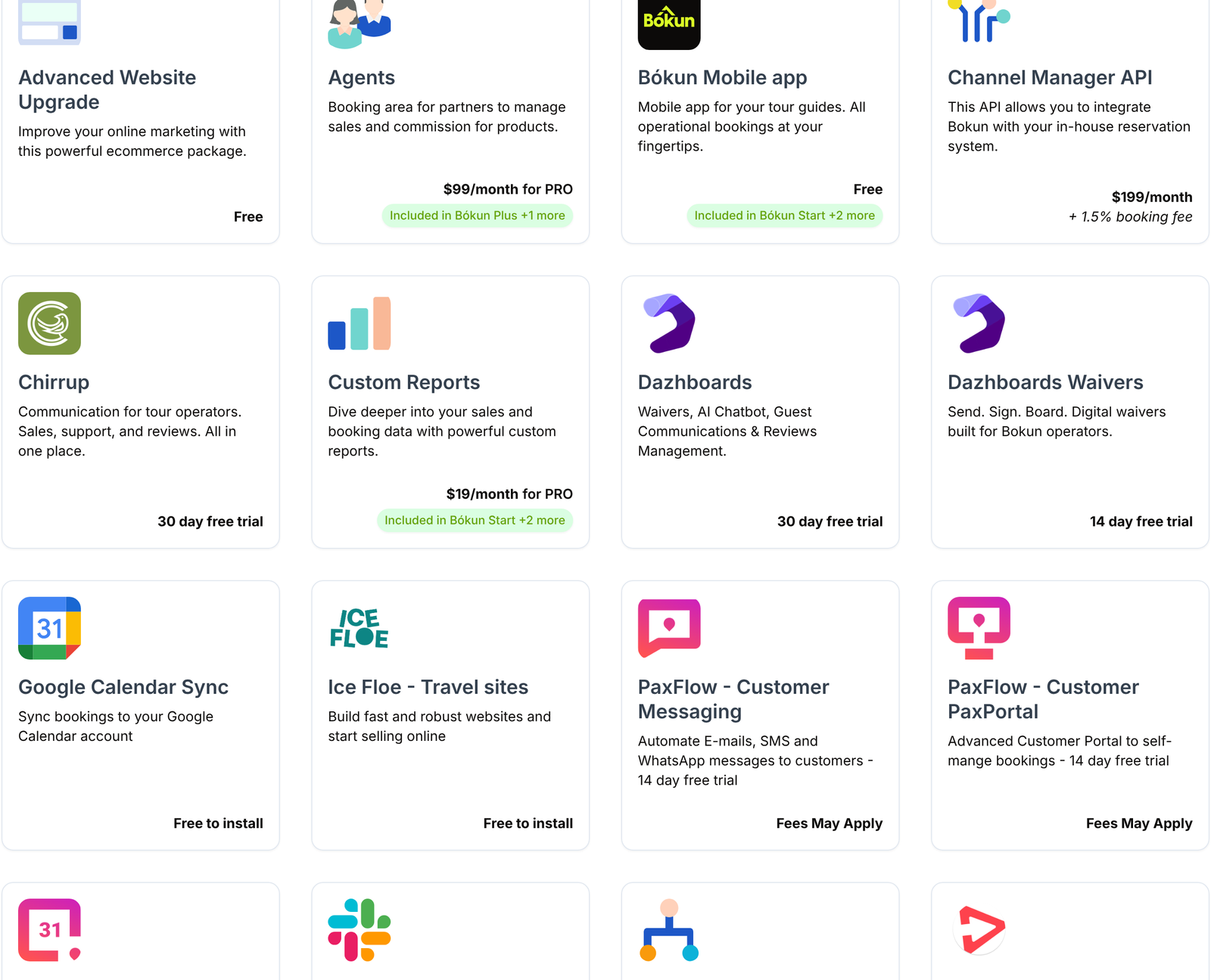
Advanced Website Upgrade, Google Calendar Sync, Slack notifications and Ice Floe for travel sites all carry a free or free-to-install label with no plan badge attached. Calendar sync and Slack alerts are small utilities, and getting them without a tier bump is a fair deal.
Free to install, entitlement sold separately
Zapier Integration reads “Free to install” and also carries a green badge reading “Included in Bókun Plus”. Those two labels together describe a free installer attached to a paid entitlement. Read the badge, not the price.
Priced per month, or bundled into your tier
Three Bókun apps follow the same shape. Custom Reports is $19 a month for Pro users and included in Start. Agents, which gives partners their own booking area with commission handling, is $99 a month and included in Plus. Subvendors Account Splitting, for running several destinations or brands in one account, is also $99 a month and included in Plus.
Add those up before choosing a plan. An operator on Start who wants both Agents and Subvendors is looking at $49 plus $198, which is $247 a month. Moving to Plus at $149 includes both and cuts the booking fee from 1.5% to 1.25%. The upgrade is nearly $100 a month cheaper than buying the two apps individually.
That arithmetic is the single most useful thing on this page. Two app subscriptions can cost more than the plan that bundles them.
Third-party apps with their own billing
The rest come from outside vendors and price themselves. TipDirect, an in-tour review and digital tipping assistant, is $159 a month. Chirrup, Dazhboards and Wayop each run a 30-day free trial, Dazhboards Waivers a 14-day one. The three PaxFlow apps covering customer messaging, a self-service portal and operations all say “Fees May Apply” with a 14-day trial, which tells you nothing about the eventual cost.
For anything in this group, Bókun is the distribution channel rather than the merchant. Pricing, support and data handling sit with the app vendor.
Channel Manager and the reseller network
This is the layer Bókun is best known for, and it works in three different directions depending on who you are.
Operators already running Bókun as their reservation system have it switched on. Experience partners can integrate directly so their own suppliers reach the network. Providers who want to keep their existing day-to-day setup connect through a single integration instead of migrating.
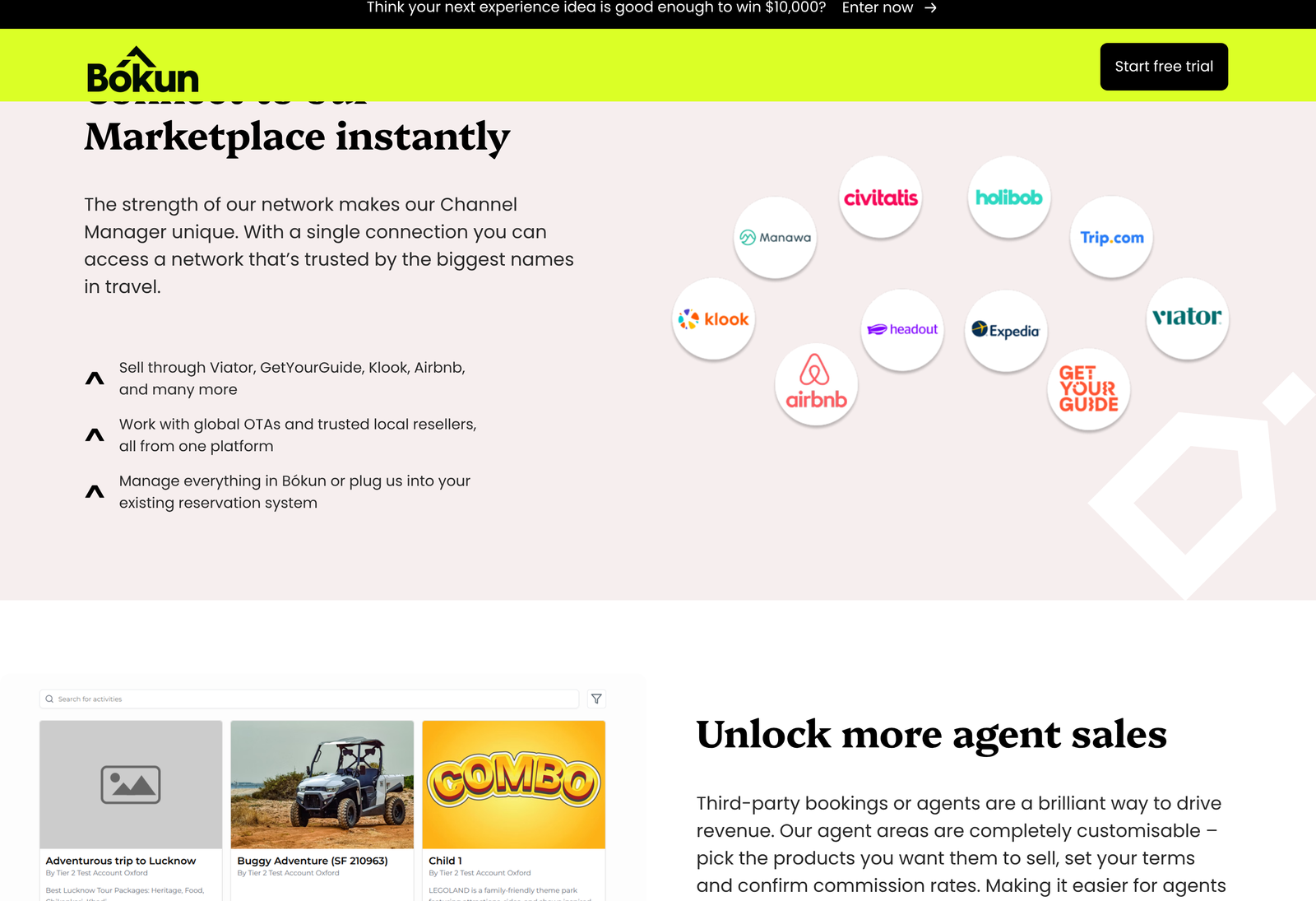
Named destinations include Viator, GetYourGuide, Klook and Airbnb. The vendor claims more than 2,600 OTAs and resellers in total and more than 70 global OTAs. Neither figure is independently verifiable, so treat both as claims.
The mechanics are specific enough to check. A booking taken on one reseller site updates every other channel, a cancellation reopens the slot everywhere, and closing a departure propagates in real time. Agent areas are configurable down to which products an agent may sell and at what commission.
Viator deserves separate mention because of the money. Zero fees apply to Viator bookings on every plan including the free one, which is unsurprising given Viator and Bókun are both Tripadvisor businesses. If most of your volume already comes through Viator, your effective fee rate is far below the headline percentage.
The developer surface
A documentation hub sits at bokun.dev, and its structure tells you where the engineering effort has gone.
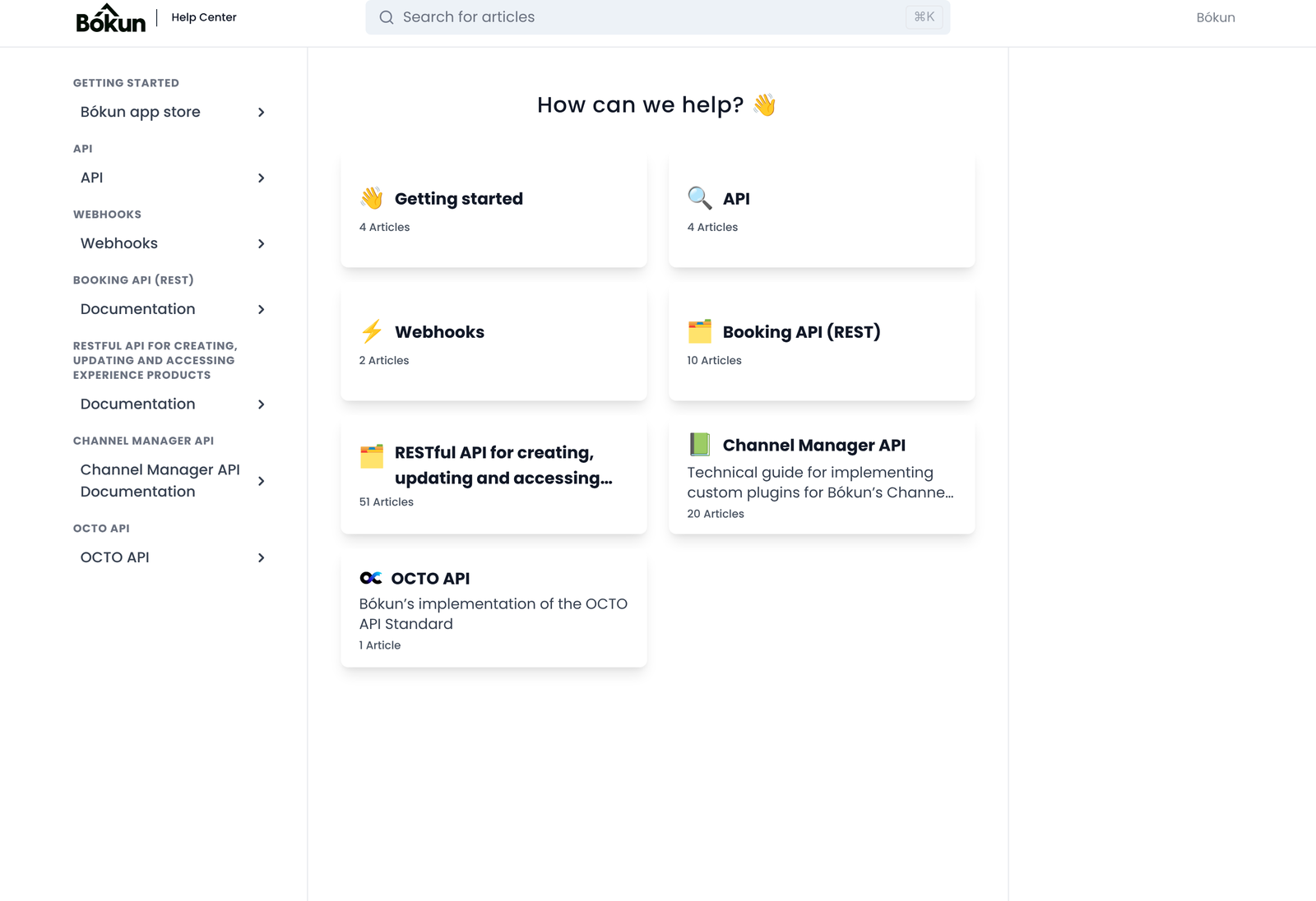
Seven sections are published, each with its article count: Getting started with four, API with four, Webhooks with two, Booking API for REST with ten, the RESTful API for creating, updating and accessing experience products with fifty-one, the Channel Manager API with twenty, and the OCTO API with one.
Fifty-one of the ninety-two articles cover product creation and maintenance. That weighting says something real about where operators spend their integration effort: keeping a catalogue of experiences, prices and availability correct across systems is the bulk of the work, and booking flow is comparatively simple.
Webhooks get two articles. For a platform whose value rests on real-time propagation, that is a thin body of documentation, and anyone planning event-driven work should read those two pages before committing to an architecture.
The OCTO standard
One section covers Bókun’s implementation of OCTO, the open connectivity standard for tours, activities and attractions. OCTO is run as an independent membership body with 121 members, publishes an open specification and charges nothing to use it.
Supporting it is a meaningful commitment rather than marketing. A supplier who builds to OCTO once can connect to any compliant partner without writing a bespoke integration, which reduces how locked in you are to Bókun specifically. Vendors do not usually volunteer that.
Terms worth reading before you build
The API licence contains two clauses that matter to anyone planning serious development. API credentials remain Bókun’s exclusive property and access sits at its sole discretion. Any service provider you use must sign an agreement protecting vendor data at least as strongly as Bókun’s own terms, and their failures count as yours.
Neither clause is unusual for a platform API. Both are reasons to read the terms before committing engineering budget rather than after.
Connecting your own reservation system
Operators who already run their own booking software and want Bókun purely for distribution end up here, and the economics are different from everything above.
The Channel Manager API is listed in the App Store at $199 a month plus a 1.5% booking fee, described as the route to integrate Bókun with your in-house reservation system. Its documentation runs to twenty articles and is framed as a technical guide for implementing custom plugins.
Add it up. Start at $49 plus the API at $199 is $248 a month before a single booking, and the app card lists its own 1.5% booking fee alongside the 1.5% already attached to Start. Whether those two percentages are the same fee described twice or two charges that stack is not stated anywhere we could find, and the difference is large enough to settle before signing.
Ask that question in writing. On $30,000 a month of applicable bookings, one interpretation costs $450 and the other costs $900.
What a working stack actually costs
Prices on individual cards are easy to read in isolation and misleading in combination. Three worked examples show how the layers add up.
A single-location operator selling through OTAs and their own website needs Start at $49 and nothing else. Calendar sync and Slack alerts are free, the Marketplace is included, and the 1.5% fee applies to online bookings outside Viator. Total: $49 a month plus fees.
A multi-brand operator with partner agents needs agent areas and account splitting. Bought as apps on Start that is $49 plus $99 plus $99, which is $247. On Plus, the same capability is $149, and the booking fee falls to 1.25%. Total: $149 a month plus fees, saving $98 against the app route.
An operator keeping an in-house reservation system pays for distribution rather than software. Start at $49 plus the Channel Manager API at $199 is $248 a month before any booking fee, and that fee question remains open. Total: $248 a month plus fees, with the percentage to be confirmed.
The pattern across all three: once you need two paid apps, the plan that bundles them is almost always cheaper, and the booking fee reduction comes along free.
Where your data sits
Integration decisions are data decisions, and the API terms are more explicit about this than the marketing pages.
Customer data covers order, payment, and account information for anyone transacting with you. Vendor data covers your own business, financial and product information, and includes customer data. Any application you build or install handles both categories under terms you accept on behalf of your business.
Two obligations follow. You must keep API credentials secure and may not share them with a third party, and any service provider you bring in must sign an agreement protecting vendor data at least as strongly as Bókun’s own policies. Their breach is treated as your breach.
For an operator installing a third-party waiver or messaging app, that is the clause to read twice. Guest signatures and contact details flow through software Bókun lists but does not sell, and the App Store listing tells you nothing about where that data is stored.
Choosing by integration need
Work backwards from the connections you need rather than from the plan names.
Choose Start if: you sell through OTAs and want widgets on your own site. Marketplace access, resource management and point of sale are all included, and the free utility apps cover calendar and Slack alerts.
Choose Plus if: you need Zapier, agent booking areas or multi-brand account splitting. Any two of those three cost more as separate apps than the upgrade does, and the booking fee drops a quarter of a point as well.
Choose Premium if: you run several companies with unlimited staff and high volume, where the 1% fee rather than the feature list carries the decision.
Budget separately if: you are keeping your own reservation system. The Channel Manager API is a $199 monthly line item that no plan includes.
What is not published
Several answers a buyer would want are missing, and we are not filling them with guesses.
No rate card exists for the three PaxFlow apps beyond “Fees May Apply”. The relationship between the Channel Manager API booking fee and the plan booking fee is undefined. API rate limits do not appear on any public page. Nor does any statement of what happens to a third-party app subscription if you downgrade the plan that included it.
Frequently asked questions
How many integrations does Bókun offer?
The App Store lists eighteen apps. Separately, the Channel Manager connects to a reseller network the vendor puts at more than 2,600 OTAs and resellers, and the developer hub documents seven API and webhook surfaces.
Is Zapier included with Bókun?
The Zapier app is free to install, but its badge shows it is included with Bókun Plus at $149 a month. Start does not list Zapier among its features.
What does the Channel Manager API cost?
It is listed at $199 a month plus a 1.5% booking fee, on top of your plan subscription. It is the documented route for connecting an in-house reservation system.
Which OTAs can I sell through?
Viator, GetYourGuide, Klook and Airbnb are named on the Channel Manager page, within a network Bókun describes as more than 2,600 resellers and more than 70 global OTAs.
Do I pay Bókun fees on Viator bookings?
No. Zero fees on Viator bookings appear on every plan including the free tier.
Does Bókun support an open integration standard?
Yes. It publishes an implementation of OCTO, the open connectivity specification for tours, activities and attractions, which is free to use and maintained by an independent body with 121 members.
Can I connect Bókun to my own website?
Yes, from Start upward. Booking widgets are part of that plan, and a free Advanced Website Upgrade app adds a fuller ecommerce package. Ice Floe, a third-party app, builds standalone travel sites and is free to install.
Are App Store apps included in my plan?
Some are. Custom Reports and the mobile app carry a badge reading included in Bókun Start, while Agents, Subvendors and Zapier are included in Bókun Plus. Third-party apps bill separately.
Sources
- Bókun App Store, read 18 October 2026, for the eighteen listed apps, their monthly prices, trial lengths and plan inclusion badges.
- Bókun developer documentation, read 18 October 2026, for the seven documented sections and their article counts.
- Bókun pricing, read 18 October 2026, for the four plans, user limits, booking fee percentages and the Zapier line on Plus.
- Bókun Channel Manager, for the three connection modes, the named OTAs and the availability behaviour.
- OCTO, the open connectivity standard for tours, activities and attractions, for the membership count and the open specification.
- Bókun API licence and terms of use, for the credential ownership and service provider clauses.
Verified 18 October 2026. All prices were read from Bókun’s own pages on the day of writing. The 2,600 reseller count, the 70 global OTA count and the 200% Marketplace booking uplift are the vendor’s own claims, carry no published methodology, and are reported as claims rather than findings. Whether the Channel Manager API booking fee stacks on top of the plan booking fee is not stated publicly and has been left open rather than guessed.