


Quick answer: Quartile publishes no prices at all. Every button on the site opens a demo request. Divide the ad spend it says it manages by the customer count it says it has and you get roughly $377,000 a year per customer, which is about $31,000 a month. That is the shape of the buyer this product is built around. Running under roughly $10,000 a month in retail media, you are below the gravity of a full-service platform, and a self-serve tool will likely serve you better.
Disclosure: Stack99 earns a commission if you buy through links on this page. It costs you nothing extra and never changes our assessment.
No published price, and what that signals
We normally put a verified pricing table here. There is nothing to put. We checked the homepage, both solutions pages, the promotion management page, and the Google to Amazon page on 26 October 2026, and found no rate card, no starting-from figure, no tier names. Quartile does not run a /pricing URL.
Quote-only pricing is not a red flag by itself. Quote-only pricing signals deal size instead. Companies price in public when the product sells itself at a fixed number and the cost to serve is predictable. They price behind a call when the engagement varies by account, which generally means humans are involved and the fee scales with your spend.
So the useful question is not what Quartile costs. Ask instead whether you are the size of customer the model is built for. The company gives you enough public numbers to work that out yourself.
What the published figures imply about the customer
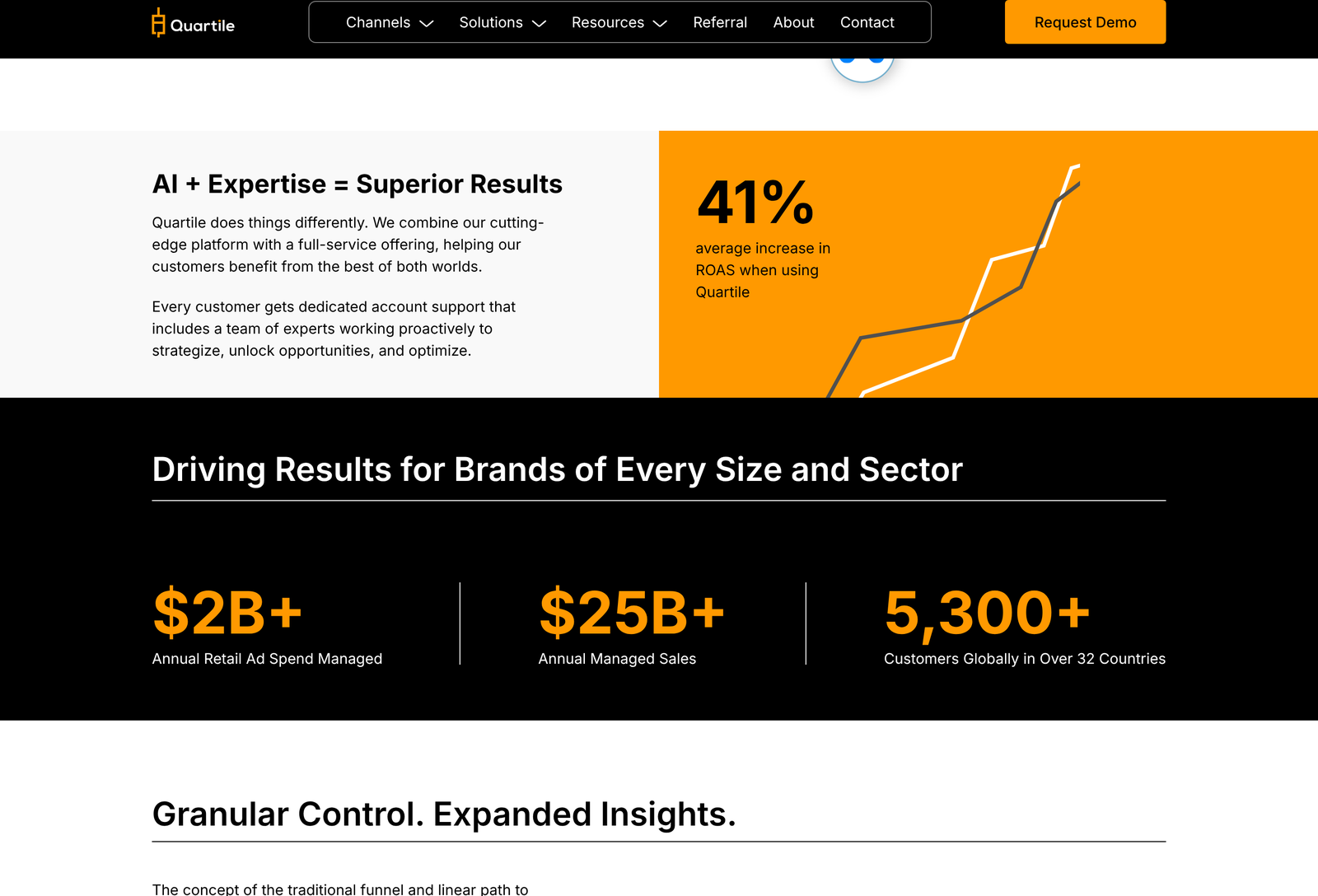
Quartile states three things on its homepage: more than $2 billion in annual retail ad spend managed, more than $25 billion in annual managed sales, and more than 5,300 customers across over 32 countries.
Divide $2 billion by 5,300 and the average customer runs about $377,000 of ad spend a year through the platform. Call it $31,400 a month. Both source figures carry a plus sign, so treat this as an order of magnitude rather than a precise mean, and remember an average gets dragged upward by a handful of very large accounts.
The second division is more flattering. $25 billion of managed sales against $2 billion of spend implies a blended return of roughly 12.5 to 1, which works out to an advertising cost of sales near 8%. Retail media buyers will recognise that as a healthy portfolio number. Note that this is a portfolio number, blended across thousands of accounts and every channel, so it tells you nothing about what your category would do.
Hold the $31,400 a month figure next to your own budget. Spending $5,000 a month puts you at one sixth of the average account. You can still be a customer, and the Small Business solution exists for exactly that reason, but you are not the account the pricing model was designed around.
What Quartile actually manages
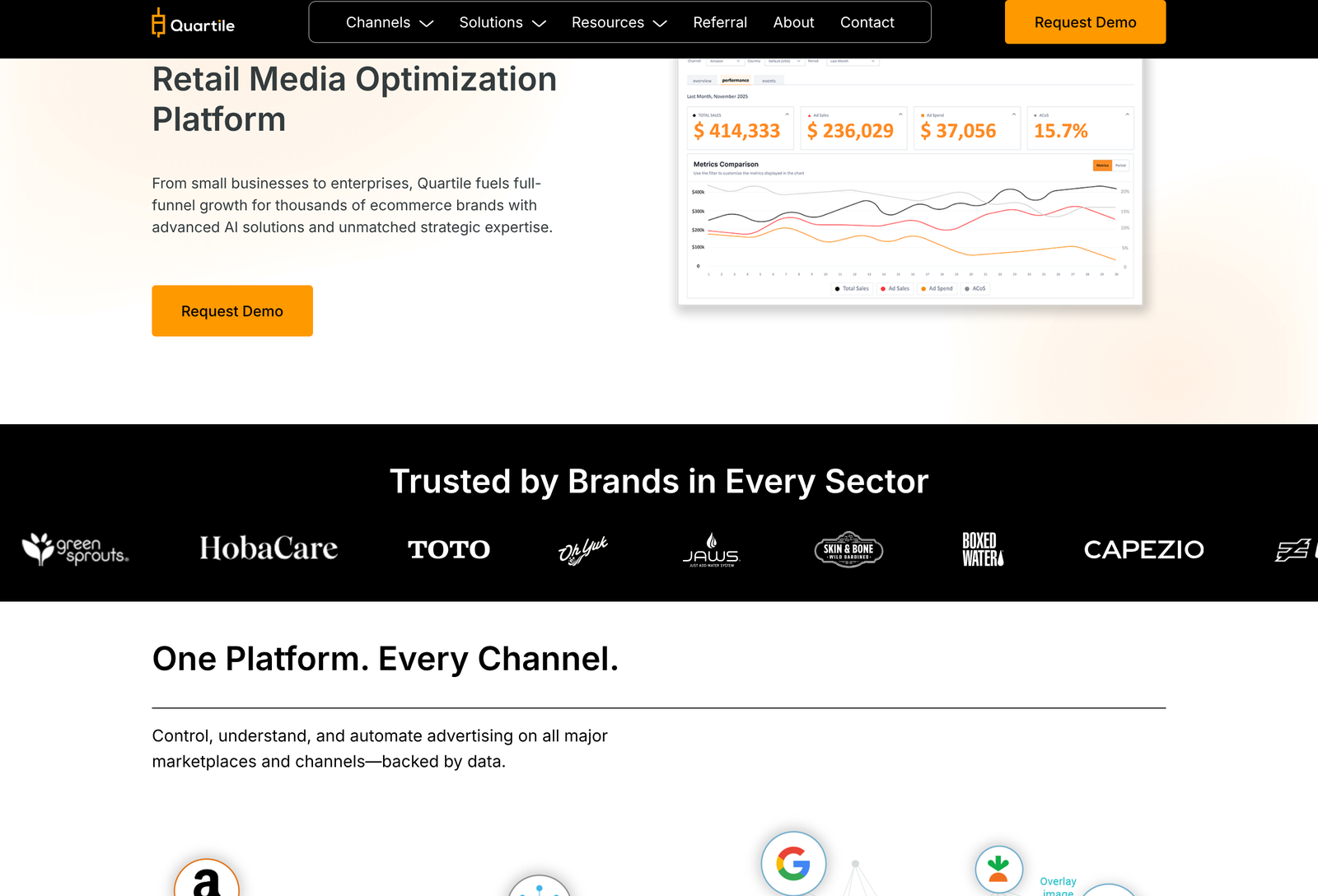
The channel list is the strongest argument for the product, and it is unusually wide:
- Marketplaces: Amazon Sponsored Ads, Amazon DSP, Walmart, Instacart, and Criteo, which carries Target and Best Buy among others.
- Direct-to-consumer: Google Ads, Meta Ads, Microsoft Ads, and ChatGPT Ads.
ChatGPT Ads appearing beside Amazon DSP is the line worth pausing on. Very few retail media platforms have added it. If placements inside an assistant are part of your 2027 plan, that is a reason to take the call.
Underneath, the described method is per-ASIN campaign construction rather than campaign-level management, with data from every connected channel feeding one optimisation layer. Four packaged solutions sit on top: Small Business, Mid-Market and Enterprise, Amazon Promotion Management, and a Google-to-Amazon product that routes external traffic to marketplace listings.
The service half is the product
Quartile describes itself as the only solution combining AI with full white-glove service, and says every customer gets dedicated account support from a team working proactively on the account.
Read that as a cost structure, not just a benefit. Dedicated humans per account set a floor under what the company can charge, and that floor is why the price is not on the website. It also explains the gap between this and a self-serve bid tool: you are buying an agency relationship with software attached rather than software with support attached.
Whether that is good news depends on what you lack. Short of people, the service is the whole value. Short of budget but holding a capable in-house buyer, you are paying for something you already have.
How to read the performance claims
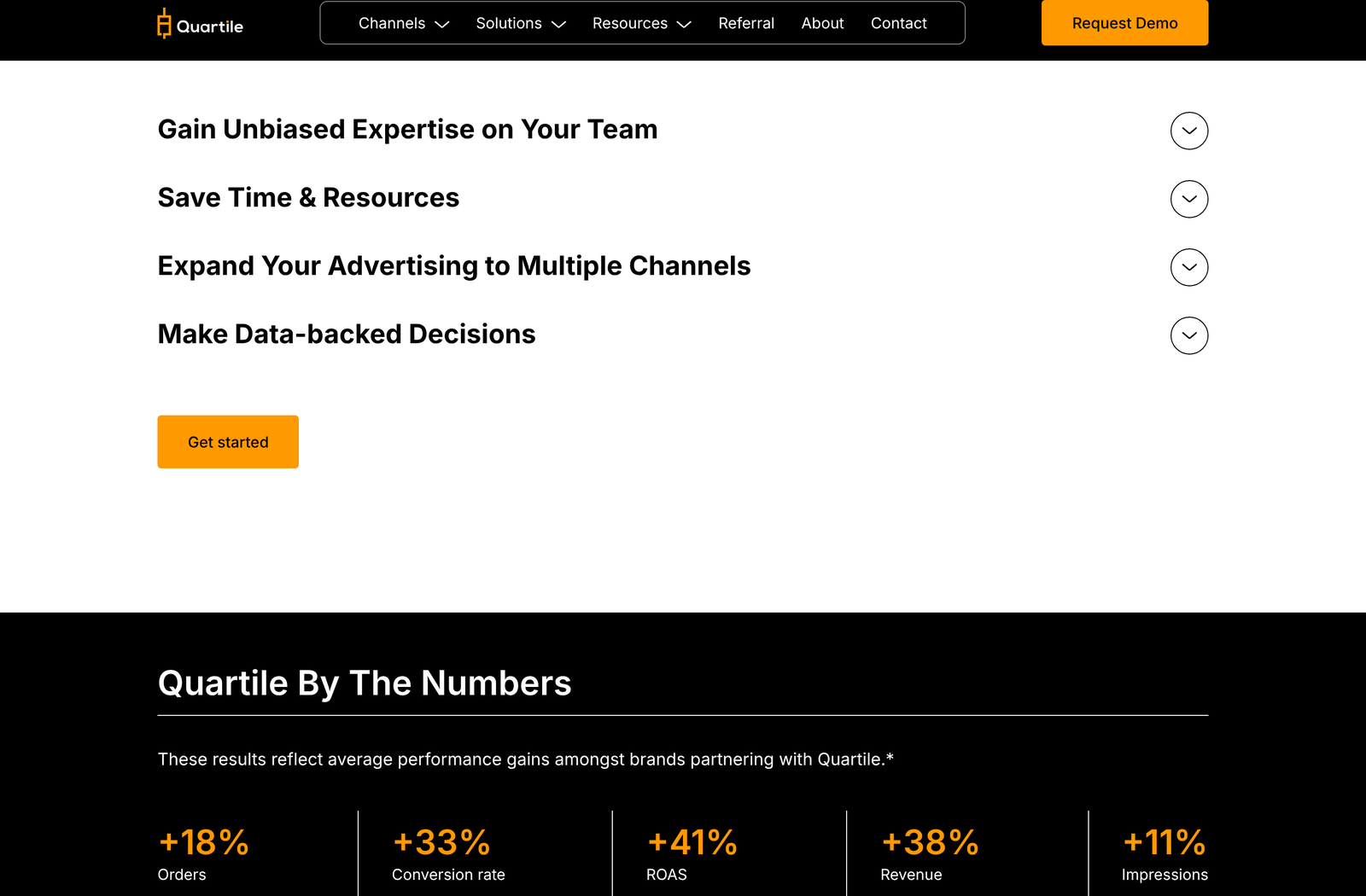
The Small Business page publishes five averages: orders up 18%, conversion rate up 33%, ROAS up 41%, revenue up 38%, impressions up 11%. The sentence introducing them says the results reflect average performance gains among brands partnering with Quartile, and it carries an asterisk.
We looked for the footnote that asterisk points to and could not find one on the rendered page. No sample size, no time window, no definition of the baseline each percentage is measured against. That does not make the numbers false. It makes them unaudited vendor averages, and you should treat them the way you would treat any figure a seller supplies about itself.
One internal consistency check is possible. A 41% ROAS lift alongside a 33% conversion rate lift and only an 11% impressions lift describes efficiency gains rather than reach gains, which is what you would expect from better bidding and tighter targeting on existing inventory. The numbers at least tell a coherent story about the mechanism.
Where an outside party backs something up
Amazon publishes Quartile case studies in its own advertising library and describes the company as an Advanced Amazon Ads Partner. That designation comes from Amazon rather than from Quartile, which makes it the most useful third-party signal available on this vendor.
One of those case studies covers Boxed Water Is Better, a food and beverage brand. Quartile restructured the account to separate business and consumer demand signals, concentrated spend on the three products generating close to 80% of revenue, and applied weekday dayparting. Reported outcomes were 34% year-on-year growth in business sales, advertising cost of sales falling from 14.22% to 5.8%, and total advertising cost of sales dropping from 2.0% to 1.4%.

Two caveats belong with those figures. Amazon attributes them to the brand rather than to its own measurement, and the page publishes no methodology. The work described is also plainly manual strategy: account restructuring, product prioritisation and dayparting are decisions a person made. All of which fits the service-led model and is inconsistent with reading Quartile as pure automation.
The break-even to run before you take the demo
Since the fee is private, calculate what it would have to be to break even. The arithmetic below uses illustrative assumptions clearly marked as ours, not figures from Quartile.
Suppose you spend $5,000 a month, so $60,000 a year, and your current return is 5 to 1. Your attributed sales come to $300,000. Apply Quartile’s claimed 41% ROAS improvement and the return becomes 7.05 to 1, producing $423,000. The gain is $123,000 of incremental sales.
Sales are not profit. At a 30% gross margin, that $123,000 becomes $36,900 of gross profit. Any annual fee above $36,900 destroys the gain, and $36,900 against $60,000 of ad spend is 61.5%. No managed retail media service charges 61% of spend, so on these assumptions there is real headroom.
Now halve the lift, because a portfolio average is not a promise. A 20% ROAS improvement produces $60,000 of incremental sales and $18,000 of gross profit, which is 30% of your ad spend. Fees in that neighbourhood are entirely plausible for a full-service engagement, and the deal gets tight.
Run those two lines with your own margin and your own current return before the call. Then ask for the fee and see which side of your own number it lands on. A vendor confident in the lift will engage with that question.
Two solutions that change the arithmetic
Beyond the main platform sit two packaged offerings that are worth separating out, because each has a mechanism behind it rather than just a positioning statement.
Google to Amazon runs Google Search campaigns that send shoppers to your Amazon listings instead of your own site. Quartile says it handles the whole execution: strategy, campaign build, attribution, optimisation, and capture of Amazon’s Brand Referral Bonus, which returns up to 10% of qualifying sales to the seller. Conversion tracking is described as surfacing which Google campaigns drove Amazon sales within 24 to 48 hours.
That 10% matters to the break-even above. A rebate on sales generated through this route is money back against your fee, not just a better return. If a meaningful share of your spend moves through Google to Amazon, the fee you can tolerate rises accordingly. Ask on the call what proportion of your budget they would expect to put there, because the rebate only applies to that slice.

The attribution problem it addresses is real. Sending paid traffic from Google to a marketplace listing normally breaks the measurement chain: Google reports clicks, Amazon reports sales, and nothing connects them. Closing that loop is the actual engineering claim, and it is the one to press hardest in a demo.
Amazon Promotion Management coordinates your discounts with your ad bidding instead of running them as separate exercises. The pitch is that a promotion and an ad campaign pointed at the same product should know about each other, so budget is not spent bidding hard on an item already discounted into profitability. Quartile adds a competitive intelligence dashboard tracking rival offers and price moves in real time.
Both solutions point at the same kind of buyer: somebody already running meaningful Amazon volume who has hit the ceiling of what single-channel bid management can do. Neither is a reason for a smaller seller to sign up, and both are reasons for a larger one to ask whether their current agency is leaving the Brand Referral Bonus on the table.
Who Quartile fits
- Brands selling across several retail media networks at once. Managing Amazon, Walmart, Instacart and Criteo in four separate consoles is the problem this product was built to remove.
- Teams with budget but no specialist. The dedicated account team replaces a hire you have not made.
- Catalogues deep enough for per-ASIN work to matter. Optimising at product level is wasted on a ten-SKU range and compounds across a thousand.
- Sellers who want traffic from Google and ChatGPT pointed at marketplace listings. The Google to Amazon solution addresses a gap most tools ignore.
- International sellers. Over 32 countries, and Amazon gave the company a localisation award in its 2026 partner awards.

Who should look elsewhere?
- Anyone under roughly $10,000 a month in ad spend. You are well below the average account and a self-serve tool plus your own attention is likely to beat a service fee.
- Single-channel Amazon sellers who already have a competent in-house buyer. You would be paying for breadth you do not use.
- Buyers who need a price before a conversation. A legitimate requirement, and one this vendor does not meet.
- Anyone wanting hands on the keyboard. The model is proactive management by their team, which is the opposite of what a control-oriented operator wants.
If you sit in the first group, the research tooling is usually the better first spend. Our Jungle Scout pricing guide covers the Amazon research side, and the AdCreative.ai review deals with the creative end of the same budget. For a fuller look at the platform itself, see our Quartile review.
Questions worth asking on the demo call
- Is the fee a percentage of ad spend, a flat retainer, or performance based? Ask for the actual structure rather than a range.
- What is the minimum monthly ad spend you accept, and what is the minimum contract term?
- What sample and time window produced the 41% average ROAS lift, and what was the baseline measured against?
- Which named person manages my account, how many other accounts do they hold, and how often do we speak?
- Does the fee change if I add Walmart or Instacart to an Amazon-only engagement?
- Who owns the campaign structures and the historical data if I leave?
- What does onboarding take, and when would you expect the first measurable change?
Have your margin and your current return to hand before the call, and the conversation gets a lot shorter. Request a Quartile demo here.
What we could not verify
- Any price, minimum spend or contract length. None is published anywhere on the site.
- The methodology behind the five Small Business averages. The asterisk on that page leads to no footnote we could locate.
- The $2 billion, $25 billion and 5,300 figures, which are vendor statements we have repeated as such and used only for proportional arithmetic.
- Aggregate review scores. Quartile displays G2 and Gartner Digital Markets badges, and all three major review platforms refuse our declared crawler, so we publish no rating.
- The ISO/IEC 27001 certification stated in the site footer, which we have not confirmed against a certification register.

Frequently asked questions
How much does Quartile cost?
Quartile publishes no pricing. There is no rate card, no starting price, and no /pricing page; every call to action requests a demo. Expect a fee negotiated against your ad spend.
Is Quartile worth it for a small ecommerce brand?
It depends on your spend. The company’s own figures work out to roughly $377,000 of annual ad spend per customer, so a brand running $5,000 a month is far below the typical account. Below about $10,000 a month, calculate the break-even before taking the call.
Which advertising channels does Quartile cover?
Amazon Sponsored Ads and Amazon DSP, Walmart, Instacart, and Criteo for retailers including Target and Best Buy. On the direct side, it covers Google Ads, Meta Ads, Microsoft Ads, and ChatGPT Ads.
Software or agency?
Both, deliberately. The company describes itself as combining its platform with a full-service offering, and says every customer gets a dedicated account team. The Amazon case study work involved manual account restructuring and dayparting decisions.
Does Quartile really improve ROAS by 41%?
The figure is a vendor-published average across its customer base, shown with an asterisk whose footnote we could not find. No sample size, time window, or baseline is given. Treat it as a claim to test on the call rather than a figure to budget against.
Does Amazon recognise Quartile as a partner?
Amazon describes Quartile as an Advanced Amazon Ads Partner in its own advertising library, and Quartile states it won a Strategic Localization Award in the 2026 Amazon Ads Partner Awards.
What is the Google to Amazon product?
One of four packaged solutions, alongside Small Business, Mid-Market, and Enterprise, and Amazon Promotion Management. The product aims to route external search traffic to marketplace listings.
How many customers does Quartile have?
The homepage states more than 5,300 customers across over 32 countries. We have repeated that as a vendor figure and could not verify it independently.
Sources
- Quartile homepage, channel list and managed spend figures, captured 26 October 2026
- Quartile for Small Business, including the five published averages
- Quartile for Mid-Market and Enterprise
- Amazon Ads, Quartile helps Boxed Water grow B2B sales 34% on Amazon, results attributed to the brand
- Quartile, Google to Amazon, including the Brand Referral Bonus claim
- Quartile, Amazon Promotion Management
- Amazon Ads Partner Awards