



Disclosure: Stack99 earns a commission if you buy through links on this page. It costs you nothing extra and never changes our assessment.
Asking what TikTok for Business costs produces the answer every auction platform gives, which is that you decide. That answer is useless for deciding whether to start. The more useful question is what the platform itself says a campaign needs in order to work, because those published recommendations draw a budget line that rules a lot of businesses in or out before anyone writes a creative brief.
This page collects the figures TikTok publishes on its own business and budgeting pages, checked on 22 October 2026, and works out what a first serious test actually costs.

The published floor is $30 a day, and it is per ad group
TikTok’s budgeting page answers the question “What is the minimum budget?” directly: “For web conversion campaigns, we recommend $30 minimum daily ad group budget for North America and EMEA brands, and $20 for APAC brands.”
Read the wording carefully, because two qualifiers are doing a lot of work. This is a recommendation rather than a hard platform limit, and it attaches to the ad group rather than the campaign. A campaign testing three audiences carries three ad groups, so the recommended floor for that structure is $90 a day in North America, not $30.
The scope qualifier matters too. Both figures are given for web conversion campaigns specifically. TikTok does not publish equivalent recommendations for awareness, traffic, or app install objectives on the same page, so a brand-awareness buyer has no published floor to work from at all.
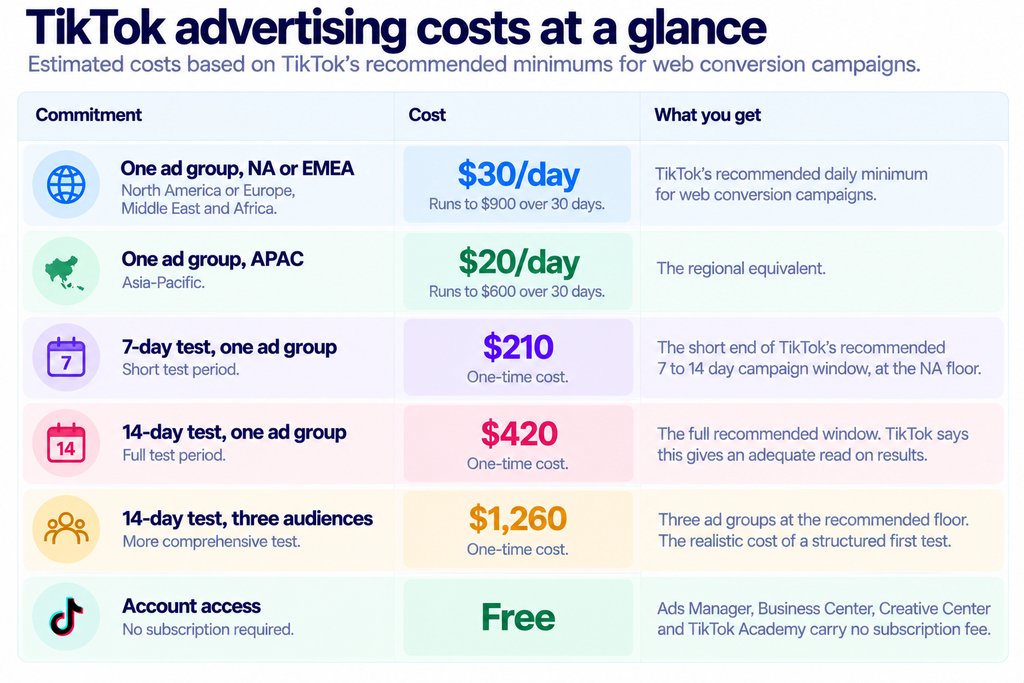
Those one-time figures are our arithmetic from TikTok’s published daily floor and its published campaign window, not prices TikTok quotes. They exist to make the commitment concrete. A business that cannot comfortably lose $1,260 learning whether the channel works should test one audience rather than three, and should expect a slower read.
Seven to fourteen days before you judge anything
TikTok answers the campaign-duration question with a specific range. “Consider running your campaign for between 7 and 14 days, as that gives you an adequate amount of time to get a good understanding of the results on budget.”
Combine that with the daily floor and the shape of a first test becomes fixed rather than open-ended. You are committing to a fortnight at a published rate, not dipping in with $50 to see what happens. Advertisers used to search platforms, where a small budget produces a small but readable result almost immediately, tend to underestimate this.
Budgets can be set as daily or lifetime, and bidding runs through two published strategies: Lowest Cost, which spends your budget as efficiently as the auction allows, and Cost Cap, which holds an average cost target. Picking Cost Cap on a first campaign with no conversion history is how new accounts end up underdelivering, since the system has nothing to optimise against.
The ad credit offers, and one that does not say what it means
New advertisers choose one of three promotional offers at signup. They work on first-30-day spend and the credits land automatically once the requirements are met.
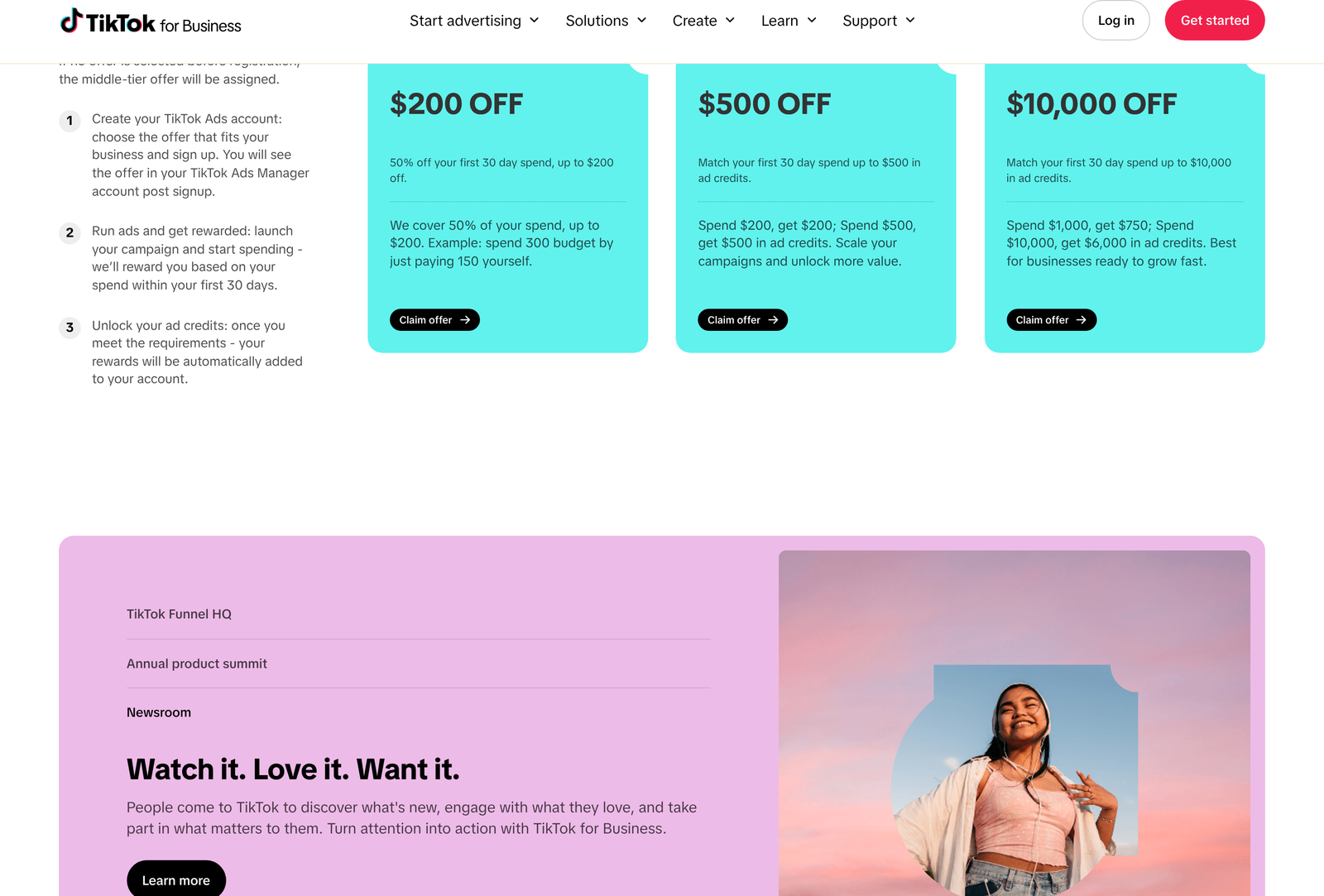
The first is straightforward. Headed “$200 OFF”, it covers 50% of your spend up to $200, and TikTok’s own example reads “spend 300 budget by just paying 150 yourself”. Extracting the full $200 therefore requires $400 of spend.
The second is a true match. Headed “$500 OFF”, it states “Spend $200, get $200; Spend $500, get $500 in ad credits”. Every dollar comes back up to the $500 ceiling.
The third is where the language and the arithmetic part company. It is headed “$10,000 OFF” and described as “Match your first 30-day spend up to $10,000 in ad credits”. Its own worked examples then read “Spend $1,000, get $750; Spend $10,000, get $6,000”. Neither is a match. One returns 75% and the other 60%, and the largest credit the card actually names is $6,000 rather than the $10,000 in the headline. We are reporting both the heading and the examples as published, because TikTok does not reconcile them anywhere we could find.
Which offer wins depends on what you plan to spend, and the crossover is not published. At $500 of spend, the middle offer returns $500 while the top offer returns something below $750. At $1,000, the top offer returns $750 against the middle offer’s capped $500. Somewhere between those points, the better choice flips, and TikTok gives no formula for finding it.
One practical note sits above the offer cards in small text: “If no offer is selected before registration, the middle-tier offer will be assigned.” Choose deliberately at signup rather than discovering later which one you were given.
TikTok tells you to target broadly, which surprises people
Asked for the best targeting approach, TikTok gives advice that runs against most advertisers’ instincts: “We always recommend starting out with broad targeting. People think they get more bang for their buck with narrow targeting but it can sometimes result in poor performance.”
That is a meaningful statement from a platform whose revenue would benefit from selling precision. The available controls cover demographics, interests, behaviours and devices, with Custom Audiences and Lookalike Audiences positioned as the advanced route for advertisers who already have customer data to match against.

For a small advertiser, the advice has a budget consequence. Narrow targeting on a $30 daily floor starves the delivery system of the volume it needs to learn, which produces exactly the poor performance TikTok warns about and then gets blamed on the channel. Broad targeting with strong creative is the cheaper experiment.
Check whether your competitors are already there
Before committing any of the above, there is a free piece of research most prospective advertisers never do. TikTok operates a Commercial Content Library at library.tiktok.com, a public searchable record of advertising on the platform.
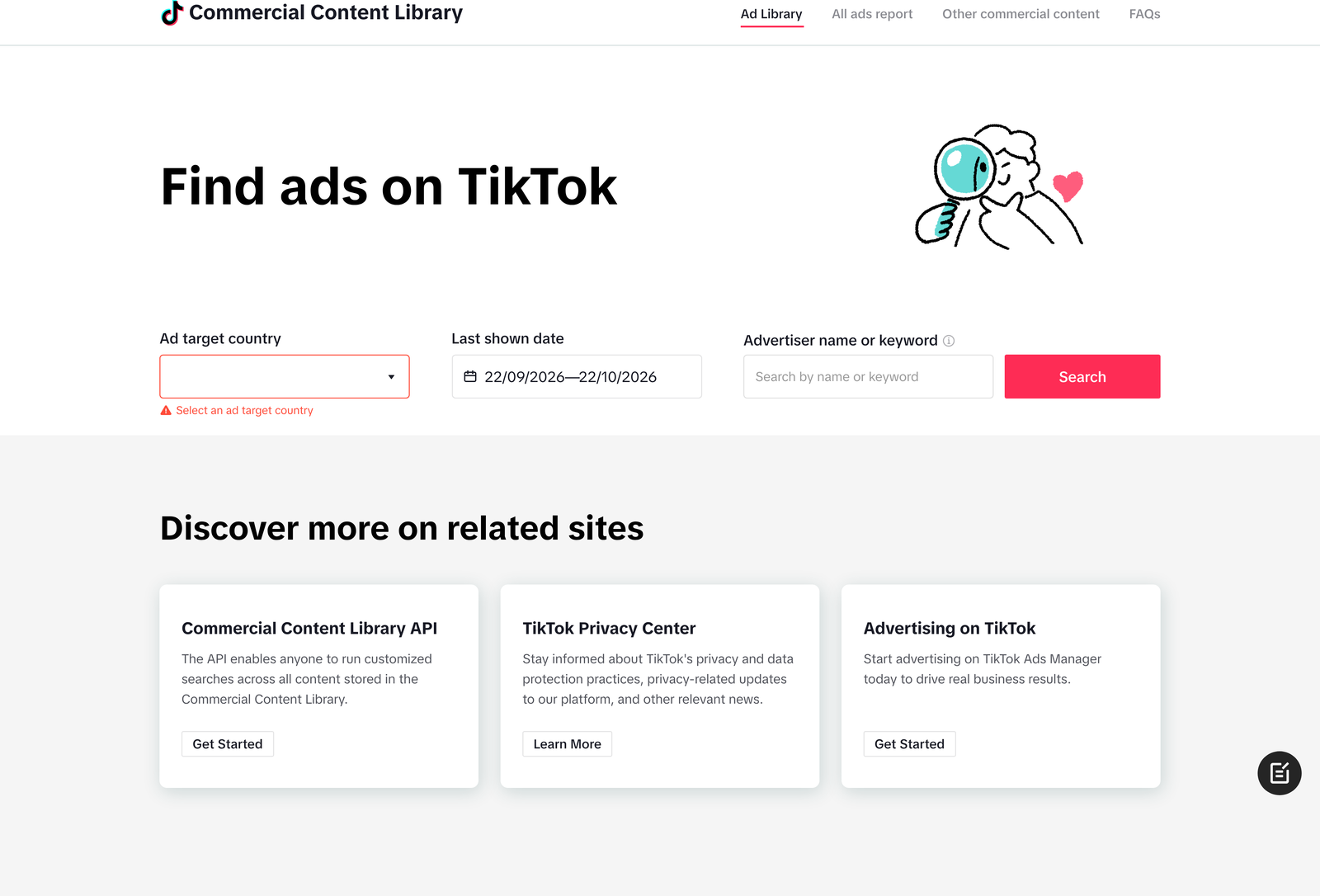
It carries an Ad Library, an all-ads report and a section for other commercial content, searchable by ad target country, last shown date and advertiser name or keyword. There is also a documented API for running queries across everything the library holds.
Spend an hour there before you spend $420. Searching your three closest competitors answers two questions a case study never will: whether anyone in your category is buying TikTok inventory at all, and what their creative looks like if they are. An empty result for your whole sector is information, though not always bad information.
What you get beyond the auction
TikTok groups its advertising products into five families: Branding for visibility campaigns, Creative for making and versioning video, Commerce for shopping journeys including TikTok Shop, Measurement for attribution, and Performance for automated optimisation.
Around those sit free tools with no subscription attached. Ads Manager runs campaigns, Business Center handles multi-account and agency access, and the creative side includes TikTok One, Symphony Creative Studio, Creative Exchange and Creative Center. TikTok Academy offers training with a certification track, and a Marketing Partners programme covers agencies.
Creative production is the real recurring cost here, and it is not on TikTok’s price list. A channel that rewards frequent native video needs someone making that video every week. Businesses already struggling to produce one video a month should price that work honestly before counting the media budget. Our AdCreative.ai review covers one route to generating ad variations at volume.
One setup choice you cannot undo
TikTok’s own getting-started steps include a warning that deserves more prominence than it gets. When filling in your business information at registration, you set a time zone, and the instructions note that “it can’t be changed later”.
Every daily budget, every scheduled start and stop, and every reporting boundary you ever read will be calculated in whatever you pick in that box. An agency setting up accounts for clients in several countries, or a business that reports to a head office in a different region, should decide this deliberately at the keyboard rather than accepting a default. Fixing it later means a new account.
The five steps, and where new accounts lose time
TikTok lays its campaign build-out in five stages: create an Ads Manager account, define the campaign objective, select the target audience, set the budget, then choose the video. Nothing there is unusual, and the order matters more than it looks.
Objective comes before audience and budget, which means the decision that governs everything downstream is made first and with the least information. Choose a web conversion objective and the published $30 floor applies; your optimisation depends on a working pixel, and TikTok needs conversion volume to learn from. Choose traffic or awareness instead, and you are operating without any published budget guidance at all.

Registration itself is eight steps by TikTok’s own count: visit the signup page, create a login, request a code, enter the code sent to your email or phone, sign up, fill in business information including that permanent time zone, register, then build and submit a first campaign with payment attached. Budget half an hour, and have your business details and billing method ready before you start rather than halfway through.
Where the ads actually appear is vaguer than it should be
Asked directly where TikTok ads run, the business site answers that “TikTok Ads Manager allows you to choose from our family of apps for delivering your ads”. It does not name those apps on that page, state which are available in which markets, or say whether placements can be excluded individually.
For most small advertisers, this is a detail. For anyone with brand-safety obligations or a media plan that specifies placement, it is the first thing to raise with a representative, because a buyer cannot evaluate inventory they cannot see described. TikTok does run a Brand Safety programme and a Marketing Partners directory for agencies, both of which are the right doors to knock on for that conversation.
Agencies and multi-brand advertisers get Business Center, which handles access across several ad accounts and users. Running client accounts through it rather than through individual logins is the difference between offboarding a staff member in one click and chasing passwords.
Training is free, which lowers the real cost of entry
One genuine advantage here is how much TikTok gives away before you spend anything. TikTok Academy runs structured training with a certification track. Creative Center publishes trends and creative examples. TikTok Insights carries research, and Funnel HQ organises the whole product set by funnel stage rather than by product name.
That changes the calculation for a small team. The $420 fortnight-long test assumes somebody who knows what they are doing, and the gap between a competent first campaign and a wasted one is usually knowledge rather than budget. Sending whoever will run the account through the Academy first costs nothing except time, and it is the cheapest risk reduction available on this platform.
Who the platform actually fits
Choose it if: you can produce vertical video continuously and your product benefits from being discovered rather than searched for. Consumer goods, beauty, fashion, food and travel all have an obvious visual story, and TikTok’s own case study categories are retail, CPG, auto, travel, and beauty.
Choose it if: you sell direct to consumers and can plug into TikTok Shop, since the commerce tooling shortens the path from a video to a transaction without sending anyone to a separate site.
Choose it if: you have at least $900 a month of media budget available per audience you want to test, and the patience to leave a campaign alone for a fortnight.
Skip it if your demand is purely intent-driven and already captured by search, if your buyer is a narrow B2B title that broad targeting will waste money finding, or if nobody on your team can make video. A local service business with a $200 monthly budget sits below the recommended floor for a single ad group, and will get a thin, hard-to-read result.
Brand monitoring is the sensible companion to any launch here, since paid video tends to generate organic conversation you did not plan. Our Brand24 pricing breakdown covers one option, and SocialBee’s per-profile pricing is worth a look if organic posting runs alongside the ads.
The results TikTok advertises
TikTok displays customer results across its business pages, including Ray-Ban and VERO MODA, and one campaign for a product called Cherry Baby Oil reporting an ROI of 2.56X and $34,000 of incremental GMV in its first month.
Treat all of it as selection rather than evidence. None of these carries a media budget, a measurement window, a control group or an independent audit, and they are chosen by the vendor from the campaigns that worked. A 2.56X return on an undisclosed spend tells you the channel can perform. It does not tell you what your category, creative or offer will do.
What we could not verify
- Any hard platform minimum. The $30 and $20 figures are published as recommendations for web conversion campaigns, not as enforced floors, and TikTok publishes no equivalent for other objectives.
- The credit formula between the published examples on the $10,000 offer, and therefore the point at which it beats the $500 offer.
- Whether the $10,000 offer’s “match” heading or its 75% and 60% examples governs. Both are published; neither is reconciled.
- Eligibility rules, qualifying countries or expiry terms for any of the three credit offers.
- Typical costs per click, per thousand impressions or per acquisition in any category. TikTok publishes none.
- Every case study figure, including the 2.56X ROI and $34,000 GMV claims, which carry no baseline or audit.
Frequently asked questions
Does TikTok for Business charge a subscription?
No. Ads Manager, Business Center, Creative Center, and TikTok Academy carry no fee. You pay for media through the auction, plus whatever your creative production costs.
What is the real minimum to start?
TikTok recommends $30 a day per ad group in North America and EMEA, or $20 in APAC, for web conversion campaigns. Pair that with its 7-to-14 days guidance and a single-audience test runs $210 to $420.
Is the $10,000 offer really a match?
Its heading says match, and its own examples do not behave like one. Spending $1,000 returns $750 and spending $10,000 returns $6,000, so the effective rates are 75% and 60%. Read the worked examples rather than the heading.
Should I target narrowly to save money?
TikTok advises against it, saying narrow targeting “can sometimes result in poor performance” and recommending a broad start. On a small budget, narrow targeting also limits the data the system needs to optimise.
Can I see what competitors are running?
Yes, free and without an account. The Commercial Content Library at library.tiktok.com searches advertising by target country, last shown date and advertiser name, and offers an API for bulk queries.
What should I get right at signup?
Your time zone and your credit offer. TikTok states the time zone cannot be changed after registration, and if you do not pick an offer the middle tier is assigned automatically.
Sources
- TikTok for Business budgeting page, for the recommended daily minimums, the 7 to 14 day window and the bidding strategies, checked 22 October 2026.
- TikTok for Business, for the three credit offers, the five solution families, the setup steps and the time zone warning.
- TikTok Commercial Content Library, for the public ad search and its API.