


In this guide
- Why Flippa’s Features Matter
- Marketplace Breadth For Digital Assets
- Free Valuation And Pricing Guidance
- Performance Data And Integrations
- First Access And Premium Buyer Advantage
- Due Diligence And Deal Workflow Support
- Traffic And Competitor Insights
- How These Features Work Together
- Pricing Context
- Which Features Matter Most By Buyer Type
Why Flippa’s Features Matter :
Flippa is two products wearing one brand. On the buy side it is a marketplace with a paid access tier. On the sell side it is a listing engine wrapped in M&A tooling, priced against the size of your business rather than a plan you pick. The features only make sense once you know which side of that split you are standing on.
Disclosure: Stack99 earns a commission if you buy through links on this page. It costs you nothing extra and never changes our assessment.
Sellers meet that split immediately. The pricing page opens with a toggle reading “I’m here to sell” against “I’m looking to buy”, then hands sellers an asking-price slider running from sub $10K to $50M+ with the instruction “Choose an asking price to see services and features”. Move the slider and the fees change. There is no tier list to compare.
So the useful question is not whether Flippa is legitimate. It is which of these tools you will actually touch during a transaction, and what each one costs you at your deal size.
If you want to look at the marketplace while you read, start with Flippa here.

Marketplace Breadth For Digital Assets
Breadth here means two separate things, and only one of them is category count.
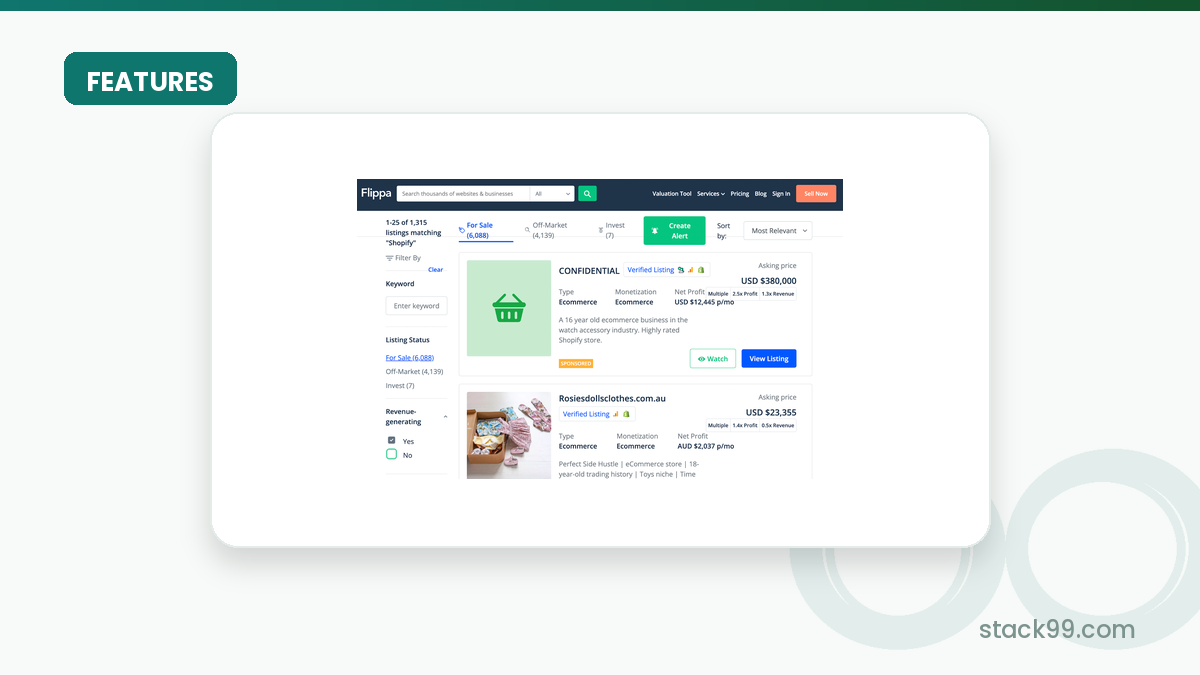
The first is asset type. Online businesses, SaaS companies, content sites, ecommerce stores, apps and domains all sit in the same search index, which is why a buyer with a loose mandate can scan several categories without maintaining accounts on several platforms.
The second is geography, and it is the more interesting number. Flippa states that deals have been done in 193 countries, with 67 percent of them cross-border. For a seller that figure is the whole argument for a marketplace over a local broker, because the buyer most likely to pay your asking price probably does not live in your country.
One structural option is easy to miss. A listing can be a full sale or a partial one, with the platform setting a floor of 25 percent or above shareholding for a partial deal. Founders who want liquidity without an exit have a route here that most marketplaces do not offer.
- Multiple asset classes in one search index.
- Cross-border demand, which the platform puts at two deals in three.
- Partial sales supported down to a 25 percent stake.
Flippa says buyers have purchased over 450,000 digital businesses through the platform. Treat that as a vendor-reported cumulative figure rather than an audited one.
Free Valuation And Pricing Guidance
Valuation is the feature Flippa pushes hardest at people who have not decided to sell. The pricing page carries an “Instant Free Valuation” block aimed squarely at that audience, with the framing “Still not ready to sell? Get a free valuation of your business.”
Behind it sits a named set of AI tools: Business Valuation, P&L Builder, CIM Generator, Buyer Matching, Deal Room and Data Room. Two of those matter before you list anything.
Business Valuation gives you a number to react to. The P&L Builder is the one that does unglamorous work, because most small digital businesses arrive at a sale with bookkeeping that cannot survive a buyer’s questions. Producing a clean profit and loss statement before you list changes the kind of buyer who engages with you.
Use the valuation as a range-finder and nothing more. An automated multiple applied to your revenue tells you which slider band you fall into, which in turn determines your listing fee and the services attached to it. That is a planning input. It is not a price.

Performance Data And Integrations
Every marketplace for businesses has the same core problem: the seller writes the numbers and the buyer has to believe them. Integrations are how Flippa attacks that, by letting a listing pull performance data from the systems that actually generated it rather than from a spreadsheet the seller typed.
Verified data changes buyer behaviour in a measurable way. Connected analytics on a listing attracts questions about growth. Screenshots attract questions about whether the screenshots are real. Sellers who connect their data spend less time defending it.
Buyers should read the absence of a connection as information. Nothing stops a seller listing without integrating, so an unintegrated listing at a healthy asking price is the one that deserves the longer diligence period.
First Access And Premium Buyer Advantage
This is the clearest paid feature on the platform, and the headline states it plainly: “See the best digital businesses 21 days earlier.”
Three weeks is a long head start in a market where good listings attract competing offers quickly. Flippa Premium costs $49 a month, or $490 a year with the page marking the annual option as “Yearly (Save 16%)”. Both are labelled “Cancel Anytime”.
The second Premium feature is quieter and arguably worth more. “Instant Deal Access” bypasses the NDA approval queue, so a Premium buyer reads the confidential detail while a free buyer waits for a seller to approve them. On a listing with forty interested parties, being early to the financials is the difference between making the first offer and reading about the sale.
Work out whether it pays. At $490 a year, Premium costs less than 0.2 percent of a $250,000 acquisition. Anyone running a genuine buy-side search closes that gap on a single deal. Anyone browsing out of curiosity should stay on the free tier, which still covers listings, AI matching and the wider marketplace.
Due Diligence And Deal Workflow Support
Flippa’s deal tooling is the part that separates it from a classifieds board, and it is grouped on the page under two headings: Broker-Led M&A Process and Technology & AI.
The technology side lists a Custom CIM and Virtual Data Room, AI Matching across what the page describes as 2M+ global buyers, LOI and APA document builders with eSignature, and integrated payments and escrow. Read that list as a transaction pipeline rather than a feature set. A confidential information memorandum, a data room, a letter of intent, an asset purchase agreement and a settlement rail are the five artefacts of a small M&A deal, and all five have a tool here.
The broker-led side lists expert negotiation support, buyer qualification and verification, deal structuring and negotiation, plus a confidential NDA-protected sale. Those are people, not software, and they come with the brokered option rather than the self-service listing.
Settlement deserves its own note. Flippa quotes FlippaPay from 1 percent and Escrow.com from 1.2 percent, describing both as saving 20 to 30 percent against standard rates. On a $200,000 deal the difference between 1 percent and 1.3 percent is $600, which is small against the transaction but still a reason to pick the rail deliberately. Payment options also include PayPal and Flippa regulatory trust accounts, with banking handled through named partners.
Traffic And Competitor Insights
Buyer matching is the feature doing the most work and getting the least attention. Flippa describes AI matching across more than 2 million global buyers, and on the sell side it is what turns a listing from a page that sits there into a listing that gets pushed at people with a relevant mandate.
For buyers the same machinery runs in reverse. Tell the platform your budget and your category and the matching surfaces listings before you go looking. Buyer profiles on the platform display budgets and transaction histories, which gives sellers a sense of who is genuinely in market at their price point.
Treat matching as a discovery aid rather than a filter you can trust. It widens the top of your funnel. Diligence still belongs to you.
How These Features Work Together :
Follow one seller through and the design becomes obvious.
- Run the free valuation to find your asking-price band.
- Build a clean P&L with the builder so the numbers survive questions.
- Choose self-service or brokered, which the slider has already priced for you.
- Connect your analytics so buyers verify rather than ask.
- Generate the CIM, open the data room, let matching bring buyers in.
- Run the NDA, the LOI and the APA through the document builders.
- Settle through FlippaPay or Escrow.com.
Each step hands its output to the next. The valuation sets the band, the band sets the fee, the fee determines which services attach. A seller who skips the early steps arrives at the deal room with a buyer and no documentation, which is where small transactions usually stall.

Pricing Context :
Buy-side pricing is simple. Sell-side pricing is a function, not a plan.
| Plan | Price | What you get |
|---|---|---|
| Buyer, free | Free | browse listings, AI matching, wider marketplace |
| Flippa Premium, monthly | $49/mo | 21-day early access plus Instant Deal Access, cancel anytime |
| Flippa Premium, yearly | $490/yr | same features, marked as a 16% saving against monthly |
| Seller, self-service | $29one-time | entry listing fee on a 60-day term, rises with asking-price band |
| Seller, longer terms | $49one-time | three-month term; six-month packages are priced higher by band |
| Brokered by Flippa | $499one-time | 6-month brokerage term, single upfront payment, dedicated broker |
| Success fee | 10% | rate displayed at the $250K to $499.9K band, paid only on a sale |
Two cautions on that table. The success fee is attached to the slider, so the 10 percent shown is the rate for one band rather than a universal commission; check your own band before budgeting. And the self-service listing fees span a wide range across bands, from $29 at the entry end up through several hundred dollars at larger asking prices, so the two figures above are the floor rather than the full ladder.
Shorter listings carry a 50 percent discount on relists; six-month packages carry 50 percent off the next renewal. An NDA add-on is listed at $199 on the cheaper packages and comes included on the premium ones.
The brokered option is the one worth modelling carefully. At $499 upfront with the success fee payable only when the business sells, the downside of a failed sale is capped at the listing cost. Compare that to a traditional broker retainer and the structure is unusually seller-friendly, which is the point the page is making with its “2x more likely to sell” badge. Treat that badge as a vendor claim.
Which Features Matter Most By Buyer Type :
First-time buyer under $50K. Stay free. Use matching and the marketplace breadth to learn what things cost before you spend anything. Premium buys you speed you cannot yet use, because your bottleneck is judgement rather than access.
Serious acquirer with a mandate. Premium pays for itself on the first competitive listing. The 21-day window and the NDA bypass together mean you are reading financials while other buyers are still waiting for approval.
Seller under $100K. Self-service with a clean P&L and connected analytics. The flat listing fee is small, the relist discount softens a failed first attempt, and brokerage economics do not work at that size.
Seller above $250K. Model the brokered route properly. A dedicated broker, buyer qualification and negotiation support change outcomes at a price point where a few percent of the sale dwarfs the $499.
Founder wanting partial liquidity. The 25 percent minimum stake rule is the feature to read first, since it determines whether your plan is possible at all.
Figures here were read from flippa.com on 8 October 2026. Fees move with the asking-price slider, so check your own band before you commit.
More on Flippa.com
Hand-picked guides to help you choose the right tool — no fluff.
 ReviewsFlippa.com Review 2026Hands-on verdict with the pros, cons and who it fits best.
 ComparisonsFlippa.com vs Alternatives 2026The strongest competitors compared side by side.
 ReviewsSpocket Review 2026Hands-on verdict with the pros, cons and who it fits best.
 PricingUltahost Pricing 2026Real tier prices and what each plan actually includes.