


In this guide
Why Spocket’s Features Matter :
Spocket sells five capabilities, and four of them are rationed by plan. Reading the feature list without reading the gating tells you what the platform can do rather than what your subscription will let you do, and on this product the difference is large.
Disclosure: Stack99 earns a commission if you buy through links on this page. It costs you nothing extra and never changes our assessment.
Everything below comes from Spocket’s own pricing and product pages, read on 5 October 2026. Where a published claim did not reconcile with the published figures, we show the arithmetic instead of repeating the claim.
You can open Spocket here while you read.
US And EU Supplier Access
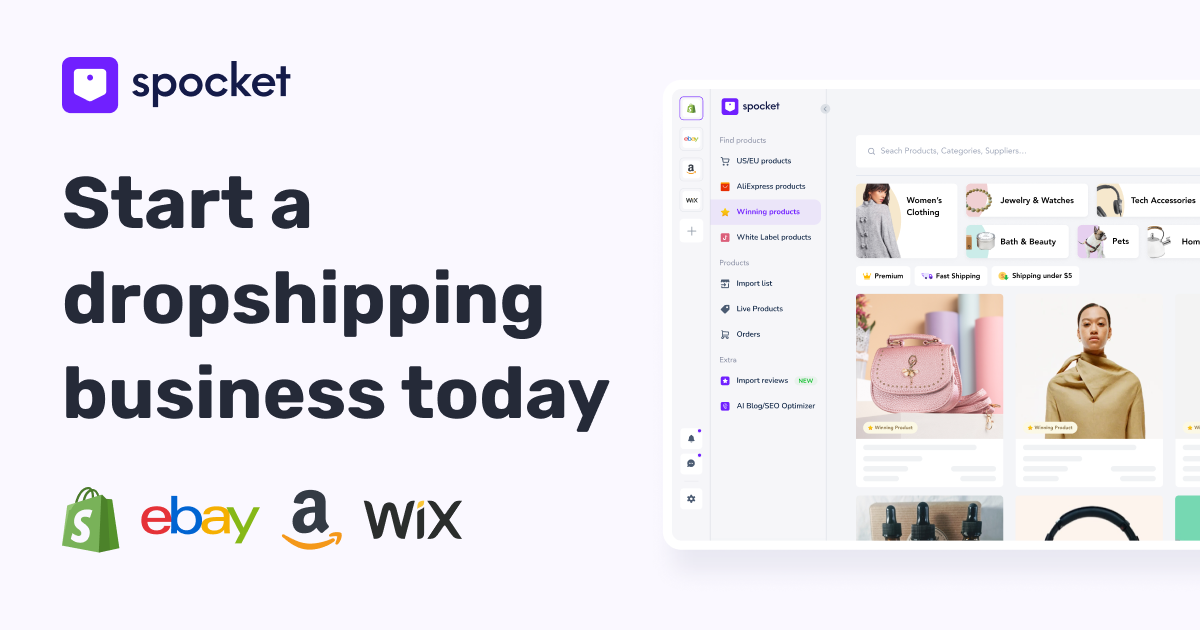
Supplier geography is the feature Spocket leads with, and it is the one that does not vary by plan. Every tier from Starter upward lists the same 100 million plus product catalog and the same AliExpress dropshipping access.
What changes between tiers is how many of those products you may actually list.
Why geography matters at all comes down to four downstream effects a store owner feels within a month of launching.
- Delivery window. A domestic supplier shortens the gap between order and doorstep, which is the single most common complaint in dropshipping support queues.
- Return handling. A return crossing a border costs more than the item in many categories, so suppliers near your customers change the economics of refunds.
- Chargeback exposure. Long delivery windows push customers toward disputing the charge rather than waiting.
- Ad economics. Faster delivery raises repeat purchase rates, which is what makes paid acquisition viable at a given margin.
None of that is unique to Spocket as a concept. What the platform provides is a catalogue filtered to suppliers in those regions, which saves the sourcing work rather than the shipping cost.
Winning Product Discovery
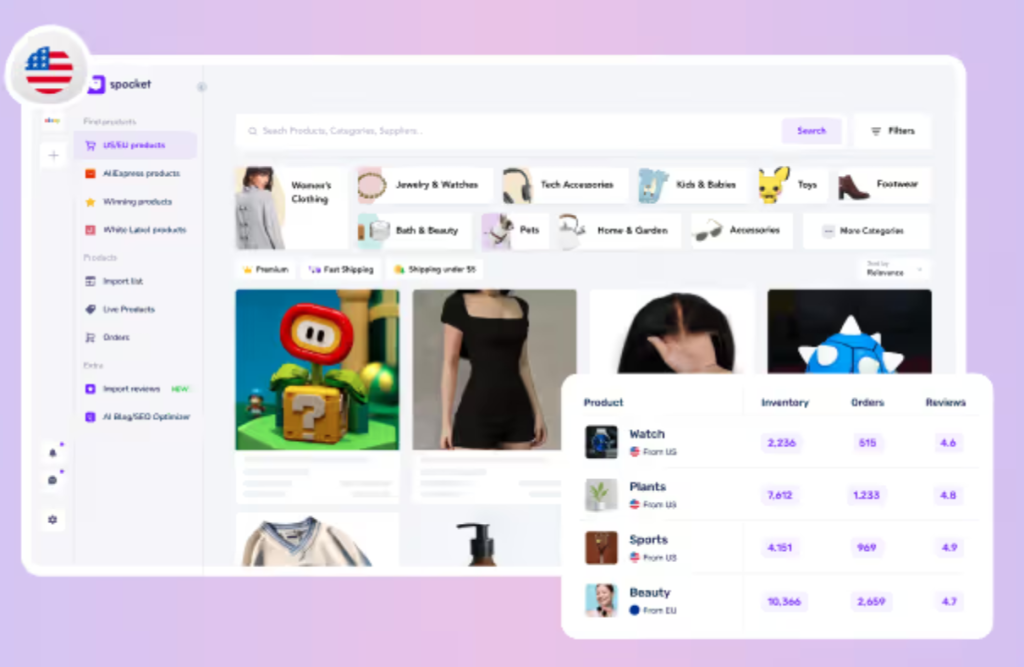
Product discovery is presented as a curated browsing experience rather than a raw search box. Spocket maintains a Winning Products section in its main navigation, separate from the general catalogue.
The practical question for a new store is how much of your decision this should carry. Curated trending lists are visible to every other subscriber at the same moment, so a product surfaced there is already being tested by other sellers. That is useful for understanding what a category looks like and poor as a basis for differentiating a store.
Use the curated view to learn the shape of a category: price bands, typical margins, what the photography looks like. Then choose from the wider catalogue rather than from the first screen everyone else is also seeing.
Product Research Tools
Research tooling sits alongside discovery under Spocket’s Tools menu. The distinction worth drawing is between finding a product and qualifying one.
Finding is easy and the platform does it for you. Qualifying is the work: checking that a supplier has stock depth, that the margin survives your shipping and ad costs, that the item is not restricted on your sales channel.
Three checks are worth building into a routine before any product goes live.
- Margin after everything. Take the supplier price, add shipping, add your payment processing, then compare against a realistic selling price rather than an aspirational one.
- Supplier responsiveness. Chat with Suppliers is a paid feature on this platform (see the gating section below), and a supplier who answers slowly during evaluation will answer slowly during a dispute.
- Channel restrictions. A product that sells fine on your own storefront may be restricted on eBay or Amazon, and those channels are themselves gated by plan here.
A catalogue of 100 million products is a filtering problem rather than a supply problem. The research tools exist to narrow it, and the quality of your narrowing is the actual differentiator between two stores using identical software.
Automated Dropshipping Workflows
Automation covers order routing and fulfilment handoff, which is the part of dropshipping that scales badly by hand. An order placed in your store passes to the supplier without a person retyping it.
Two pricing details attach to this directly. Spocket advertises a 0% transaction fee on every plan, so the platform does not take a cut of each order on top of the subscription. Unlimited orders, by contrast, is gated: Starter and Professional do not list it, while Empire and Unicorn do.
That pairing deserves attention. A plan with no transaction fee but a cap on orders behaves like a plan with a transaction fee once you approach the cap, because the next order forces an upgrade. Work out your expected monthly order count before choosing between Professional and Empire.
What automation buys you is time rather than certainty. Routing an order automatically does not confirm the supplier shipped it, and the hours you recover should go into the parts of the business that still need a person.
- Testing offers and creative.
- Answering customers before they open a dispute.
- Watching margin per product rather than revenue.
- Building relationships with the two or three suppliers who carry your best sellers.
Broad Channel And Catalog Support
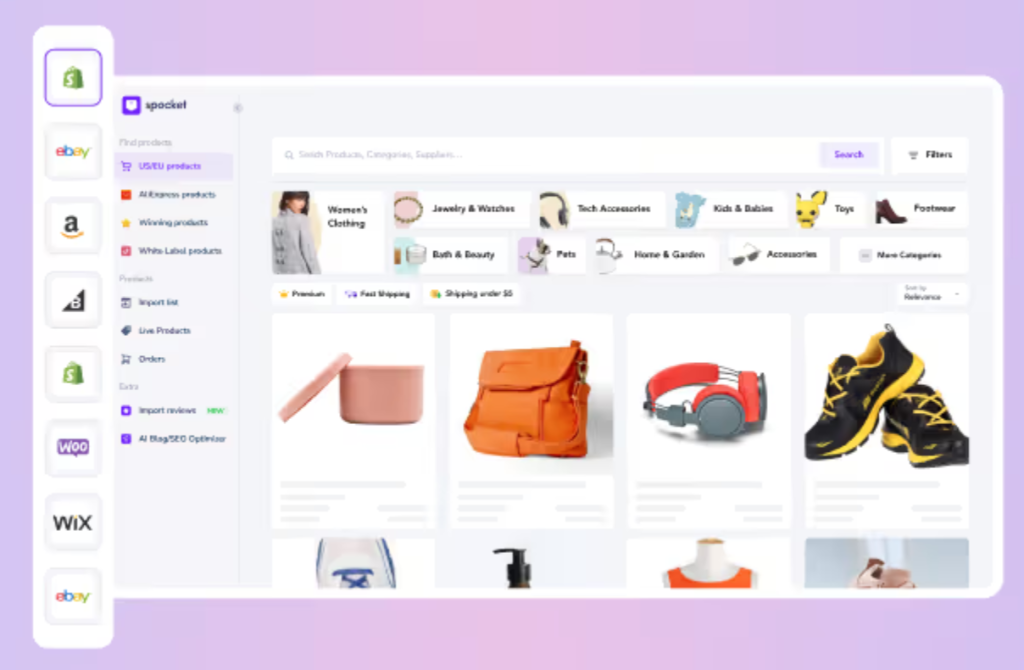
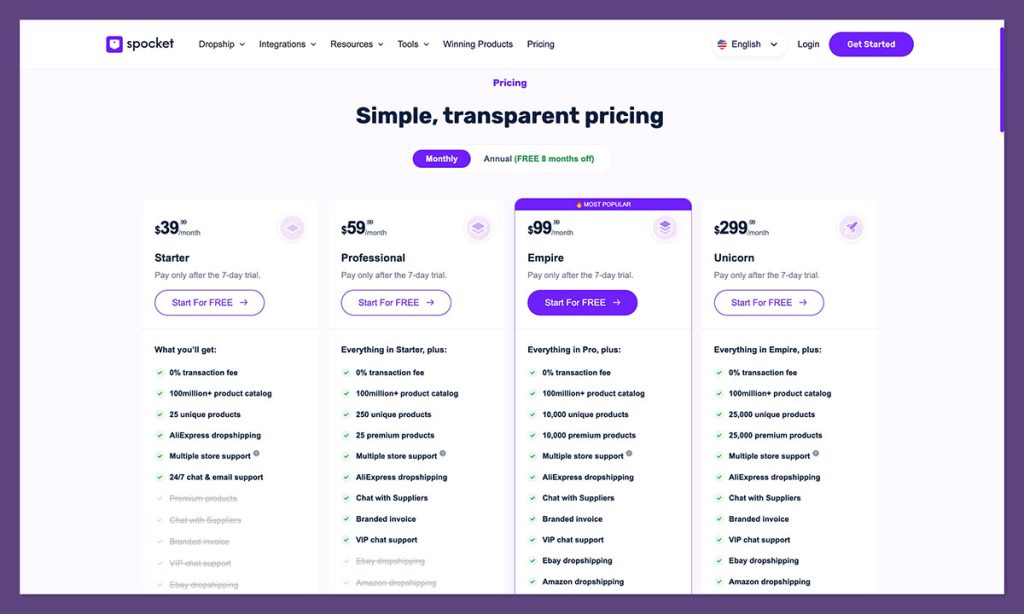
Channel support is where the plan ladder bites hardest, and the published cards make the gating explicit through struck-through entries.
eBay dropshipping, Amazon dropshipping, Spocket academy and unlimited orders are all struck through on Starter and on Professional. They appear as included only from Empire upward. Bulk checkout goes further still: it is struck through on Empire and appears only on Unicorn.
So a seller who needs marketplace channels is looking at Empire regardless of catalogue size, and a seller who needs bulk checkout is looking at the top plan regardless of everything else. Those two features, rather than product counts, are what move most buyers up the ladder.
Three more items are gated between the bottom two tiers. Premium products, Chat with Suppliers and Branded invoice are struck through on Starter and included from Professional upward, along with VIP chat support.
Pricing Context :
Monthly billing is the view that loads by default, with four plans and a 7-day trial noted on each card.
| Plan | Price | What you get |
|---|---|---|
| Starter | $39.99/mo | Monthly billing only, no annual option. 25 unique products, AliExpress dropshipping, multiple stores, 24/7 chat and email. No premium products, supplier chat, branded invoice or marketplace channels. |
| Professional | $59.99/mo | Monthly rate. $24 a month billed annually. 250 unique and 25 premium products, supplier chat, branded invoice, VIP chat support. No eBay, Amazon or unlimited orders. |
| Empire | $99.99/mo | Monthly rate. $57 a month billed annually. 10,000 unique and 10,000 premium products, eBay and Amazon dropshipping, Spocket academy, unlimited orders. No bulk checkout. |
| Unicorn | $299.99/mo | Monthly rate. $79 a month billed annually. 25,000 unique and 25,000 premium products, plus bulk checkout, which no other plan includes. |
Switch the toggle to Annual and something unusual happens: the Starter plan disappears. Three cards remain, at $24, $57 and $79 per month billed annually for Professional, Empire and Unicorn. Anyone wanting the entry plan is on monthly billing whether they prefer it or not.
The toggle is labelled “Annual (FREE 8 months off)”. Check that against the figures on the same page.
- Professional. $59.99 monthly is $719.88 a year. Annual billing at $24 a month is $288. You keep $431.88, which is 60.0% and works out to 7.2 months rather than 8. The card’s own “Save $432” matches our arithmetic.
- Empire. $99.99 monthly is $1,199.88. Annual at $57 is $684. You keep $515.88, or 43.0%, equivalent to about 5.2 months free. The card says “Save $516”, which again matches. The 8-month claim does not.
- Unicorn. $299.99 monthly is $3,599.88. Annual at $79 is $948. By our arithmetic you keep $2,651.88, equivalent to 8.8 months. The card states “Save $2563”, which is $88.88 lower than the figures on the same page produce.
Two conclusions follow. The per-plan saving figures are accurate on Professional and Empire and do not reconcile on Unicorn, so verify that one against your own invoice. The headline “8 months off” describes Unicorn reasonably well and overstates the saving on Empire, the plan carrying the Most Popular badge, by roughly three months.
Trial length is also stated two ways in Spocket’s own material. The plan cards say “Pay only after the 7-day trial.” Older FAQ material has referred to 14 days. We read 7 days on the cards and have not been able to reconcile the two, so treat 7 as the figure to plan around and confirm before you rely on a longer window.
If you want to compare the plan ladder yourself, open the pricing page here and read the toggle in both states.
What Makes Spocket Feel Different :
Plenty of dropshipping platforms advertise a large catalogue. Catalogue size is the least informative number any of them publish, because nobody lists 100 million products and the figure says nothing about which suppliers you can actually reach.
Spocket’s more defensible claim is the combination of supplier geography with a plan ladder that exposes marketplace channels as you grow. A seller can start on a single storefront and add eBay and Amazon without changing platform, which is a real migration cost avoided.
The 0% transaction fee is the other point of genuine difference. A platform taking a percentage of every order shares your upside; a flat subscription does not. Against that, the order cap on the lower two plans pulls in the opposite direction, so the benefit is clearest on Empire and above where orders are unlimited.
What Is More Niche Than It Looks :
Several of these features suit a narrower buyer than the marketing suggests, and it is worth being clear about which.
- US and EU supplier access matters most if your customers are in those regions. Selling primarily into other markets reduces the advantage considerably.
- Curated product discovery helps a first-time seller learn a category and helps an experienced one very little.
- Premium products and supplier chat only pay back once you are placing enough volume for a supplier relationship to mean something.
- Bulk checkout is a Unicorn-only feature at $299.99 monthly, so it is relevant to a small number of high-volume operators rather than to most subscribers.
Rank the features against your own stage rather than against the order the pricing page presents them in. A seller validating a first product and a seller shipping a thousand orders a month are buying almost different products from the same company.
Verdict :
Spocket’s feature set is coherent and its gating is unusually legible, which is a compliment: the struck-through entries on each card tell you exactly what you are not getting. Few vendors in this category are that direct.
The decision reduces to two questions. Do you need marketplace channels, which puts you on Empire at $99.99 monthly or $57 annually? And do your expected orders exceed whatever cap sits on the lower plans, which pushes the same way?
Starter at $39.99 is a validation plan. Twenty-five unique products, no premium catalogue, no supplier chat, no marketplace channels, and no annual billing option. It does the job of proving a category works before you spend more.
Check the Unicorn saving figure against your own invoice if you go to the top plan, since the number on the card and the number its own pricing produces are $88.88 apart.
For the broader evaluation see our Spocket vs alternatives comparison and who Spocket is best for. To try it, start with Spocket here.
FAQ :
What is Spocket’s best feature in 2026?
Access to suppliers based in the US and EU, because it shortens delivery and reduces the return and chargeback costs that decide whether a store is profitable. It is also the one headline feature that does not vary by plan.
Does Spocket still offer a free trial?
Yes. Every plan card states “Pay only after the 7-day trial.” Older material has referred to a 14-day trial, and we could not reconcile the two, so plan around 7 days and confirm before relying on more.
How much does Spocket cost?
On monthly billing: Starter $39.99, Professional $59.99, Empire $99.99, Unicorn $299.99. On annual billing the Starter plan is not offered, and the remaining three are $24, $57 and $79 per month billed annually.
Who should care most about Spocket’s advanced features?
Sellers who need eBay or Amazon channels, since both are gated to Empire and above, and high-volume operators who need bulk checkout, which only Unicorn includes. Below that, the advanced tiers mostly buy product count you may not use.
More on Spocket
Hand-picked guides to help you choose the right tool — no fluff.
 ComparisonsSpocket vs Alternatives 2026The strongest competitors compared side by side.
 Use CasesWho Is Spocket Best For? Use Cases & Fit (2026)Who gets the most out of it – and who should skip it.
 ReviewsIDrive Review 2026Hands-on verdict with the pros, cons and who it fits best.
 ReviewsBrand24 Review 2026Hands-on verdict with the pros, cons and who it fits best.