


In this guide
Why This Post Matters :
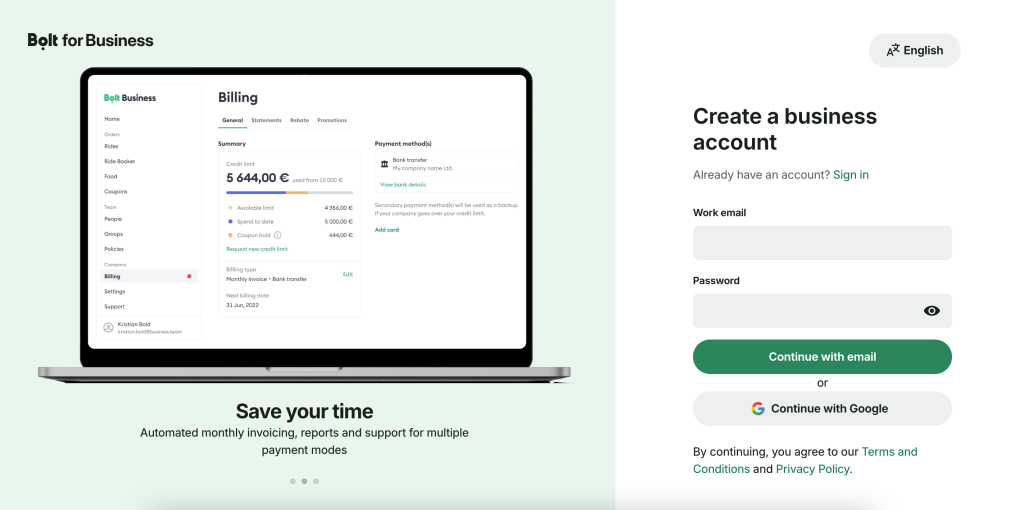
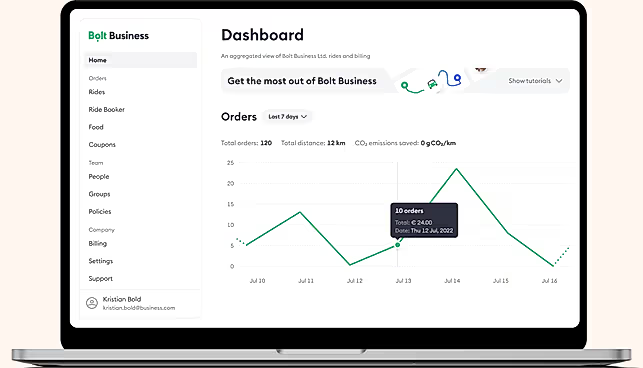
Bolt for Business is the corporate account layer of the Bolt app, letting companies manage employee rides, scooters and travel under one billing dashboard. It fits businesses that want to replace loose expense receipts with centralized invoicing, spending limits and policy controls across the cities where Bolt operates. There’s no per-seat license — you pay for the trips employees actually take, so costs track real travel rather than a fixed subscription.
Disclosure: Stack99 earns a commission if you buy through links on this page. It costs you nothing extra and never changes our assessment.
The official material suggests that Bolt for Business is best understood through its working model, pricing signals, and how clearly the product explains its own use case in 2026.
If you want to inspect the product while you read, start with Bolt for Business here.
What The Official Pages Keep Pointing To :
- Core workflow
- Features
- Pricing shape
- Team fit
Product Fit In 2026 :
The strongest reading from the official pages is that Bolt for Business is best evaluated through real workflow fit rather than generic feature shopping. Teams get more value when the product shape already matches the kind of work they need to do.
If you want to pressure-test that fit early, check Bolt for Business here and compare the official workflow language against your team’s current process.
Pricing And Data Notes :
The official pages reviewed do not present a simple public pricing table, so the safer reading is to treat pricing as plan- or conversation-dependent.
The important part is to use only the pricing, feature, and workflow details that are visible on the official pages instead of filling in gaps with assumptions.
What Buyers Should Watch :
Buyers should pay attention to product fit, daily operational friction, expansion paths, and whether the workflow shown on the official pages matches the work the team actually needs to run.
If you want to evaluate that directly, open Bolt for Business here and compare it against one real business workflow.
Practical Recommendation :
The safest recommendation is to adopt Bolt for Business when its strongest official use case matches the problem you need solved right now. If your use case is broader or different, an adjacent alternative may still make more sense.
Final Buying Note :
In 2026, the smartest way to evaluate Bolt for Business is still to use the official product pages, compare them against one real workflow, and decide whether the product reduces friction in a way your team will actually feel every week. That kind of grounded evaluation tends to beat generic feature shopping.
FAQ :
Why Is Bolt for Business Worth Evaluating In 2026?
Because the official product pages make a clearer workflow case than a lot of tools in the same space, which helps buyers decide faster.
Should I Rely On Third-Party Pricing Summaries?
No. Use the official pages only and treat anything missing as something to verify before a purchase.
What Is The Best Way To Test Bolt for Business?
Use one real workflow, compare it against the official setup path, and judge whether the product removes friction.
Does Bolt for Business Look Better For Focused Or Broad Use Cases?
That depends on the product angle, but focused use cases are usually the clearest starting point.
When Should I Move Forward?
Move forward when the official workflow, visible pricing logic, and team fit all line up well enough to replace a messier current process.
More on Bolt
Hand-picked guides to help you choose the right tool — no fluff.
 TutorialsBolt for Business Beginner's Guide 2026A clean start-here walkthrough with no jargon.
 Advanced GuidesBolt for Business Advanced Guide 2026Deeper workflows once the basics are in place.
 FeaturesOutgrow Top Features 2026The standout features and whether they justify the price.
 Advanced GuidesPilim Advanced Guide 2026Deeper workflows once the basics are in place.