


- Billing Architecture At Scale
- Designing Group And Spend Policy
- Rollout Sequencing Beyond The Pilot
- Failure Modes Advanced Teams Hit
In this guide
- Who This Advanced Guide Is For
- The Four Mobility Surfaces You Are Governing
- Billing Architecture: Card Versus Postpaid At Scale
- Dashboard Controls In Depth
- Designing Group And Spend Policy
- Rollout Sequencing Beyond The Pilot
- Work Profile As A Coverage Gap
- Reconciliation And The 15th Of The Month
- Failure Modes Advanced Teams Hit
- Advanced Verdict
Who This Advanced Guide Is For
You already have a Bolt Business account running. Rides are booked, a card is attached, and somebody in finance has started asking why the reconciliation takes so long. This guide picks up there rather than at signup.
Disclosure: Stack99 earns a commission if you buy through links on this page. It costs you nothing extra and never changes our assessment.
Everything below assumes three things: more than one team is using the account, the spend is large enough that policy matters, and somebody owns the outcome. If none of those apply yet, the setup walkthrough in our beginner guide is the better starting point.
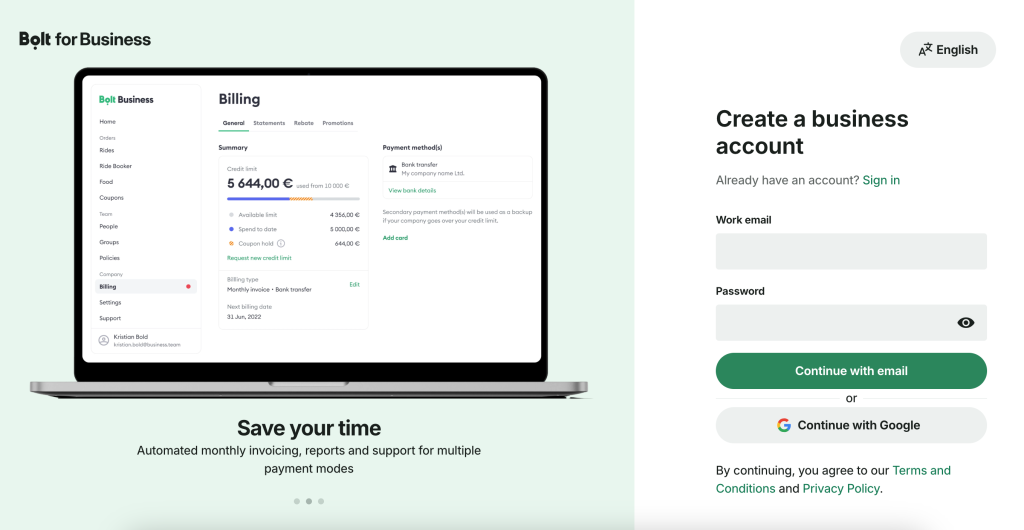
The core argument of this guide is that Bolt Business is a policy system wearing a booking app, and the decisions that cost you money later are made in billing configuration and group design rather than anywhere riders ever see. start with Bolt for Business here if you want the admin console open while you read.
The Four Mobility Surfaces You Are Governing
Bolt’s official pages describe the business product as covering four distinct things, and treating them as one is the first governance mistake at scale.
- Work rides to the office, meetings and airports.
- Bolt Drive car rental for company use.
- E-scooters and e-bikes for shorter trips.
- Bolt Food for Business for team meals and office perks.
Each carries a different risk profile. A late-night airport ride is a duty-of-care expense your board would defend without blinking. An office food order is a perk that finance will benchmark against a budget line. Scooter trips sit somewhere in between and generate a long tail of small transactions that clutter any report built for taxis.
Advanced teams separate these deliberately, usually by putting food and micromobility behind tighter limits than ground transport. Bolt says the business product is used by more than 50,000 businesses, a vendor figure we could not independently verify, but the breadth of the catalogue is visible on the public pages regardless of the count.
Billing Architecture: Card Versus Postpaid At Scale
Two billing models exist, and the choice between them is the single highest-leverage configuration decision in the product. Bolt’s own support documentation describes them as follows.
- Credit card billing: charges land after each trip, every company ride can charge to one card, and no credit check is required.
- Postpaid billing: you receive monthly credit, get a single invoice, and pay by the 15th of the month to renew that credit.
Card billing wins on speed and loses on volume. Hundreds of individual charges against one card produce a statement nobody wants to reconcile, and a declined card interrupts travel rather than accounting. Postpaid inverts both properties: one invoice, clean reconciliation, and a hard operational dependency on paying on time.
Note what the postpaid model actually is. Monthly credit that renews on payment is a credit facility with a ceiling, so a month of unusually heavy travel can exhaust it before the invoice cycle turns. Teams that switch to postpaid for the clean invoice sometimes discover the ceiling during a conference week, which is the worst possible moment.
Dashboard Controls In Depth
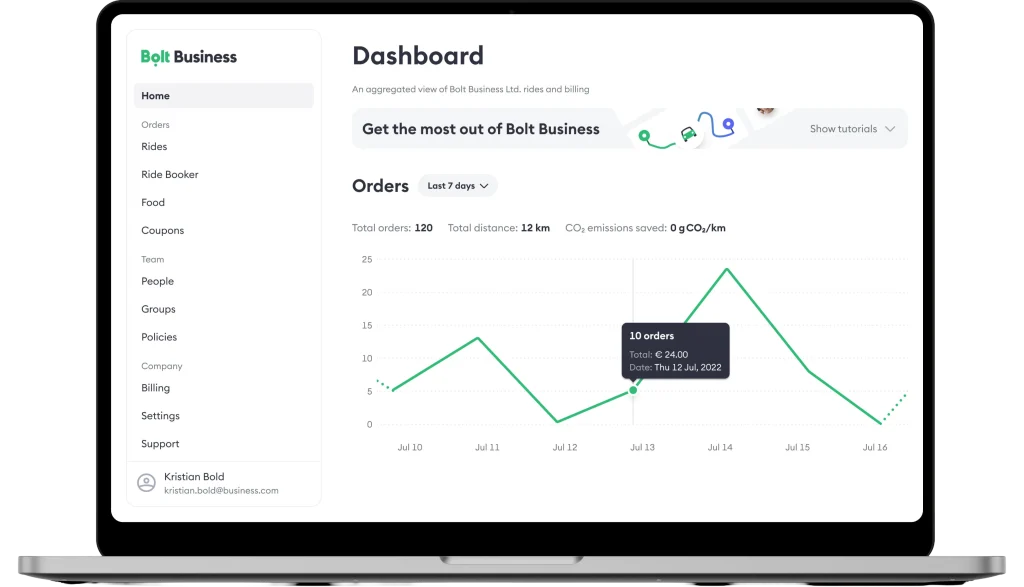
Bolt’s public pages do not expose every screen, though the operating model is clear enough from the documentation. The business account gives administrators billing visibility, group and employee controls, spending limits, payment-method management and centralised invoicing or card charging.
The Billing tab in the Company Dashboard is where most advanced work happens. Bolt’s company billing article describes it as the place to review current payment information, add payment methods, switch preferred billing type and manage cards. Switching billing type from a live account is the operation worth rehearsing before you need it.
Build your mental model around three audiences with conflicting wants. Riders want booking friction near zero. Managers want oversight without approving every trip. Finance wants one number that reconciles. Every control in the dashboard trades one of those against another, and configuring for all three at once is what separates a working account from one that generates complaints.
Designing Group And Spend Policy
Bolt’s business page describes organising employees into groups with specific limits. That capability is where policy stops being a document and starts being enforced, so design it properly rather than mirroring your org chart.
Group by travel pattern instead of by department. A sales team and a support engineer who both visit customer sites have more in common operationally than the sales team has with its own manager who never leaves the office. Patterns worth separating usually include airport transfers, customer meetings, late-night safe transport and occasional ad-hoc travel.
Set limits that bind rarely. A ceiling triggered weekly becomes a queue of exception requests and the policy quietly dies. A ceiling triggered twice a year catches genuine anomalies and nobody resents it. Review the distribution of actual spend before picking numbers rather than choosing a round figure that feels responsible.
Document why each group exists. Six months on, the person maintaining this will not remember, and undocumented limits get raised rather than examined. If the group structure is still on a whiteboard, start with Bolt for Business here and build it in the console where the limits actually apply.
Rollout Sequencing Beyond The Pilot
Most accounts start with one department and stall there. Expanding properly is a sequencing problem, and the order below keeps the finance relationship intact.
- Validate the receipt and invoice trail on the pilot group before adding anyone.
- Add a second group with a genuinely different travel pattern, not a similar one.
- Re-check reconciliation after that second group, since mixed patterns break reports that single-pattern accounts never exposed.
- Only then decide whether the billing model still fits, and switch before the account gets larger rather than after.
Reversing that order is how teams end up migrating billing type across a company-wide account mid-quarter. Switching is supported from the Billing tab, but doing it with four hundred riders attached is a different exercise from doing it with twenty.
Work Profile As A Coverage Gap
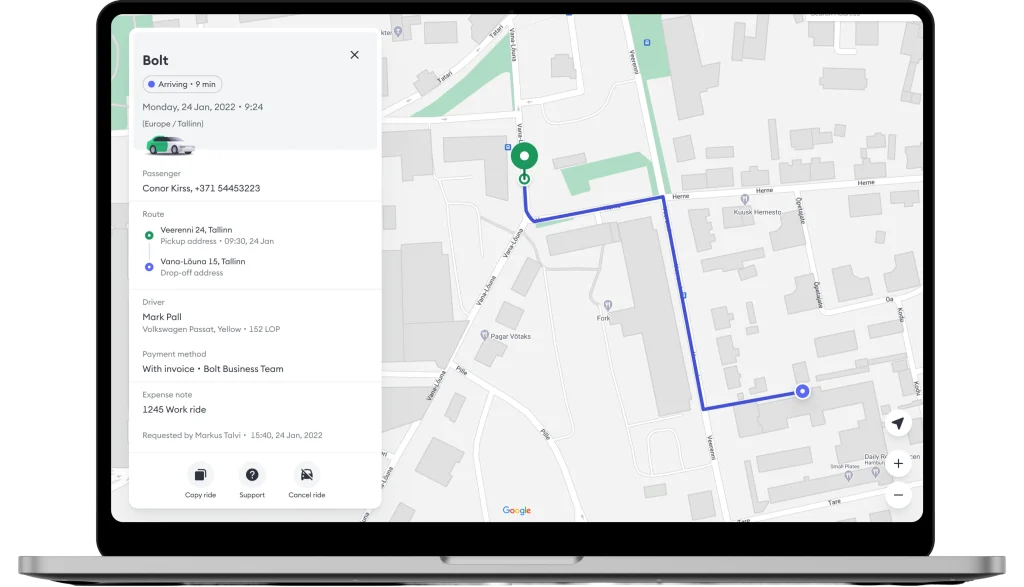
Work Profile is a free feature in the Bolt app that keeps personal and business rides separate and sends pre-filled work-ride receipts to an address you choose. Bolt’s own page also mentions connecting that flow to expense tools.
Advanced accounts treat it as a coverage mechanism rather than a convenience. Contractors, new joiners before provisioning completes, occasional travellers who do not justify a seat, and anyone travelling in a region your main account does not cover all fall outside the company account. Work Profile catches them without creating reimbursement threads.
The trade is visibility. A Work Profile ride is not governed by your group limits and does not land on the company invoice, so it is a gap in control even as it closes a gap in coverage. Audit who is using it periodically, because a quiet drift of regular travellers onto Work Profile hollows out the policy you spent time designing.
Reconciliation And The 15th Of The Month
Postpaid accounts carry a date that belongs in your finance calendar. Bolt’s documentation states that payment by bank transfer should be completed by the 15th of the month to renew postpaid credit.
Build the process backwards from that. An invoice that needs approval from someone who is travelling, in a company where bank transfers take two working days, needs to be in the approver’s hands well before the 10th. Miss the renewal and the consequence is not a late fee, it is credit that has not refreshed while people are trying to book.
Two safeguards are worth putting in place. Keep a card on the account even while running postpaid, so a missed renewal degrades to per-trip charging rather than to no service. And assign the invoice to a role rather than a person, since the single most common cause of a missed 15th is the approver being on leave.
Failure Modes Advanced Teams Hit
Beginner mistakes are about setup. The failures that bite established accounts are different, and all four below come from the configuration decisions above rather than from the app.
Credit ceilings discovered during peak travel. A postpaid account sized against an average month fails during the one week everyone travels, and that is exactly when nobody has time to fix it.
Groups that mirror the org chart. Limits calibrated for a department containing both heavy and zero travellers end up too loose for one and irrelevant to the other, which produces the worst of both outcomes.
Silent migration to Work Profile. Riders route around friction, and an unmonitored Work Profile population means your reported company travel spend is understating reality.
Billing type switched under load. Doing it is supported. Doing it with a large live account during a billing cycle is the kind of change that generates a week of finance questions. start with Bolt for Business here and test the switch while the account is still small enough to recover from.
Advanced Verdict
Bolt for Business is a good beginner option in 2026 because the official pages is clear. It helps teams move people around, centralize billing, automate reporting, and keep policy control in admin hands.
The product makes the most sense for companies that want a lighter entry point into business travel management instead of a giant procurement-heavy rollout.
The sweet spot looks like this:
- Companies That Want Faster Ride Setup.
- Teams That Need Cleaner Expense Management.
- Managers Who Want Spending Rules.
- Finance Leads Who Want One Billing View Instead Of Random Receipts.
If that sounds like your setup, start with Bolt for Business here and begin with one team, one payment model, and one reporting loop.
FAQ :
Is Bolt for Business hard to set up?
No. The official site presents it as a three-step rollout: add company details, choose payment, add team members, and start booking. The real work is choosing the right billing model and limits.
What is the difference between credit card billing and postpaid billing?
Credit card billing charges after each ride to a single card. Postpaid billing gives monthly credit and one consolidated invoice that should be paid by the 15th of the month to renew credit.
What is Bolt Work Profile?
It is a free feature in the Bolt app that keeps personal and business rides separate and sends pre-filled work-ride receipts to your chosen email.
Can Bolt connect to expense tools?
Yes. The Work Profile page specifically mentions SAP Concur, Rydoo, Expensify, and Zoho Expense.
More on Bolt
Hand-picked guides to help you choose the right tool — no fluff.
 ReviewsBolt for Business Review 2026Hands-on verdict with the pros, cons and who it fits best.
 TutorialsBolt for Business Beginner's Guide 2026A clean start-here walkthrough with no jargon.
 PricingLearnWorlds Pricing 2026: Online Course Platform & LMSReal tier prices and what each plan actually includes.
 FeaturesPayoneer Workforce Management Top Features 2026The standout features and whether they justify the price.