


In this guide
The Short Answer
Salesmsg fits businesses where a text message does the work a phone call used to do, and where the people sending those texts already live inside a CRM. Appointment confirmations, quote follow-ups, arrival windows, review requests. The deciding number is not the subscription. It is how many message credits your conversations burn in a month, because the two published plans sit 500 credits apart at the bottom and 10,000 at the top with nothing in between.
Disclosure: Stack99 earns a commission if you buy through links on this page. It costs you nothing extra and never changes our assessment.
Work out your monthly credit burn before anything else. Everything below is an attempt to help you do that honestly for your own business rather than a hypothetical one.
If you want the platform open while you read, start with Salesmsg here.

What A Credit Really Is
Salesmsg bills message credits, and its help centre is specific about how they are counted. A plain GSM text of 1 to 160 characters costs 1 credit. Run to 161 to 306 characters and it costs 2. The ladder continues to 10 credits at 1,378 to 1,530 characters. A picture message counts as 2 credits for anything up to 1,600 characters.
Three rules in that documentation change budgets more than the price list does.
- Inbound messages cost credits as well as outbound ones. A conversation is billed in both directions, so a six-message exchange is six credits, not three.
- One emoji re-encodes the whole message as UCS2, where a credit buys 70 characters instead of 160. A friendly 150-character note with a thumbs-up costs 3 credits rather than 1.
- Call forwarding costs 2 credits per voice minute, so the same meter covers your phone calls.
Salesmsg also warns that text pasted in from another app can carry hidden formatting that forces UCS2 encoding, roughly doubling credit use against typing the message directly into the composer. Teams that work from a document of canned replies should test that before committing to a plan size.
What The Two Plans Cost
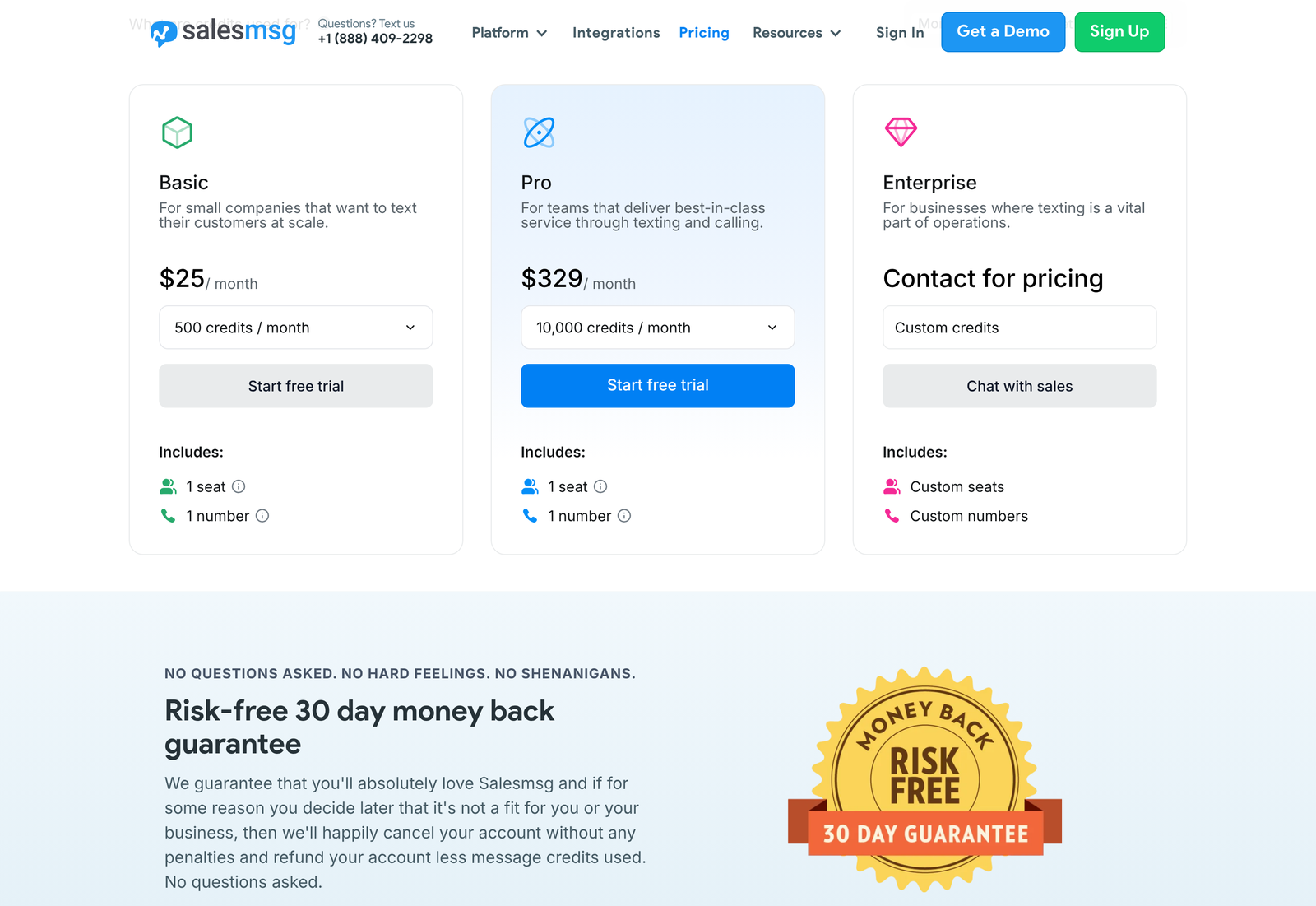
The pricing page opens on the annual toggle, so the first figures you see are yearly-billed rates. Switch to Monthly and Basic is $25 a month with 500 credits a month, Pro is $329 a month with 10,000 credits a month, and both include one seat and one phone number. Enterprise is a conversation rather than a price.
Annual billing is advertised as two months free. Basic falls to $21 a month billed yearly with 6,000 credits for the year, and Pro falls to $277 a month billed yearly with 120,000 credits. Multiply those out: Basic costs $252 a year against $300 paying monthly, a saving of $48 or 16%. Pro costs $3,324 against $3,948, saving $624 or 15.8%. Credit volumes are identical either way, so the annual choice is purely about cash flow and the discount.
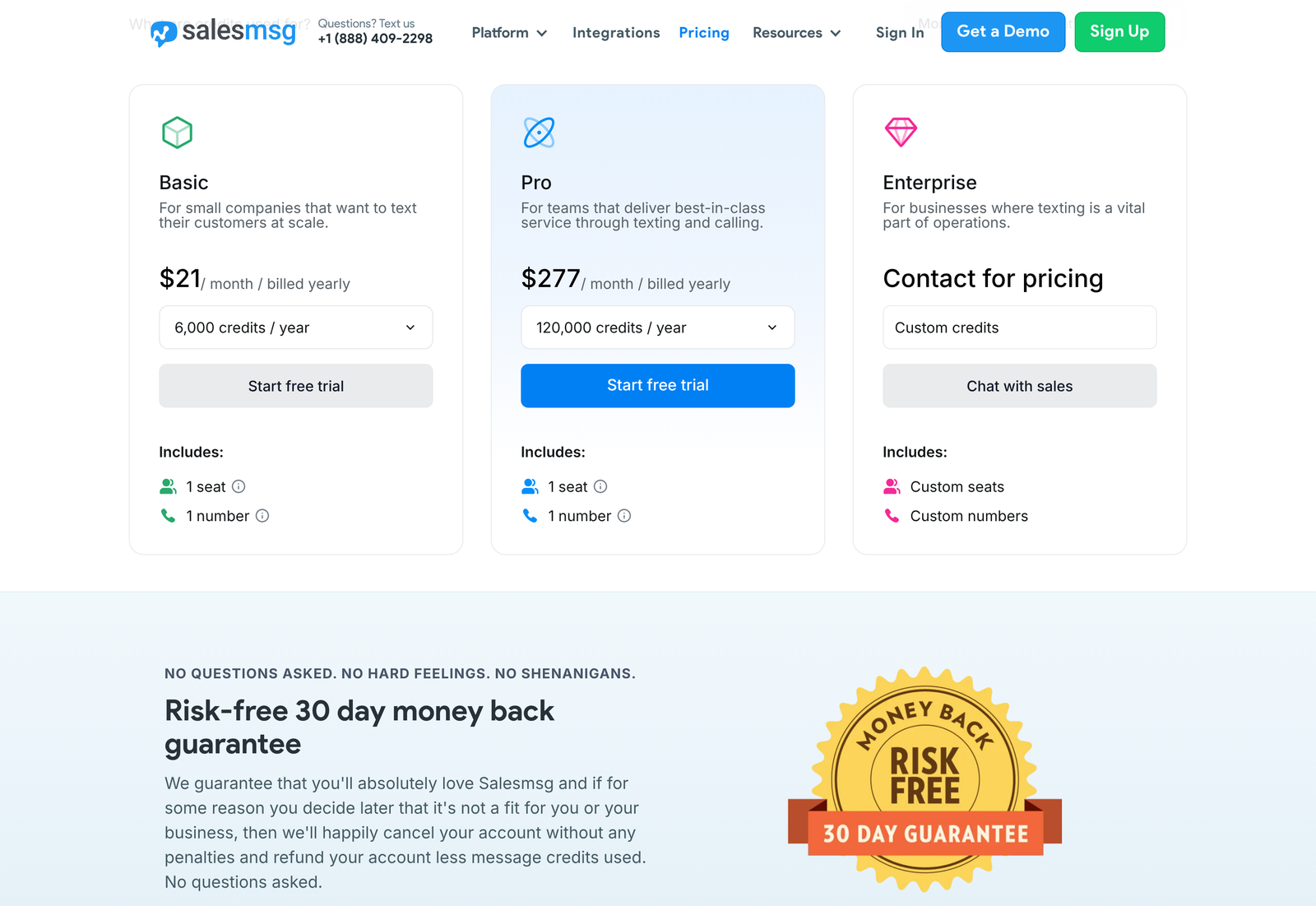
Per credit that works out at 5.0 cents on Basic monthly, 4.2 cents on Basic annual, 3.29 cents on Pro monthly and 2.77 cents on Pro annual. One caution on these figures: the credit volume on each card sits inside a dropdown, and other volumes are selectable at other prices. We captured and are quoting the default state only, so confirm your own selection on the page before budgeting.
Now the gap that decides fit. Moving from Basic to Pro multiplies your bill by 13.2 and your credits by 20. There is no published middle tier. A business needing 2,000 credits a month pays the same $329 as one needing 10,000, which is 16.5 cents per credit rather than 3.29. That single discontinuity is what makes Salesmsg excellent for some businesses and poor value for others.
Field Service And Home Services
This is the strongest fit on the list. Plumbers, electricians, cleaners and pest control firms run on arrival windows, and an arrival window is a one-line text. Salesmsg lists Housecall Pro in its app marketplace with webhook triggers from job events, so a scheduled job can fire a confirmation without anyone typing.
Model it. A two-van operation doing 12 jobs a day, 22 days a month, sends a booking confirmation, a day-before reminder, an on-the-way note and a review request. Four outbound single-segment texts per job is 4 credits, and customers reply to roughly half of them, adding perhaps 2 inbound credits. Six credits across 264 jobs a month is 1,584 credits. Basic cannot carry that, so the answer is Pro at $329 a month, or $1.25 per job.
Shrink it to a single-operator business doing 3 jobs a day and the arithmetic flips. Sixty-six jobs a month at 6 credits is 396 credits, which fits inside Basic’s 500 with room to spare. That operator pays $21 a month on annual billing. Our Housecall Pro advanced guide covers the scheduling side of the same workflow.
Real Estate And High-Touch Sales
Agents and inside sales reps text because buyers answer texts and ignore voicemail. Salesmsg supports this shape well: the marketplace names Follow Up Boss, Close, HubSpot, Attio and Insightly on the CRM side, plus Calendly and Chili Piper for booking, so a viewing or a demo can trigger a message from the system of record rather than somebody’s personal phone.
Volume here is lower per contact but conversations run longer. An agent working 40 active buyers with a genuine back-and-forth of 10 messages a month each burns 400 credits, which is a Basic plan. Add a second agent and you need a second seat, and seats are where this gets expensive rather than credits.
One habit to break early: long, chatty messages. A 300-character property description costs 2 credits, and adding a single emoji pushes it to 5. Across 400 messages a month that difference is the gap between staying on Basic and being forced onto Pro.
Clinics And Appointment-Led Teams
Dental practices, physiotherapists, salons and veterinary clinics share one economic fact: a no-show costs the full slot. Reminder texting pays for itself faster here than anywhere else, and the credit cost of a reminder is one of the smallest numbers in the business.
Salesmsg markets HIPAA compliance as a product area, which matters for any practice handling patient information. Treat that as a question for their sales team rather than a settled fact for your particular workflow, because the compliance page we tried was returning a 404 on 9 October 2026 and we could not read the terms. Ask for the business associate agreement in writing before you send a single patient reminder.
On volume, a clinic running 60 appointments a week with two reminders each sends 480 outbound texts a month. Allow a third for replies and you are near 640 credits, which overruns Basic. Clinics almost always land on Pro, and at $277 a month on annual billing against the cost of a handful of recovered no-shows the case usually writes itself.
Ecommerce Support Desks
Weaker fit, with a specific exception. Salesmsg lists BigCommerce, Gorgias, Front and Intercom in its marketplace, so order events and support tickets can trigger texts. For a store sending shipping notifications to thousands of customers, though, the credit model works against you: 5,000 notifications is 5,000 credits before anybody replies, and inbound replies are billed too.
Where it does work is high-value, low-volume commerce. Furniture, bespoke equipment, anything with a delivery conversation rather than a delivery notification. Two hundred orders a month with a real exchange around each one is well inside Pro, and the texting replaces phone calls your team was making anyway.
Stores wanting broadcast marketing SMS at scale should price a dedicated campaign platform instead and compare cost per message directly.
Who Should Skip It
- Teams sending between 600 and 3,000 credits a month. You are paying Pro money for Basic volume, at anywhere from 5 to 16 cents a credit. Either grow into the plan or price a usage-billed provider.
- Anyone whose texting is pure one-way marketing blast. The two-way inbox is most of what you are buying, and you would not use it.
- Businesses outside the countries their number provisioning covers. Confirm availability for your market before trialling.
- Teams with no CRM. The integrations are the reason to choose this over a cheaper inbox, and without one you are paying for connections you cannot use.
The Seat And Number Trap
Both published plans include exactly one seat and one phone number. Read that twice if you are sizing this for a team, because it is the limit people discover after they have migrated.
Salesmsg does not publish the price of additional seats or numbers on the pricing page, which means a five-person sales desk cannot work out its bill from public information. Enterprise is where custom seats and custom numbers live, and that is a quote. Before you evaluate anything else, ask what seat two through five cost, because that figure will dominate your total far more than the credit rate will.
The trial gives you 14 days and the money-back guarantee runs 30 days, refunding the account less whatever message credits you used. That is a generous window for testing deliverability and CRM sync. It is not long enough to discover seasonal volume, so size the plan on your busiest historical month rather than the month you happen to be trialling in.
Verdict
Salesmsg is built for the appointment-led, CRM-connected business where a text replaces a call. Home services and clinics are the clearest fits, real estate and high-touch sales run a close second, and broadcast ecommerce is the wrong shape for the credit model.
Do the credit sum first. Count your outbound messages, add the inbound replies, add 2 credits for every forwarded voice minute, and multiply anything with an emoji in it. Land under 500 and Basic at $21 a month billed yearly is a bargain. Land over 10,000 and Pro at $277 is reasonable. Land in the middle and the honest answer is that another vendor will serve you better until you grow. For the tier-by-tier breakdown see our Salesmsg pricing guide, and for an adjacent CRM that Salesmsg plugs into, read the Keap review.
FAQ :
Who is Salesmsg best for?
Appointment-led businesses with a CRM, where a text message replaces a phone call. Home services, clinics, salons and high-touch sales teams get the most from it.
How many credits does one text message use?
One credit for a standard message up to 160 characters, 2 credits up to 306 characters, rising to 10 credits at 1,530 characters. A picture message costs 2 credits. Adding an emoji drops the allowance to 70 characters per credit.
Do incoming messages cost credits?
Yes. Salesmsg counts inbound and outbound messages against the same allowance, so budget for whole conversations rather than sends.
How many users does a Salesmsg plan include?
Basic and Pro each include one seat and one phone number. Additional seats and numbers are not priced publicly, so a multi-person team has to ask for a quote.
Does Salesmsg offer a free trial?
Yes, 14 days. Salesmsg also advertises a 30-day money-back guarantee that refunds the account less any message credits already used.
Which CRMs does Salesmsg connect to?
Its marketplace names HubSpot, Close, Attio, Insightly, Follow Up Boss, Keap and ActiveCampaign among others, alongside Aircall, Calendly, Chili Piper, Gorgias, Front, Intercom, BigCommerce and Housecall Pro.
Before You Choose, Compare These
Hand-picked guides to help you choose the right tool — no fluff.
 ComparisonsSalesmsg vs Alternatives 2026The strongest competitors compared side by side.
 PricingSalesmsg Pricing 2026Real tier prices and what each plan actually includes.
 AlternativesNavan Alternatives 2026Credible alternatives and when each one wins.
 Use CasesWho Is Nickel Best For? Use Cases & Fit (2026)Who gets the most out of it – and who should skip it.