


In this guide
Capsule CRM is a small-business CRM with a free tier, four paid plans and a separate marketing add-on. This page answers one question: which kinds of business actually fit it, and which should keep looking. Every price and limit below was read from capsulecrm.com on 6 October 2026.
Disclosure: Stack99 earns a commission if you buy through links on this page. It costs you nothing extra and never changes our assessment.
Who Capsule Is Built For
Capsule is unusually direct about its target market. The vendor segments its own site by business size, listing solopreneurs, startups, small business, medium-size business and larger organizations, and by sector, naming professional services, manufacturing, consultants, construction, accountants and freelancers.
Read that list and a pattern appears. These are relationship businesses with long client lifecycles and project delivery attached to the sale. An accountant, a construction firm and a consultancy all share the same shape: a modest number of valuable contacts, work that continues after the deal closes, and nobody employed full time to administer software.
The product is built around that shape, and the plan limits confirm it. If your business looks like the above, try Capsule here and judge it against the sections below.
The Plan Ladder
Five tiers, with the first free and the last quoted by sales.
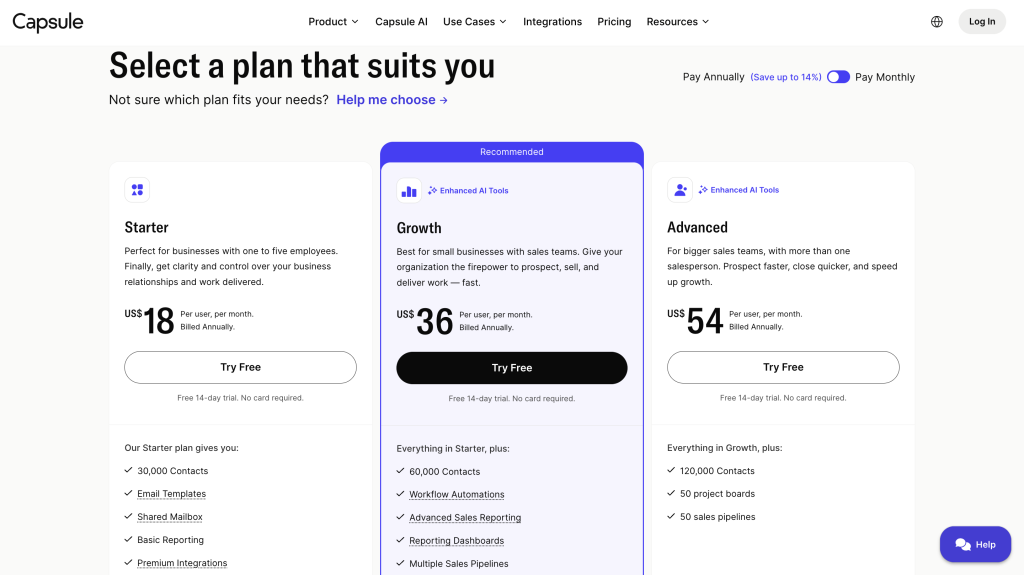
- Free. $0, maximum 2 users, 250 contacts, 5 custom fields, 1 sales pipeline, custom sales milestones and task categories, and a Gmail or Outlook mail connection.
- Starter. $22 per user per month, or $18 billed annually. 30,000 contacts, email templates, shared mailbox, basic reporting, premium integrations including Xero and Zendesk, goals, an AI pipeline generator.
- Growth. $40 per user per month, or $36 annually. 60,000 contacts, workflow automations, advanced sales reporting, reporting dashboards, multiple pipelines and project boards, email sync, team and access controls, and the AI enrichment, summary and meeting-prep tools.
- Advanced. $60 per user per month, or $54 annually. 120,000 contacts, 50 project boards and 50 sales pipelines.
- Ultimate. No published price. Described as ideal for scaling teams of five or more, with an account manager and custom training, reached through a trial and a sales conversation.
Note what moves between tiers and what does not. Contact ceilings double each step, which almost nobody will ever hit. The genuine gates are workflow automations, multiple pipelines and the AI tools, and all three sit on Growth.
Solopreneurs And Freelancers
The Free plan is a real product rather than a trial, and for a one-person business it may be the whole answer.
Two hundred and fifty contacts sounds tight until you count the contacts you actually work. A freelance designer with 40 past clients, 30 live prospects and a handful of suppliers is nowhere near the ceiling. One sales pipeline is enough when there is one way work arrives.
What you give up is email templates, a shared mailbox and reporting. A solo operator writing individual emails loses nothing by missing templates. Reporting to yourself is a glance at the pipeline.
Capsule allows two users on Free, which quietly covers a founder plus a part-time assistant. Few free CRM tiers do.
Move up when contacts pass 250 or when you want reusable email templates, and $18 a month on annual billing is a small step. The 14-day Capsule trial needs no card.
One To Five Employees
Starter is described by the vendor as perfect for businesses with one to five employees, and the feature list backs that claim.
Three capabilities matter at this size. A shared mailbox means a sales@ or info@ address can be answered by whoever is free, with the thread attached to the right contact. Email templates stop two people writing the same quote follow-up differently. Premium integrations connect accounting through Xero, which closes the loop between winning work and invoicing it.
At five users, Starter costs $90 a month on annual billing, or $1,080 a year. That is roughly the price of one afternoon of a consultant’s time per year, which makes the cost argument easy for the kind of firm Capsule targets.
Starter falls short in one specific place: no workflow automations. A business that repeats the same six steps for every new client will do them by hand here. That limitation is the main reason to look at Growth.
Small Teams With A Sales Process
Growth is positioned for small businesses with sales teams, and the jump from Starter is the largest on the ladder.
- Workflow automations: configure repeatable series of tasks, notifications and stage changes on pipelines and project boards.
- Multiple sales pipelines and multiple project boards, so a firm selling two different services can model each properly.
- Email sync, logging messages against contacts without anyone remembering to copy them in.
- Team and access controls, which matter the moment a junior should not see every deal.
- Reporting dashboards covering conversions, task efficiency, pipeline and contact health.
- AI business and contact enrichment, AI summaries of the last 50 activities on a record, and an AI meeting prep brief currently marked beta.
Price the automation alone. Four users on Growth annually costs $1,728 a year against $864 on Starter. The extra $864 buys back time: if automations save each person twenty minutes a week, four people recover roughly 69 hours across a year. Any professional services firm billing above $13 an hour is ahead.
Growth is where Capsule stops being a contact list and starts being an operating system for the sales process. A team of three or more with a repeatable process belongs here rather than on Starter. You can test Growth free for 14 days before committing to a year.
Project-Led Service Businesses
Project boards are the feature that separates Capsule from most CRM tools at this price, and they decide fit for a particular kind of business.
Agencies, consultancies, construction firms and accountants all sell work that then has to be delivered over weeks or months. A pure sales CRM drops the record once the deal closes. Capsule carries it into a project board, so the same system tracks the pitch and the delivery.
Advanced raises the ceiling to 50 project boards and 50 sales pipelines. For most firms that is unreachable. It becomes relevant when every client gets their own board, which is a real pattern in agencies running bespoke delivery for each account.
A firm with 30 active client boards has a genuine reason to pay $54 per user per month. A firm running three service lines does not, and should stay on Growth.
Who Should Look Elsewhere
Four situations point away from this product.
High-volume outbound teams
Capsule has no dialler, no sequencer and no native prospecting database. Sales teams whose day is 80 cold calls and 200 emails need a different category of tool, with Capsule at best sitting behind it as the system of record.
Businesses needing deep customisation
Free allows 5 custom fields and the paid tiers expand from there, but nobody is rebuilding a bespoke process here the way they might in a platform with its own scripting layer. Simplicity is the design goal, and that cuts both ways.
Teams of five or more who want published pricing
Ultimate is aimed at exactly that group and carries no price on the page. Scaling teams who want to budget before talking to anyone will find the ladder stops short of them.
Anyone whose marketing must live in the CRM
Marketing is a separate product here, sold as an add-on from $11 a month. For businesses that want campaigns, forms and the CRM in one subscription, that split will feel like a workaround.
The Annual Discount Trap
The toggle at the top of the pricing page loads on Pay Annually and carries a badge reading “Save up to 18%”. Both halves of that are literally true and the second half is doing more work than it appears.
Starter is the only plan that reaches 18%. Twelve months at $22 is $264, against $216 billed annually, which is $48 saved or 18.2%.
Growth saves $48 as well, but against a larger base: $480 monthly versus $432 annually, so 10%. Advanced saves $72 against $720, also 10%.
Anyone budgeting Growth or Advanced on the assumption of an 18% annual discount will be out by roughly 8 percentage points. Model it at 10% and the surprise disappears.
The page is also set to annual on arrival, so the $18, $36 and $54 you see first are commitment rates. True monthly prices are $22, $40 and $60.
Where Transpond Fits
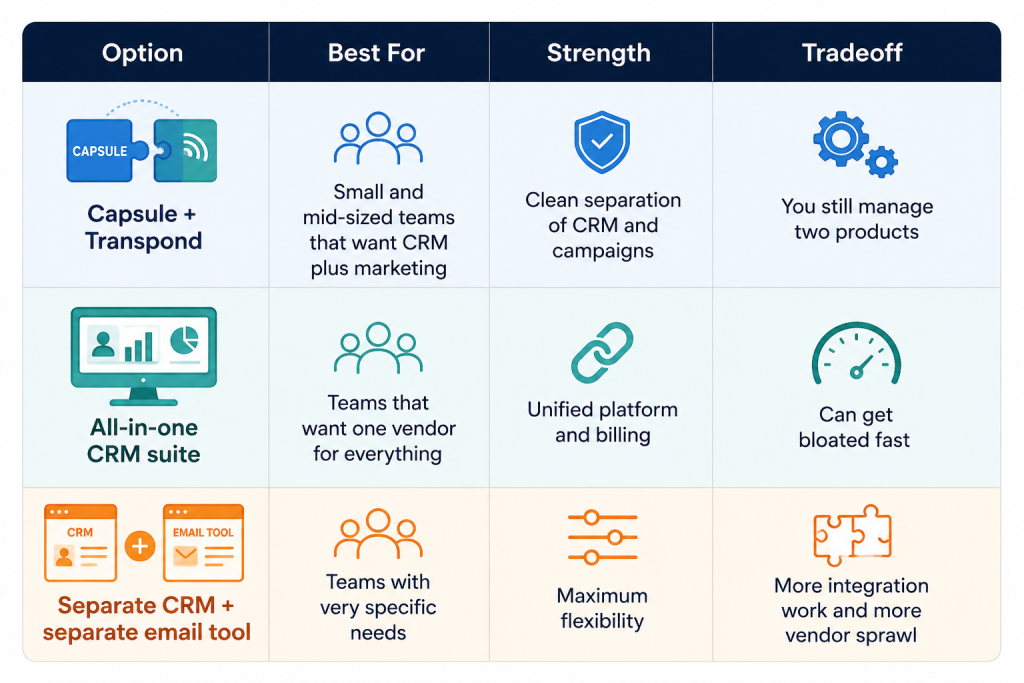
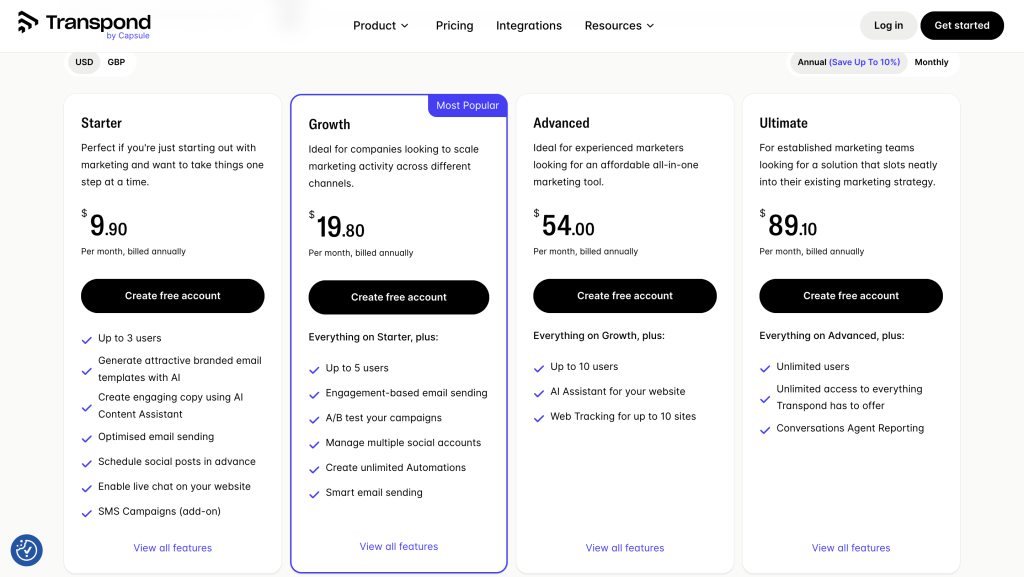
Transpond is the marketing add-on, activated from inside a Capsule account and priced from $11 a month.
Keeping it separate suits businesses that want a CRM and nothing more, which is most of Capsule’s stated audience. A construction firm tracking tenders has no use for campaign automation, and should not pay for it inside a bundle.
The arrangement works against you if marketing and sales genuinely operate as one motion. Two products means two interfaces and two subscriptions, even when the integration between them is tight.
Treat the add-on as a later decision. Buy the CRM, run it for a quarter, and add marketing only when somebody is asking for campaign reporting.
Fit Summary
Capsule fits you if: you run a service or project business with fewer than about 25 staff, your contact list is in the hundreds or low thousands, and work continues after the sale closes.
Start on Free if: you are one or two people with under 250 contacts and a single way work arrives.
Start on Starter if: you have up to five employees, a shared inbox and repeat emails worth templating. $18 per user per month on annual billing.
Start on Growth if: three or more people follow a repeatable process, or you need more than one pipeline. $36 per user per month annually, and the automations usually pay for themselves.
Consider Advanced if: every client needs its own project board and you expect to pass a dozen of them.
Skip it if: you run high-volume outbound, need heavy customisation, or want marketing inside the same product.
For the wider picture, see our Capsule and Transpond pricing breakdown and the comparison against alternatives.
FAQ
Is Capsule CRM free?
There is a permanent free plan for up to two users and 250 contacts, with one sales pipeline and five custom fields. Paid plans start at $18 per user per month billed annually.
What does Capsule cost per user?
Starter is $22 monthly or $18 annually. Growth is $40 or $36. Advanced is $60 or $54. Ultimate is quoted by sales.
Which plan has workflow automations?
Growth and above. Starter has email templates and a shared mailbox but no automations, which is the main reason small teams upgrade.
How many contacts can I store?
250 on Free, 30,000 on Starter, 60,000 on Growth and 120,000 on Advanced. For the businesses Capsule targets these ceilings are rarely the constraint.
Does Capsule include marketing?
No. Marketing is the Transpond add-on, activated from within your account and priced from $11 a month.
Is the annual discount really 18%?
Only on Starter, at 18.2%. Growth and Advanced both save exactly 10%. The badge says “up to 18%”, which is accurate but easy to misread.
Sources
- Capsule CRM pricing, read 6 October 2026 on both the annual and monthly billing toggles.
- Capsule CRM, for the sector and business-size segmentation used throughout this page.
Before You Choose, Compare These
Hand-picked guides to help you choose the right tool — no fluff.
 ComparisonsCapsule and Transpond vs Alternatives 2026The strongest competitors compared side by side.
 PricingCapsule and Transpond Pricing 2026Real tier prices and what each plan actually includes.
 Use CasesWho Is Bright Data Best For? Use Cases & Fit (2026)Who gets the most out of it – and who should skip it.
 ComparisonsCanvas Score by Roya.com vs Alternatives 2026The strongest competitors compared side by side.