


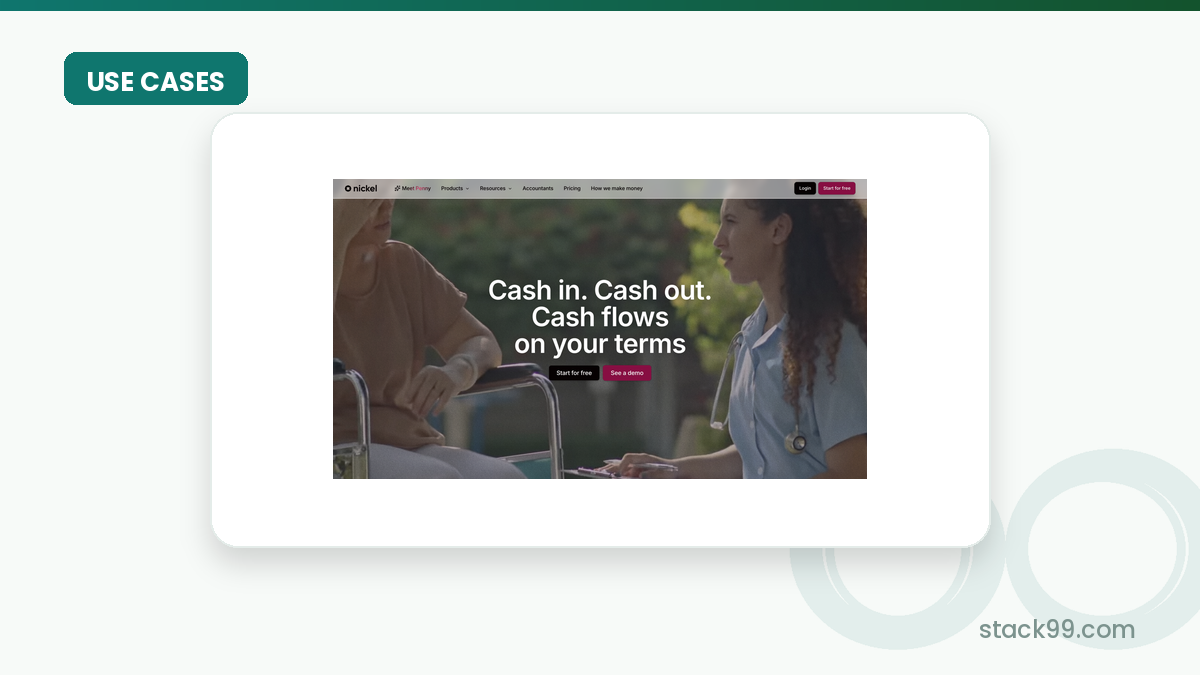
Small businesses under the $25,000 transaction ceiling with three or fewer active users, on QuickBooks.
A free tier carrying bill pay, a payment page, QuickBooks sync and free expedited ACH at no cost.
Headcount, not transaction size. Most teams hit the three-user wall on Core long before the $25,000 limit.
In this guide
Who This Post Is For
Nickel is an accounts payable and receivable product for small businesses, and its free tier is the reason to pay attention. Core costs nothing and carries a $25,000 transaction limit, three active users and a QuickBooks connection. That combination decides almost everything about who this suits.
One structural point up front: Nickel Technology Inc. is a financial technology company rather than a bank. Its own footer states that banking services and the Nickel Visa Commercial Card are provided by Grasshopper Bank, N.A., Member FDIC. That matters when you read the 2 percent yield advertised on balances.
Disclosure: Stack99 earns a commission if you buy through links on this page. It costs you nothing extra and never changes our assessment.
Three numbers sort the candidates. The $25,000 transaction limit on the free plan, the jump to $45 a month for Plus, and the $375 a month for Pro. Work out which side of each line you sit on and the decision makes itself.
If you want to inspect the product while you read, start with Nickel here.
Why Nickel Fits A Specific Niche
The official pages keep surfacing ideas like:
- Team fit
- Workflow clarity
- Productivity
- Governance
The free plan is unusually complete for this category. Invoice payments, a payment page, bill pay, vendor onboarding and a QuickBooks Online and Desktop integration all sit on Core at no cost, alongside free expedited ACH. Most competitors put bill pay behind a subscription.
The Niche Where Nickel Looks Strongest
The sharpest fit is a business billing under $25,000 per transaction with three or fewer people touching the money, already running QuickBooks. That business pays nothing, earns 2 percent on idle balances, and gets expedited ACH free. For a small agency or contractor invoicing in the low thousands, that is a genuinely strong offer.
Second-sharpest fit: a team that has outgrown three users and wants recurring invoices. That is the Plus case, and the trigger is usually headcount rather than transaction size.
That could mean:
- A startup moving beyond informal processes.
- A department scaling volume.
- A team standardizing work that used to be fragmented.
Top Features For This Niche
Feature gating follows the tiers closely, so here is what each one unlocks.
| Plan | Price | What you get |
|---|---|---|
| Core | Free | 2% APY on balances, free expedited ACH, $25,000 transaction limit, standard turnaround. Three active users, invoice payments, payment page, bill pay, vendor onboarding, QuickBooks Online and Desktop, email and chat support. |
| Plus | $45/mo | Monthly rate. $35 a month billed annually, a 20% saving. Raises the limit to $1M per transaction, one day faster turnaround, unlimited users, stored customer card or bank details, recurring invoices, vendor tax documents, 1099 filing, priority support. 14-day trial. |
| Pro | $375/mo | Monthly rate. $300 a month billed annually. Everything in Plus plus API access, vendor verification, a dedicated account manager, dedicated onboarding and training, and single sign-on over SAML or OIDC. |
| Enterprise | Custom | Dedicated support line, API and developer tools, custom per-transaction pricing, multi-entity support, custom ERP and data warehouse integrations, invoice-based billing. |
Read the price column carefully. The pricing page opens with annual billing selected, showing $35 and $300. Switch the control to Monthly and those become $45 and $375. Both figures are labelled per month, which is how the lower one ends up quoted as a monthly rate it is not.
To check whether that fit is real, open Nickel here and compare the official workflow to one live task your team already runs.
For a second live product check, review Nickel here and map the official use case against the one recurring task your team most needs to improve.

Real-World Team Scenario
Picture a six-person design studio invoicing clients between $4,000 and $18,000 a project. Every invoice sits under the free tier’s $25,000 ceiling. The problem is users: the founder, the operations lead and the bookkeeper fill the three Core seats, and two project leads who raise their own invoices have nowhere to sit.
That studio pays $45 a month for Plus, or $420 a year on annual billing, purely for unlimited users. Recurring invoices and 1099 filing come along as a bonus rather than the reason. Nothing about their transaction sizes required the upgrade.
Headcount forced that decision, which is the usual pattern.
Pricing In Context
Nickel publishes a clear four-tier table, so pricing is not the guessing game it is with many fintech products. The structure to understand is the gap rather than the levels. Free to $45 is a real step, and $45 to $375 is an unusually wide one.
What sits in that $330 gap is mostly infrastructure rather than finance features. API access, SAML or OIDC single sign-on, vendor verification and a named account manager. Those are IT and compliance requirements, which means Pro is usually bought by a company whose security review demands it rather than by a finance team that ran out of features.
The 2 percent yield on balances complicates any straight cost comparison, and it applies on Core as well as the paid tiers. Hold an average balance of $50,000 and that is $1,000 a year in theory, which covers the $420 annual cost of Plus several times over. Treat it as a factor rather than a guarantee, since advertised yields move and the banking is provided by a partner bank rather than by Nickel itself.
Alternatives For This Niche
The most common alternatives are usually:
- Lighter tools that are easier to start but weaker on structure.
- Broader platforms that cover more but often feel heavier.
- Manual processes that look cheap but create ongoing drag.
Setup Advice For This Niche
Start on Core, because it is free rather than a trial, and connect QuickBooks first. The integration is the piece most likely to create work if it behaves unexpectedly, and discovering that costs nothing on the free plan.
Run one full billing cycle before considering Plus. The 14-day Plus trial is better spent later, once you know which limit you are actually hitting, since a trial started in week one tests features you have no basis to judge yet.
Verdict
Nickel suits a small business under the $25,000 transaction ceiling with three or fewer people in the system, already on QuickBooks. That business should be on Core, paying nothing. Outgrow the seat count and Plus at $45 monthly is reasonable. Pro at $375 is a different purchase entirely, bought for API access and single sign-on rather than for finance capability.
Look elsewhere if you routinely invoice above $25,000 and cannot justify Plus, if you do not use QuickBooks, or if multi-entity accounting is a requirement, since that sits on the quoted Enterprise tier.
If that sounds like your team, try Nickel here and evaluate the fit through one real operational workflow.
FAQ
What Kind Of Team Is Nickel Best For?
Small businesses invoicing under $25,000 per transaction with three or fewer active users, running QuickBooks Online or Desktop. That profile costs nothing on the Core plan and still gets bill pay, a payment page and free expedited ACH.
Why Does Niche Fit Matter More Than Feature Count?
Because the free tier is genuinely free rather than a trial, and because the limits that end it are specific. A $25,000 transaction ceiling and three users are easy to check against your own numbers before you commit to anything.
Should I Judge Nickel As Universal Software?
Usually headcount rather than transaction size. Plus at $45 a month buys unlimited users and raises the per-transaction limit to $1M, and most teams hit the three-user wall first.
What Is The Best Rollout Strategy?
Connect QuickBooks on the free Core plan and run one complete billing cycle. Save the 14-day Plus trial until you know which constraint is actually binding.
When Should I Choose Something Else?
When transactions regularly exceed $25,000 and Plus cannot be justified, when QuickBooks is not your ledger, or when you need multi-entity support, which Nickel places on its quoted Enterprise plan. Its own comparison pages line it up against Melio, Bill.com, Square, QuickBooks Payments and Forwardly.
Decision Baseline
Count two things before looking at Nickel at all. Your largest single invoice or bill in the last twelve months, and how many people need to raise or approve payments. Those two numbers place you on a tier without a demo. A business whose largest transaction was $9,000 with two people involved has already established that Core is sufficient.
A Better Trial Question
Ask what happens at the $25,000 line. Does a larger transaction get blocked, split or simply refused, and does the system warn you before a customer is left unable to pay? Discovering that is left to you on a free tier, and it is better understood before an important invoice meets it.
The First Week Test
Week one is the QuickBooks connection and one real invoice through the payment page. Nothing else. The sync between a payments tool and a ledger is where reconciliation problems originate, and a single invoice travelling the whole path end to end will tell you more than a dozen test records.
Adoption Reality
Adoption for an AP and AR tool is decided by vendors and customers rather than by your own team. Your vendors have to complete onboarding to be paid, and your customers have to use the payment page. Both are listed on Core, so you can test real-world willingness without spending anything, which is the single most useful property of this free tier.
What To Measure
Track days sales outstanding before and after, and the share of customers who pay through the payment page rather than by their old method. The second number is the honest adoption signal. A payment tool nobody outside your company uses has moved the work rather than removed it.
The Handoff Check
The handoff that matters is into QuickBooks. Confirm how payments, fees and partial payments appear in your ledger, and whether your bookkeeper accepts the result. Vendor tax documents and 1099 filing sit on Plus, so a business relying on those at year end should know that the free tier stops short of them.
Team Ownership
Your bookkeeper or accountant should hold the verdict here, not whoever found the product. They carry the reconciliation work, and Nickel runs a dedicated accountants programme that suggests the vendor expects that relationship. Bring them in before the QuickBooks connection is made rather than after.
Where Complexity Hides
Complexity hides in the banking arrangement. Nickel is a financial technology company and not a bank, with banking services and the Visa Commercial Card provided by Grasshopper Bank, N.A., Member FDIC. Anyone treating the 2 percent yield as a core reason to adopt should read that structure properly, because the yield is a feature of a partner banking relationship rather than a rate Nickel sets alone.
A Fair Evaluation Window
One full billing cycle on Core, then a decision. The free plan removes any clock, which cuts both ways: nothing forces a verdict, so set the date yourself. Keep the 14-day Plus trial in reserve for the moment a specific Core limit starts hurting.
Evidence Over Enthusiasm
The evidence here is three counts from one billing cycle. Invoices that cleared without manual chasing, transactions that hit the $25,000 ceiling, and the number of people who asked for access and could not have it. Those three decide the tier, and all three are free to collect.
The Exit-Cost Question
Exit cost is low while you stay on Core, since the ledger of record remains QuickBooks and that is where your history lives. Moving off becomes harder once vendors are onboarded and customers have stored payment details, because both have to be re-established elsewhere. Vendor onboarding is the sticky part rather than the data.
Before You Choose, Compare These
Hand-picked guides to help you choose the right tool – no fluff.
 FeaturesNickel Top Features 2026The standout features and whether they justify the price.
 Use CasesWho Is ThorData Best For? Use Cases & Fit (2026)Who gets the most out of it – and who should skip it.
 AlternativesSeel Alternatives 2026Credible alternatives and when each one wins.
 FeaturesProcess Street Top Features 2026The standout features and whether they justify the price.