


In this guide
Why This Post Matters :
Bouncer checks whether an email address is real and deliverable before you send to it. Typos, dead inboxes, role accounts and spam traps get flagged, and your bounce rate drops. That much is true of every verification service. What separates them is the surrounding toolkit, and Bouncer ships eight distinct products rather than one.
Disclosure: Stack99 earns a commission if you buy through links on this page. It costs you nothing extra and never changes our assessment.
The reason this matters in 2026 is a number: 0.3%. Google and Yahoo both require senders to keep the spam complaint rate below that threshold, and both also expect SPF or DKIM on every sending domain. A list full of dead addresses damages the engagement signals that keep you under the line, and a single send to a spam trap can undo months of careful reputation building.
If you want to inspect the product while you read, start with Bouncer here.
What The Official Pages Keep Pointing To :
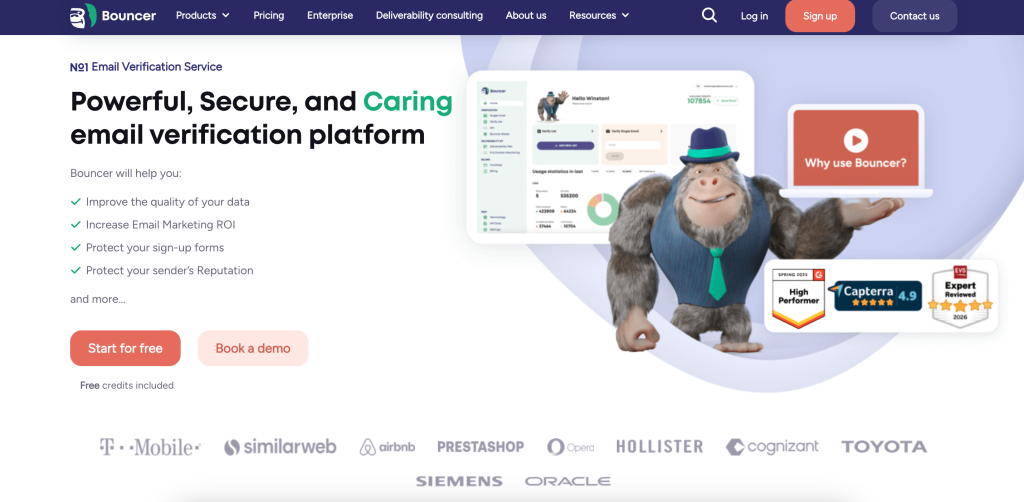
Bouncer lists eight things under the heading of what it can do, and each is a separate product rather than a feature of one.
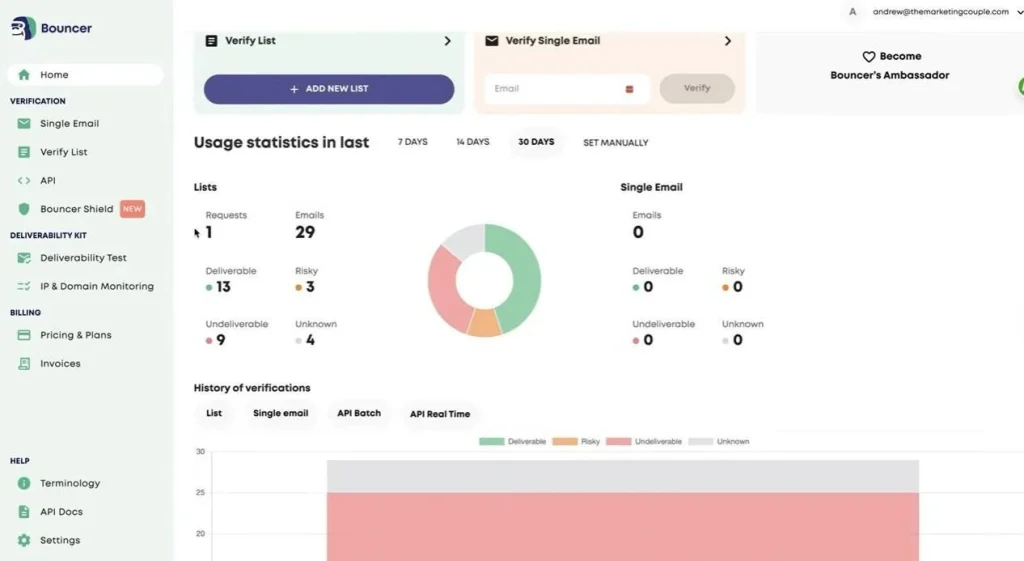
- Email Verification App for bulk list cleaning in the browser
- Email Verification API with synchronous and asynchronous endpoints
- Bouncer Shield for real-time checks at the signup form
- Toxicity Check scoring addresses from 0 to 5
- Deliverability Kit for inbox placement and blocklist monitoring
- Integrations with 25 named marketing and outreach platforms
- Company Data Enrichment from publicly available company information
- Email Engagement Insights
Most buyers need two of those eight. Working out which two is the whole exercise, because the pricing model treats them very differently.
Product Fit In 2026 :
Three of the eight deserve a closer look, because they solve problems the other five do not.
Toxicity Check goes past valid or invalid. Bouncer scores an address from 0 to 5 based on whether it has been widely circulated or exposed in a breach, whether it belongs to a known complainer or litigator, and whether it looks like a potential spam trap. A technically valid address can still be the one that ends your sending reputation, and a binary verifier will wave it straight through.
Bouncer Shield moves verification to the moment of entry. It checks an address as someone types it into your signup form and blocks bad entries on the email address or on the originating IP, without code. Cleaning a list after the fact is remedial work. Stopping the bad address from entering the database is the fix.
The Deliverability Kit answers a different question entirely. Verification tells you the address exists. Inbox placement testing tells you whether your message arrived in the inbox rather than the spam folder, and blocklist monitoring tells you whether an IP or domain has been listed. Plenty of teams buy verification credits and wonder why open rates stay flat. The answer often lives here.
To pressure-test that fit early, check Bouncer here and compare the official workflow language against your team’s current process.
Pricing And Data Notes :
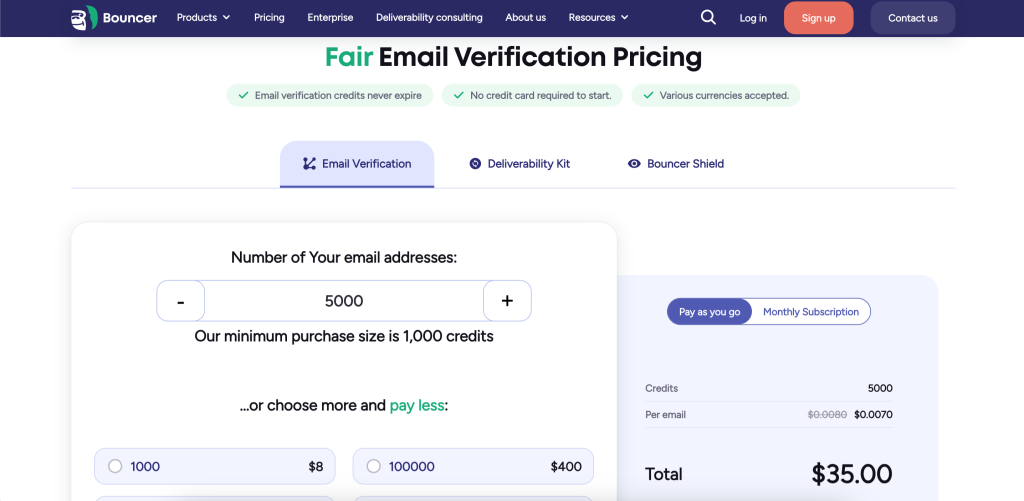
Verification is sold as pay-as-you-go credits rather than a monthly subscription, and the credits never expire. Minimum purchase is 1,000. No card is required to start, and the ladder published on 25 October 2026 runs like this.
- 1,000 credits, $8, which is $0.0080 an email
- 5,000 credits, $35, which is $0.0070 an email
- 10,000 credits, $60, which is $0.0060 an email
- 50,000 credits, $250, which is $0.0050 an email
- 100,000 credits, $400, which is $0.0040 an email
- 250,000 credits, $750, which is $0.0030 an email
- 500,000 credits, $1,250, which is $0.0025 an email
- 1,000,000 credits, $2,000, which is $0.0020 an email
- Above a million, quote only
Unit cost falls fourfold between the smallest and largest purchase. Because credits do not expire, the arithmetic rewards buying ahead: 100,000 credits at $400 costs the same as 50,000 at $250 plus another 50,000 at a worse rate, with $100 left over. Anyone verifying regularly should buy one tier above their immediate need.
Writing that this product has no public pricing would be wrong. The ladder is published, explicit and easy to read. What sits outside it are the two subscription products: the Deliverability Kit starts at $25 a month on a Starter plan covering 250 test emails and 10 IPs or domains monitored, and Bouncer Shield is priced separately again.
What Buyers Should Watch :
Four things, in descending order of how often they catch people out.
Three products, three bills. Verification credits, the Deliverability Kit and Bouncer Shield are purchased separately. A budget built from the credit ladder alone will miss two subscriptions.
Unknown results still consume credits. Every verifier returns a proportion of addresses it cannot resolve, usually because the receiving server refuses to confirm or deny. Bouncer advertises an unknown rate below 2%, which is a vendor figure we could not independently confirm. Ask how unknowns are billed before committing to a large purchase.
Check your platform is on the list. Bouncer names 25 integrations including Mailchimp, Klaviyo, HubSpot, Brevo, GetResponse, Constant Contact, AWeber, ConvertKit, MailerLite, Moosend, Mautic, Pipedrive, Lemlist, Woodpecker and QuickMail, plus automation bridges through Make, Integrately and Pabbly. A platform missing from that list means API work or a CSV round trip.
Verification is not authentication. No amount of list cleaning substitutes for SPF, DKIM and a DMARC record. Google requires authentication from every sender and tightens the requirements past 5,000 messages a day to Gmail. Clean the list and publish the DNS records, in whichever order suits you, but do both.
Want to evaluate that directly? open Bouncer here and compare it against one real business workflow.
Practical Recommendation :
Buy 1,000 credits for $8 and run them against a segment you already understand. Pick a list where you can predict roughly how many addresses are dead, then check whether the results match your expectation. Eight dollars buys a real answer about accuracy, which no comparison table can give you.
Teams sending to a stable opt-in list a few times a month will find the credit ladder cheap and the Deliverability Kit the more valuable purchase. Cold outreach has the opposite profile: heavy credit consumption, and Toxicity Check earning its place because litigator and spam-trap addresses are the specific risk in that work.
Anyone running paid acquisition into a signup form should look hard at Shield. Fake and disposable addresses entering through a form are a cost you pay twice, once in ad spend and again in sender reputation.
Final Buying Note :
Credits that never expire remove most of the risk from this decision. A thousand of them cost less than lunch, and the only way to judge a verification service is to run your own addresses through it and inspect what comes back.
Work out which of the eight products you actually need before the sales conversation starts. Most teams need verification plus one other, and paying for all three subscription lines when you need one is the common mistake here.
Verdict :
Bouncer is a verification engine wrapped in a deliverability toolkit, priced transparently, with the per-email cost dropping from $0.008 to $0.002 as volume climbs. The credit model suits lumpy workloads better than a monthly subscription would, and the extras beyond verification are genuinely separate products rather than tiers of one.
The vendor publishes several large headline counters covering addresses verified and bounces prevented. Those are vendor figures we could not verify, so judge the product on the $8 test rather than on the numbers above the fold.
To judge it on your own data, try Bouncer here and compare one real team workflow against the product’s official path.
FAQ :
How much does Bouncer cost per email?
Between $0.0080 and $0.0020 depending on how many credits you buy at once. A thousand credits cost $8, a million cost $2,000. Credits never expire and the minimum purchase is 1,000.
Do Bouncer credits expire?
No. The pricing page states that email verification credits never expire, which means buying a larger tier at a better unit rate carries no deadline risk.
What is the difference between verification and Toxicity Check?
Verification answers whether an address exists and can receive mail. Toxicity Check scores it from 0 to 5 on risk, flagging widely circulated or breached addresses, known complainers and litigators, and potential spam traps. An address can pass the first test and fail the second.
Does Bouncer integrate with Mailchimp and HubSpot?
Both are among the 25 named integrations, alongside Klaviyo, Brevo, GetResponse, Constant Contact, AWeber, ConvertKit, MailerLite, Pipedrive, Lemlist and others. Make, Integrately and Pabbly cover platforms with no direct connector.
Is the Deliverability Kit included with credits?
No. It is a separate monthly subscription starting at $25 a month for 250 test emails and 10 IPs or domains monitored. Bouncer Shield is priced separately again.
Will verification alone keep me out of spam?
No. Google and Yahoo both require SPF or DKIM authentication from every sender and a spam complaint rate below 0.3%. Clean lists help you stay under that threshold, though the DNS records are a separate job you still have to do.
More on Bouncer
Hand-picked guides to help you choose the right tool — no fluff.
Case StudiesApollo.io Case Study 2026What actually happened when teams rolled it out.
IntegrationsInboxAlly Integrations Guide 2026What it connects to and how well each link holds up.
IntegrationsJibble Integrations Guide 2026What it connects to and how well each link holds up.
ComparisonsRank Prompt vs Alternatives 2026The strongest competitors compared side by side.