


This Apollo.io case study is written as a practical operating story for a B2B team that has outgrown…
The best Apollo rollout starts with a narrow use case. Instead of importing every possible account and…
A responsible Apollo case study should avoid invented numbers. The right way to measure results is to…
In this guide
Company And Challenge :
This Apollo.io case study is written as a practical operating story for a B2B team that has outgrown scattered prospecting. It is not a fake customer win with invented revenue numbers. The useful lesson is more grounded: Apollo is strongest when a team uses it to connect account research, contact discovery, sequencing, AI-assisted work, and CRM handoff into one repeatable sales motion.
Disclosure: Stack99 earns a commission if you buy through links on this page. It costs you nothing extra and never changes our assessment.
In 2026, that matters because outbound teams are under pressure from two sides. Buyers expect more relevant outreach, while sales leaders still need enough pipeline coverage to keep growth predictable. A spreadsheet, a generic email tool, and a separate enrichment vendor can work for a while, but the workflow starts to fray once reps need to prioritize accounts, personalize outreach, avoid duplicate touches, and report what happened.
Apollo’s own help materials position sequences as multichannel campaigns that can include email, calls, social touches, and tasks. Apollo also describes AI workflows that can search for people and companies, enrich records, create or update contacts and accounts, add prospects to sequences, and analyze performance from an AI workspace. That combination is the real case study here: fewer disconnected steps between “find the right account” and “start the right conversation.”
If you want to follow along with the product open, start Apollo.io here.
Problem Before The Product :
The pre-Apollo workflow usually looks simple on paper and messy in practice. Someone builds a target account list, another person finds contacts, a rep copies notes into the CRM, and an ops person tries to understand which sequence is active. The problem is not one missing feature. The problem is the handoff between tools.
That creates four common bottlenecks:
- Prospect data gets stale before the team acts on it.
- Reps spend too much time deciding who to contact next.
- Outreach happens in isolated sequences with uneven quality control.
- Reporting shows activity, but not always the path from research to response.
Apollo fits this problem because it does not stop at contact lookup. The platform brings search, enrichment, sequencing, AI support, and integrations into the same operating layer. That makes it easier to build a workflow a sales manager can inspect and improve, rather than a loose collection of rep habits.
Implementation Process :
The best Apollo rollout starts with a narrow use case. Instead of importing every possible account and launching every sequence at once, the team should pick one market segment, one buyer persona, and one outreach goal.
In this case-study workflow, the implementation would happen in five steps.
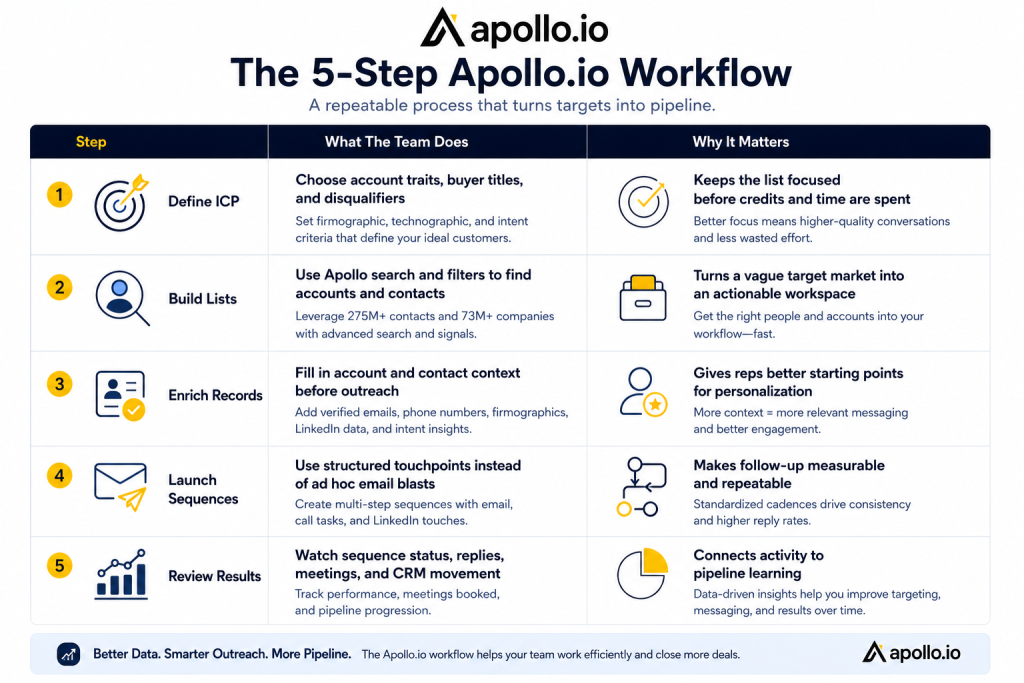
Apollo’s sequence documentation is especially important in this process because sequences can include planned touchpoints over time. The point is not simply to send more emails. It is to create a controlled path where the team can see which prospects are active, which contacts are already enrolled, and where follow-up needs attention.
Results And Metrics :
A responsible Apollo case study should avoid invented numbers. The right way to measure results is to define the metrics before the rollout, compare them against the team’s previous baseline, and then review whether the workflow improved the quality or speed of pipeline creation.
The most useful metrics are:
- List acceptance rate: The share of accounts and contacts that reps agree are worth pursuing.
- Sequence enrollment quality: The share of enrolled contacts that match the intended persona.
- Reply quality: The share of replies that create a real next step.
- Meeting conversion: The share of relevant replies that become booked conversations.
- CRM cleanliness: The share of contacted accounts with useful notes, stages, and follow-up context.
- Rep time saved: The time was reduced across research, enrichment, and sequence setup.
Those metrics keep the conversation honest. Apollo can support the workflow, but the ROI still depends on how clearly the team defines the market, how carefully it builds sequences, and how consistently reps work the follow-up.
For a small team, the first win may simply be less list-building chaos. For a larger team, the bigger win may be a more controlled sales process that managers can coach.
If that is the problem you are trying to solve, try Apollo.io here and start with one focused segment instead of the whole database.
Important Features :
Prospecting And Search –
Apollo’s core value starts with helping teams find accounts and contacts. The search layer matters because it sets the quality ceiling for everything that follows. If the list is too broad, even a polished sequence will feel generic.
The practical move is to build saved searches around real buying signals: company profile, job function, geography, technology fit, or account stage. A messy list creates messy outreach. A tight list makes every later step easier.
Sequences –
Sequences are where Apollo becomes operational. Apollo describes them as outreach campaigns that help teams contact prospects over a planned period using email, calls, social engagement, and tasks. That is useful because sales work rarely happens in one touch.
The strongest teams build separate sequences for different situations: cold outbound, event follow-up, inbound recycling, partner outreach, and account expansion. Each sequence should have a reason to exist.
AI Workflows –
Apollo’s AI documentation describes workflows where AI tools can work with Apollo data to search, enrich, create or update records, add prospects to sequences, and analyze performance. That is a meaningful direction for teams that want less manual switching between research and action.
The caution is simple: AI should accelerate a defined workflow, not replace judgment. The team still needs clear ICP rules, review checkpoints, and quality control.
Integrations –
Apollo is more useful when it fits the rest of the revenue stack. Teams should pay attention to CRM sync, sequence ownership, permissions, and how data flows into reporting. A tool can look great in isolation and still fail if it creates duplicate data downstream.
Pros And Cons :
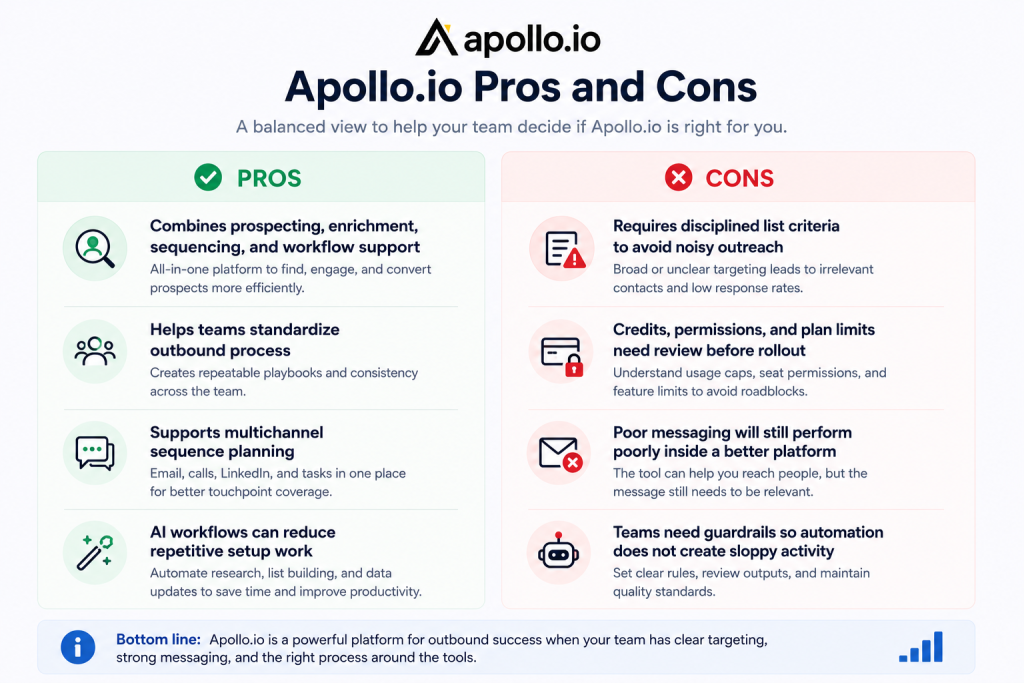
The balanced view is that Apollo is not a magic pipeline. It is infrastructure for teams willing to run outbound with more structure.
Lessons Learned :
The main lesson is that Apollo works best when the team treats it as a system, not a shortcut. A rushed rollout can produce more activity without more quality. A careful rollout can create cleaner targeting, faster research, better sequence management, and more useful sales data.
The second lesson is that ownership matters. Someone should own list quality. Someone should own sequence performance. Someone should own CRM hygiene. Apollo can support each role, but it cannot decide those responsibilities for the team.
The third lesson is that the first use case should be small enough to learn from. One segment, one buyer persona, and one campaign is enough to prove whether the workflow is improving.
ROI Calculation :
The cleanest Apollo ROI calculation uses your own baseline.
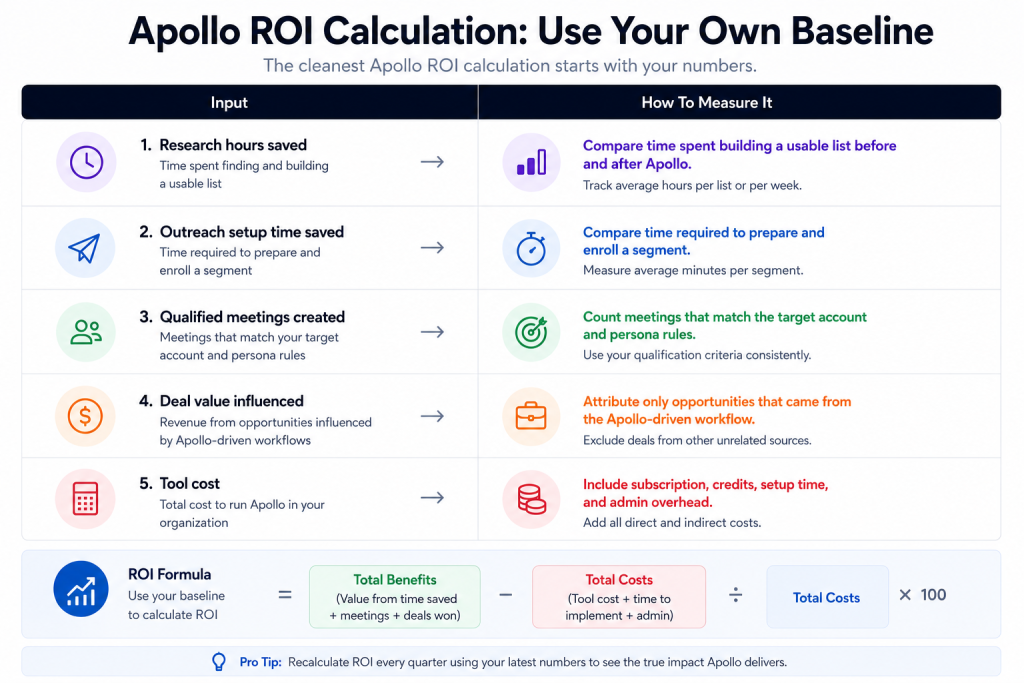
The simple formula is:
ROI = pipeline value influenced minus Apollo cost, divided by Apollo cost.
That formula is only useful when the team is strict about attribution. Do not count every closed deal if Apollo only touched one side of the activity. Count the opportunities where the Apollo workflow clearly helped identify, engage, or manage the account.
Before you commit to a full rollout, open Apollo.io here and test the ROI model with one segment.
How To Replicate This Workflow :
Start with a segment that is narrow enough to judge. For example, use one industry, one company-size range, and one buyer persona. Build the account and contact list, then review it manually before launching anything.
Next, write a sequence that reflects the segment’s actual pain. Keep the message specific. Use Apollo’s sequence structure to plan the steps, but do not let automation become an excuse for generic copy.
Then, define the CRM rules. Decide which fields must be updated when a contact is disqualified, how replies are categorized, and when a rep should move from automated sequence to personal follow-up.
Finally, review the campaign after enough activity has happened to learn from it. The goal is not to declare victory after the first reply. The goal is to understand whether the workflow produces better targeting, cleaner activity, and more qualified conversations than the previous process.
If it does, repeat the pattern with the next segment.
Expert Verdict :
Apollo.io is a strong fit for teams that want a connected outbound workflow in 2026. Its value is clearest when prospecting, enrichment, sequencing, AI assistance, and CRM flow are part of one process. The product is less compelling if a team only wants a quick list export and does not plan to improve how outreach is run.
The best reason to consider Apollo is not that it promises easy results. It is that it gives serious teams a more organized way to build and measure outbound.
If your team is ready to test that kind of workflow, start Apollo.io here.
FAQ :
Is Apollo.io useful for outbound sales teams in 2026?
Yes. Apollo is useful when a team wants to connect prospecting, enrichment, sequencing, and workflow management instead of running those steps in separate tools.
Does Apollo.io include sequences?
Yes. Apollo’s official documentation describes sequences as outreach campaigns with planned touchpoints such as emails, calls, social engagement, and tasks.
Can Apollo.io support AI-assisted sales workflows?
Yes. Apollo’s official materials describe AI-connected workflows for searching, enriching, creating or updating records, adding prospects to sequences, and analyzing performance.
What should I measure in an Apollo.io case study?
Measure list quality, sequence enrollment quality, reply quality, meetings created, CRM cleanliness, rep time saved, and pipeline influenced.
Is Apollo.io a good fit for every team?
Not always. Apollo is strongest for teams that will define their ICP, manage sequences carefully, and review results. Teams that only want quick exports may not use enough of the platform to justify the effort.
Before You Choose, Compare These
Hand-picked guides to help you choose the right tool — no fluff.
 FeaturesApollo.io Top Features 2026The standout features and whether they justify the price.
 ReviewsApollo.io Review 2026Hands-on verdict with the pros, cons and who it fits best.
 ReviewsStampEzee Review 2026Hands-on verdict with the pros, cons and who it fits best.
 Use CasesWho Is Melio Best For? Use Cases & Fit (2026)Who gets the most out of it — and who should skip it.