


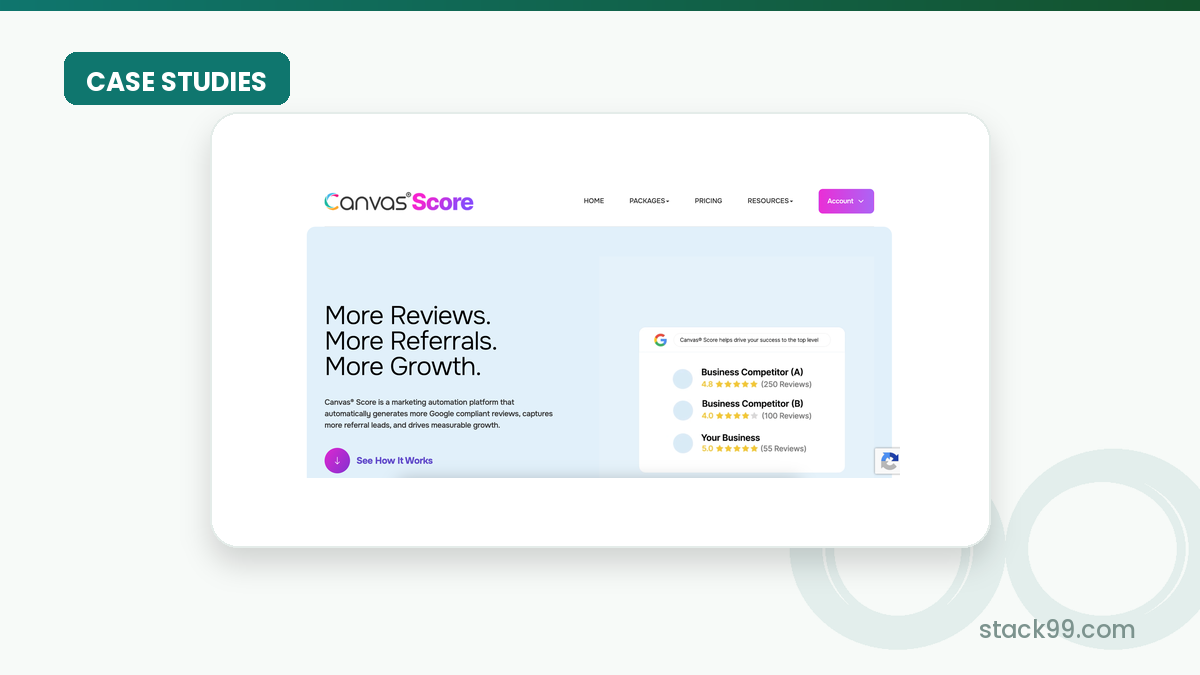
Canvas® Score does not publish a classic named public customer case study with before-and-after revenue…
For a realistic implementation, the Pulse package is the most sensible official starting point because…
In this guide
Company And Challenge :
Canvas® Score does not publish a classic named public customer case study with before-and-after revenue numbers on the pages reviewed for this draft. So instead of pretending we have metrics the official site does not provide, this article uses a transparent real-world implementation walkthrough built only from official product claims, package details, and public feature pages.
Disclosure: Stack99 earns a commission if you buy through links on this page. It costs you nothing extra and never changes our assessment.
That approach matters because accuracy matters more than fake storytelling.
The official Canvas® Score site positions the product as a review and referral automation platform that integrates with Google Business Profile and, on higher tiers, can connect with a practice management or EHR system. The product is also publicly described as being trusted by thousands of healthcare practices, which makes a healthcare-style use case the most natural lens.
So the challenge here is straightforward: imagine a growing healthcare or local service business that already delivers good customer experiences but struggles to turn that goodwill into a visible online reputation, referral flow, and review-response rhythm.
That is the exact operational problem Canvas® Score is built to solve.
If you want to inspect the official product directly while reading, start with Canvas® Score here.
The Problem Before Canvas® Score :
Before a platform like this, the work usually gets split across too many small manual tasks:
- Staff ask for reviews inconsistently.
- Review Replies Sit Too Long.
- Referral Requests Happen Only When Someone Remembers.
- Contact Lists Are Not Centralized.
- Website Testimonials Go Stale.
- Google Business Profile Activity Feels Reactive Instead Of Systematic.
That is a bigger issue than it sounds.
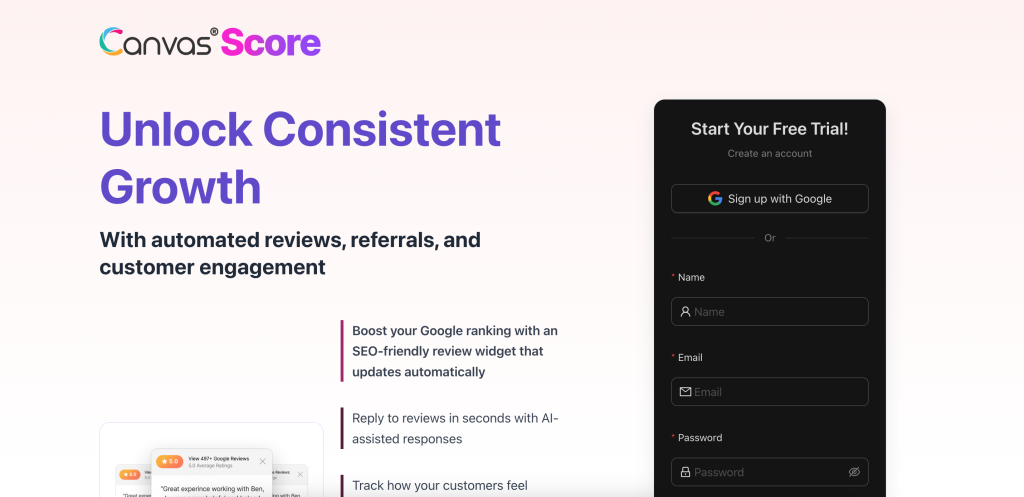
A business can be excellent offline and still look average online if no system exists to collect reviews, respond quickly, surface trust signals, and guide happy customers toward referrals. The official Canvas® Score messaging leans hard into that gap. It talks about more reviews, more referrals, and more growth, with Google Business Profile integration, AI-powered replies, review widgets, NPS surveys, and campaign automation doing the heavy lifting.
In other words, the challenge is not “how do we become a better business?” The challenge is “how do we turn existing customer satisfaction into visible digital proof without burning staff time?”
Implementation And Package Choice :
For a realistic implementation, the Pulse package is the most sensible official starting point because the public pricing page calls it the most popular plan and adds the capabilities that move the workflow beyond passive monitoring.
According to the official pricing and package pages, Pulse includes:
- 1 Google Business Profile Location.
- 1,000 Active Contacts.
- 1 Referral Incentive Campaign.
- 100 AI-Powered Replies Per Month.
- 2 Review Embed Widgets.
- 250 SMS Messages Per Month.
- 250 Email Messages Per Month.
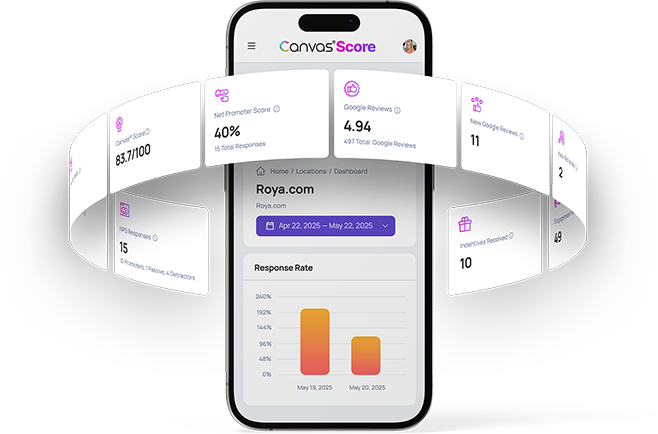
- Full Reputation Intelligence Dashboard.
- NPS Surveys And Feedback Insights.
That matters because Echo is a lighter reputation starter, while Surge is aimed at higher volume and multi-location use. Pulse is where review management starts becoming an actual growth workflow instead of a basic monitoring tool.
A sensible rollout looks like this:
- Connect Google Business Profile.
- Import Or Upload The Active Contact List.
- Set Up The Review Widget On The Website.
- Configure AI-Assisted Review Replies.
- Launch A First Referral Campaign.
- Send NPS Surveys To Capture Feedback And Spot Promoters.
That is not guesswork. It is the public feature set translated into an operating sequence.
If you want to test that same official workflow yourself, open Canvas® Score here.
What Changed Operationally :
Since the official site does not publish a named customer’s private outcomes, the safest way to talk about results is to focus on what the workflow can now measure and automate.
After implementation, the business can now systematically manage:
- Review Collection Through Google Business Profile Integration.
- Faster Replies Through AI-Assisted Response Drafting.
- Website Trust Through Live Review Widgets.
- Contact Follow-Up Through SMS And Email Quotas.
- Referral Capture Through A Built-In Campaign.
- Loyalty Signals Through NPS Surveys.
That is already a meaningful operational shift.
Before the platform, staff might have been manually chasing reviews and occasionally updating a site testimonial section. After the platform, review requests, review replies, referral workflows, and feedback collection all sit inside one system with a clearer dashboard.
That is the real-world improvement you can trust from the official material. Not a fake “237% growth” number. A tighter, more repeatable reputation and referral machine.
The Most Important Features Behind The Change :
The first key feature is Google Business Profile integration. Officially, Canvas® Score connects with GBP so reviews can be managed in one place. That matters because the review workflow breaks down quickly when staff have to bounce between tools.
The second key feature is AI-powered replies. The official help and blog materials say the platform can generate professional, on-brand responses for review replies, and that users can approve them and post directly. That is one of the highest-value features because it saves repetitive admin work while keeping response speed healthy.
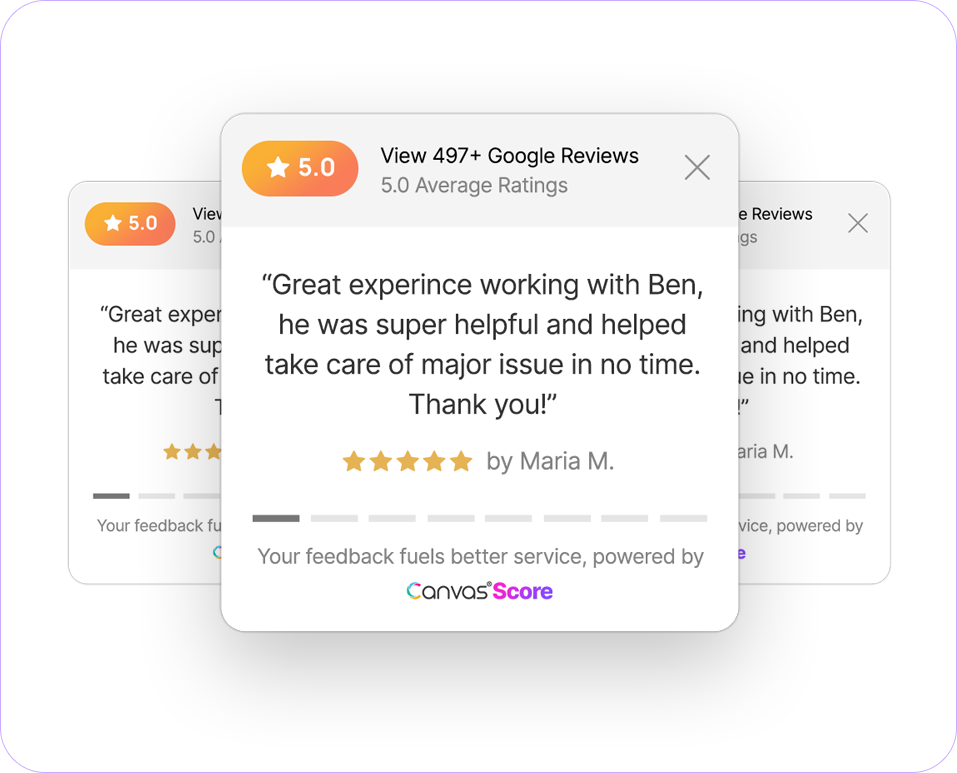
The third key feature is the SEO-friendly review widget. The official site repeatedly highlights that widgets can pull in live Google reviews and keep the website current. That is practical because it turns reputation proof into visible site content instead of leaving it trapped on Google alone.
The fourth key feature is the contact and survey layer. Pulse and Surge add contact storage, NPS surveys, and referral campaigns. That is where Canvas® Score stops being just a review tool and becomes a broader customer-engagement system.
The fifth key feature is routing and messaging. Pulse includes lead routing plus monthly SMS and email allowances. That gives teams a cleaner way to run follow-up without improvising every step.
Lessons Learned From This Real-World Use Pattern :
The first lesson is that reputation management works better when it is tied to workflow, not goodwill.
Most teams do not need a pep talk about asking for reviews. They need a system that makes asking, replying, showcasing, and following up happen consistently.
The second lesson is that a review platform becomes more valuable when it also handles referrals and surveys. Officially, that is where the upgrade path from Echo to Pulse and Surge becomes meaningful. A business is no longer just collecting stars. It is building a pipeline from feedback to referral activity.
The third lesson is that public trust signals should not live in one channel only. If reviews stay only inside Google Business Profile, the website misses a major proof layer. The review widget closes that gap.
The fourth lesson is that named-case-study vanity metrics are less important than a repeatable process. A team that can reliably collect, respond, display, and route customer sentiment is already in a much stronger position.
ROI Without Fake Math :
I am not going to fabricate return-on-investment numbers that the official site does not provide. But we can still evaluate ROI honestly.
The public monthly pricing is:
- Echo: $25.
- Pulse: $89.
- Surge: $269.
A buyer should ask:
- Would Faster Replies Save Staff Time?
- Would One Additional Referred Customer Cover The Plan?
- Would A Better Review Flow Improve Conversion Trust On The Site?
- Would NPS Feedback Help Catch Service Problems Earlier?
That is the clean way to think about ROI here.
Even one meaningful customer win, one saved relationship, or one measurable reduction in admin work can make the lower tiers easy to justify. The exact number depends on the business, which is why the honest answer is to test the workflow instead of inventing a made-up payback period.
If you want to run that test properly, start with Canvas® Score here.
How To Replicate This Workflow :
If you want to reproduce this case-study pattern inside a real business, keep it simple:
- Choose The Package That Matches Your Current Scale.
- Connect Google Business Profile First.
- Set Up At Least One Review Widget On The Website.
- Train One Team Member To Review And Approve AI Replies Daily.
- Import Contacts And Launch A Controlled NPS Or Referral Flow.
- Review Dashboard Trends Weekly Instead Of Guessing.
That process is grounded in the official public product structure. It does not rely on hidden tricks or speculative tactics.
The point is not to automate everything at once. The point is to get one repeatable loop working cleanly, then expand.
Verdict :
Canvas® Score makes the most sense for businesses that want to turn reputation management into a steady operating system instead of a side chore. The public feature set is strongest when the business needs Google review management, live website proof, AI reply support, referral generation, and customer-feedback loops to work together.
The product looks especially relevant for healthcare and local-service environments, because that is where Google Business Profile visibility, trust, and referrals have direct commercial weight.
The biggest strength is not one isolated feature. It is the way the official platform combines reviews, replies, widgets, surveys, and referrals into one coherent loop.
If that sounds like your workflow gap, open Canvas® Score here and test the package that fits your current scale.
FAQ :
Does Canvas® Score Publish Public Named Customer Metrics?
Not on the pages reviewed for this draft. That is why this article uses a transparent official-feature walkthrough instead of inventing outcomes.
Which Canvas® Score Plan Fits A Growing Single-Location Business Best?
Pulse is the strongest public fit because it adds contact storage, NPS surveys, referral campaigns, AI-powered replies, and messaging volume without jumping all the way to multi-location scale.
What Makes Canvas® Score Different From A Basic Review Tool?
Officially, it combines Google Business Profile review management with AI-assisted replies, review widgets, NPS surveys, referral automation, and, on higher tiers, deeper integrations.
Is Canvas® Score Only For Healthcare Practices?
No. The official FAQ says it is designed for any business with a Google Business Profile, though the public site also notes strong traction with healthcare practices.
What Is The Fastest Way To Evaluate It?
Connect GBP, set up a widget, test AI replies, and run one simple contact-based campaign. That will tell you more than a sales pitch ever will.
More on Canvas® Score by Roya.com
Hand-picked guides to help you choose the right tool — no fluff.
 Advanced GuidesCanvas® Score by Roya.com Advanced Guide 2026Deeper workflows once the basics are in place.
 ReviewsCanvas® Score by Roya.com Review 2026Hands-on verdict with the pros, cons and who it fits best.
 ComparisonsFreshsales vs Alternatives 2026The strongest competitors compared side by side.
 ComparisonsSitesGPT.com vs Alternatives 2026The strongest competitors compared side by side.