


In this guide
| Product | Price | What you get |
|---|---|---|
| Residential Proxies | $2.00/GB | unit price buying 1 GB; falls to $0.65/GB only at the 5,000 GB step costing $3,250 |
| Mobile Proxies | $5.00/GB | unit price buying 1 GB; $2.20/GB at the 500 GB step costing $1,100 |
| Static ISP Proxies | $0.75/IP | advertised per-IP rate for long sessions on one address |
| SERP API | $1.20/1K | per thousand responses at 15,000; $0.70 at 1,000,000 responses costing $700 |
Pricing Overview :
ThorData sells proxy bandwidth and scraping endpoints rather than software seats, which changes how you should read its pricing page entirely. Nothing here is a monthly plan. You buy a quantity, you consume it, and the unit price you pay depends on how large that quantity was.
Disclosure: Stack99 earns a commission if you buy through links on this page. It costs you nothing extra and never changes our assessment.
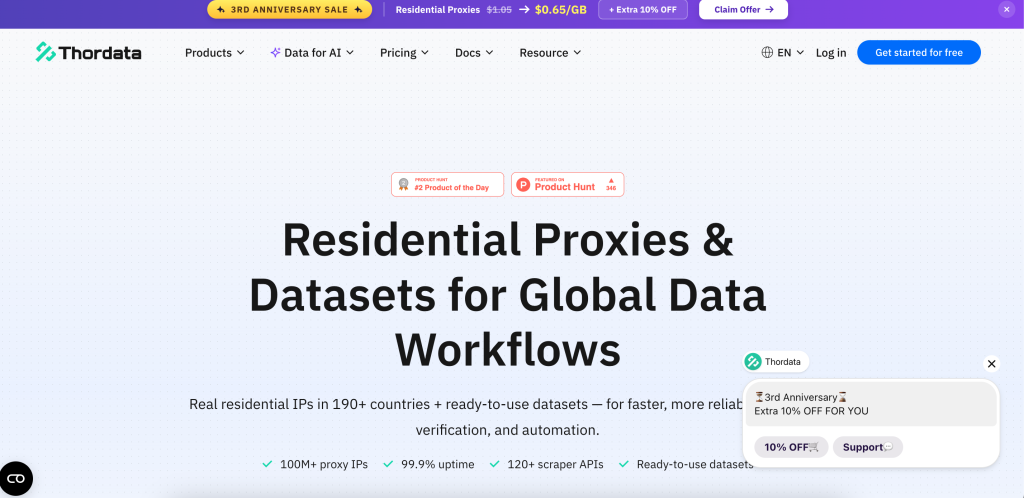
The top of the page shows four product cards with a single figure each: residential at $0.65/GB, mobile at $2.20/GB, static ISP at $0.75/IP, and the Web Scraper API offered on a free trial. Scroll past the FAQ and a second section headed Thordata pricing packages lists the actual volume steps. Those two parts of the same page disagree about what you will pay, and the lower section is the one that bills you.
Open the packages section yourself while you read. The ThorData pricing page carries both views, and the gap between them is the whole story of this product’s cost.
What The Official Pages Emphasize :
Residential bandwidth runs through eight published steps, and the unit price moves by a factor of three across them.
- 1 GB at $2.00 a gigabyte, total $2.00
- 10 GB at $1.80 a gigabyte, total $18.00
- 50 GB at $1.50 a gigabyte, total $75.00
- 150 GB at $1.00 a gigabyte, total $150.00
- 350 GB at $0.80 a gigabyte, total $280.00
- 1,000 GB at $0.73 a gigabyte, total $730.00
- 2,000 GB at $0.70 a gigabyte, total $1,400.00
- 5,000 GB at $0.65 a gigabyte, total $3,250.00
Reaching the advertised rate therefore costs $3,250 in one purchase. A team testing the network on a single gigabyte pays $2.00, which is 3.1 times the number on the card. The halfway mark is interesting too: at 150 GB you pay $1.00 a gigabyte, already 54 percent above the headline after spending $150. Several steps also display a struck-through original unit price, and those are not monotonic. The 150 GB step shows $1.50 struck through while the larger 350 GB step shows $1.70, so the supposed list price rises as volume rises. Treat the struck figures as decoration and price from the live column.
Pricing Tiers And Cost Shape :
Mobile bandwidth follows the same curve on a higher base. One gigabyte costs $5.00. Twenty-five gigabytes bring the unit price to $3.96 for a $99 total, 100 GB to $3.30 for $330, 300 GB to $2.64 for $792, and 500 GB to $2.20 for $1,100. The advertised $2.20 again sits at the final step, so a buyer comparing mobile against residential on card prices alone is comparing two numbers that both require four-figure commitments.
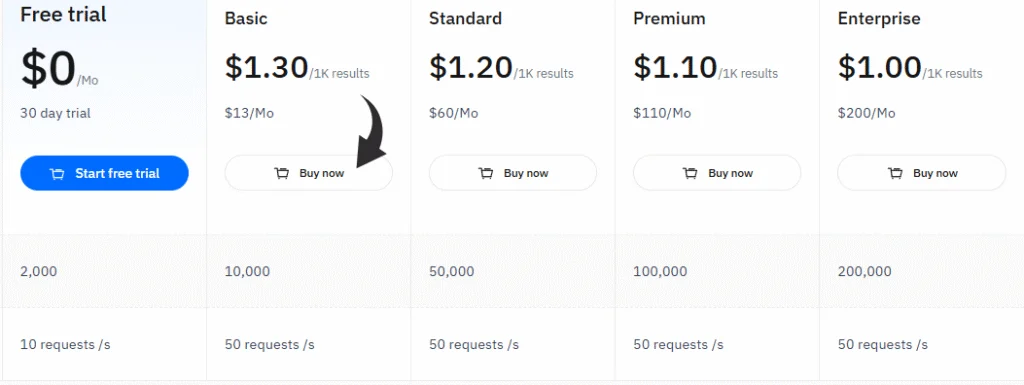
Request-based products are priced per thousand responses rather than per gigabyte. The SERP API starts at $1.20 per thousand for 15,000 responses, moves to $1.10 at 50,000, $0.90 at 150,000, $0.80 at 500,000 and $0.70 at one million, where the total is $700. The Web Scraper API runs $1.00 per thousand credits at 30,000, $0.83 at 150,000, $0.67 at 750,000 and $0.50 at three million for $1,500. You can check both ladders against your own volume on the ThorData packages table.
Hidden Costs And Gotchas :
The genuine trap is buying small while planning big. Residential bandwidth consumed at the 1 GB rate costs $2,000 per terabyte. The same terabyte bought as a single 1,000 GB package costs $730. Nothing about the product differs between those two purchases, so a team that drip-feeds its top-ups through a pilot can spend nearly three times what a single planned purchase would have cost. Estimate your monthly draw before the first payment rather than after the third.
ROI Example :
Work the arithmetic on a concrete job. Suppose price monitoring across retail sites consumes 40 GB a month. Buying 50 GB monthly at $1.50 costs $75 a month, or $900 a year. Buying 500 GB twice a year sits between the 350 GB and 1,000 GB steps, and committing to 1,000 GB once at $730 covers 25 months of that same draw. The saving is roughly $1,100 over two years, and it comes entirely from purchase timing rather than from any negotiation.
Cost Comparison :
Comparisons against other networks usually founder on this point. A competitor quoting a flat per-gigabyte rate with no volume ladder may look expensive beside $0.65 and cheap beside $2.00, and both impressions come from the same price sheet. Compare at the volume step you will actually buy, then check whether unused bandwidth expires, because an expiry date converts a volume discount into waste.
High Bandwidth Proxies are sold by duration instead, and the same shape appears: one day costs $280, seven days cost $900 at $128.57 a day, 30 days cost $2,370 at $79 a day, and 60 days cost $4,140 at $69 a day. Compare the duration ladder against the per-gigabyte products if your workload is continuous rather than bursty.
Best Value Path :
Best value depends on which number is scarce for you. Teams with a predictable monthly draw should buy the largest step they will genuinely consume, since each step down the ladder is a permanent discount rather than a promotion. Teams still validating a scraper should accept the $2.00 entry rate deliberately, treat it as the cost of finding out, and move to a planned purchase once the draw is measured. Request-based products suit anyone who would rather buy outcomes than bandwidth, because a thousand SERP responses is a unit you can map to a report.

Discounts Or Billing Notes :
No annual billing, no seat count and no subscription tier appears anywhere on the page. Discounting works purely through volume, which means there is nothing to negotiate at small scale and no contract to escape. Payment is by credit card through a quick payment option, and invoices are issued from the dashboard under My Account and then Billing after an order completes. A free trial is offered on the scraping products.
Final Buying Note :
Price this product from the packages table, never from the four cards at the top. Write down the volume you expect to consume in a quarter, find the step that covers it, and read the unit price in that row. That number is your actual cost, and it may be triple the figure that brought you to the page.
Verdict :
ThorData publishes more pricing detail than most networks in this category, and the detail is accurate once you find it. The criticism is one of presentation: advertising the eighth rung of a ladder as the price of the product sets up every small buyer for a surprise at checkout. Judged on the packages table alone, the rates are competitive and the volume discounts are real.
Map your own expected draw onto the steps before committing. Start with the ThorData free trial on the scraping products, measure what one real job consumes, then buy the step that matches it.
FAQ :
Is ThorData Expensive In 2026?
At 1 GB it is expensive, at $2.00 a gigabyte. At 5,000 GB it is among the cheaper residential networks, at $0.65. Both statements describe the same price list, so the answer depends entirely on the volume step you buy.
Does ThorData Have Public Pricing?
Yes, and unusually detailed public pricing at that. Eight residential steps, five mobile steps, five Web Scraper API steps and six SERP API steps are all published with unit and total prices. The datacenter proxy ladder is the exception, listed as four options without figures attached, so request those directly.
What Matters More Than The Headline Price?
The volume step you will realistically reach. A 3.1x spread between the entry and headline rate on residential bandwidth dwarfs the differences between competing networks at any single volume.
How Should I Compare ThorData To Alternatives?
Pick the volume you will buy, find that row in each vendor’s table, and compare unit prices there. Add the question of whether bandwidth expires, since a cheaper rate on bandwidth that lapses in 30 days can cost more than a dearer rate that does not.
What Is The Best First Step?
Run one real job on the free trial and measure the bandwidth it consumes. That single number converts this whole price list into a decision, and no spreadsheet built without it will be right.
More on ThorData
Hand-picked guides to help you choose the right tool — no fluff.
 Use CasesWho Is ThorData Best For? Use Cases & Fit (2026)Who gets the most out of it — and who should skip it.
 AlternativesThorData Alternatives 2026Credible alternatives and when each one wins.
 ComparisonsGusto vs Alternatives 2026The strongest competitors compared side by side.
 TutorialsEleven Labs Inc. Beginner's Guide 2026A clean start-here walkthrough with no jargon.