


In this guide
- When To Consider Alternatives
- Alternative 1: Do More Inside Your ESP
- Alternative 2: Use A Broader Email Platform
- Alternative 3: Use Deliverability Services Only When Needed
- Alternative 4: Authentication And Hygiene First
- Comparison Matrix
- How InboxAlly Actually Works
- What The Plans Mean In Practice
- When Alternatives Make More Sense
- A Practical Decision Rule
When To Consider Alternatives :
InboxAlly is a serious deliverability tool in 2026, but that does not automatically make it the best fit for every sender.
Disclosure: Stack99 earns a commission if you buy through links on this page. It costs you nothing extra and never changes our assessment.
The official product pages make its purpose very clear: improve inbox placement by creating authentic engagement signals through real mailbox activity. That is powerful when you need reputation repair, warmup, or more confidence in deliverability.
You should consider alternatives when:
- Your volume is small and you only need basic best-practice setup.
- You want deliverability fixes handled mostly inside your ESP.
- You need a broader email platform rather than a focused warmup tool.
- Your team wants to solve deliverability through process, authentication, and list hygiene first.
If you want to review InboxAlly while you read, start with InboxAlly here.
Alternative 1: Do More Inside Your ESP
One alternative to InboxAlly is to push more of the work into the sending platform you already use.
That does not mean InboxAlly is unnecessary. It just means some teams would rather improve:
- SPF, DKIM, and DMARC alignment.
- List quality.
- Sending cadence.
- Content relevance.
- Complaint management.
If you are early in your deliverability journey, that may be enough to get meaningful gains without adding another tool.
Alternative 2: Use A Broader Email Platform
Another alternative is to rely on a broader email marketing or sending platform instead of a specialized deliverability tool.
This works better when your priority is not warmup or reputation repair, but overall campaign execution. In that case, you may prefer a tool that already combines:
- Sending.
- Automation.
- Segmentation.
- Analytics.
- Deliverability basics.
The trade-off is obvious: you gain breadth, but you lose the focused reputation-training behavior that InboxAlly is known for.
Alternative 3: Use Deliverability Services Only When Needed
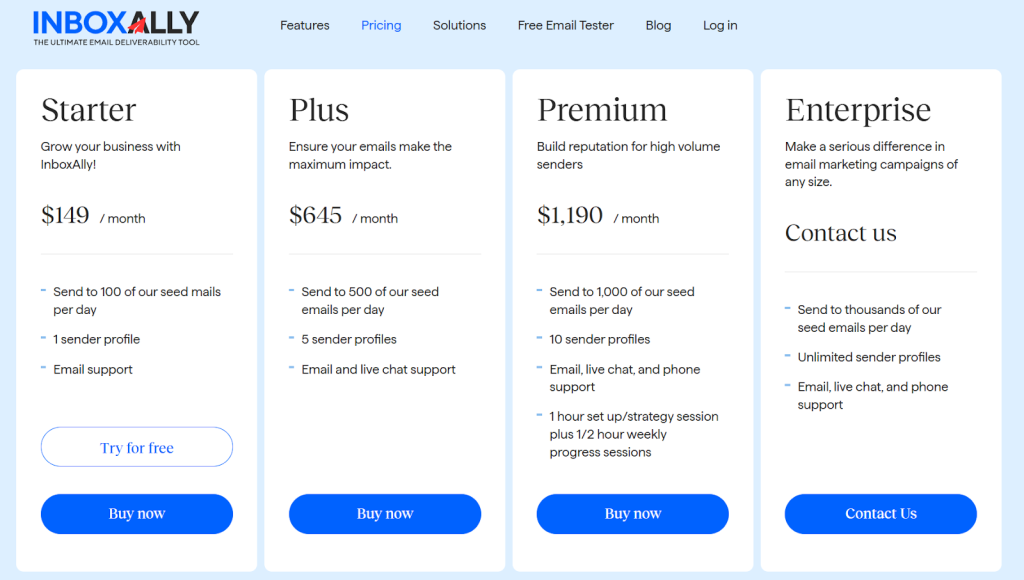
InboxAlly’s pricing page makes the product feel serious rather than casual.
The visible plans are:
| Plan | Price |
|---|---|
| Starter | $149/mo |
| Plus | $645/mo |
| Premium | $1,190/mo |
| Enterprise | Custom |
That tells you the product is built for people who view deliverability as a business problem, not a hobby.
If your deliverability issue is temporary or narrow, a dedicated deliverability service might still be overkill. In that scenario, you may only need it during launch, recovery, or a period of heavy sending.
Alternative 4: Authentication And Hygiene First
InboxAlly’s own docs make a good case for why this category exists. They explain that deliverability depends on reputation, authentication, engagement, and content quality.
That means a real alternative is not only another tool.
It is a different operating approach:
- Fix The Technical Foundation.
- Clean Your List.
- Send Consistently.
- Improve Content Relevance.
- Monitor Complaint And Engagement Patterns.
For some teams, that is enough.
For others, especially new senders or teams recovering from spam-folder problems, InboxAlly remains the more direct way to generate positive signals quickly.
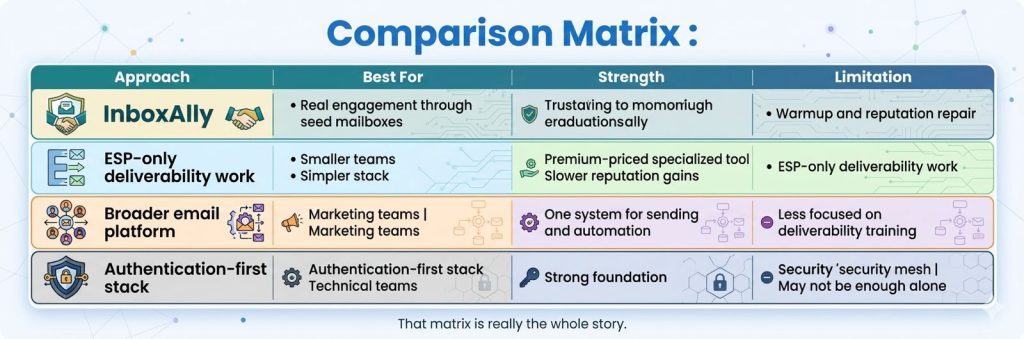
Comparison Matrix :
How InboxAlly Actually Works :
The official knowledge base explains the mechanism very clearly.
InboxAlly uses seed emails and real mailbox engagement to generate actions like:
- Opens.
- Clicks.
- Replies.
- Inbox moves.
Those actions teach mailbox providers that your mail is wanted. That is the core reputation-training model.
The docs also say InboxAlly can work with any sending platform, which is useful because it means the deliverability layer does not have to replace your ESP.
If your sending system is already locked in and the issue is reputation or inbox placement, start with InboxAlly here and see whether the seed-email model fits your volume.
What The Plans Mean In Practice :
The pricing page is one of the clearest ways to judge the product.
- Starter gives you
100seed mails per day and1sender profile. - Plus gives you
500seed emails per day and5sender profiles. - Premium gives you
1,000seed emails per day,10sender profiles, and live support plus strategy sessions. - Enterprise expands to thousands of seed emails per day and unlimited sender profiles.
That is a strong indicator that the product is designed for real deliverability work, not a casual warmup gimmick.
The practical implication is simple:
- Smaller senders can start low.
- Larger senders need more seed coverage.
- Serious reputation recovery probably belongs on higher tiers.
When Alternatives Make More Sense :
Alternatives make more sense when your deliverability problem is really a broader operational problem.
For example:
- If your authentication is broken, fix that first.
- If your list quality is bad, clean that first.
- If your content is spammy, rewrite it first.
- If your sending rhythm is unstable, stabilize that first.
InboxAlly is strong, but it is still a specialist tool.
That means you should buy it when the problem is specific enough that a specialist tool is the right answer.
A Practical Decision Rule :
The simplest decision rule is this:
- Use InboxAlly if you need faster reputation building, inbox placement improvement, or warmup.
- Use A Broader Email Stack If Deliverability Is Only One Small Part Of The Problem.
- Use Foundation Work First If You Have Never Cleaned Up Authentication Or List Quality.
That sounds obvious, but it is exactly how a lot of teams save money.
When To Stick With InboxAlly :
You should stick with InboxAlly if:
- You Need Better Inbox Placement Fast.
- You Are Recovering Sender Reputation.
- You Send At Scale And Need A Dedicated Deliverability Workflow.
- You Want Engagement Signals From Real Mailboxes Rather Than A Generic Tool.
The official docs say the tool improves deliverability by generating authentic engagement through real mailbox interfaces, and that is the strongest reason to keep it in the conversation.
What Makes InboxAlly Different :
InboxAlly is different because it focuses on a part of email marketing that most tools only treat as an afterthought.
It does not just want you to send. It wants mailbox providers to trust your sending behavior.
That is why the pricing, feature set, and docs all revolve around seed mail, sender profiles, progress tracking, and engagement profiles. It is a deliverability tool with a very specific job.
How To Evaluate It Without Overbuying :
The best InboxAlly evaluation is practical, not theoretical.
Start by looking at the actual deliverability problem you are trying to solve. If the issue is one bad campaign, a temporary setup mistake, or a broken authentication record, you may not need a full specialist stack yet.
If the issue is broader, ask these questions:
- Are your inbox placement problems persistent?
- Do you send enough volume for reputation to matter every day?
- Do you need to train mailbox providers with real engagement signals?
- Is your team already doing the foundation work and still not getting traction?
If the answer is yes, InboxAlly is easier to justify.
If the answer is no, then the smarter move may be to clean the foundation first and revisit the tool later.
That is why InboxAlly works best when it is attached to a real reputation problem. The tool is strong, but it should still be matched to the size of the issue.
A Simple Buying Rule :
Use the tool when deliverability is the thing blocking revenue.
Do not use it as a substitute for good sending habits or clean list management. That is where a lot of teams get the category wrong.
If the foundation is already decent and inbox placement is still weak, InboxAlly becomes much easier to justify.
If the foundation is messy, fix the messy parts first and then use the product where it can actually multiply the gain. That keeps the tool in the right role: amplification, not magic. That is the cleanest way to avoid overspending on a specialist tool before the basics are actually ready. It also keeps the decision grounded in revenue impact, which is the only reason to buy it. That is the line that keeps the tool honest.
Verdict :
InboxAlly is one of the clearest specialized deliverability tools in 2026, but it is not always the only answer.
If your needs are simple, ESP-native fixes or foundational hygiene may be enough. If you need reputation repair, warmup, or stronger inbox placement signals, InboxAlly is the more direct play.
If deliverability is already costing you opens and revenue, start with InboxAlly here and compare the Starter, Plus, and Premium plans against the volume and reputation risk you are actually carrying.
FAQ :
What does InboxAlly do?
It improves email deliverability by generating authentic engagement signals through real mailbox interfaces so providers are more likely to place your messages in the inbox.
How much does InboxAlly cost?
The official pricing page shows Starter at $149 per month, Plus at $645, Premium at $1,190, and Enterprise by custom quote.
Is InboxAlly only for warmup?
No. It is also useful for reputation repair, ongoing deliverability optimization, and improving inbox placement at scale.
What should I try before buying InboxAlly?
Make sure your SPF, DKIM, and DMARC are correct, your list quality is solid, and your sending cadence is reasonable. InboxAlly works best when the foundation is already respectable.
More on InboxAlly
Hand-picked guides to help you choose the right tool — no fluff.
 IntegrationsInboxAlly Integrations Guide 2026What it connects to and how well each link holds up.
 TutorialsInboxAlly Beginner's Guide 2026A clean start-here walkthrough with no jargon.
 Advanced GuidesVektorOS Advanced Guide 2026Deeper workflows once the basics are in place.
 ReviewsTresorit Review 2026Hands-on verdict with the pros, cons and who it fits best.