


Quick answer
Short answer: If you need raw synthesis at volume, Deepgram and Murf publish metered rates roughly 5–12× lower than the implied per-character cost of an ElevenLabs subscription. If you need a full studio suite, however, none of these alternatives fully replaces the bundle.
Best price per character: Deepgram Aura-1 — $0.0150 per 1,000 characters, pay-as-you-go.
Best for small teams: Cartesia — unlimited workspace seats on every plan, including the $5 tier. ElevenLabs does not include a second seat until the $299 tier.
Best no-commitment option: Murf API — $10 in free credit every month, while purchased credit does not expire.
What you lose by leaving ElevenLabs: 70+ languages in one product, professional voice cloning with managed slots, Dubbing Studio, music, and a unified balance covering the ecosystem.
Disclosure: Stack99 earns a commission if you buy through links on this page. It costs you nothing extra and never changes our assessment.
People go looking for ElevenLabs alternatives for one of three reasons, and they need completely different answers. The first is cost: a subscription with bundled credits works out around $0.18 per 1,000 characters, and metered providers publish a fraction of that. The second is seats: nothing below the $299 Scale tier gives a second person their own login. The third is a specific capability gap, a language, a latency target, a compliance term.
This page sorts the options by which of those problems you have. Every price below was read off the vendor’s own pricing page on 2 October 2026. Where a page made it impossible to tell whether a figure was the recurring rate, we have said so and left the number out rather than guess, because a wrong price is worse than no price.
What you are actually comparing against
A fair comparison needs the ElevenLabs baseline stated properly. It sells subscriptions with a shared credit pool: $0 Free (10,000 credits), $6 Starter (30,000), $22 Creator (121,000), $99 Pro (600,000), $299 Scale (1.8M, 3 seats) and $990 Business (6M, 10 seats), with Enterprise quoted. Annual billing is the monthly price times ten.
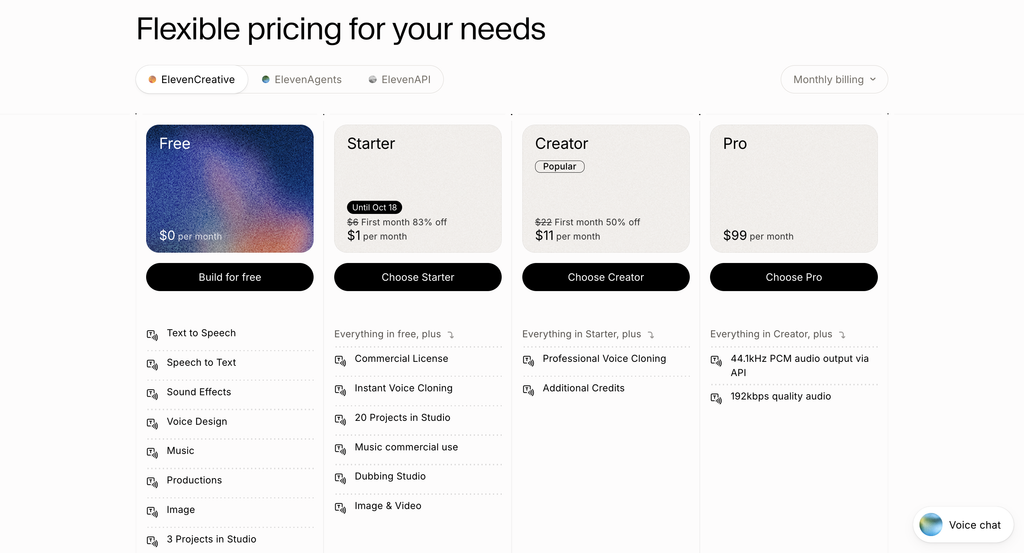
Text-to-speech burns roughly 1 credit per character on the V2 Multilingual models, so dividing price by credits gives an effective rate of about $0.20 per 1,000 characters on Starter, $0.182 on Creator, and $0.165 on Pro and above. API use of the V2 Flash, Turbo English, and V2.5 Flash and Turbo Multilingual models is discounted to between 0.5 and 1 credit per character, which at the bottom of that range roughly halves the effective rate. Full detail is in our ElevenLabs pricing breakdown.
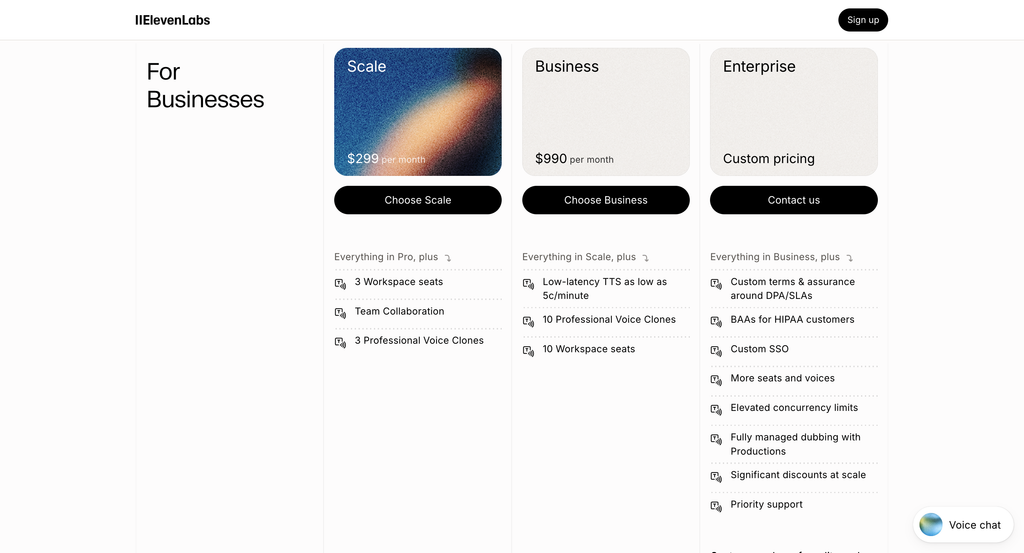
That credit pool also funds speech-to-text at 330 credits a minute, music at 900, sound effects at 200 per generation, voice changing and isolation at 1,000 a minute, and dubbing at up to 10,000 a minute. None of the alternatives below replaces all of that. Most replace exactly one part of it, which is why they are cheaper.
Cartesia: the closest structural rival
Cartesia sells subscriptions with monthly credits, which makes it the only option here that compares to ElevenLabs on the same terms rather than on a different pricing model.
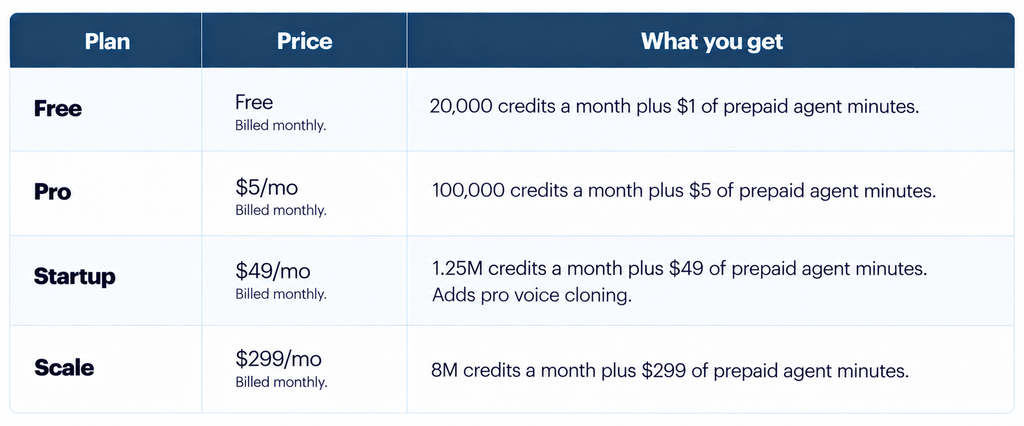
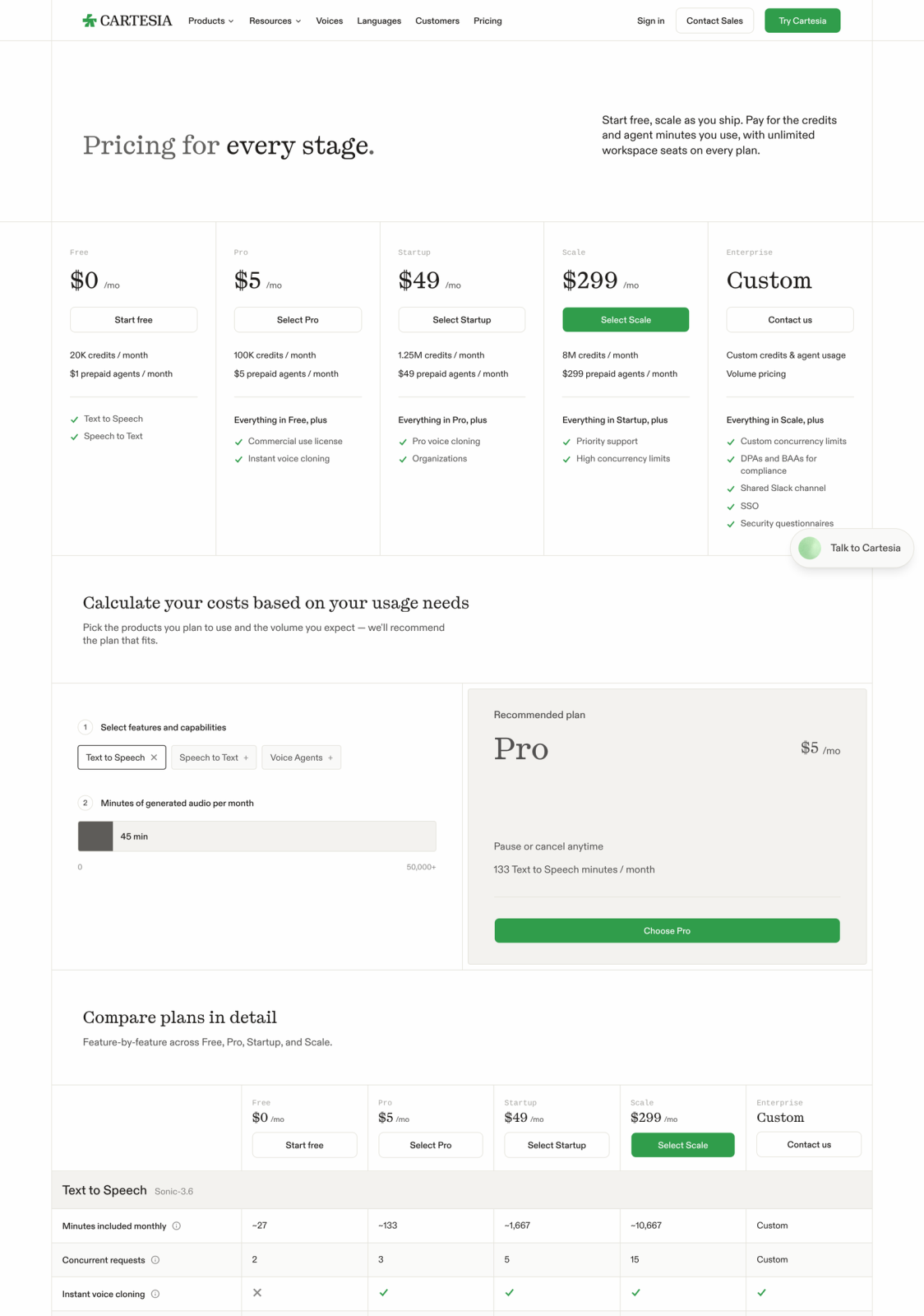
Two numbers deserve attention. Cartesia’s free tier carries twice the credits of the ElevenLabs free tier. And its Scale plan is $299 for 8M credits, where ElevenLabs charges $299 for 1.8M, though credits are not a standardised unit across vendors, so that is a headline comparison rather than a like-for-like one, and you should test your own workload before treating it as a 4× advantage.
The structural difference that is not about credits at all: Cartesia advertises unlimited workspace seats on every plan, including the free one. For a three-person studio, that single line is worth more than any per-character arithmetic, because the equivalent on ElevenLabs costs $299 a month.
Choose it if: you want a subscription shape you already understand, you have more than one person who needs access, and your work is primarily synthesis and voice agents rather than dubbing, music, and mixed media.
Deepgram: cheapest published per-character rate
Deepgram is pure metered usage with no subscription required, and publishes a plain rate card for its text-to-speech models:
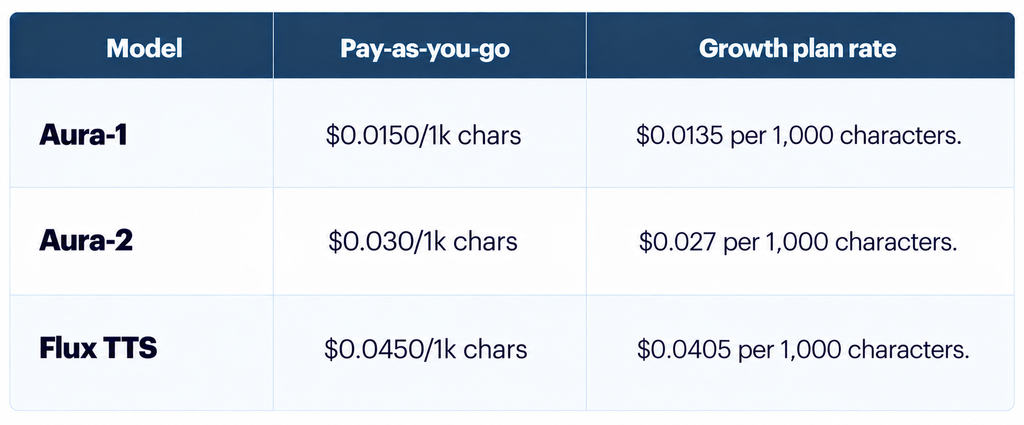
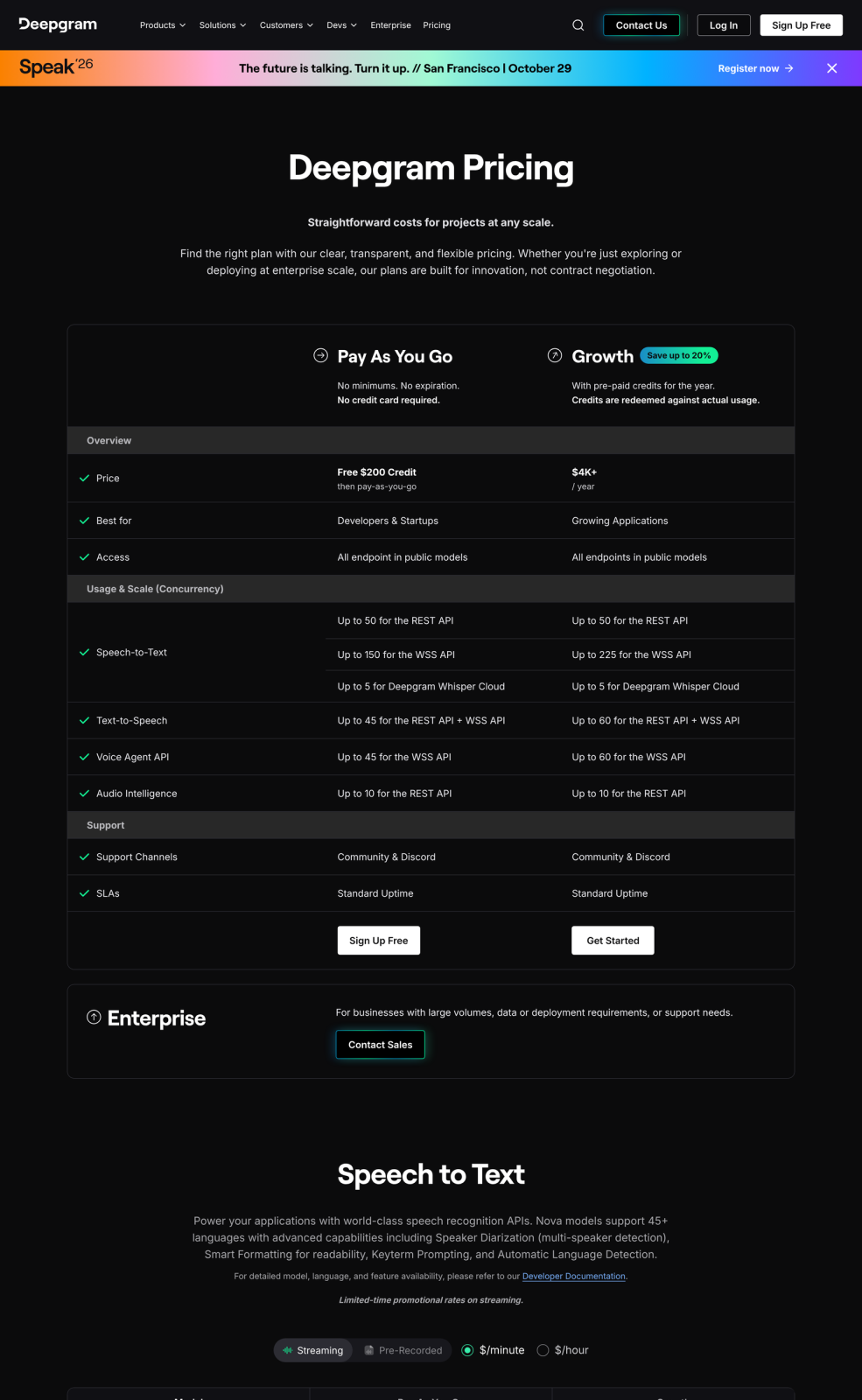
Set Aura-1 against the roughly $0.18 implied by the ElevenLabs Creator plan and the gap is about twelve times. Even Flux TTS, Deepgram’s most expensive text-to-speech model at $0.045, is around a quarter of the ElevenLabs rate. Concurrency is published too, up to 45 concurrent requests across the REST and WSS APIs on pay-as-you-go, rising to 60 on the higher plan. Which matters if you are serving live traffic.
You give up everything that is not synthesis. There is no Studio, no dubbing workflow, no music generation, no creator-facing interface. Deepgram also sells credits rather than seats, so there is no team model to speak of; this is infrastructure, bought by engineers.
Choose it if: your product calls a TTS endpoint, your volume is high enough that per-character cost is a line item someone argues about, and nobody on your team needs a user interface.
Murf: metered rates with a standing free allowance
Murf’s API pricing is pay-as-you-go with a free trial that renews:
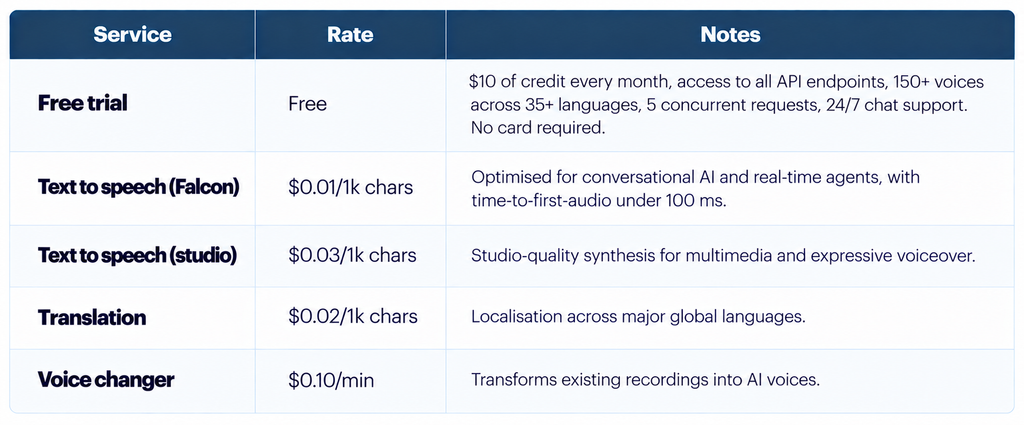
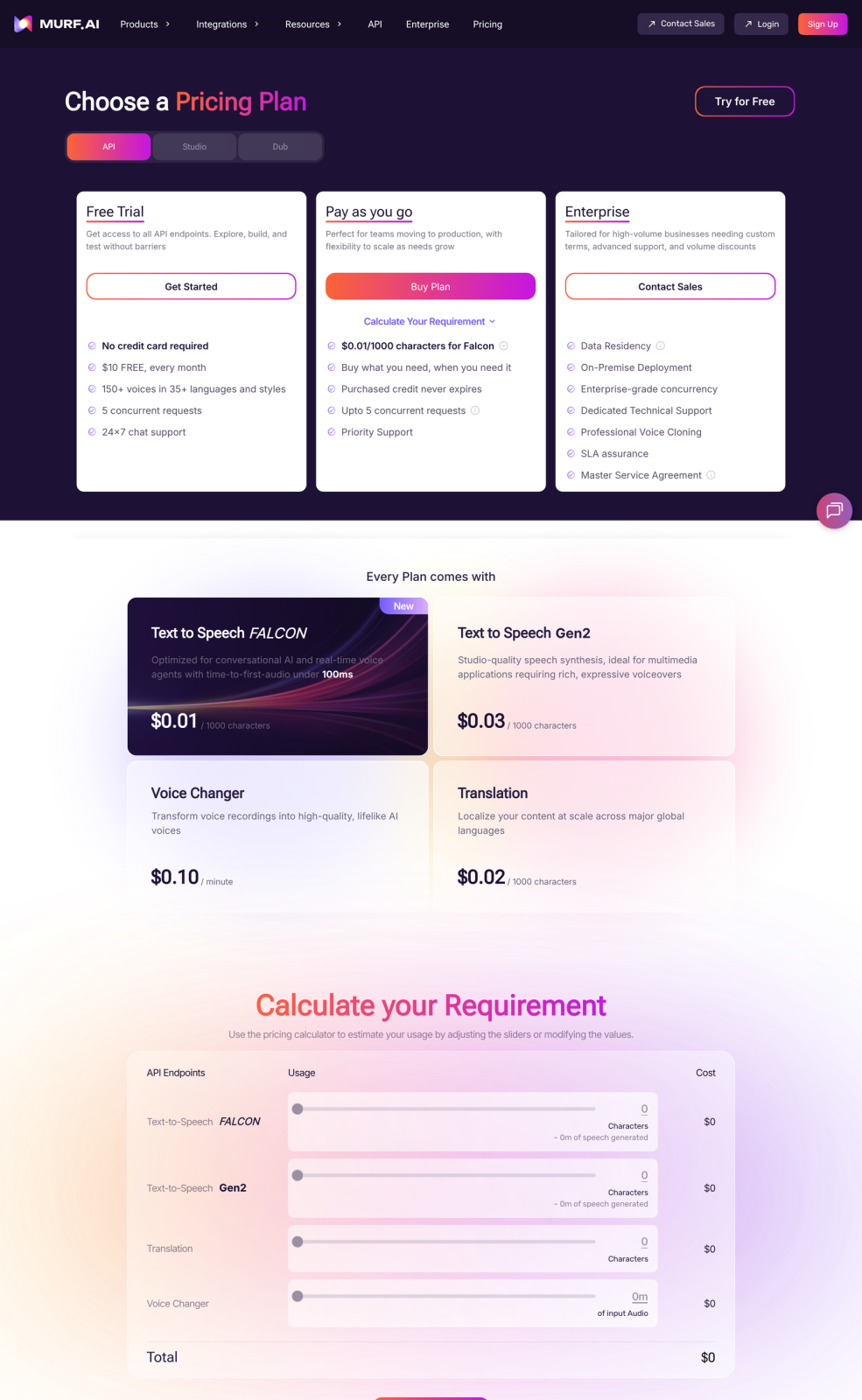
The $10 of free credit every month is the standout. At $0.01 per 1,000 characters on the Falcon model, that allowance covers around a million characters a month at no cost, comfortably more than the ElevenLabs Creator plan delivers for $22. Purchased credit also does not expire, which is a meaningful contrast with ElevenLabs forfeiting unused credits on downgrade or cancellation.
The constraints are real: 35+ languages against seventy-plus, five concurrent requests on the free tier, and professional voice cloning sits behind an enterprise conversation rather than a self-serve tier. Murf also sells Studio and Dub products separately from the API, so the figures above describe the API line specifically.
Choose it if: you want metered pricing without a contract, your language needs are mainstream, and a standing free allowance would cover most or all of your usage.
Options we looked at and could not price honestly
Three vendors came up in research and are not given a price table above, deliberately.
- Resemble AI. Its pricing page as served to us presented plans for deepfake detection: Flex at $0 a month, Team at $280 and Business at $800, each annotated “billed annually.” With a monthly/annual toggle on the same page and the displayed figures labelled as annual billing, we could not establish which number is the recurring monthly rate for its voice generation product. Rather than publish a figure that might be wrong by 20% or more, we have left it out. Check resemble.ai/pricing directly.
- Speechify. The pricing page states “prices shown per month, billed monthly,” but the plan grid did not render reliably enough for us to attribute a figure to a named tier with confidence. Speechify is also positioned differently from the rest of this list; it is a reading and productivity product first, with voice-over and dubbing as adjacent lines, so it is a poor substitute for a production audio platform in any case. See speechify.com/pricing.
- PlayHT. Its pricing page did not load for us at all during this review. We have no figures to offer and will not quote second-hand ones.
We mention this because most alternatives roundups quote a number for every vendor regardless of whether anyone checked it, and those numbers then propagate from one article to the next until nobody can trace them. A page that admits three gaps is more useful than one that fills them with recycled figures.
Choosing by the problem you actually have
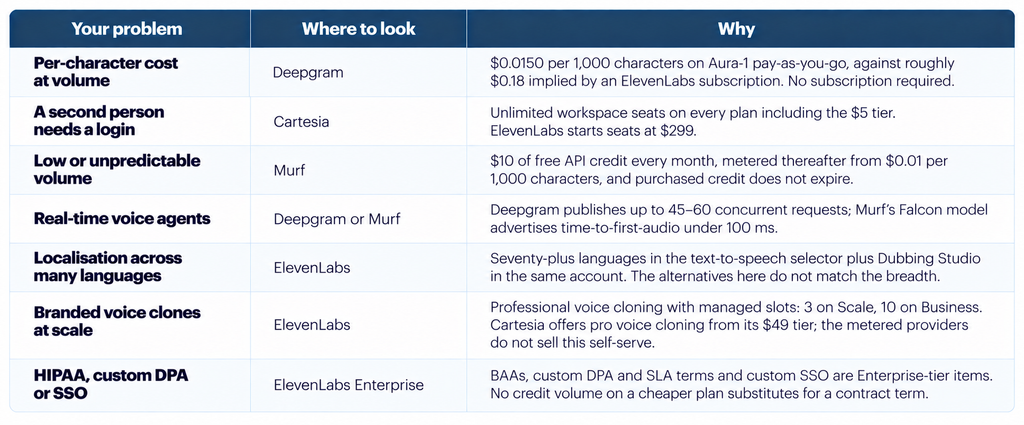
Three worked scenarios
Rate cards are abstract. Here is what the choice looks like for three realistic workloads, using only the published figures above. Treat the arithmetic as indicative. It assumes 1 credit per character on ElevenLabs V2 Multilingual and ignores the API discount on the Flash and Turbo models, which can halve that side of the comparison.
A weekly podcast with show notes
Say 4,000 words of narration a week (roughly 24,000 characters) plus two hours of transcription a month. On ElevenLabs, that is about 96,000 characters of speech at 1 credit each, plus 120 minutes of speech-to-text at 330 credits a minute, which is 39,600 credits, about 136,000 credits in total, just over the Creator allowance of 121,000. You would sit on Creator at $22 and occasionally top up, or carry rollover from a quieter month.
On a metered provider, the narration alone would cost roughly $1.44 a month at Deepgram’s Aura-1 rate, but you would need to source transcription separately, and you would lose the Studio interface that makes editing a script against audio practical. For this workload, the subscription is not obviously bad value: one tool, one bill, and the transcription is included.
A product that reads notifications aloud
Say 20 million characters a month of short, functional speech through an API. On ElevenLabs, that is 20M credits, well beyond the 6M on Business at $990, so you are in an Enterprise conversation. At Deepgram’s published Aura-1 pay-as-you-go rate, 20M characters is around $300; at Murf’s Falcon rate, it is around $200. Even allowing generously for the API model discount on the ElevenLabs side, the gap at this volume is the difference between a procurement process and a credit card.
This is the clearest case for leaving. Nothing in the ElevenLabs bundle helps a notification service, and the per-character premium compounds linearly with volume.
A three-person agency producing client videos
Say moderate narration volume, four branded voice clones, and occasional dubbing. The credit arithmetic is not what decides this. The seats and the clone slots are. Three people each needing a login puts you on ElevenLabs Scale at $299 a month, which also supplies three professional voice clone slots; a fourth client voice pushes you toward Business at $990.
Cartesia’s unlimited seats on a $49 Startup plan with pro voice cloning is the obvious alternative to price against, and at these numbers the annual difference runs into thousands. The trade is Dubbing Studio and the language breadth, so the decision turns on whether your clients need localisation. If they do, the ElevenLabs premium is buying something real. If they do not, it is not.
Why credit counts are not comparable between vendors
One caution before you build a spreadsheet. ElevenLabs and Cartesia both sell “credits,” and the numbers look directly comparable: 121,000 against 100,000, 1.8M against 8M. They are not. A credit is whatever each vendor defines it as, and the consumption rate per character, per minute, and per generation differs between them and between models within the same vendor.
ElevenLabs publishes its rates plainly, which is how the per-character figures on this page were derived: 1 credit per character on V2 Multilingual, 330 credits a minute for transcription, 900 for music, 1,000 for voice changing, up to 10,000 for dubbing. Where a vendor does not publish an equivalent conversion, a credit count tells you nothing you can act on.
Two units are comparable across vendors: cost per 1,000 characters and cost per minute of audio. Convert everything to one of those before comparing, and ignore headline credit allowances entirely. That single discipline removes most of the misleading claims in this category, including some you will find in comparisons that look more confident than this one.
The switching cost nobody prices in
Three things make leaving more expensive than the rate card suggests.
- Voice continuity. Where you have published content in a cloned or selected voice, moving providers means your back catalogue and your new output no longer match. Audiences notice. The practical fix is to switch at a natural break (a new series, a new product line) rather than mid-stream.
- Banked credits evaporate. ElevenLabs credits roll over for up to two months on paid plans, but downgrading or cancelling forfeits the unused balance at the end of the cycle. Two months of accumulated rollover is thrown away on cancellation. Time the move for just after a cycle resets, not just before.
- Pipeline rework. If synthesis is wired into an automation (Zapier, n8n, Make, or a CRM integration) the endpoint, the voice identifiers, and the audio format all change. Deepgram and Murf are API-first and straightforward to call, but the surrounding glue is yours to rebuild.
None of these is a reason to stay on a plan that costs five times what you need. They are a reason to plan the move rather than make it on a Friday afternoon.
Verdict
For raw synthesis at volume, the alternatives win on price, and it is not close: Deepgram at $0.0150 per 1,000 characters and Murf at $0.01 on its fastest model sit far below the roughly $0.18 an ElevenLabs subscription implies. For small teams, Cartesia’s unlimited seats on a $5 plan solves a problem ElevenLabs charges $299 to solve.
For everything else, the honest answer is that there is no replacement for the bundle. Seventy-plus languages, professional cloning with managed slots, Dubbing Studio, music, sound effects, and transcription on one balance is a genuinely different product from a TTS endpoint, and the price reflects it rather than inflating it. Our full ElevenLabs review works through where that bundle earns its keep.
The test that settles it costs nothing: run the same script through the free tiers of ElevenLabs, Cartesia and Murf in the same afternoon, on your own material in your own language. You will have a clearer answer in two hours than any comparison table can give you.
Frequently asked questions
What is the cheapest alternative to ElevenLabs?
On published per-character rates, Deepgram’s Aura-1 model at $0.0150 per 1,000 characters pay-as-you-go, dropping to $0.0135 on its Growth plan. Murf’s Falcon model is $0.01 per 1,000 characters, with $10 of free API credit every month on top.
Is there a free alternative to ElevenLabs?
Cartesia has a free tier with 20,000 credits a month, twice the ElevenLabs free allowance. Murf’s API free trial carries $10 of credit every month with no card required. Both are genuinely free rather than time-limited trials.
Which alternative is best for a small team?
Cartesia, on seats alone. It advertises unlimited workspace seats on every plan, including the $5 Pro tier, where ElevenLabs does not include a second seat below the $299 Scale plan.
Do any alternatives match ElevenLabs on languages?
Not from the options verified here. ElevenLabs lists seventy or more languages in its text-to-speech selector; Murf advertises 35+. Localising into less common languages makes breadth the strongest reason to stay.
Can I move my cloned voice to another provider?
No. A voice clone is a model trained inside one provider’s system and does not transfer. Switching means re-cloning from your original source audio, and accepting that the result will not sound identical, which is why published back catalogues are the real switching cost.
Is ElevenLabs still worth it given the price gap?
It depends entirely on how much of the platform you use. If you only call a synthesis endpoint, you are paying a large premium for software you never open. If you use two or more of dubbing, music, transcription, cloning, and Studio, assembling equivalents from separate vendors usually costs more in both money and integration time.
What happens to my ElevenLabs credits if I switch?
Unused credits are forfeited at the end of the billing cycle when you downgrade or cancel. Rollover only persists while you hold an active paid subscription, so switch just after a cycle resets rather than just before, and spend any banked balance first.
Sources
- ElevenLabs plan prices, credits, and per-product credit costs: elevenlabs.io/pricing, both billing toggles captured 2 October 2026.
- Cartesia plan prices and credit allowances: cartesia.ai/pricing, captured 2 October 2026.
- Deepgram text-to-speech rate card and concurrency limits: deepgram.com/pricing, captured 2 October 2026.
- Murf API rates, free trial allowance, and voice and language counts: murf.ai/pricing, captured 2 October 2026.
- Pages we could not price with confidence: Resemble AI, Speechify, and PlayHT, whose pricing page did not load.
- Affiliate link used on this page: ElevenLabs. The alternatives above are linked without affiliate tracking.
Credits are not a standardised unit between vendors, so credit-count comparisons are indicative rather than exact. Per-character and per-minute rates are directly comparable; credit allowances are not. Prices change – verify before you commit.