


- What The Official Pages Show About Connectivity
- Where Superfiliate Fits In A Real Stack
- Popular Workflow Patterns
- Setup Approach
In this guide
Why Integrations Matter Here
Superfiliate is a creator marketing platform that only makes sense once it is wired into a Shopify store. Its integrations page lists 28 named connections, and the architecture behind them is unusual: three of those entries are channels rather than tools, and roughly a third of the remainder are subscription-commerce apps. Read the catalogue closely and it describes a product built for one shape of business, which is a direct-to-consumer brand on Shopify running a subscription or repeat-purchase model.
Disclosure: Stack99 earns a commission if you buy through links on this page. It costs you nothing extra and never changes our assessment.
Pricing reflects the same dependence. Superfiliate publishes no rate card. Its pricing page describes a custom monthly subscription set by two inputs: which of the three channels you activate, and your trailing twelve months of ecommerce revenue. The company states explicitly that it does not charge per creator, per click or per program.
If you want to inspect the connection catalogue while you read, start with Superfiliate here.
What The Official Pages Show About Connectivity
Superfiliate groups its connections into five functional families:
- Channels: Shopify Influencer Hub, Meta Ads Suite and TikTok Shop
- Creator communications: Gmail, Instagram, Klaviyo, Attentive, Postscript and Sendlane
- Subscription management: Appstle, Awtomic, Bold, Juo, Loop, Ordergroove, Prive, ReCharge, Skio, Smartrr and Stay AI
- Analytics and insights: Google Analytics 4, Triple Whale and a Custom API entry
- Influencer payouts: Lumanu, PayPal and Tremendous
Notice what is absent. There is no Zapier listing, no general automation layer, and no connector for a non-Shopify storefront. The Custom API entry is the only general-purpose escape hatch on the page.
Where Superfiliate Fits In A Real Stack
Shopify is the foundation rather than an option. Superfiliate reads orders, customers, discount codes and the product catalogue directly from Shopify in real time, and that feed is what makes creator attribution and payouts possible. Install is one click from the Shopify App Store, needs no developer time, and the company says it works on any Shopify plan. Everything else in the catalogue decorates that core relationship.
Popular Workflow Patterns
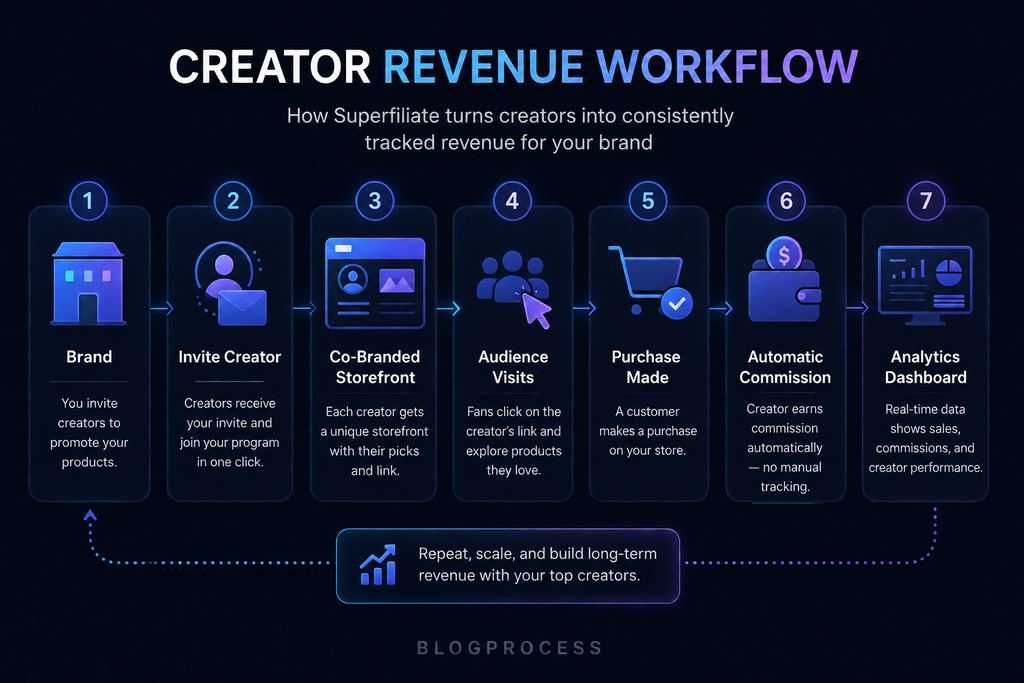
What the Shopify connection unlocks, in Superfiliate’s own description:
- Orders, customers, discount codes and the product catalogue sync in real time between Shopify and Superfiliate.
- Revenue is attributed to individual creators automatically.
- Unique codes and links are generated without manual setup.
- Payouts trigger on verified, paid orders rather than on clicks.
Setup Approach
Start with the channel you intend to measure first. The Influencer Hub consolidates influencer, affiliate and ambassador programs with first-party connections to Instagram, YouTube and TikTok. The Meta Ads Suite adds one-click ad account authentication and Partnership Ads. TikTok Shop is the third. Since pricing is set partly by how many channels you switch on, activating all three at the start raises your quote before you have evidence that any of them works.
If you want to test that directly, open Superfiliate here and check the Shopify install against the store data you already trust.
Two connections carry setup conditions you should know in advance. Superfiliate Email needs a custom domain with DNS verification and runs on SendGrid. The Lumanu payouts connection requires a separate Lumanu account. Review Superfiliate here if either of those sits awkwardly with your current stack.
Automation And API Considerations
A Custom API entry appears in the integration list, but no public documentation portal is linked from the integrations page and no developer plan is published. Treat API access as something to scope during a sales conversation. The native connections are where the automation actually lives: Instagram DM automations handle discovery and recruitment, and Superfiliate Email merges program data such as codes, tiers and earnings into mass sends from your own domain.
Troubleshooting Lens
When attribution looks wrong, work backwards from Shopify rather than from the creator. The platform attributes revenue from orders, customers and discount codes pulled out of the store, so a code created outside Superfiliate, a draft order, or a subscription renewal processed by an app it does not read will all produce gaps. Confirm which of the subscription platforms you run is on the supported list before blaming the creator report.

Verdict
Superfiliate’s integration catalogue is narrow on purpose and deep where it counts. For a Shopify brand with a subscription model and a real creator program, the combination of first-party commerce data, subscription-aware attribution and compliant global payouts through Lumanu is genuinely hard to assemble from parts.
If that sounds relevant, try Superfiliate here and ask for a quote based on your trailing twelve-month revenue before comparing anything else.
FAQ
Why Are Integrations Important For Superfiliate?
Because attribution is the product. Without the Shopify feed of orders, customers and discount codes, there is no way to credit a creator with revenue or trigger a payout on a verified order.
Should I Connect Everything At Once?
No. Channel count is one of the two inputs to your price, so activate one channel, prove it, then expand.
What Matters More Than The Number Of Integrations?
Whether your subscription app is on the list. Superfiliate names Appstle, Awtomic, Bold, Juo, Loop, Ordergroove, Prive, ReCharge, Skio, Smartrr and Stay AI, and a brand running something else loses recurring-revenue attribution.
How Should I Evaluate The Integration Fit?
Run one creator through a full cycle: code issued, order placed, revenue attributed, payout released. If that chain completes without manual intervention, the integration works for you.
When Does The Integration Story Look Weak?
When your store is not on Shopify, when your subscription platform is missing from the list, or when you need a general automation layer, because no Zapier connector is listed.
Decision Baseline
Work out your two pricing inputs before the first call, since Superfiliate sets a custom monthly subscription from the channels you activate and your trailing twelve months of ecommerce revenue. Know both numbers and you can judge a quote rather than react to it. The model has a real advantage worth naming: because the price ignores creator count, clicks and program count, a program that grows from 50 creators to 5,000 does not generate a bigger bill on that basis alone.
A Better Trial Question
Rather than asking whether the dashboard looks clean, ask whether revenue attribution survives a messy week. Issue codes to several creators, let a subscription renew, process a refund, and then check whether the creator report still reconciles to Shopify. Superfiliate’s whole value rests on that reconciliation, so test it against the awkward cases rather than a clean first order.
The First Week Test
Keep week one to the Influencer Hub and the Shopify connection. Install from the App Store, connect a handful of creators, generate codes, and watch orders attribute. Leave the Meta Ads Suite and TikTok Shop switched off, partly to isolate the variable and partly because each additional channel feeds into the price. Add Google Analytics 4 if you want program traffic visible alongside the rest of your marketing, since that connection needs only a Measurement ID.
Adoption Reality
Adoption here fails at the payouts step more often than at setup. Paying creators across borders brings tax forms, verification and chargebacks, and Superfiliate pushes that to Lumanu, which holds funds in a dedicated wallet and handles KYC and KYB verification, W-9 and W-8 collection and 1099 filings across 190 or more countries. Finance will want to review that arrangement, and they will want to review it before the first payout run rather than after.
What To Measure
Three measures tell you whether the integration is earning its keep. Track the share of orders attributed to a creator automatically, the time from a verified order to a released payout, and the proportion of creator communications sent from inside the platform rather than a personal inbox. All three come straight out of the connections described above.
The Handoff Check
The handoff worth watching runs between the organic creator team and the paid media team. Superfiliate’s pitch is that both see identical performance data, with creator discovery powered by Meta’s first-party data feeding Partnership Ad building. Test that claim with one creator whose content gets promoted, and check whether the paid side sees the same revenue figure the influencer side reports.
Team Ownership
Give this to whoever owns creator payouts, not whoever recruits creators. The recruiter sees a working Instagram DM automation. The person releasing payments discovers the Lumanu account requirement, the tax collection flow and the refund handling. Bring finance into the evaluation early, because the payouts chain is where the integration genuinely binds you.
Where Complexity Hides
Complexity hides in the conditions attached to specific connections. Superfiliate Email needs a verified custom domain. Lumanu needs its own account. The subscription family only helps if your particular app is among the eleven named. None of these appears in a headline integration count, and each can delay a launch by a week.
A Fair Evaluation Window
Superfiliate publishes no free trial and no self-serve signup, so evaluation runs through a demo and a scoped pilot. Agree the pilot’s end date and its success measure before the first call, and make the measure a reconciliation figure rather than an impression. Without a trial clock to force the issue, these evaluations drift.
Evidence Over Enthusiasm
Collect evidence Shopify can confirm. Export the orders attributed to creators during the pilot and reconcile them against your own store reports. Superfiliate states it is trusted by more than 700 brands, which is a durability signal rather than proof it fits yours. Your own reconciliation is the only evidence that settles it.
The Exit-Cost Question
Your commerce data stays in Shopify throughout, which makes the exit cheaper than it first looks. What lives inside Superfiliate is the creator relationship layer: profiles, communications history, program tiers and earnings records. Confirm you can export creator contact details and earnings history, and remember that the Lumanu wallet is a separate relationship to unwind.
Training Without Theater
Train on one complete creator lifecycle. Recruit through an Instagram DM automation, issue a code, let an order land, watch it attribute in Shopify, then release the payout. Half an hour spent on that single loop teaches the team more than a tour of all 28 integrations, and it exposes any attribution gap on day one.
The Honest Limitation Test
The boundary is Shopify. Superfiliate’s integrations page is built around reading first-party commerce data from a Shopify store, and no connector for another storefront appears anywhere in the catalogue. A brand on a different platform should stop here. The second boundary is the absence of a general automation layer, so anything outside the 28 named connections runs through the Custom API entry, which carries no published documentation.
More on Superfiliate
Hand-picked guides to help you choose the right tool : no fluff.
 ReviewsBouncer Review 2026Hands-on verdict with the pros, cons and who it fits best.
 PricingCredit Repair Cloud Pricing 2026Real tier prices and what each plan actually includes.
 ReviewsDiginius Review 2026Hands-on verdict with the pros, cons and who it fits best.
 PricingEasyDMARC Pricing 2026Real tier prices and what each plan actually includes.