


In this guide
Quick Verdict :
Put Freshservice beside Jira Service Management and the gap is not about capability, since both run incidents, requests, changes and assets. The gap is where each vendor places those capabilities on its price ladder, and what it charges for AI on top.
Disclosure: Stack99 earns a commission if you buy through links on this page. It costs you nothing extra and never changes our assessment.
All figures below were read from both vendors’ own pricing pages on 15 October 2026. One warning before the numbers: the Freshservice page loads with the Annually toggle already selected, so the $19 you see on arrival is the annual rate and not what you pay billing month to month. Switching the toggle raises every tier.
Here is the short version of the comparison.
- Atlassian undercuts Freshservice at the paid entry point, at $21.50 an agent monthly against $29 for Freshservice Starter.
- Change management arrives on Freshservice Pro at $99 an agent annually, and on Atlassian’s Premium tier at $55.28 monthly.
- Freddy AI Copilot is an add-on costing $29 an agent annually or $35 monthly, while Atlassian folds Rovo credits into Standard and Premium.
- Atlassian offers a free tier for three agents. Freshworks offers a 14-day trial and no free plan.
- Both meter asset management separately, and only Atlassian publishes the overage rate.
If you want to look at the platform while you read, start with Freshservice here.

Product Facts And Overview :
Two vendors carry most of the mid-market ITSM decision, and they come at it from opposite directions.
Freshservice is sold as a standalone IT service desk that grew upward into service operations, with its own asset database and its own AI layer. Atlassian’s Jira Service Management, now bundled inside what it calls Service Collection, is sold as the service-facing end of a development platform, so it arrives already touching the systems your engineers use.
Those origins decide the awkward parts of each evaluation.
- Freshworks states 74,000 or more businesses use Freshservice, a vendor figure with no breakdown published.
- Atlassian licenses agents and leaves customers unlicensed and free, with no cap on how many people raise tickets.
- Freshservice meters assets in Asset Units, its own licensing metric for the CMDB.
- Atlassian meters assets in objects, publishing free allowances per tier and a rate above them.
- Both run a 14-day trial, and Atlassian will extend its trial to 30 days on request.
Neither vendor publishes an Enterprise price. Atlassian goes further and hides its Enterprise tier entirely unless the page is switched to annual billing, since that tier is sold on annual terms only.
Pros And Cons :
Pros –
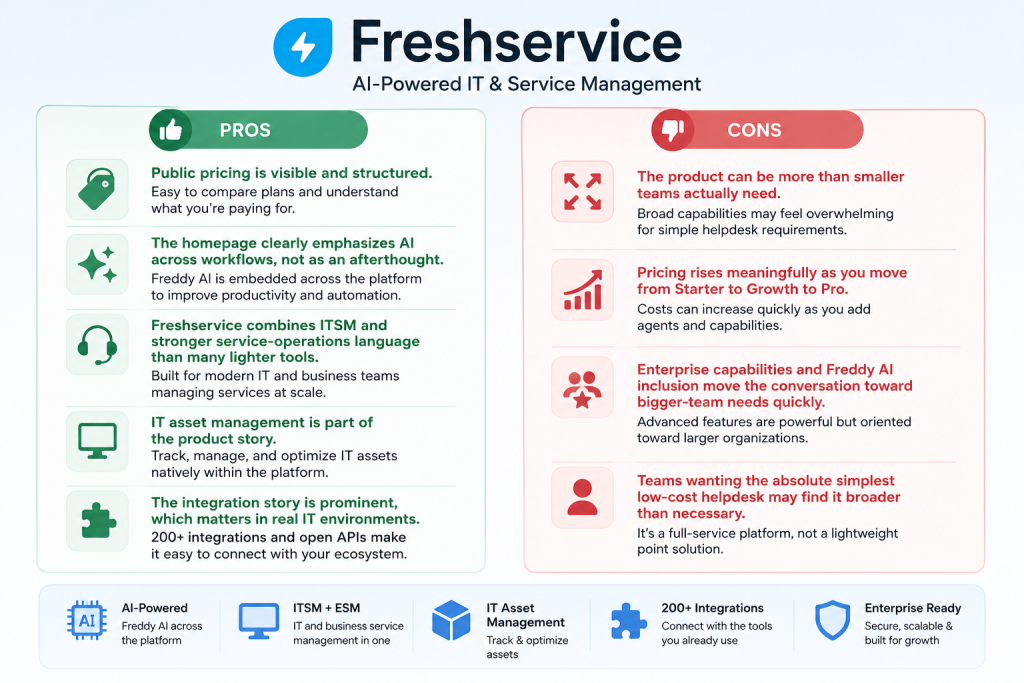
- Freshservice publishes rates for three of its four tiers in both billing cycles, which Atlassian matches only partly.
- Its Starter annual discount is 34.5%, far deeper than the 17% Freshworks applies higher up or the 17% Atlassian advertises.
- Service catalog, SLA management and on-call all arrive at Growth, one tier below where Pro sits.
- Enterprise bundles Freddy AI rather than charging the per-agent add-on.
- Nothing in the stack requires you to already run Jira, which matters for IT teams in non-engineering companies.
Cons –
- No free tier exists, while Atlassian runs three agents free with no time limit.
- Pro at $99 an agent annually is where change management sits, along with problem and release management.
- AI costs $29 an agent annually on top, or $35 billed monthly, outside the Enterprise tier.
- The Asset Unit allowance is 100 on the published plans, with extra capacity priced on a separate page.
- The pricing page opens on annual rates, so the headline figure understates month-to-month cost by about a third at Starter.
Features Deep Dive :
Service Management Core –
Both products cover the basics, so the comparison is about which tier holds what.
Freshservice Starter carries incident management, knowledge management, task management and a support portal. Growth adds service catalog, SLA management, on-call management and cloud management. Pro is where problem management, change management, major incident management, workload management, release management and employee journeys appear. Enterprise adds a sandbox and audit logs.
Atlassian splits the same ground differently. Its free tier already covers alerts, on-call schedules, an embedded knowledge base and a customer portal, for three agents. Standard adds asset and configuration management alongside audit logs. Premium is where change management, advanced incident and problem management, deployment gating and the virtual service agent live.
Read those two paragraphs against each other and the single most expensive difference becomes visible. An organisation that needs formal change control pays $99 an agent annually at Freshworks and $55.28 an agent monthly at Atlassian. On-call scheduling runs the other way, arriving free at Atlassian and at the $49 Growth tier on Freshservice.
Built-In AI Across Workflows –
Here the two vendors have made genuinely opposite commercial choices, and it is the cleanest thing to compare in the whole evaluation.
Freshworks sells Freddy AI Copilot as an add-on at $29 per agent per month billed annually, rising to $35 month to month. The Enterprise tier includes Freddy AI along with Freddy AI Agent (Classic) and Freddy AI Insights, which is the only way to stop paying the add-on separately.
Atlassian bundles Rovo into the subscription and meters it with credits. Standard carries 250 Rovo credits and 1,000 indexed objects per user per month, Premium raises that to 700 credits and 2,500 objects, and Enterprise to 1,500 and 6,250. Premium also includes the virtual service agent with 1,000 assisted conversations a month, after which conversations start at $0.30 each.
Work the arithmetic on a 10-agent desk wanting AI. Freshservice Growth plus Freddy Copilot costs $78 per agent per month annually, or $9,360 a year. Atlassian Premium at its monthly rate costs $6,633.60 a year and includes its AI allowance. The bundled model wins on sticker price, though credits are a consumption limit and a seat licence is not, so heavy use can close the gap in ways neither page lets you model in advance.
IT Asset Management Relevance –
Asset management is where both vendors quietly move cost off the main price card, and buyers miss it routinely.
Freshservice bundles the ITAM Growth package with 100 ITAM Growth Asset Units on its published plans. Asset Units are the licensing metric for the CMDB, counted by the number and type of assets managed. Additional functionality is available for extra cost on a separate IT Asset Management pricing page, and no rate for it appears on the main pricing page.
Atlassian counts objects instead and publishes the whole scale. Standard includes 5,000 Assets objects, Premium 50,000 and Enterprise 500,000, with anything above starting at $0.02 per object per month and volume discounts beyond that.
Count your estate before you compare headline prices. A 400-device company with laptops, monitors, licences and cloud resources will pass 100 Asset Units immediately, which makes the Freshservice quote incomplete until you have the ITAM number beside it. The same company sits comfortably inside Atlassian’s 5,000-object Standard allowance.

Integrations –
Integration strength is the one dimension where the comparison is not really about price.
Atlassian’s advantage is structural rather than earned: if your engineers already live in Jira, service tickets and development work share a platform, and deployment gating through connected CI/CD tools comes as a Premium feature rather than an integration project. Freshworks has to reach those systems from outside, which it does, but through connectors rather than through shared infrastructure.
Invert the question if your company does not ship software. A finance or healthcare IT team with no Jira estate gets none of that benefit and inherits Atlassian’s complexity for nothing, which is the strongest practical argument for Freshservice in this comparison.
Multi-Stage Capability Growth :
Each ladder is built for a different idea of how a service desk matures:
- Freshservice climbs by ITIL process, moving from incidents to catalog and SLAs, then to change and release.
- Atlassian climbs by scale and automation volume, moving from 1,250 automation steps to 3,000 and then 6,500 per user.
- Freshworks gates the formal disciplines behind its third tier, which suits teams adopting ITIL deliberately.
- Atlassian gates them behind its second paid tier, which suits teams that already work this way informally.
Pick the ladder that matches how you actually grow. A team planning a staged ITIL rollout over two years will find the Freshworks progression easier to budget against, because each step corresponds to a named practice.
Pricing Breakdown :
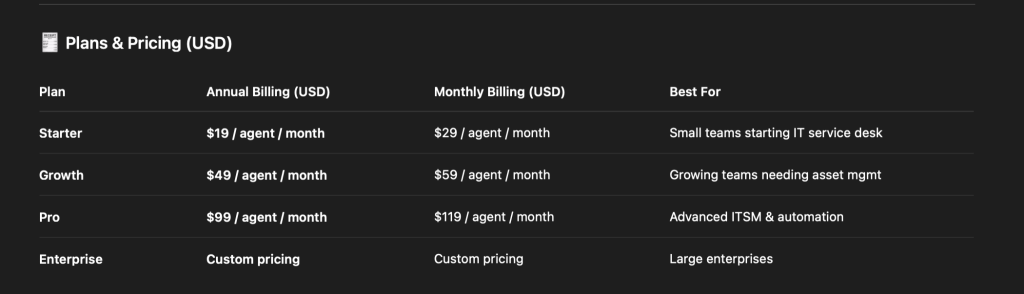
Both billing cycles for Freshservice, read on 15 October 2026:
| Plan | Price | What you get |
|---|---|---|
| Starter | $19/mo | Per agent, billed annually. $29 billed monthly, a 34.5% annual discount. Incident, knowledge and task management plus a support portal. |
| Growth | $49/mo | Per agent, billed annually, or $59 month to month. Adds service catalog, SLA management, on-call and cloud management. |
| Pro | $99/mo | Per agent, billed annually, or $119 month to month. Adds problem, change, major incident, workload and release management. |
| Enterprise | Custom | Quote only. Adds sandbox and audit logs, with Freddy AI included rather than charged as an add-on. |
| Freddy AI Copilot | $29/mo | Per agent add-on, billed annually, or $35 month to month. Required on Starter, Growth and Pro for AI features. |
Atlassian’s equivalent ladder, read from its own page on the same date:
- Free: $0 forever for three agents, 2GB storage, 1,250 automation steps a month, community support only.
- Standard: $21.50 per agent per month, adding asset and configuration management, audit logs, data residency and Rovo.
- Premium: $55.28 per agent per month, adding change management, advanced AIOps, the virtual service agent and a 99.9% uptime SLA.
- Enterprise: quote only, sold on annual terms, with pricing visible on the page only in annual mode.
- Annual billing saves up to 17% by Atlassian’s own description.
One caution on reading those two lists side by side. Atlassian prices by tier bands on annual subscriptions, charging for the band nearest your user count rather than your exact headcount, so a team of 11 may pay for more than 11.
If you want to map that to your own team, start with Freshservice here and compare your current service maturity against the public Starter, Growth, and Pro plan descriptions before jumping straight to features.
Who Should Use Freshservice :
Four situations favour Freshworks over Atlassian on the published evidence:
- Companies with no Jira estate, where Atlassian’s platform advantage does not apply at all.
- Teams adopting ITIL in deliberate stages, since the Freshworks ladder maps to named practices.
- Buyers committing annually at the entry tier, where the 34.5% discount beats anything Atlassian advertises.
- Organisations that want AI governed as a per-seat licence rather than as a monthly credit allowance.
That last point is more than a preference. A per-agent AI licence is predictable and a credit pool is not, and finance teams frequently prefer the line item that cannot surprise them.
Who Should Not Use Freshservice :
The comparison goes the other way in four equally clear cases:
- Teams of three or fewer agents, who run free on Atlassian indefinitely and pay $87 a month on Freshservice Starter billed monthly.
- Software companies already standardised on Jira, where service and delivery work share a platform.
- Anyone whose main requirement is change management, which costs roughly twice as much per agent at Freshworks.
- Buyers with large asset estates who need a published overage rate before signing.
None of those make Freshservice a weak product. They describe situations where a rival’s commercial model happens to fit better.
Watch one trap in that third bullet. Comparing $99 annually against $55.28 monthly is not like for like, so convert both to the same cycle before quoting the gap to anyone.
Converted properly, Freshservice Pro costs $1,188 per agent per year and Atlassian Premium costs $663.36 per agent per year at its monthly rate, falling further on annual terms.
Formal change control at Freshworks therefore carries a premium of roughly $525 per agent per year over the Atlassian equivalent, before any AI add-on.

Real Cost In Practice :
Take a 10-agent service desk and price the same requirement on both platforms.
- Freshservice Starter: 10 x $19 = $190 a month billed annually, or $2,280 a year. Billed monthly it is $290, or $3,480 a year.
- Freshservice Growth: $490 a month annually, $5,880 a year, rising to $590 and $7,080 on monthly billing.
- Freshservice Pro: $990 a month annually, $11,880 a year, rising to $1,190 and $14,280 on monthly billing.
- Atlassian Standard: $215 a month, $2,580 a year at the monthly rate.
- Atlassian Premium: $552.80 a month, $6,633.60 a year at the monthly rate.
Those pairs do not line up on features, which is exactly the point.
Match them on requirement instead. A desk needing change management compares Freshservice Pro at $11,880 against Atlassian Premium at $6,633.60, a difference of $5,246.40 a year. A desk needing only incidents and a portal compares Freshservice Starter at $2,280 annually against Atlassian Standard at $2,580, which is close enough that the decision moves to features.
Add AI and the picture shifts again. Adding Freddy Copilot to Growth reaches $9,360 a year for ten agents, more than Atlassian Premium with its AI allowance included.
Then add assets, which neither of the figures above covers for a real estate. Atlassian’s overage is published at $0.02 per object per month and the Freshworks equivalent is not on the pricing page, so one of these quotes can be completed from public information and the other cannot.
Ask for the ITAM number in writing before comparing anything. A quote missing its asset line is not a quote.
What Deployment Actually Looks Like :
Rollout effort diverges more than the price does, and it diverges on where your people already are.
Choosing Freshservice means standing up a service desk as its own system. Portal, categories, workflows and the CMDB all get built, and the integrations into identity, endpoints, chat and monitoring come after. Nothing is inherited, which is slower to start and cleaner to own.
Choosing Atlassian in a company that already runs Jira means inheriting projects, permissions and user directory from day one, along with whatever mess those already contain. Teams migrate faster and spend the saved time untangling conventions that predate the service desk.
A realistic sequence works the same way on either platform:
- Stand up intake and get every request arriving in one queue.
- Fix routing and ownership before adding any automation on top.
- Load the asset estate, which is where both vendors’ metering starts to bite.
- Introduce change and problem management last, once the data underneath is trustworthy.
Notice that the third step is the one that determines your real bill on both platforms, and it usually happens after the contract is signed.
Buyers who sequence it that way should price the asset estate during evaluation rather than during implementation.
Where Freshservice Can Disappoint :
Three disappointments show up specifically in comparison, rather than in isolation.
Small teams feel the first one. Three agents cost nothing on Atlassian forever, while the same three on Freshservice Starter billed monthly cost $87 a month, or $1,044 a year, for a product the rival gives away at that size. The Freshworks trial runs 14 days and then stops.
The second is the AI add-on. Paying $29 or $35 per agent per month for Freddy Copilot on top of a subscription reads badly next to a competitor bundling credits, and the only escape is the unpriced Enterprise tier.
Third is the asset metering. Publishing a 100 Asset Unit allowance and sending buyers to a separate page for anything beyond makes a complete comparison impossible from public information alone.
Those three will not matter to every buyer. They land hardest on exactly the small, cost-sensitive teams the Starter tier is written for:
- Ownership.
- Response workflows.
- Service visibility.
- Asset context.
- Cross-team coordination.
If that readiness is there, start with Freshservice here and compare the public plan ladder to the real complexity of your incidents, requests, approvals, and internal handoffs.
Weigh one thing the price tables cannot show. Atlassian’s cheaper change management arrives inside a platform built for software delivery, and running it well in a company that ships no software means adopting conventions designed for engineers.
Several ITSM buyers have paid the Freshworks premium knowingly for that reason, and it is a defensible trade rather than an error.
What is not defensible is comparing an annual rate on one page with a monthly rate on another, which is the single most common mistake in this particular matchup.
Both vendors load their pricing page in the state that flatters them, Freshworks on annual and Atlassian on monthly.
Toggle both before you write anything down.
Everything in this comparison was read in both states on 15 October 2026, and the Freshservice figures are reproduced in the table above for exactly that reason.
Prices in this market move, so re-check both pages before signing rather than trusting any article, including this one.
Verdict And CTA :
Atlassian wins this comparison on price at nearly every matched requirement, and loses it on fit for any company that does not already run Atlassian tooling.
Freshservice earns its premium in two specific places. Entry-tier annual buyers get a 34.5% discount that no rival here advertises, and ITIL-staged adopters get a ladder whose rungs match the practices they are rolling out. Everyone else is paying more for a comparable outcome.
If your team is trying to move from reactive support into more structured service operations, start with Freshservice here and compare the public plan ladder against the actual complexity of your incidents, requests, assets, and workflows today.

Run your own headcount and asset estate through both pricing pages before deciding, since a 10-agent difference of $5,246 a year at the change-management tier is large enough to fund other things.
If the current shared-inbox or lightweight-helpdesk approach is already slowing your IT team down, start with Freshservice here and test whether the Starter, Growth, or Pro positioning matches the stage your service desk is actually in.
Our Freshservice review covers the product on its own terms, without the competitive framing used here.
FAQ :
How much does Freshservice cost in 2026?
Starter is $19 per agent per month billed annually and $29 billed monthly, Growth is $49 and $59, Pro is $99 and $119, and Enterprise is quote only. The Freddy AI Copilot add-on costs a further $29 per agent annually, or $35 monthly, on the three published tiers.
Is Freshservice only for large enterprises?
No, though it is the pricier choice for small teams in this comparison. Jira Service Management runs three agents free with no time limit, while the smallest Freshservice commitment is Starter at $29 per agent billed monthly after a 14-day trial.
What is Freshservice best at?
Serving IT teams outside software companies. Nothing in it assumes an existing Jira estate, and its tier ladder follows ITIL practices, which suits organisations adopting formal service management in planned stages.
When is Freshservice too much?
When you need change management and nothing else distinguishes the options. That capability sits on Pro at $99 per agent annually, against $55.28 per agent monthly on Atlassian Premium, which works out at roughly $525 more per agent per year.
Before You Choose, Compare These
Hand-picked guides to help you choose the right tool — no fluff.
 ReviewsFreshservice Review 2026Hands-on verdict with the pros, cons and who it fits best.
 Use CasesWho Is Freshservice by Freshworks Best For? Use Cases & Fit (2026)Who gets the most out of it – and who should skip it.
 ComparisonsWebydo vs Alternatives 2026The strongest competitors compared side by side.
 Case StudiesWegic Case Study 2026What actually happened when teams rolled it out.