


In this guide
Diginius Insight is a PPC and digital reporting platform aimed squarely at agencies and the businesses they serve. This page walks through what the product actually does, feature by feature, and which plan each capability sits on. Every figure below was read from diginius.com on 6 October 2026.
Disclosure: Stack99 earns a commission if you buy through links on this page. It costs you nothing extra and never changes our assessment.
The vendor describes Insight as a sales and marketing platform that unifies digital data and consolidates reporting and analytics. Four capability areas are named on the homepage, and the pricing table gates them in ways the marketing copy does not spell out. You can start with Diginius here if you want the interface open while you read.

Advertising Insights
The first module answers one question: where is the money going and what is it returning.
Diginius aggregates paid performance across Google, Microsoft, Facebook and LinkedIn into a single view, and the product copy frames the purpose as optimising toward the highest-performing channels rather than simply displaying numbers side by side.
- Aggregate performance across Google, Microsoft, Facebook and LinkedIn in one place.
- Analyse key metrics across all online marketing activity rather than per network.
- Use the consolidated view to drive budget allocation decisions.
Two platform-specific tools sit alongside this and both are unusual. The Microsoft Publisher Network Tool appears as its own row in the pricing table, and higher tiers add new Microsoft Ads account creation plus support on those accounts. Diginius also runs a partner programme exclusive to PPC agencies built around Microsoft advertising, which explains why that network gets more attention here than in general-purpose reporting tools.
Connected TV appears as a separate feature row, gated by plan. The site does not detail what the row covers, so confirm its scope before treating it as a reason to upgrade.
Reporting And Email Automation
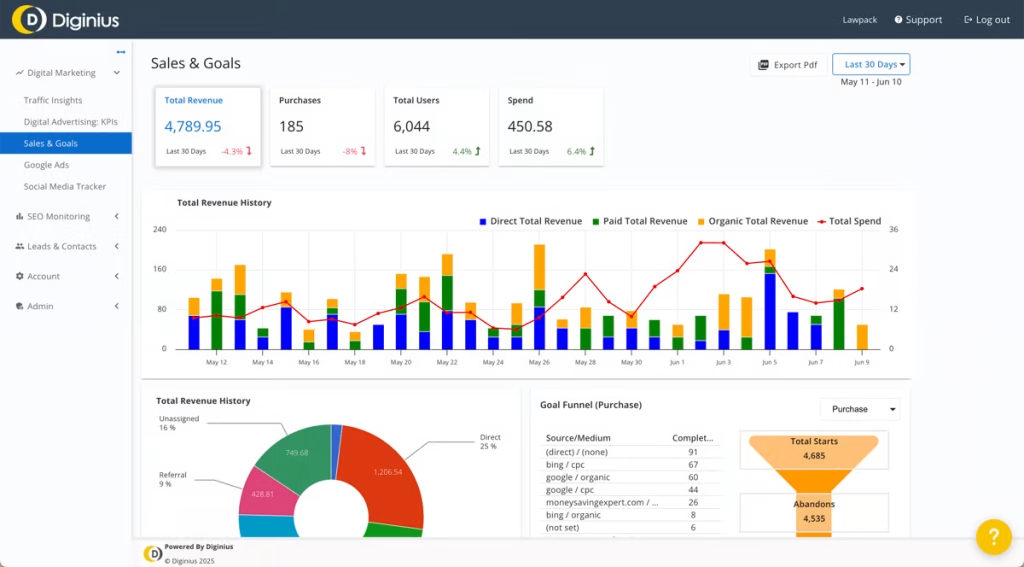
Reporting is the module most agencies buy this class of product for, and Diginius splits it into three jobs.
- Automate and schedule email reports rather than exporting by hand.
- Reconcile data from different networks into a single source of truth.
- Report across organic traffic, paid search, SEO, social and lead intelligence from one place.
Scheduled email reporting is listed as a feature row in the pricing table, which means it is tier-gated rather than universal. For an agency sending weekly client updates, that row is the difference between an automated Monday morning and somebody rebuilding four dashboards by hand.
The reconciliation claim deserves attention too. Anyone who has compared Google Ads conversions against GA4 sessions knows that two sources rarely agree, and a platform that commits to producing one reconciled figure is taking on a genuinely hard problem. Test it against your own numbers during the trial rather than assuming it is solved.
Lead And Intent Intelligence
Two separate things live under this heading, and the pricing table counts them separately.
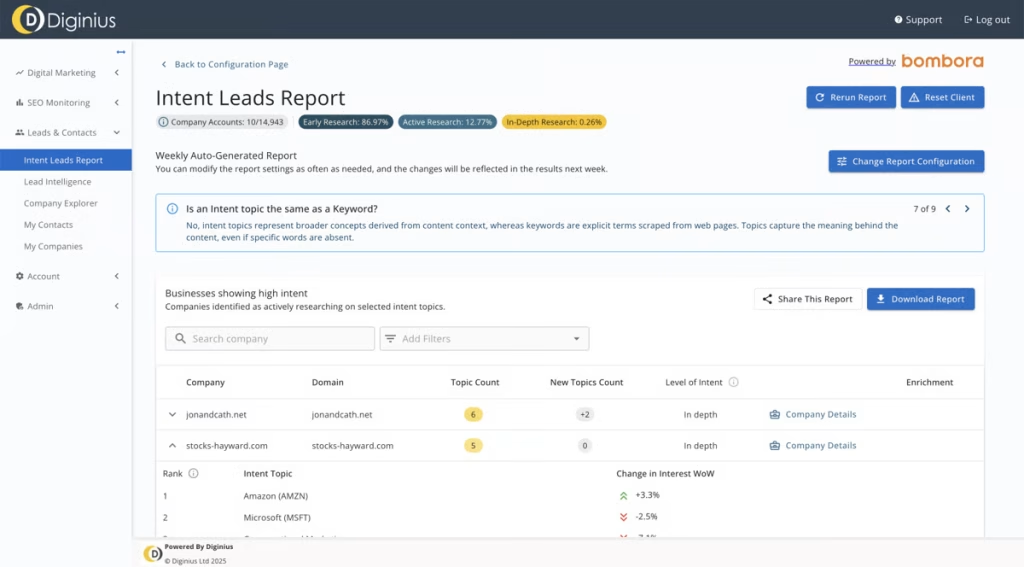
Lead Intelligence
This identifies B2B visitors on your own website and surfaces behaviour, so sales can tailor outreach to companies already showing interest. The allowance is metered weekly: 10 leads a week on Essential, 25 on Pro, 50 on Core, custom on Business.
Intent Leads by Bombora
A separate feed, named after the third-party intent data provider behind it, metered at 10, 50 and 100 leads a week across the three published tiers. Contact info credits are metered monthly at 25, 50 and 100.
Notice how differently those two scale. The first multiplies by five from Essential to Core. The second multiplies by ten. A business buying this platform mainly for intent data gets far more from each upgrade than one buying it for site visitor identification.
The 30-day trial is more generous than any paid tier on these rows: Diginius states it includes 100 Intent Leads a week and 100 contact info credits, after which your plan limits apply. Budget for the drop. A trial running at Core-level intent volume will feel very different from Essential at 10 a week.
SEO Site Health And Keywords
The SEO module covers site health, organic reach and competitive keyword tracking.
- Identify and locate website errors with the SEO site health tool.
- Track and monitor keyword rankings alongside the competitor landscape.
- Understand organic reach and potential against current performance.
Both of the headline limits here are tier-gated and they move fast. Keywords tracked run 25, 500 and 1,000 across Essential, Pro and Core. Site pages crawled run 1,000, 5,000 and 10,000.
Essential at 25 keywords is the tightest limit on the entire price list. A single client in a competitive category will consume that before lunch, so treat Essential as a reporting plan with SEO attached rather than an SEO plan.
The Agency Layer
Diginius sells two different products under one name, and the agency side has its own pricing page and its own feature list.
Six capabilities are listed for agency operations specifically:
- Manage every client in one place and assign them to individual managers.
- Report on client budget pacing, with custom parameters and alerts for over or underspending.
- Email reporting aimed at internal managers as well as clients.
- Finance automation that tracks and calculates client fees and pushes them into invoice generation.
- Bidding engines for Search and Shopping campaigns with profit-focused budgeting and KPI management.
- White-label dashboards carrying your agency colours and logo.
Budget pacing alerts are the row worth pausing on. Overspending a client budget is the error that costs an agency the account, and a tool that watches the burn rate and shouts before month end is doing work that otherwise falls to a person with a spreadsheet and a calendar reminder.
The bidding engines are the other genuine differentiator. A customer quote on the site singles out the proprietary bidding engine and the lead insight feature as the two things that stood out for B2B work. If either matters to you, start with Diginius here and test them against a live account rather than a demo.
White Label And Finance Tools
White labelling here goes past a logo upload. The agency page describes tailoring dashboards and customising the system with agency colours and branding, which means the client-facing surface can carry your identity rather than the vendor’s.
Finance automation is rarer still in this category. Tracking client fees, calculating them and pushing the result into invoice generation closes a loop that most reporting tools leave open, and it is the kind of feature that saves a day a month in an agency of any size.
Neither capability appears on the business price list. Both sit on the agency product at $25 per user per month, which makes the agency plan the cheaper route to them by a wide margin.
Integrations
The published FAQ names the connections directly: the major ad networks including Google, Microsoft, Facebook and LinkedIn, plus X, GA4, and a link to your own website for SEO monitoring.
Integration count is listed as unlimited on every business tier including Essential, which is a sensible decision. Metering connections rather than usage punishes exactly the multi-channel customer the product is built for.
CRM integration is the exception. It appears as its own row in the pricing table and is gated by tier, so confirm which plan carries it before assuming your CRM will sync.
What Each Tier Unlocks
Five metered rows separate the business plans, and reading them together is more useful than reading the plan names.
- SEO keywords: 25 on Essential, 500 on Pro, 1,000 on Core, custom on Business.
- SEO site pages: 1,000, then 5,000, then 10,000, then custom.
- Lead Intelligence leads per week: 10, 25, 50, custom.
- Intent Leads by Bombora per week: 10, 50, 100, custom.
- Contact info credits per month: 25, 50, 100, custom.
Support scales alongside them: email support on Essential, a customer success representative on Pro, and a dedicated representative on both Core and Business.
Three further rows are tier-gated without published detail: new Microsoft Ads account creation, support on Microsoft Ads accounts, and Connected TV. Ask which plan carries each one if any of them is load-bearing for you.
Pricing Context
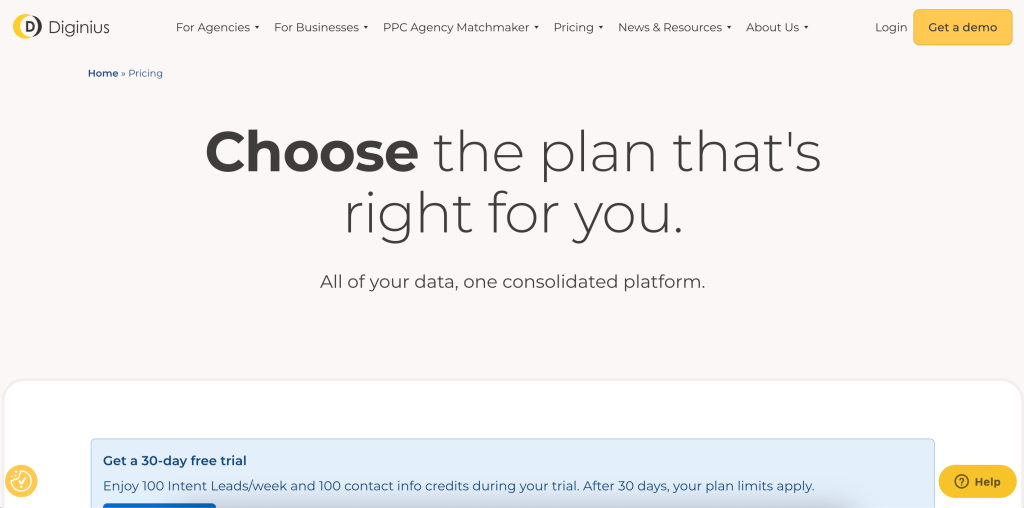
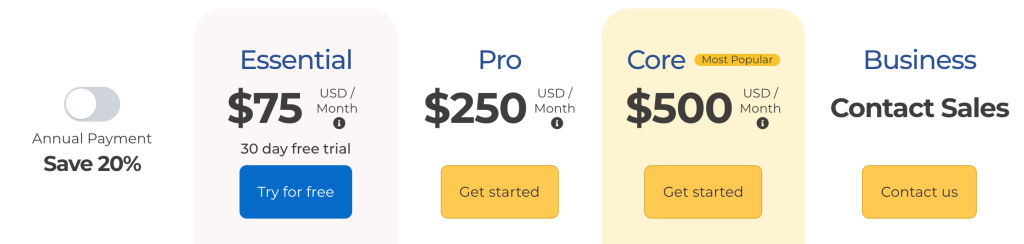
Business plans are listed at $75, $250 and $500 USD per month for Essential, Pro and Core, with Business quoted by sales. Agency seats are priced at $25 a month or $240 a year each.
A 20% annual discount is stated twice, once as a badge beside the business plan cards and once in the FAQ. On our reading the business cards did not change figures when that control was used, so the discounted monthly rates are not published. Applying 20% to the listed prices implies $60, $200 and $400 a month, or $720, $2,400 and $4,800 a year, though those are our arithmetic rather than vendor-published numbers. Confirm them at checkout.
Both bases are printed on the agency page, and they reconcile exactly: $25 a month is $300 across a year against a published annual price of $240, which is 20% to the penny.
One structural note on the two price lists. An agency with four staff pays $100 a month for the agency suite, which is more than Essential and less than half of Pro, while getting white labelling, finance automation and bidding engines that no business tier lists at all. The per-user model only becomes expensive above roughly ten users.
Which Features Earn The Upgrade
Buy Essential if: you want consolidated multi-channel reporting and nothing else. At 25 keywords and 10 leads a week, the SEO and intelligence modules are demonstrations rather than working tools.
Buy Pro if: SEO is a real part of the brief. The jump from 25 to 500 keywords is the single largest proportional increase anywhere on the price list, and it costs $175 a month.
Buy Core if: intent data drives your pipeline. One hundred Bombora leads a week and 100 contact credits a month is ten times what Essential allows, and a dedicated success representative comes with it.
Buy the agency suite if: you bill clients. White labelling, budget pacing alerts, finance automation and the bidding engines live only on that product, and $25 per user is cheap against what they replace.
Look elsewhere if: you need deep attribution modelling or a data warehouse destination. Diginius consolidates and reports; it does not position itself as a modelling layer.
FAQ
What does Diginius Insight cost?
Business plans are $75, $250 and $500 per month for Essential, Pro and Core, with Business quoted by sales. Agency seats cost $25 per user per month or $240 per user per year. A 20% annual discount is stated for the business plans but the discounted figures are not printed.
Which ad networks does it connect to?
Google, Microsoft, Facebook and LinkedIn for paid performance, plus X, GA4 and a direct link to your website for SEO monitoring. Integration count is unlimited on every tier.
How many SEO keywords can I track?
25 on Essential, 500 on Pro, 1,000 on Core and a custom figure on Business. Site page crawling runs 1,000, 5,000 and 10,000 across the same three published tiers.
What is the difference between Lead Intelligence and Intent Leads?
Lead Intelligence identifies B2B visitors on your own site. Intent Leads is a separate feed supplied by Bombora. Both are metered weekly, at 10, 25 and 50 for the former and 10, 50 and 100 for the latter.
Is there a free trial?
Yes, 30 days, and the vendor states it includes 100 Intent Leads a week and 100 contact info credits. Those allowances exceed every paid tier, so expect a drop when your plan limits take over.
Which features are agency-only?
White-label dashboards, client assignment to managers, budget pacing alerts, finance automation into invoice generation, and the Search and Shopping bidding engines. None of these appear on the business price list.
Sources
- Diginius business pricing, read 6 October 2026, including the feature comparison table and FAQ.
- Diginius agency pricing, for the per-user rate and the agency feature list.
- Diginius Insight, for the four capability areas and the Microsoft partner programme.
More on Diginius
Hand-picked guides to help you choose the right tool — no fluff.
 Use CasesWho Is Diginius Best For? Use Cases & Fit (2026)Who gets the most out of it – and who should skip it.
 Case StudiesDiginius Case Study 2026What actually happened when teams rolled it out.
 Use CasesWho Is Dry Ground AI Best For? Use Cases & Fit (2026)Who gets the most out of it – and who should skip it.
 IntegrationsEasyDMARC Integrations Guide 2026What it connects to and how well each link holds up.