


Platform teams routing volume across many models, under SSO, audit and residency requirements.
Per token against a committed balance, never per seat.
In this guide
Who This Post Is For :
BLACKBOX AI changed shape. The self-serve plans at $10, $20 and $40 a month that this guide previously described are gone from the pricing page as published on 14 October 2026. What sits there now is a per-token inference platform sold through an annual committed-spend contract, with no seats, no monthly tier and no signup path to pricing.
Disclosure: Stack99 earns a commission if you buy through links on this page. It costs you nothing extra and never changes our assessment.
So the fit question has a different answer than it did six months ago. This post is for engineering and platform leaders deciding whether a single metered endpoint across many model providers is worth a committed contract. It is no longer for an individual developer looking for a cheap coding assistant, because nothing on the public site sells one.
If you are evaluating the platform while you read, look at BLACKBOX AI here.
Why BLACKBOX AI Fits This Niche :
The pitch is consolidation with governance attached. One endpoint reaches a catalogue the vendor puts at more than 300 models, billed on one invoice, with routing, failover and caching in front of it.
Three properties decide whether that suits you.
- Metering is per token and explicitly not per seat. Headcount growth does not change the bill, and a team of forty costs the same as a team of four at equal usage.
- Spend is committed up front through a purchase order and drawn down as teams consume it. Finance sees one number at the start of the year rather than a variable monthly charge.
- The controls that normally require a separate negotiation are bundled: SAML SSO, SCIM, role-based access control, audit logs, contractual zero data retention with a DPA, data residency, and a PII removal layer applied before traffic reaches closed models.
That last group is the real filter. An organisation that does not need SSO, residency or contractual retention terms is paying a commitment for governance it will not use.
Top Features For The Niche :
Four items stand out for a platform team specifically.
Bring your own provider accounts. The FAQ states you can connect existing OpenAI, Anthropic or Google accounts and route through rates you already negotiated, while routing, failover, caching and the dashboard stay available and usage bills through that provider. Anyone already holding a discounted enterprise agreement keeps it.
A dedicated forward-deployed engineer, with implementation included at no cost on the Enterprise arrangement. The vendor describes that person as writing code in your stack: migration from the current provider, production integrations, eval harnesses, routing and latency tuning.
Dedicated single-tenant deployment with data residency, described as infrastructure isolated from every other customer. Routed traffic has retention and training suppressed through provider terms and per-request flags wherever the provider API supports it, which is a carefully bounded claim worth reading twice.
An Agents API with cloud coding agents, remote agent sandboxes, and dedicated runners behind SSO. Multi-agent orchestration is listed as metered, so it draws on the same balance.
Real-World Example :
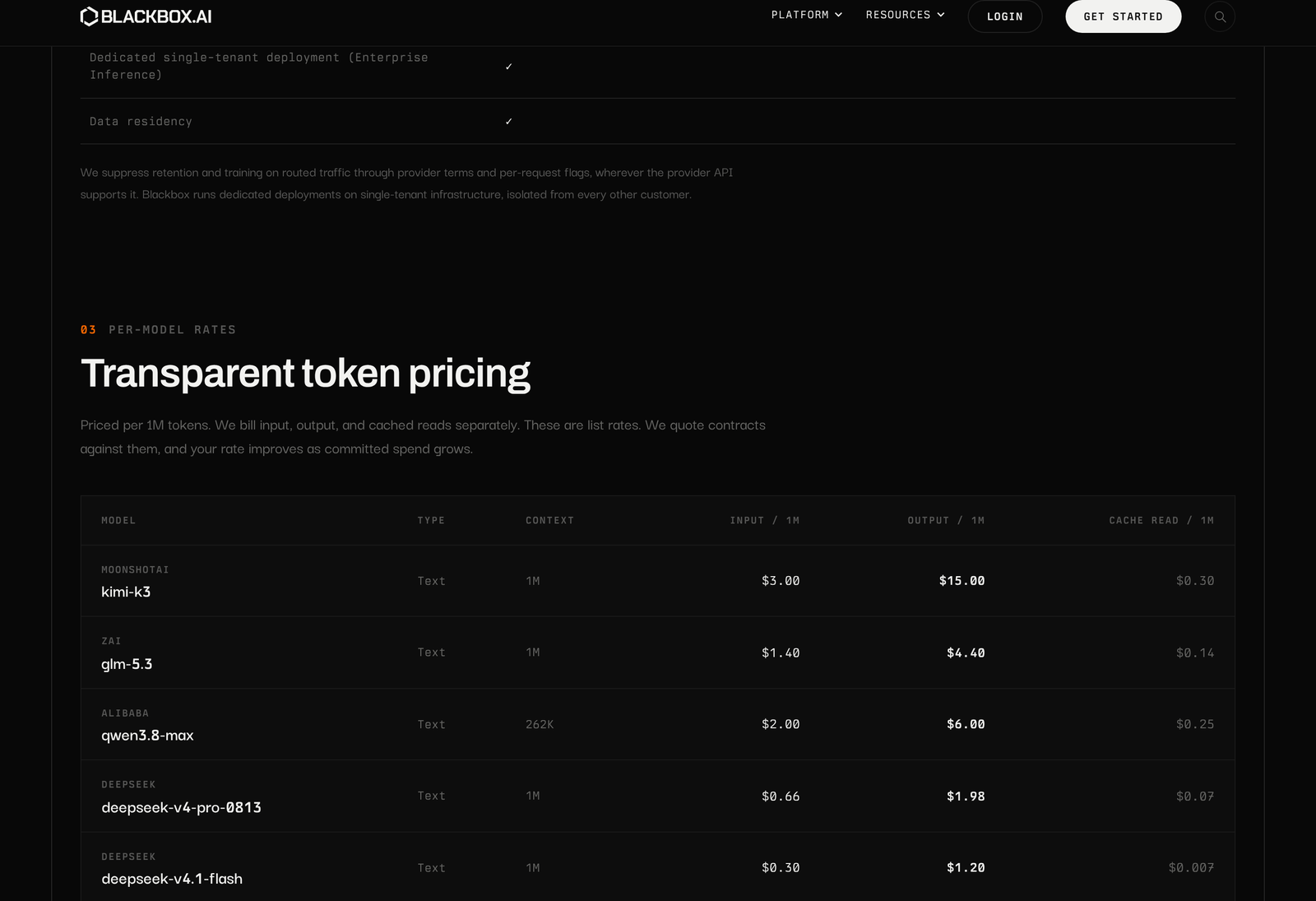
Model choice moves the bill more than the contract discount does, and the published rates make that easy to show.
Take a team consuming 10 million input tokens and 2 million output tokens in a month. On kimi-k3 at $3.00 input and $15.00 output per million, that month costs $30 plus $30, so $60. On deepseek-v4.1-flash at $0.30 and $1.20, the same volume costs $3.00 plus $2.40, so $5.40. The cheaper model is 11 times less expensive for identical traffic.
Now compare that with the commitment discount, which the page describes as at least 5 percent on closed models and at least 10 percent on open-weight ones. A 10 percent saving on the $60 month is $6. Switching model saves $54.60. Routing work pays for itself long before contract negotiation does.
Cached reads sharpen the point further. On deepseek-v4.1-flash a cached read costs $0.007 per million against $0.30 for fresh input, which is roughly one forty-third of the price. On kimi-k3 the cache read is $0.30 against $3.00 input, a flat ten to one. Workloads with a large stable prompt prefix should expect very different economics from workloads without one.
Pricing In Context :
List rates, read 14 October 2026, priced per million tokens with input, output and cached reads billed separately.
| Plan | Price | What you get |
|---|---|---|
| Enterprise commit | Custom | Annual committed spend on a purchase-order burn-down. At least 5 percent off closed models, at least 10 percent off open-weight. No platform fee, no seat charge. |
| kimi-k3 (moonshotai) | $3.00/1M in | 1M context. $15.00 per 1M output, $0.30 per 1M cached read. |
| glm-5.3 (zai) | $1.40/1M in | 1M context. $4.40 per 1M output, $0.14 per 1M cached read. |
| qwen3.8-max (alibaba) | $2.00/1M in | 262K context. $6.00 per 1M output, $0.25 per 1M cached read. |
| deepseek-v4-pro-0813 | $0.66/1M in | 1M context. $1.98 per 1M output, $0.07 per 1M cached read. |
| deepseek-v4.1-flash | $0.30/1M in | 1M context. $1.20 per 1M output, $0.007 per 1M cached read. |
Two commercial terms deserve a hard look before signing. Unused commitment expires at the end of the billing period, with spend alerts at 75 and 90 percent, so the vendor’s own advice is to size the commit against minimum usage rather than forecast usage. Separately, the claim that routing and prompt caching stretch the same commit by 10 to 20 percent is a vendor estimate we have no way to test.
Our BLACKBOX AI pricing breakdown was written against the earlier plan structure and predates this change.
What Changed, And Why It Matters :
Worth stating plainly, because anyone arriving from an older review will be looking for plans that no longer exist. The previous structure sold Pro at $10 a month, Pro Plus at $20 and Pro Max at $40, each bundling a dollar allowance of model usage with features such as multi-agent execution, an app builder, a coding agent across 35 or more IDEs, Slack integration and SAML SSO at the top tier.
None of those tiers appears on the pricing page today. The capabilities have not vanished, and several survive as line items in the enterprise comparison table, including the Agents API, remote agent sandboxes and SSO. What has gone is the route to buy them without talking to someone.
For a solo developer this is a downgrade in access, whatever it does for the product. For a company that was already assembling several provider accounts, a gateway and a security review on its own, the change removes work. Decide which of those two descriptions fits you before reading any further comparison, and check the current BLACKBOX AI pricing page yourself, since this is clearly a product in motion.
One benchmark claim sits alongside the rates and should be read as the vendor’s own. BLACKBOX AI says its Nemotron 3 Ultra deployment was ranked first on output speed by Artificial Analysis in July 2026, and that it is 2.7 times cheaper than the second fastest provider. We have not verified either figure at the benchmark source.
Alternative Tools For This Niche :
Judge the alternatives by what you are actually buying, which is a routing and governance layer rather than a model.
Going direct to a single provider removes the layer entirely. You lose cross-model routing and the single invoice, and you keep a simpler contract. Teams standardising on one model family rarely need anything else.
Running your own gateway, open source or built in house, gives the same routing and caching without a committed spend. The cost moves from a contract line into engineering time, and the governance features listed above become your problem to build.
Buying through a cloud marketplace suits organisations with existing committed cloud spend, since the inference bill can draw down an agreement already signed. The platform lists Microsoft Azure under its own deployment options, which is worth raising if your Azure commitment is large.
We have not priced these alternatives here, because each depends on contracts specific to the buyer. Treat this as a list of the questions to ask rather than a ranking, and get a scoped quote from BLACKBOX AI to compare against them.
Setup Steps :
Onboarding begins with a conversation rather than a signup, which the vendor states plainly. The sequence it describes runs like this.
- Scope the workload, the controls your security review requires, and the volume you expect.
- Agree a commit sized, in the vendor’s words, so that a director or VP can sign without an approval chain.
- A forward-deployed engineer configures the account, including controls such as PII removal.
- Traffic moves across the surfaces that share one balance: Enterprise Inference, the Router, the API, the CLI and the Agents API.
- Watch the balance draw down in the dashboard, with alerts at 75 and 90 percent.
Build your own evaluation before step two. A commit sized against a model you later replace is money spent on the wrong assumption, and the eleven-fold difference shown earlier is the reason to settle routing first.
Verdict :
Good fit: a platform team routing meaningful inference volume across several model families, inside an organisation whose security review asks for SSO, audit logs, residency and contractual zero retention. The per-token metering rewards you for adding users, and the governance stack arrives without a separate negotiation.
Poor fit: an individual developer, a small team wanting a monthly subscription, or anyone whose usage is too uncertain to commit against. Unused balance expires, and there is no published self-serve plan to fall back on.
Undecided: organisations already holding negotiated provider agreements. The bring-your-own-account route means the value on offer is routing and governance rather than token price, so price the layer on its own merits. To scope it, talk to BLACKBOX AI here.
FAQ :
Does BLACKBOX AI still have a $10 a month plan?
Not on the pricing page as published on 14 October 2026. The Pro, Pro Plus and Pro Max tiers at $10, $20 and $40 no longer appear. Pricing is now per token under an annual committed-spend contract.
Is there a per-seat charge?
No. The page states there is no platform fee, no credit-purchase fee and no per-seat charge, and that metering is per token. How seats are treated is set by the individual contract.
What happens to commitment I do not use?
It expires at the end of the billing period. Spend alerts fire at 75 and 90 percent, and the vendor advises sizing the commit to minimum rather than expected usage.
Can I keep my existing OpenAI or Anthropic contract?
Yes. You can connect those accounts and route through your negotiated rates, with usage billing through that provider while routing, failover, caching and the dashboard remain available.
How much does the committed discount save?
The page quotes at least 5 percent on closed models and at least 10 percent on open-weight models, improving as committed spend grows. No upper figure is published.
Before You Choose, Compare These
Hand-picked guides to help you choose the right tool, no fluff.
 PricingBLACKBOX AI Pricing 2026Real tier prices and what each plan actually includes.
 Use CasesWho Is Flatpay Best For? Use Cases & Fit (2026)Who gets the most out of it – and who should skip it.
 AlternativesSeel Alternatives 2026Credible alternatives and when each one wins.
 Use CasesWho Is airSlate Best For? Use Cases & Fit (2026)Who gets the most out of it – and who should skip it.