


Kinetic publishes offshore salary benchmarks against local market wages, with savings between 56% and 65% on the roles it lists.
Kinetic handles paperwork, timekeeping, payroll and HR support after appointment. You manage the person.
The model suits a startup filling a single clear bottleneck, not one outsourcing a vague shortage of hands.
In this guide
Why Kinetic Fits Startups So Well
Startups buy time with money they do not have much of. That single tension explains why offshore staffing keeps coming up at seed stage, and why it goes badly as often as it goes well.
Disclosure: Stack99 earns a commission if you buy through links on this page. It costs you nothing extra and never changes our assessment.
Kinetic Innovative Staffing places remote staff in the Philippines for companies elsewhere, and has been doing it since 2013 according to its own site. Three things about how it operates matter more to a startup than to a larger buyer.
First, you are not setting up an entity. Kinetic states that after appointment your staff report to you while it takes care of paperwork, timekeeping, payroll and HR support. A four-person company does not have anyone to run Philippine payroll compliance, so that division of labour is the whole product.
Second, the commercial model is a salary comparison rather than a seat licence. Kinetic publishes indicative annual wage ranges by role next to average local market wages, which lets you model a hire before you speak to anyone. Few staffing agencies put that on a public page.
Third, the process is deliberately short. Briefing, shortlist, interview, appointment. Kinetic says shortlists usually arrive within a week.

Top Features For Startups
Published Benchmarks You Can Model Against
The pricing section carries a role table with an average, low and high offshore figure plus an average local wage and a savings percentage. Captured in Australian dollars on 7 October 2026, the Administration and Support category reads:
| Role | Offshore average (AUD) | Offshore range (AUD) | Average local wage (AUD) | Saving |
|---|---|---|---|---|
| Customer Service Representative | 26,700 | 24,300 to 29,000 | 70,000 | 62% |
| Data Entry Specialist | 24,900 | 23,400 to 26,300 | 63,000 | 60% |
| Legal Assistant | 32,600 | 26,700 to 38,400 | 80,000 | 59% |
| Technical Support Staff | 30,300 | 26,000 to 34,600 | 85,980 | 65% |
| Virtual Assistant | 30,000 | 25,300 to 34,600 | 68,250 | 56% |
Kinetic labels these indicative estimates based on its published benchmarks, notes that offshore figures are average annual rates and local figures are average market rates, and warns that actual costs vary by seniority and requirements. Treat the table as a modelling input, never as a quote. A currency selector offers AUD, CAD, GBP, USD and NZD, and other role categories cover engineering and construction support, finance and accounting, sales and marketing, and web developers and programmers.
A Four-Step Hiring Process
Kinetic describes four stages. You supply a job description. Kinetic returns a shortlist, usually within a week. You interview and select. After appointment the staff member reports to you, and Kinetic handles the administrative layer.
Short processes suit startups for an unglamorous reason: founders run hiring themselves and have no slack. Four stages with one week to shortlist is something a founder can fit around a product release.
Post-Appointment Admin You Do Not Have To Build
Paperwork, timekeeping, payroll and HR support sit with Kinetic. Its published commitments include no additional costs, no hidden charges and transparent transactions. Get those in writing in your agreement rather than relying on a web page, since a promise list is marketing until it appears in a contract.

Real-World Startup Example
Picture a six-person SaaS company a year past launch. Support tickets have outgrown the founders. Onboarding calls are being skipped. Nobody is updating the CRM.
The local answer is one customer success hire at the market average Kinetic cites for a customer service representative, AUD 70,000 a year, plus recruitment time and on-costs. The offshore answer using Kinetic’s published average is AUD 26,700.
Run it as two roles instead of one. A customer service representative at AUD 26,700 plus a virtual assistant at AUD 30,000 totals AUD 56,700. The equivalent local pair, at Kinetic’s quoted market averages of AUD 70,000 and AUD 68,250, totals AUD 138,250. The gap is AUD 81,550 a year, and for most seed-stage companies that is several months of runway rather than a line item.
Now the part the savings table does not show. Two new people in a different time zone need a manager, documented processes and a decision about overlap hours. A six-person company usually has none of those. The saving is real; the management load arrives with it, and founders who skip that step end up paying twice.

Pricing In Context
Kinetic publishes no fixed subscription fee or placement price. What it publishes is the salary benchmark table and a savings calculator where you pick a role and a headcount between one and twenty, then see estimated local cost, Philippines cost, annual saving and five-year saving. Final numbers come from a quote.
Budget around three questions the public page does not answer. What is the service margin on top of the salary figure? What notice period applies if the role does not work out? What happens to the engagement if your funding round slips? Those three decide whether this is a good deal for a company whose plans change quarterly.
Our Kinetic Innovative Staffing pricing breakdown goes further into the commercial model.
Alternatives Startups Might Consider
Offshore staffing is one answer among several, and a startup should price the others honestly.
- A local part-time hire. Costs more per hour, needs no time zone planning and no process documentation. For under fifteen hours of work a week this often wins.
- Freelance marketplaces. Cheapest to start and cheapest to stop. Continuity is the trade, which hurts most in support roles where customers notice a new name every month.
- An employer of record. Lets you hire anywhere without an entity, generally at a per-employee monthly fee on top of salary. You run the recruiting yourself, which Kinetic does for you.
- Automation before headcount. A help centre, canned replies and a decent routing rule can absorb a surprising share of an early support load for a fraction of any salary.
For named competitors see our Kinetic alternatives roundup.
Setup Steps For A Startup
Step 1: Define One Role Clearly
Write the job description before you contact anyone, because Kinetic’s process starts with you supplying one. Vague briefs produce vague shortlists. Name the five tasks the person will own in week one.
Step 2: Match The Role To A Measurable Bottleneck
Pick something you already count: first response time, tickets per day, invoices processed. A role attached to a number can be judged at ninety days. A role attached to a feeling cannot.
Step 3: Use The Shortlist Seriously
Kinetic returns candidates usually within a week and you run the interviews. Resist the temptation to delegate that step back. The agency screens for capability; only you know whether someone will survive a startup with no manual.
Step 4: Build A Clean Onboarding Plan
Decide overlap hours, the tools they get on day one, and who answers their questions. Kinetic covers payroll and HR support, not your internal context. Thirty days of written process beats six months of improvisation.
Step 5: Measure The Role Against Time Saved
Review at ninety days against the number from step two. A customer service hire at Kinetic’s AUD 26,700 average costs roughly AUD 513 a week. Compare that to founder hours recovered at whatever you believe those are worth, and the decision stops being a feeling.
Where Startups Get The Most Value
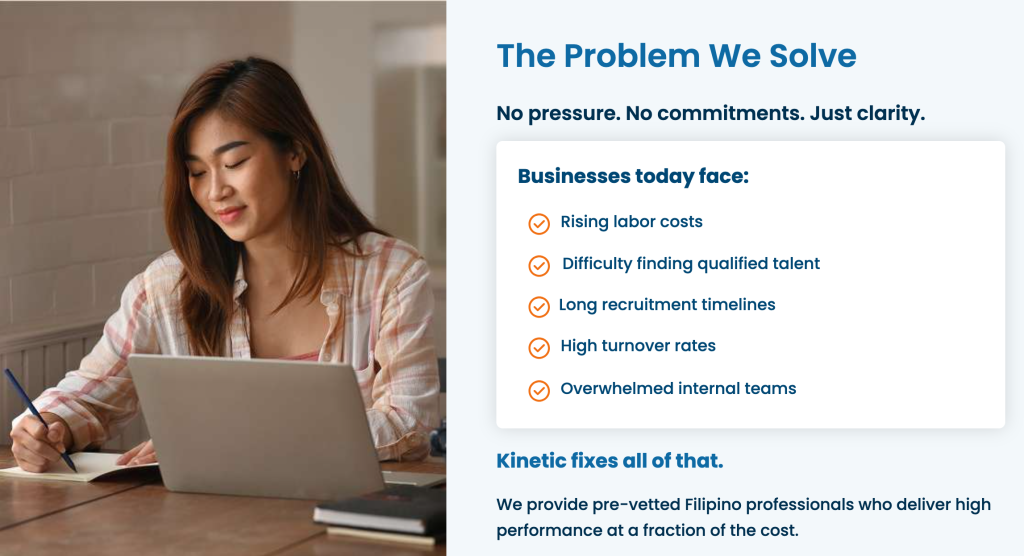
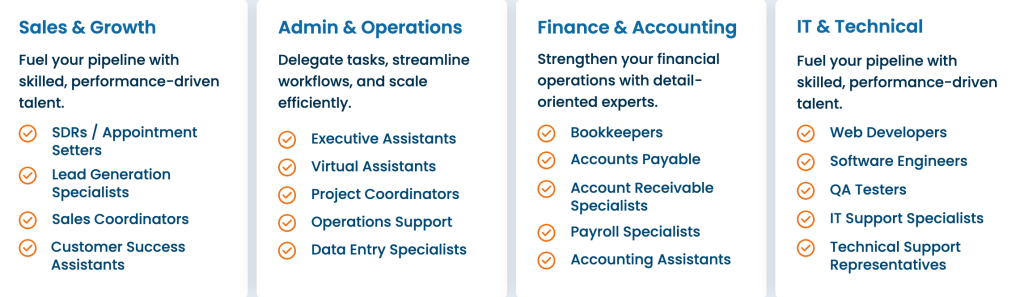
Value concentrates in roles that are repeatable, documented and continuous. Customer support queues. Data entry and CRM hygiene. Back office and bookkeeping. Scheduling and inbox triage. Kinetic lists all of these among the categories it staffs.
Value evaporates in roles that are judgement-heavy and undocumented. Early product decisions, founding sales, anything requiring deep context your company has not written down yet. Offshoring those is not a cost saving; it is a transfer of your hardest problem to someone with the least context.
Kinetic also names specific industries it serves, including healthcare, finance and accounting, legal services, engineering, logistics and real estate. A startup inside one of those verticals is likelier to find candidates who have done the work before.
Verdict
Kinetic suits a startup that has one clearly defined, repeatable role and no appetite for building an international payroll function. The published benchmarks make it unusually easy to model before you talk to a salesperson, and the four-step process respects how little time founders have.
It suits you poorly if the work is undefined, if you need fewer than fifteen hours a week, or if nobody on your team has capacity to manage a remote report. Those conditions sink offshore hires regardless of the provider.
Treat the savings table as a model and the quote as the truth. You can book a free consultation with Kinetic to get the numbers that apply to your roles.
FAQ
Is Kinetic Innovative Staffing good for startups?
It fits startups with a defined, repeatable role and no in-house payroll capability abroad. Kinetic handles paperwork, timekeeping, payroll and HR support while the staff member reports to you, which is the arrangement a small team needs.
What roles does Kinetic publish benchmarks for?
Categories include administration and support, engineering and construction support, finance and accounting, sales and marketing, and web developers and programmers. The administration table covers customer service representatives, data entry specialists, legal assistants, technical support staff and virtual assistants.
How much can a startup save?
Kinetic’s own published comparison shows savings between 56% and 65% across the administration roles it lists, measured against average local market wages. Those are indicative estimates by Kinetic’s own disclaimer, and real costs vary with seniority and requirements.
How does the hiring process work?
Four steps. You provide a job description, Kinetic sends a shortlist usually within a week, you interview and select, then your chosen staff member reports to you while Kinetic manages the administration.
Does Kinetic publish a fixed price?
No. The public page shows salary benchmarks and a savings calculator rather than a subscription or placement fee. Final pricing comes from a quote, so ask about the service margin and notice terms early.
Which currencies does the calculator support?
Australian, Canadian, British, United States and New Zealand dollars. Figures in this guide were captured in Australian dollars.
More on Kinetic Innovative Staffing
Hand-picked guides to help you choose the right tool — no fluff.
PricingKinetic Innovative Staffing Pricing 2026Real tier prices and what each plan actually includes.
AlternativesKinetic Innovative Staffing Alternatives 2026Credible alternatives and when each one wins.
ComparisonsSalesmsg vs Alternatives 2026The strongest competitors compared side by side.
ReviewsSitesGPT.com Review 2026Hands-on verdict with the pros, cons and who it fits best.