


In this guide
Quick Verdict :
Comparing Gusto against its alternatives is unusually lopsided, because the vendors do not compete on the same terms. Gusto prints a base fee and a per-person fee for all three of its plans. Rippling prints nothing at all and routes every visitor to a custom quote. Deel and Rise publish flat per-head rates built for cross-border work rather than domestic payroll. You are rarely choosing between four versions of the same product.
Disclosure: Stack99 earns a commission if you buy through links on this page. It costs you nothing extra and never changes our assessment.
So the comparison turns on workforce shape.
Gusto wins when your people are employees on a United States payroll and you want a number you can budget before talking to anyone. The global platforms win when your people sit in other countries, where Gusto’s per-person employee pricing was never the relevant model. Rippling wins when payroll is one part of a bigger consolidation project, and loses whenever you need a figure today.
Where each option lands:
- Gusto: best for United States employees, with published pricing you can model in a spreadsheet.
- Deel and Rise: built for contractors and overseas employees, priced per head rather than per company.
- Rippling: quote-only, aimed at buyers consolidating payroll with devices and app access.
- Nobody in this group is cheapest at every headcount, because the pricing shapes differ.
If you want to check the platform while you read, start with Gusto here.
Product Facts And Overview :
Three distinct pricing shapes are in play, and recognising which one you are looking at matters more than any feature table.
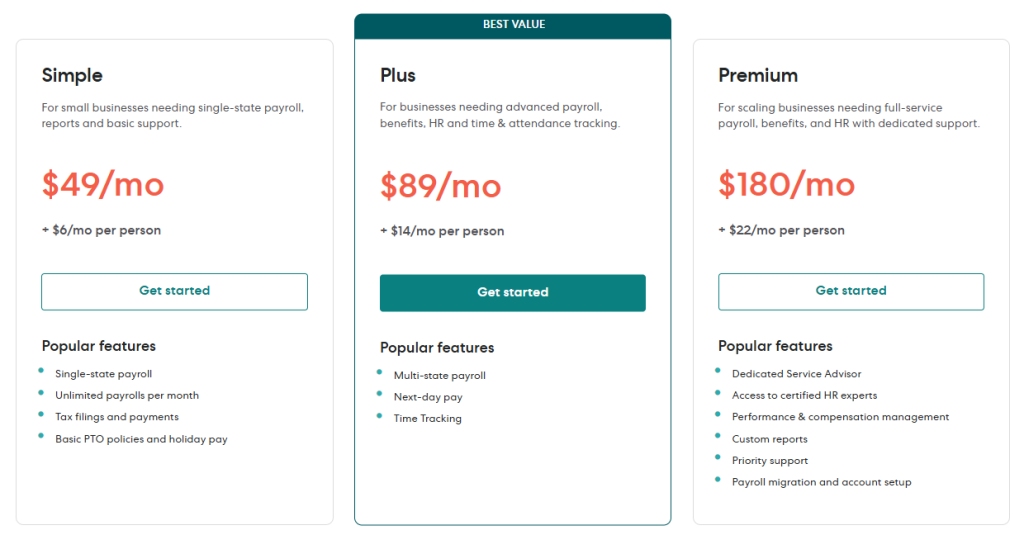
The Gusto model is a monthly platform fee plus a charge per person. Simple costs $49 a month plus $6 per person, Plus costs $80 plus $12, and Premium costs $180 plus $22. A base fee that small amortises quickly, which makes the model cheap at scale and relatively expensive for very small teams.
Cross-border vendors drop the base fee entirely and charge per worker. Deel publishes contractor management from $49 per contractor a month, Contractor of Record from $325, United States PEO from $125 per employee a month, and Employer of Record from $599. Rise publishes $49 per contractor, $299 for Agent of Record and $399 for Employer of Record. Flat per-head pricing has no economy of scale at all: ten people cost exactly ten times one person.
Rippling takes the third route and publishes no figure anywhere, asking instead what services you need so it can send a custom quote. That is a legitimate way to sell a modular platform, and it also means Rippling cannot be placed on a price comparison without contacting sales first.
Those shapes explain most apparent contradictions between reviews. A claim that Gusto is expensive usually comes from a two-person company paying the base fee. A claim that it is cheap usually comes from a fifty-person company spreading the same base fee across fifty heads.
Pros And Cons :
Pros –
- Every plan price is published, which Rippling does not match.
- The base-plus-per-person model gets cheaper per head as you grow, unlike flat per-head rivals.
- Contractor payments carry no monthly per-contractor fee, where both rivals charge $49.
- Add-ons are individually priced, so you can approximate a higher tier without buying it.
Cons –
- No employer-of-record product, so hiring an employee abroad needs a different vendor.
- The per-person fee nearly quadruples between Simple and Premium, from $6 to $22.
- Several capabilities bundled by competitors arrive as separately billed add-ons here.
- Very small teams pay a high effective rate per person while the base fee dominates.

Features Deep Dive :
Payroll And Tax Filing –
All three Gusto plans run full-service payroll with unlimited payroll runs a month and automatic tax filings. Unlimited runs is the detail to check against any rival, because providers that meter payroll runs make off-cycle corrections expensive.
Scope is where the alternatives diverge sharply. Simple covers basic payroll in one state, and multi-state payroll is a Plus feature. Rise sells a separate Direct Payroll product covering all fifty states with unlimited runs, though its page shows “$49” above the words “Starting At” without naming the billing unit, which makes a direct cost comparison impossible. Deel’s domestic equivalent is a PEO at $125 per employee a month, a co-employment arrangement rather than a payroll subscription.
Benefits Administration –
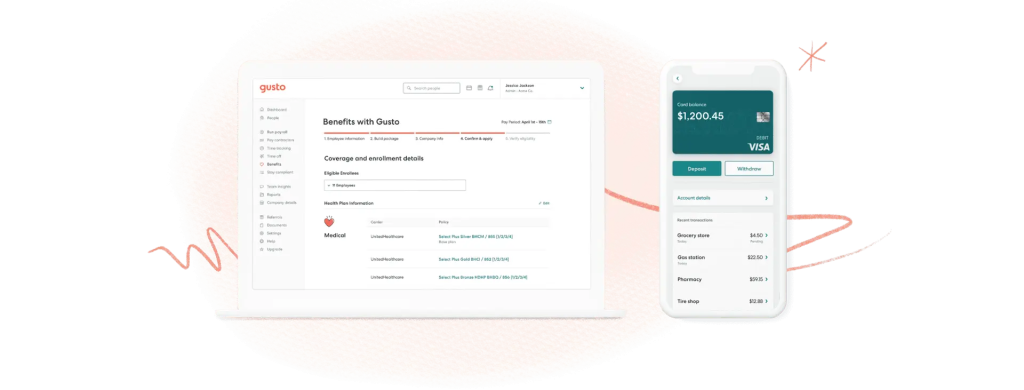
Gusto administers health, life and disability cover, 401(k) plans and workers’ compensation alongside payroll, which removes the handoff between a payroll system and a separate benefits broker.
A PEO works differently and the distinction matters commercially. Under co-employment, the provider can pool your employees into its own benefit plans, which sometimes buys better rates than a small employer gets alone. Deel prices that at $125 per employee a month against Gusto’s $6 to $22, so the comparison is really between an administration tool and a risk-pooling arrangement. Pick on what your benefits actually cost, not on the platform fee.
Hiring And Team Management –
Hiring and team management sit on the higher Gusto plans, with Premium adding a named advisor, HR guidance and Gusto Business Compliance for tracking state registrations and agency mail.
Rippling’s pitch targets the same buyer from another direction by tying payroll to device management and app provisioning, so onboarding a hire also issues their laptop and accounts. Whether that integration beats Gusto’s HR depth is impossible to judge on price, because Rippling publishes none. Our Gusto review goes deeper on how these modules behave day to day.
Time And Attendance Add-Ons –
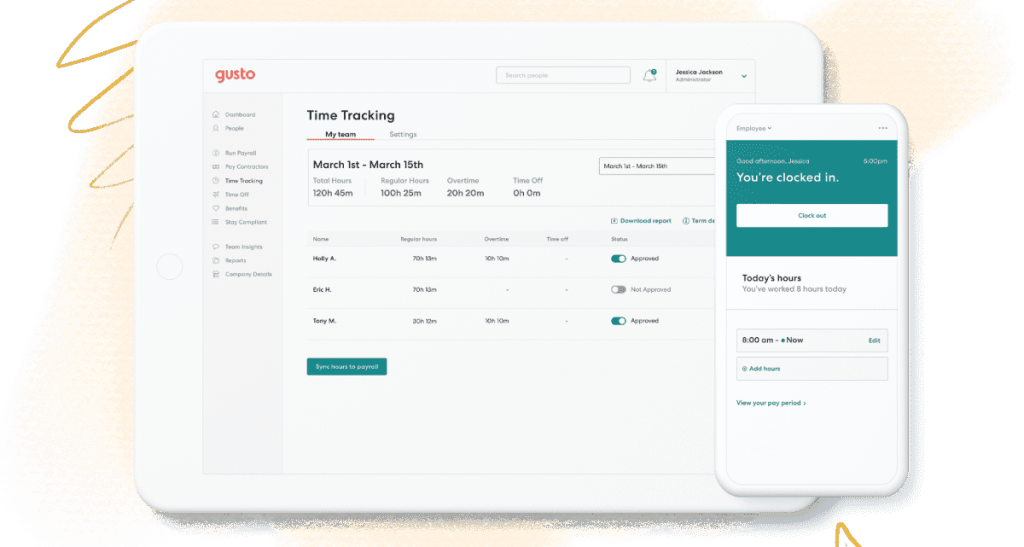
Time tracking and scheduling are built into Plus. On Simple, Time & Attendance Plus is an add-on at $6 per person a month after a free trial, which doubles the per-person cost of that plan from $6 to $12.
Run the sum before assuming the cheap plan is cheaper. Simple with time tracking costs $49 plus $12 per person; Plus costs $80 plus $12 per person and includes multi-state payroll, contractor invoice management and unlimited next-day pay for the extra $31 a month. Any team needing time tracking should treat Plus as the real entry point.
HR Resource And Performance Add-Ons –
Priority Support costs $30 a month plus $3 per person on Simple and Plus. Gusto Business Compliance costs $85 per state a month on an annual contract and is included with Premium. Remote I-9 runs $20 a submission with E-Verify at $5 on top, both included on Premium. Gusto HR Partners offers fractional HR support without a published figure.
Add-on stacking is where Gusto’s transparency advantage erodes. A Simple-plan company buying time tracking, priority support and compliance in two states would pay $49 plus $170 in state fees plus $30, before a single per-person charge. At that point a Premium quote deserves a look, and so does a Rippling quote, since bundling is the argument Rippling makes.
Pricing Breakdown :
Gusto’s published plans, read from its own pricing page on 23 October 2026:
| Plan | Price | What you get |
|---|---|---|
| Contractor payments | $5/payment | Contractors in more than 120 countries with no monthly per-contractor fee. The $5 applies to payments into US-based bank accounts; foreign exchange rates vary. |
| Simple | $49/mo | + $6 per person. Basic payroll in one state, unlimited payroll runs, tax filings, basic PTO and holiday pay. |
| Plus | $80/mo | + $12 per person. Adds time tracking and scheduling, multi-state payroll, contractor invoice management, unlimited next-day pay. |
| Premium | $180/mo | + $22 per person. Adds a named advisor, HR guidance, Gusto Business Compliance, unlimited same-day and instant pay, project costing. |
Add-ons listed on the same page:
- Next-Day pay: $15 a month plus $3 per person, included with Plus and Premium.
- Instant pay: $100 per payroll, included with Premium.
- Same-day pay: $90 per payroll, included with Premium.
- Time & Attendance Plus: $6 per person a month after a free trial, for Simple.
- Priority Support: $30 a month plus $3 per person, for Simple and Plus.
- Gusto Business Compliance: $85 per state a month on an annual contract, included with Premium.
- Remote I-9 at $20 a submission, E-Verify at $5 on top, both included with Premium.
- R&D tax credits: 15% of identified credits, with discounts on Premium.
Against that, the alternatives publish either flat per-head rates or nothing. Deel lists $49 per contractor, $325 for Contractor of Record, $125 per United States PEO employee and $599 per Employer of Record employee, all labelled as starting points. Rise lists $49 per contractor, $299 for Agent of Record and $399 for Employer of Record. Rippling lists no figure and offers a custom quote.
If you want to test that against your own numbers, start with Gusto here and map your actual headcount, states and add-on needs against the published ladder.
Who Should Use Gusto :
Gusto beats the alternatives in four situations:
- Your workforce is United States employees, where per-head global pricing would cost several times more.
- You need a budget figure before a sales call, which rules Rippling out immediately.
- You pay contractors occasionally and object to a monthly fee for each one sitting idle.
- Headcount is growing, so a fixed base fee keeps spreading across more people.
That third point is the most overlooked advantage in this comparison. Gusto charges no monthly per-contractor fee and takes $5 per payment into a United States bank account. Both Deel and Rise charge $49 per contractor every month whether that person invoices or not.
Ten contractors paid once a month costs roughly $50 through Gusto and $490 through either global platform. The gap narrows when those contractors are overseas, since Gusto notes that foreign exchange rates vary and does not publish an international payout fee, which is one figure to confirm before switching.
Who Should Not Use Gusto :
Four situations send you to a rival instead:
- Hiring employees in a country where you have no legal entity, which needs an EOR that Gusto does not sell.
- Carrying misclassification risk on long-term contractors, which Deel and Rise both sell products against.
- Consolidating payroll with device management and app provisioning, which is Rippling’s territory.
- Paying people in cryptocurrency, which Rise supports and Gusto does not advertise.
None of those is a defect. Gusto sells United States payroll and HR, and the other three sell cross-border employment or stack consolidation. Buying the wrong category is a more expensive mistake than picking the wrong tier within one.
Real Cost In Practice :
Take a twelve-person United States company and run it through the published rates.
- Gusto Simple: $49 plus twelve at $6, so $121 a month, or $1,452 a year.
- Gusto Plus: $80 plus twelve at $12, so $224 a month, or $2,688 a year.
- Gusto Premium: $180 plus twelve at $22, so $444 a month, or $5,328 a year.
- Deel United States PEO: twelve at $125, so $1,500 a month, or $18,000 a year.
- Rippling: no published figure, so no line here.
Read the PEO line carefully rather than as a twelvefold markup. Co-employment bundles benefits and employment liability that the Gusto figures exclude, so the honest comparison adds your own benefit costs to the Gusto column. The numbers still show how differently these models scale.
Scale is the clearest effect. Gusto Simple works out at $30.50 per person for a two-person company, $10.08 at twelve people and $6.98 at fifty. Flat per-head pricing never moves: $49 a contractor is $49 whether you have one or a hundred. Those figures are our arithmetic on published rates rather than numbers any vendor quotes.
Comparison To Alternatives :
Head to head on the dimensions that actually separate these products:
- Price visibility. Gusto publishes all three plans and every add-on. Per-head rates appear on both Deel and Rise, with Deel hedging each as a starting point. Rippling publishes nothing.
- United States employees. Gusto is built for this and prices accordingly. Deel offers a PEO at $125 a head. Rise offers Direct Payroll without a stated billing unit.
- Employees abroad. Gusto has no EOR. Rise asks $399 per employee a month, Deel asks $599. Neither gap is small across a team.
- Contractors. No monthly fee from Gusto, just $5 per United States payment. The global platforms each charge $49 per contractor a month, buying tooling Gusto does not attempt.
- Classification risk. Gusto offers no product. Rise sells Agent of Record at $299, Deel sells Contractor of Record at $325.
One pattern runs through the whole table. Gusto is cheaper wherever the work is domestic and employee-based, and absent wherever the work crosses a border. Hybrid workforces often end up running two vendors, which is less elegant than one platform but frequently cheaper than forcing domestic staff onto per-head global pricing.
For more on fit, our guide to who Gusto suits best covers the use cases in detail, and the wider comparisons library has the neighbouring matchups.
Verdict And CTA :
Gusto wins this comparison on its home ground and does not contest the rest of the field. For United States employees it is cheaper than a PEO, more predictable than a quote-only platform, and the only option here that lets you cost a decision before speaking to a salesperson.
Two caveats belong next to that verdict. The per-person fee climbing from $6 to $22 across the ladder means a Premium decision at scale deserves the same scrutiny as any enterprise quote. And add-ons stack quietly, so the published base fee flatters a company buying compliance in several states.
If your workforce is domestic and employee-based, start with Gusto here and price Simple and Plus against your real headcount and state count.
If any part of your team sits overseas, price a global platform for those people and keep Gusto for the rest. Running two vendors sounds untidy, though the arithmetic above usually favours it over paying per-head global rates for staff who never leave the country.
Whichever way you lean, get Rippling to quote as well. A platform that refuses to publish prices may still come in competitively, and the only way to find out is to ask. Start with Gusto here for the baseline figure to measure that quote against.
FAQ :
Is Gusto cheaper than Deel?
For United States employees, yes by a wide margin: twelve people cost $121 a month on Gusto Simple against $1,500 on Deel’s PEO, though the PEO bundles benefits and employment liability Gusto’s fee excludes. For contractors, Gusto charges no monthly per-head fee where Deel charges $49.
How does Gusto compare with Rippling on price?
No comparison is possible from public information. Rippling publishes no prices and asks every visitor for a custom quote, while Gusto publishes all three plans and its add-ons. Use the Gusto figure as the benchmark when a Rippling quote arrives.
Can Gusto replace an employer of record?
No. Gusto sells no EOR product, so employing someone in a country where you have no entity needs a different vendor. Rise publishes $399 per employee a month for that and Deel publishes $599.
Which Gusto plan competes best with the alternatives?
Plus at $80 a month plus $12 per person, because it includes time tracking, multi-state payroll and contractor invoice management. Adding time tracking to Simple already lifts it to $12 per person, so the extra $31 of base fee buys the rest for little more.
Before You Choose, Compare These
Hand-picked guides to help you choose the right tool, no fluff.
 ReviewsGusto Review 2026Hands-on verdict with the pros, cons and who it fits best.
 Use CasesWho Is Gusto Best For? Use Cases & Fit (2026)Who gets the most out of it – and who should skip it.
 Use CasesWho Is Process Street Best For? Use Cases & Fit (2026)Who gets the most out of it – and who should skip it.
 TutorialsRunpod Beginner's Guide 2026A clean start-here walkthrough with no jargon.