

Company And Challenge
Picture a PPC agency that has grown past the spreadsheet stage. The team is running Google, Microsoft, Meta, and LinkedIn campaigns. Clients want reporting every week. The sales team wants cleaner lead intelligence. The agency wants a single place to see what is actually happening instead of piecing together five dashboards by hand.
That is the kind of problem Diginius Insight is built to solve.
The official site positions Diginius as a sales and marketing platform that consolidates digital data, reporting, analytics, advertising, SEO, and lead intelligence. That makes it especially relevant for agencies that need a cleaner way to manage multi-channel campaigns and client reporting.
If you want to inspect the platform while you read, start with Diginius here.
Problem Before Diginius
Before the switch, the agency had the usual problems:
- Every platform had its own report.
- PPC performance had to be assembled manually.
- SEO and lead insights lived in separate tools.
- The team spent too much time answering “what changed?” questions.
- Client reporting turned into copy-paste work instead of analysis.
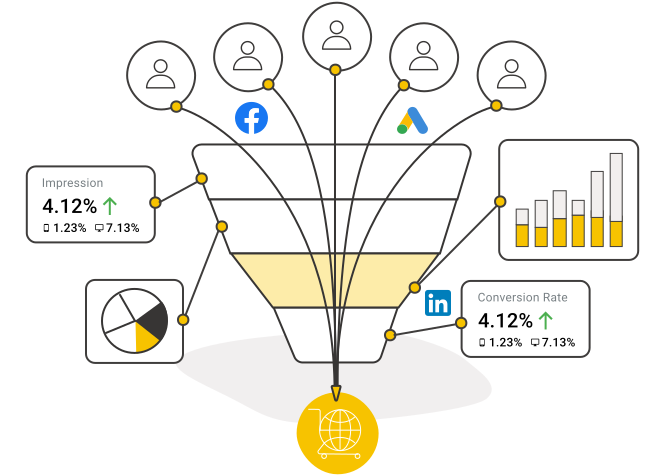
Diginius exists because that workflow is inefficient. Its homepage and software pages make the core point plainly: the platform unifies reporting, analytics, advertising, SEO, and lead insight in one interface.
That is a big deal for agencies because reporting is not a side task. It is part of the delivery model.
Implementation Process
The rollout was built around the parts Diginius is strongest at.
Step 1: Centralize Reporting
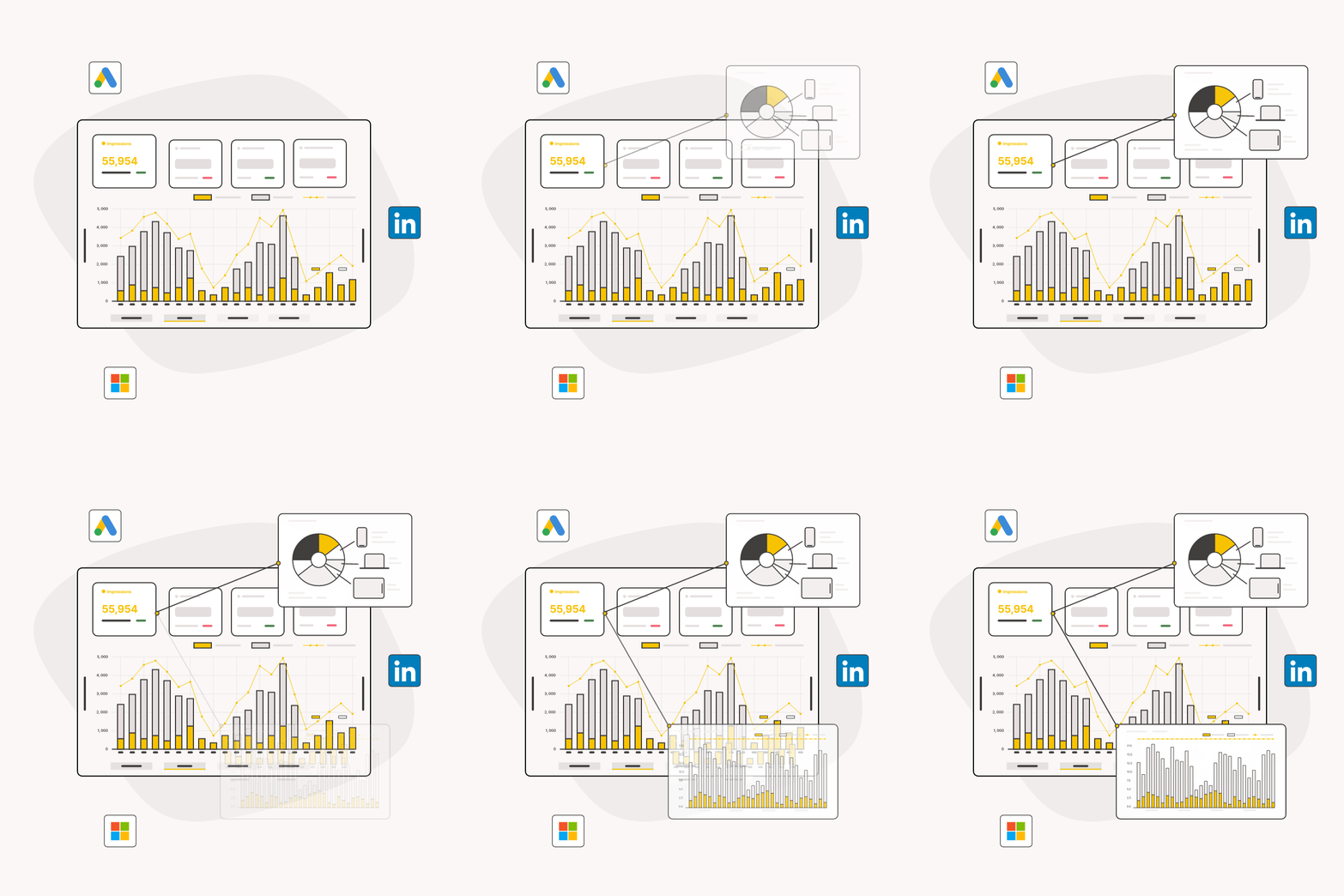
The team connected the main ad channels and used Diginius Insight as the single reporting layer. That reduced the number of places the team had to check every morning.
Step 2: Add Multi-Channel Performance Views
Diginius’ official product pages highlight multi-channel reporting and performance data across Google, Microsoft, Facebook, and LinkedIn. That let the agency compare channels in one place rather than stitching each platform together separately.
Step 3: Turn On Lead Intelligence
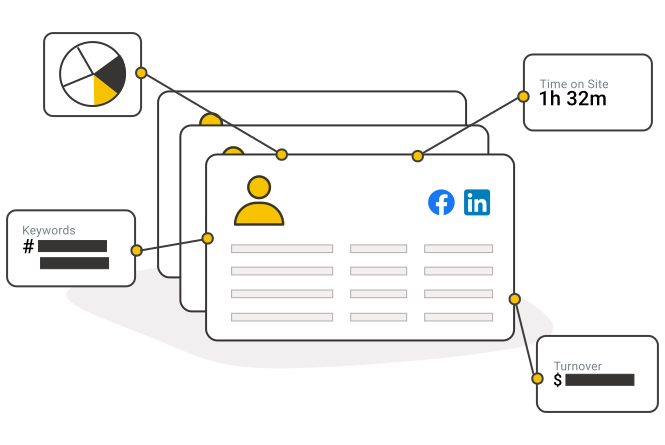
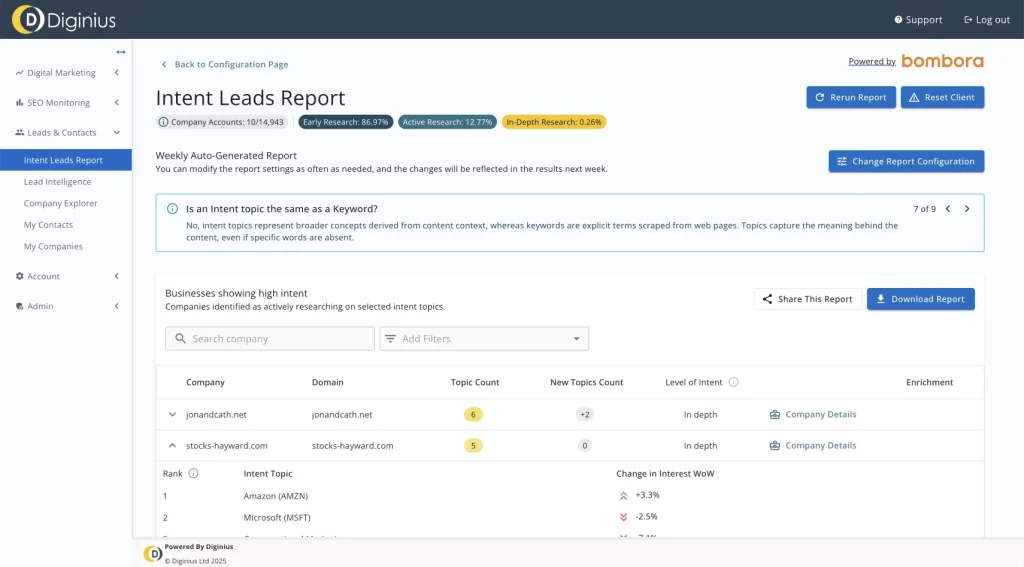
The platform’s lead intelligence tools made the workflow more useful for the sales side too. The team could see which companies had visited the site and use that data to shape follow-up and targeting.
Step 4: Use SEO And Reporting Together
The software pages also emphasize SEO site health, keyword tracking, competitor insight, and automated reporting. That meant the agency could connect paid search and organic visibility instead of treating them like unrelated departments.

If your agency wants reporting and lead intelligence in one place, start with Diginius here.
Results And Metrics
The realistic result of this kind of rollout is usually not one giant magic number. It is a set of operational improvements:
- Less time spent building reports by hand.
- Faster visibility into campaign shifts.
- Better cross-channel budget decisions.
- Cleaner client communication.
- More useful lead follow-up for sales.
For an illustrative example, imagine an agency spending 8 hours a week on manual reporting. If Diginius cuts that work to 2 hours, the team gets 6 hours back every week. Over a month, that is roughly 24 hours of recovered time that can go back into account optimization, strategy, or sales.
That is the ROI story here. It is not just software savings. It is management time, reporting time, and decision speed.
Important Features
The features that make Diginius useful in a case-study rollout are the ones it highlights on its site:
- Multi-channel reporting.
- Microsoft Publisher Network Tool.
- SEO keywords and SEO site pages.
- Lead intelligence.
- Intent lead data.
- CRM integration.
- Connected TV support.
- White-label options for agencies.
- Email reports and automated reporting.
Those are not random checklist items. They map directly to how agencies deliver work. You can monitor campaigns, surface leads, and report back to clients without rebuilding the same reports every week.

If your current reporting process is too manual to trust, start with Diginius here.
Lessons Learned
The first lesson is that a reporting platform only works if the team agrees on the source of truth.
The second lesson is that lead intelligence matters more when the sales team actually uses it. If the team collects website visitor data and never follows up, the feature is wasted.
The third lesson is that agencies need white-label presentation almost as much as they need data. Client trust improves when the reporting surface looks like part of the agency, not a patchwork of exports.
The fourth lesson is that multi-channel visibility is more valuable than channel-specific perfection. A cross-channel overview often makes better decisions possible faster than a perfect deep dive into one platform.
ROI Calculation
Here is a practical way to think about the return.
Suppose the agency serves 12 clients and spends 4 hours per client each month building reports. That is 48 hours of reporting work. If Diginius reduces that by even 50 percent, the agency gets 24 hours back every month.
If those hours are used for upsell conversations, strategy, campaign optimization, or client retention work, the platform can pay back quickly. The result is not only lower labor cost. It is also better timing. Faster reporting means faster reaction, and faster reaction usually means better performance.
If the lead intelligence layer helps the sales team identify better-fit opportunities, the upside compounds further.
How To Replicate It
If you want to replicate this rollout, start with a simple sequence:
- Connect your ad platforms.
- Build your dashboard and report templates.
- Add SEO keyword and site health monitoring.
- Turn on email reports for stakeholders.
- Layer lead intelligence into sales follow-up.
- Add white-label presentation once the reporting flow is stable.
That order matters. If you start with too many modules at once, the platform becomes hard to understand. If you start with reporting first, the value becomes visible quickly.
If you want one platform for ad reporting, SEO visibility, and lead intelligence, start with Diginius here.
Pricing Context
Diginius has a public pricing model that is easy enough to evaluate:
- Essential: $75 per month, with annual payment options and a free trial.
- Pro: $250 per month.
- Core: $500 per month.
- Business: custom pricing.
- Agency suite: $25 per user per month on the agency pricing page.
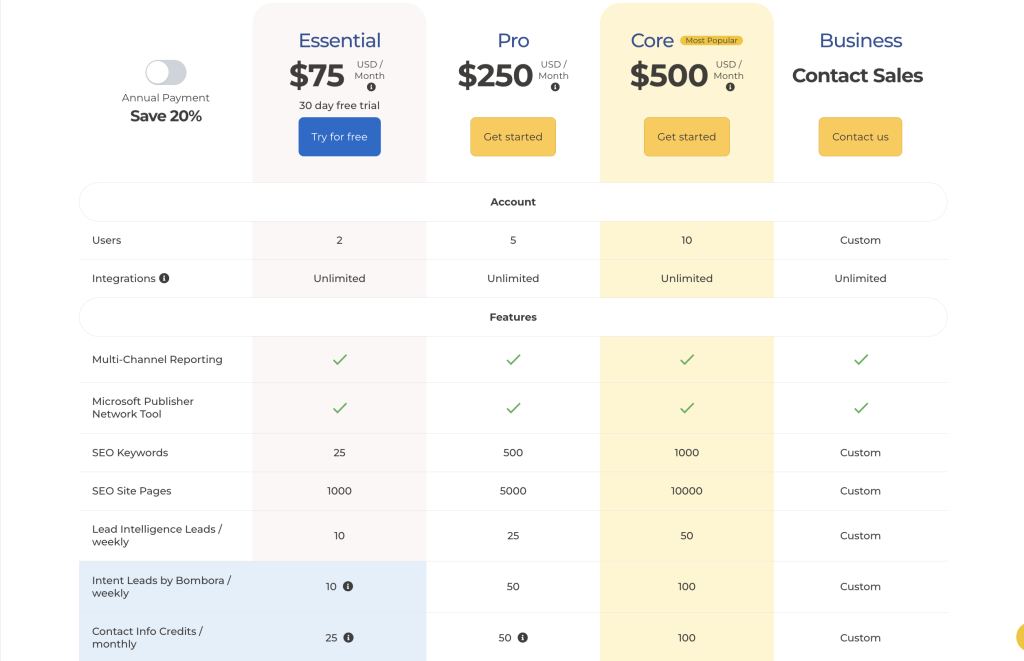
The key thing is that the product is not priced like a toy. It is priced like a reporting and marketing operations layer.
That means the best comparison is not against free reporting exports. It is against the time your team spends assembling data, the confusion it creates, and the missed optimization opportunities that follow.
What The First 30 Days Usually Prove
The first month usually tells the team whether Diginius is reducing friction or just moving it around.
If the reporting layer is working, stakeholders stop asking for raw exports. If the lead intelligence is working, sales starts using the data instead of ignoring it. If the SEO and paid data are both visible, the agency starts making better budget calls because the channels are no longer isolated.
That is the real test. A reporting platform should make decisions easier, not just prettier.
It should also make meetings shorter. If Diginius is doing its job, the team spends less time arguing about whose spreadsheet is correct and more time deciding what to do next.
That is the practical sign that the platform has moved from a reporting utility to a decision system.
Once that happens, the platform stops being a reporting task and starts being part of the agency’s operating rhythm.
The team can feel the difference because client updates become faster and more specific.
Verdict
Diginius is a strong fit for agencies and performance teams that need reporting, lead intelligence, SEO visibility, and ad-platform consolidation in one place. The public pricing structure is clear enough to evaluate, and the platform’s feature surface maps directly to real agency work.
The biggest advantage is workflow simplification. The biggest risk is buying it without a plan for who owns the dashboards and the follow-up process.
If your agency is still living in spreadsheet-report land, start with Diginius here and see whether the reporting consolidation alone justifies the switch.
FAQ
Does Diginius have a free trial?
Yes. The Essential plan shows a 30-day free trial on the pricing page.
What does Diginius cover?
It covers multi-channel reporting, Microsoft advertising tools, SEO keyword tracking, lead intelligence, CRM integration, and connected TV support.
Is Diginius good for agencies?
Yes. The homepage and agency pricing page both position it for PPC agencies with reporting and white-label needs.
What is the most useful feature?
For most agencies, the biggest win is the single consolidated reporting layer across paid and organic channels.
Is Diginius useful outside agencies?
Yes. Any team managing multiple channels and reporting layers can benefit from it.